
How Much Do Facebook and Instagram Ads Cost? From $5 to a Real Test
Facebook and Instagram ads have no price list: you set the budget and Meta's auction sets the price of each click. How Meta charges, what the benchmarks say and how to size a first test.

Mauricio Valdivia
·15 min

Two stores, one budget, two prices per click
Two online stores open Meta Ads Manager on the same Monday. Both type in the same daily budget. Both want clicks to their product pages. A week later, they compare notes.
They did not pay the same.
Nobody quoted either of them a rate, because there is no rate. Meta does not publish a price list for Facebook or Instagram ads. Its own budgets page says there isn't a one-size-fits-all answer to what ads cost, then lists the factors that move the cost. You decide how much to spend. An auction decides what each click or each thousand impressions costs you.
That auction is not getting cheaper. In its second quarter 2026 results, Meta reported that its average price per ad rose 12% year over year.
This guide answers the cost question with what Meta actually publishes: how daily and lifetime budgets are charged, where Meta tells you to start, what moves the price of your ads, what a benchmark report with a published method says and leaves out, and how to size a first test with math you can rerun on your own numbers.
How much Facebook ads cost: the short answer
The short answer has three parts. You pay the budget you set. Meta names a concrete starting point. And the price the auction produces moves over time. Each part changes how you should plan the money.
You pay your budget, not a rate card
Facebook ads are not bought like a magazine page, with a list price per slot. You set a budget, pick an objective, and Meta spends that money across auctions for each chance to show your ad. The unit prices you see afterward (cost per click, cost per thousand impressions, cost per result) are the outcome of those auctions, not prices anyone set in advance.
That has a practical upside. Meta calls your budget your most valuable cost control tool when creating an ad, and says you can cancel or pause your ad at any time. There is no monthly package to sign and no slot to prepay.
Instagram is not a separate store. Meta describes Ads Manager as the starting point for running ads on Facebook, Instagram, Messenger or Audience Network. So "how much do Instagram ads cost" gets the same answer as the Facebook question: the same budget rules and the same auction. If you have never set up a campaign, the Facebook ads beginner's guide walks through it step by step.
Where Meta tells you to start
If you want an entry number, Meta gives one. In the FAQ of its budgets page, it says the recommended practice is to start with at least $5 for your budget and to choose a duration over six days, so its delivery system can find the best people for your ad. Higher up the same page, it asks for a budget you can use over at least seven days, so Meta can learn from performance and decide how to allocate your money.
Meta's lesson on creating Facebook and Instagram ads shows how a small budget is charged: set a daily budget of $5 over five days, and you'll be charged up to $25 in total.
Read the recommendation carefully:
- $5 is the door, not the test. It is what Meta suggests so its system has something to work with, not what it costs to learn which ad works. We do that math further down.
- The week matters more than the day. Seven days is the window Meta asks for. Switching a campaign off on day three because "it isn't working" throws away the three days you already paid for.
- The recommendation is not per day. Meta says a budget of at least $5 and a duration over six days. How you spread it is your call.
What Meta reported about ad prices in 2026
One number Meta publishes is a price, just not yours. In its second quarter 2026 results, published July 29, 2026, Meta reported that average price per ad increased 12% year over year, and that ad impressions delivered across its family of apps increased 14%.
That average blends every country, format, objective and app Meta runs. It won't tell you your CPM in Denver, Manchester or Toronto. It does tell you something useful: more ads are being delivered, and each one costs more on average than a year earlier. If a 2025 media plan assumed the same budget would buy the same reach this year, check it against your own account.

How Meta charges your budget: daily vs. lifetime
Meta offers two types of budget for a campaign. The difference is not just convenience. It changes how much can leave your card on any single day.
The daily budget and the 75% rule
Meta defines a daily budget as the average amount you're willing to spend on an ad set or campaign per day. The key word is average. Meta's pricing page says it "may spend up to 75% over your daily promotional budget to maximize advertising opportunities," and that this averages out over the course of the week, so your spend "will not be greater than seven times your daily budget."
Here is what that means with a $20 daily budget:
- A strong day can spend up to $35 ($20 plus 75%).
- The full week cannot pass $140 (seven times $20).
- A weaker day spends less to make up for it, because what holds is the weekly total.
The cash-flow consequence is direct. If your business cannot absorb a day above $20, a daily budget does not promise you that. Plan around the weekly ceiling, not the daily figure you typed.
The lifetime budget: a ceiling that doesn't move
A lifetime budget is the amount you're willing to spend over the entire run of an ad or campaign. Meta notes that daily spend may fluctuate, but the total cost will remain within the budget you gave. It also says lifetime budgets work best for advertisers who have more flexibility on what they can spend each day.
| Daily budget | Lifetime budget | |
|---|---|---|
| What you set | Average per day | Total for the run |
| What can move | Up to 75% more in a day | Each day's spend |
| Ceiling | Seven times daily, per week | The total you set |
| Fits | Always-on campaigns | Promotions with an end date |
A simple rule for choosing:
- Use a daily budget when the campaign is always on and you want an even pace you can raise or lower.
- Use a lifetime budget when there is an end date (a seasonal sale, a launch) and the number you cannot exceed is the total for the period.
Advantage+ campaign budget: one budget, many ad sets
There is a third option worth knowing. Advantage+ campaign budget, which Meta says was formerly called campaign budget optimization, replaces individual ad set budgets with one campaign budget that is distributed and optimized in real time across your ad sets. Meta says it can help decrease CPA by an average of 4.6%, a figure from Meta itself rather than from an independent test.
It is convenient, with one catch for testing. A shared budget flows toward the ad set the system sees as the better opportunity, which is not the same as giving two creatives an equal share of the money. Meta's answer is control: you can set ad set minimums or maximums to limit how much budget shifts across ad sets.
Boosting a post vs. creating an ad
Not every paid post goes through Ads Manager. Meta's lesson describes boosting as a simple way to turn a regular post on your Facebook Page or Instagram business account into a paid advertisement: you pay to show it to a broader audience beyond your current followers.
The money works the same way, because you still set a duration and a budget. What differs is the job:
- Boosted posts are usually set up, in Meta's words, to encourage engagement, such as Page likes, comments, shares or general brand awareness.
- Ads created in Ads Manager can be set up for actions like website visits, shop orders or app installs.
If what you are paying for is sales, the budget math in this guide assumes an ad, not a boost.
What sets the price of each click on Facebook and Instagram
If the budget is what you spend, the unit price is what that spend buys. This is where the auction comes in, and where most cost guides stop too early.
An auction that weighs more than the bid
Every time there is a chance to show your ad to someone in your audience on Facebook, Instagram or Messenger, that chance enters an ad auction. Meta's explainer adds the part people miss: unlike traditional auctions that pick a winner based on the highest bid, its auction system "looks at a number of factors equally to determine which ad is displayed."
Meta names five components that the best-performing ads in its auction combine:
- The right objective. Meta offers six: awareness, traffic, engagement, leads, app promotion and sales. A scarce result (a sale) costs more than an abundant one (a click).
- Targeting. The people you let the system reach.
- A sufficient budget. Enough money for the system to learn.
- Enough duration. Enough days for it to learn.
- Compelling ad creative. The piece you build before you ever open Ads Manager.
After launch, Meta describes three stages. In assessment, the auction looks at your objective, budget, duration, audience and creative. In delivery, it shows your ad to people in your audience to learn who is more likely to engage. In optimization, it narrows toward the people more likely to interact. Two stores with the same budget pay different prices per click because they walk into that auction with different inputs.
Ad quality and relevance
Meta's auction page says ad quality is determined from several sources, including assessments of low-quality attributes in the ad, such as withholding information, sensationalized language and engagement bait. Together, it says, estimated action rates and ad quality measure ad relevance.
That turns three copywriting habits into cost lines:
- Withholding information. A teaser that hides what the product is gets assessed as low quality, not as clever.
- Sensationalized language. Hype that reads as clickbait to a viewer reads the same way to the auction.
- Engagement bait. "Comment YES if you agree" is named explicitly.
Our stance, plainly: on a small budget, the creative is the cost lever that depends most on you. You cannot decide how many advertisers compete with you this week. You can decide which ad you bring to the auction.
Audience size and placements
Two recommendations on Meta's budgets page point the same way: give the system room to work.
- Audience: Meta says ad sets with an audience size of at least 2 million often see better performance, because the auction has more chances to find the people most likely to engage.
- Placements: it recommends turning on Advantage+ placements, or selecting and adding at least six placements manually.
Meta's lesson suggests testing the trade-off instead of guessing: create one narrow audience and another that is broader, then see how delivering ads to each affects your results. In our reading of that guidance, a very small, very specific audience is rarely a cheap one, because shrinking the pool of people the auction can reach tends to raise what each impression costs. That doesn't mean dropping targeting, only using it on purpose. The guide to targeting audiences in Meta Ads covers how to build them.
Why Instagram follows the same rules
Meta covers both platforms on a single budgets page, titled "Facebook and Instagram Ads: Budgets, Costs & Schedules." Its Instagram ads page adds that Ads Manager uses the same advertising tools as Facebook, and that you can buy and run Instagram ads in three ways: in the Instagram app, in Ads Manager, or through an Instagram Partner. Even a promotion started from the Instagram app asks you for a destination, an audience, a budget and a duration.
So there is no separate Instagram rate to look up. Whether Instagram placements cost more for your particular ad is a test question, and Meta's A/B testing page lists placement among the things you can test, next to creative, audience and objective. The split between a placement and the ad format it carries is laid out in our guide to types of social media ads. If you are building your first campaign there, see how to make Instagram ads.

What Facebook ads benchmarks say, and what they leave out
This is the point where many cost guides paste a CPC and CPM table. Here is one recent report with a published method instead, with the fine print that decides how much weight it deserves.
The numbers in WordStream's 2025 report
WordStream's Facebook Ads Benchmarks 2025 report, last updated September 15, 2025, gives these figures across industries:
- Traffic campaigns: an average cost per click of $0.70.
- Leads campaigns: an average cost per click of $1.92.
- Leads campaigns: an average cost per lead of $27.66.
The fine print sits at the bottom of the report. Its traffic figures come from a sample of 554 US-based campaigns and its leads figures from a sample of 726, all running between April 1, 2024 and June 30, 2025. And its "averages" are technically median figures, to account for outliers.
That is a real, dated sample with a stated method, which is more than most tables that circulate can show. It is still a sample of a few hundred US campaigns, not the market, and not you.
Why your number will differ
Even inside that one report, the spread is wide. For traffic campaigns, the median cost per click runs from $0.34 for Shopping, Collectibles & Gifts to $1.22 for Finance & Insurance. On the leads side, Dentists & Dental Services reaches $9.78 per click.
Three things push your own number away from any table:
- Industry. Within the same report, the priciest traffic category pays more than three times what the cheapest one pays per click.
- Objective. In the same report, a leads click costs almost three times a traffic click. A campaign that optimizes for purchases is paying for a different result again.
- Period. The sample ends in mid-2025, and Meta's own quarterly numbers, covered above, show the average price per ad still rising a year later.
So use a benchmark as a sanity check. If your traffic CPC is several times the median for your category, look at your creative and your targeting before blaming the platform. Never use it as your budget input. The budget input is your own cost per result.
How to read your own CPM and CPC
The number you can trust is in your account. Meta describes Ads Manager as an all-in-one tool for creating ads, managing when and where they run, and tracking how your campaigns perform, with an app for iOS and Android.
The three metrics everyone quotes:
- CPM (cost per thousand impressions): spend divided by impressions, times 1,000.
- CPC (cost per click): spend divided by clicks.
- Cost per result: spend divided by the result you chose as your objective (a purchase, a lead, a link click).
The first two describe the auction. The third describes your business. A low CPM on an ad nobody clicks produces a high cost per result. For the full formula and how to use it, see what CPM is and how to calculate it.
Where you read the numbers matters as much as which numbers you read. Meta's lesson splits every campaign into three parts:
- Campaign: where you choose the objective.
- Ad set: where you decide who sees your ads, and choose placements, budget and schedule.
- Ad: where you customize the creative, including text, images and video.
Compare cost per result at the ad level to learn which creative is cheaper, and at the ad set level to learn which audience is. Mixing the two levels is the most common way to draw wrong conclusions from correct data.
How much to spend on a first Facebook ads test
Knowing what a click costs doesn't answer the question that matters most: how much money it takes to learn which ad works. Meta publishes three rules that let you calculate it.
Two weeks minimum, 30 days maximum
On its A/B testing best practices page, Meta says that for the most reliable results you should keep A/B tests running for at least 2 weeks or up to 30 days, and wait until Meta delivers your final test results before assuming a winner.
The tool matters as much as the calendar:
- Use the A/B testing tool. Meta explains that when multiple campaigns or ad sets run at the same time in Ads Manager without it, the system does not split them evenly but treats them in combination, skewing delivery and budget distribution.
- Keep the test audience to itself. Meta says not to use your A/B test audience for any other campaign you are running at the same time.
- Don't fake it. Two ads dropped into one ad set and compared at the end is not an A/B test.
The 100-event math
Meta says you will start seeing results once there are at least 100 events observed for the cost per result you are testing. That turns the test into arithmetic:
Minimum budget per variant = 100 × your cost per result.
Counting 100 events for each variant is our conservative rule, not Meta's wording, because a variant that reached 20 events and one that reached 80 are not on equal footing. If your cost per result is $2, each variant needs at least $200. If it is $20, each needs $2,000.
That math explains a choice many small businesses make without knowing why. On a short budget, test first against a frequent, cheap result (a link click, a product page view) and save the purchase test for when the budget can carry it.
Up to five variants, one variable
Meta lets you test up to five ad variants, and its best practices say to test only one variable at a time. Its A/B testing FAQ also explains why a test needs more budget than a normal campaign: audiences are randomly split, and an adequate budget ensures an even split.
Those rules together have a budget consequence:
- Every extra variant multiplies the cost. Five variants need five times the 100 events.
- One variable keeps the result readable. Change the script and the format at once and you learn which ad won, not why.
- On a short budget, test two. A control and one clear change buy more learning per dollar than five half-funded variants.
How many creatives you need once a test finds a winner is a separate question, answered in how many ad creatives you need.
Worked example: a skincare brand sizes its first test
A small skincare brand sells online and wants to know whether its video works better showing the product alone or showing a person talking about it. It doesn't know its Meta costs yet. The result numbers below are invented to show the math, not a market average. The budget rules are Meta's.
Step 1: a calibration week
Before testing, the brand needs its own cost per result. It sets a daily budget of $10 for seven days on one ad set with the traffic objective.
- Ceiling for any single day: $17.50 ($10 plus 75%).
- Ceiling for a week: $70 (seven times $10).
Say that at the end of the week, Ads Manager shows $70 spent and 140 link clicks. The cost per result is $70 ÷ 140 = $0.50 per click.
Step 2: 100 events per variant
With that number, the 100-event rule sets the floor per variant: 100 × $0.50 = $50. Two variants (the product alone vs. a person) need at least $100 in total.
If the brand tested straight against purchases, the math would change scale. At a hypothetical $25 per purchase, each variant would need $2,500. That is why this first test measures clicks: it is the question this budget can actually answer.
Step 3: the calendar and the weekly ceiling
Meta asks for at least two weeks. The brand gives each variant a $5 daily budget for 14 days, which comes to $70 per variant, above the $50 the 100-event math requires.
| Item | Math | Result |
|---|---|---|
| Cost per click (calibration) | $70 ÷ 140 clicks | $0.50 |
| Minimum per variant | 100 × $0.50 | $50 |
| Plan per variant | $5 × 14 days | $70 |
| Weekly ceiling per variant | $5 × 7 | $35 |
| Full test, 2 variants | $70 × 2 | $140 |
| Calibration plus test | $70 + $140 | $210 |
How to know it worked: each variant passed 100 clicks, the test ran at least 14 days, and Meta delivered its final results. If a variant never reached 100 events, the honest verdict is not "it lost." It is "the budget ran short."
In this example, the answer to "how much should I spend on Facebook ads to start" is about $210 over three weeks. With your own cost per result the number changes. The math does not.
Creative is the cost lever you control
The math above hides an assumption: that you have two different ads ready to test. For many businesses, that is the real bottleneck.
What Meta says about winning tests
Meta publishes a figure of its own on the value of testing. Its A/B testing page says that in a Meta study, winning A/B tests drove a 30% lower cost per result on average.
It is a platform's number about its own tool, so treat it as a signal, not a promise for your account. The logic holds without it: if ad quality is one of the auction's inputs, every test that finds a better ad works on the price you pay, not just on your sales.
What to test first in a video ad
Meta says to start with a creative variable, and several of its examples are about video:
- Content: a video that features a service or product vs. one that features a human.
- Aspect ratio: a 1:1 video vs. a 9:16 video.
- Length: a 30-second video vs. a 5-second video.
- Audio: no sound vs. added audio, such as sound effects, a voiceover or music.
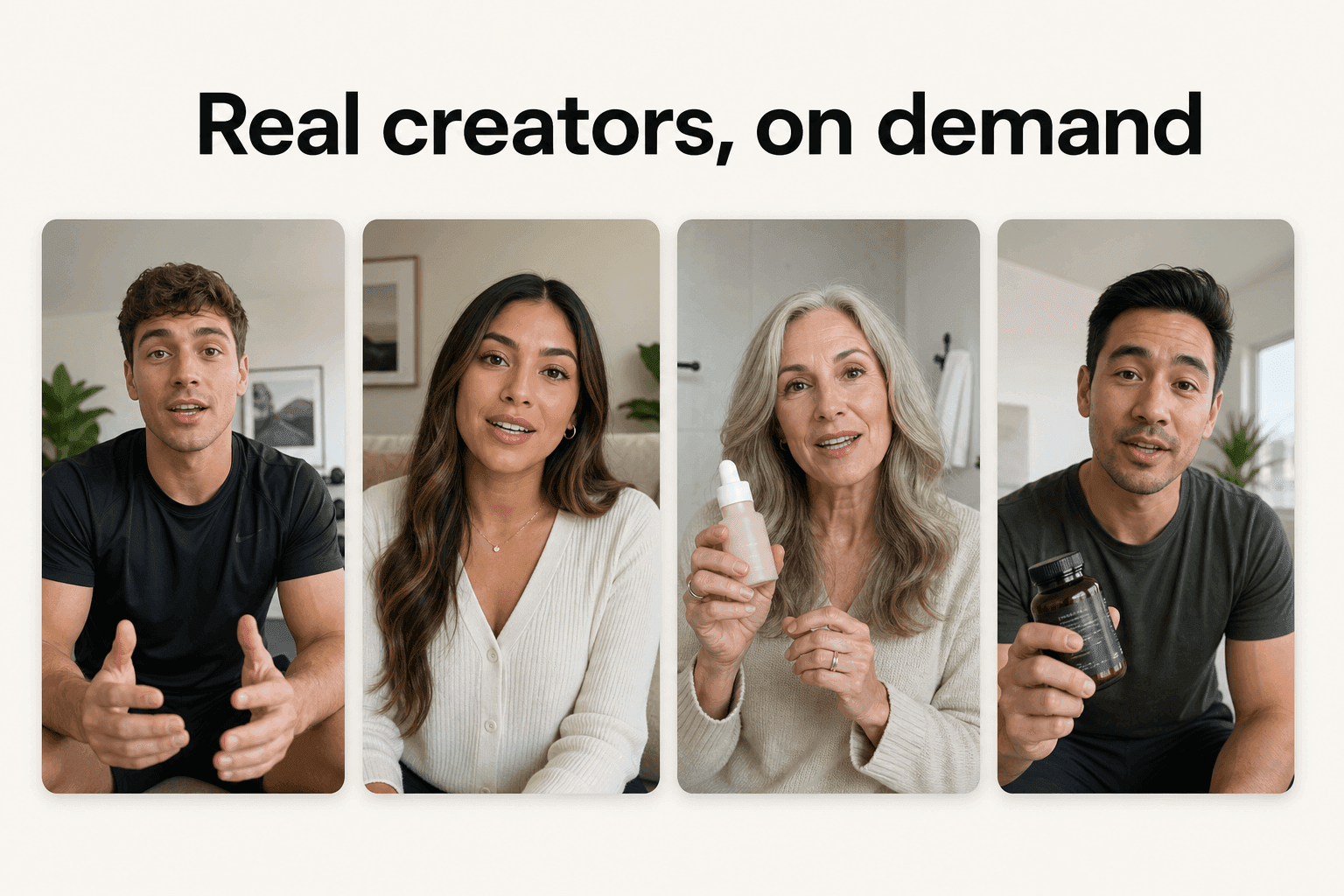
The first one changes the nature of the ad the most, and it is the one in the worked example. A person talking to camera, in the look of a video shot on a phone, is what is known as a UGC ad. If the script is your variable, the opening second outweighs everything after it, and the guide to writing ad hooks covers how to test it.
Making variants without filming each one
The problem shows up when you count. A one-variable test needs at least two ads. A second round needs two more. Once a variant wins, you will want another script to test against it. Hiring a creator and filming every version turns testing into a production project, and the budget runs out before it ever reaches the auction.
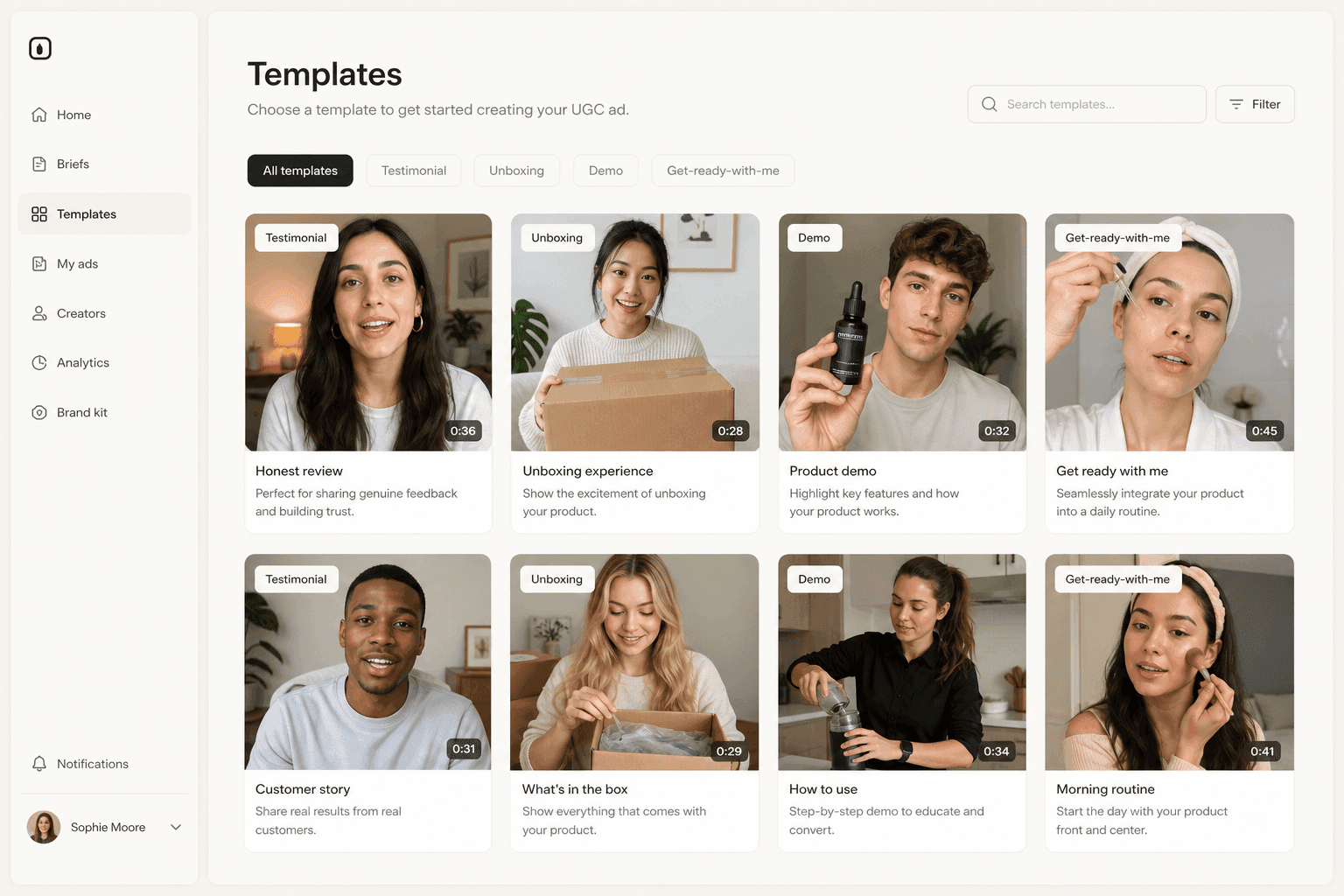
That part is something AI can solve. In Novoads you write the script, pick an AI actor and get a UGC-style video in vertical, square or horizontal format, as a file you can upload to Ads Manager. The "person" variant from the worked example and its 1:1 version come from the same script, with no second shoot. Novoads starts at $49/month (Starter, 50 credits per month). All plans are published on /pricing.
If you also advertise on TikTok, the same budget logic applies under that platform's own rules, compared in how much TikTok ads cost.
The auction sets the price, your ad sets the cost
"How much do Facebook ads cost" has an answer that does not fit in a table. You decide the budget, starting from the $5 and more than six days Meta recommends. An auction decides the price of each click, from inputs Meta names: objective, targeting, budget, duration and creative. And the cost of learning what works can be calculated: 100 results per variant, two weeks at minimum.
What stays in your hands is what you bring to that auction. Measure your own cost per result, test one variable at a time, and carry the math through to the end.
On Facebook you don't buy a slot. You buy a chance to win an auction, and you win it with the ad you bring.
Frequently Asked Questions
How much do Facebook ads cost?
There is no fixed price. You set the budget, and Meta's ad auction decides what you pay per click or per thousand impressions. Meta's own budgets page recommends starting with at least $5 for your budget and a duration over six days, so its delivery system can find the best people for your ad.
How much does Facebook charge per day for ads?
Your daily budget is an average, not an exact cap. Meta's pricing page says it may spend up to 75% over your daily promotional budget on a given day, but spend averages out over the week and will not be greater than seven times your daily budget. With a $10 daily budget, one day can reach $17.50 and the week cannot pass $70.
What is the average cost per click for Facebook ads?
WordStream's Facebook Ads Benchmarks 2025 report puts the median at $0.70 per click for traffic campaigns and $1.92 for leads campaigns, from US-based campaigns that ran between April 1, 2024 and June 30, 2025. Treat it as a sanity check, not a budget: your own CPC is your spend divided by your clicks in Ads Manager.
Are Instagram ads more expensive than Facebook ads?
Not by rule. Instagram and Facebook ads can be bought in the same Ads Manager, enter the same ad auction and follow the same daily and lifetime budget rules. Whether Instagram placements cost more for your ad is a test question, and placement is one of the variables Meta's A/B testing tool lets you test.
How much budget do I need for a Facebook A/B test?
It depends on your cost per result. Meta says you start seeing results once at least 100 events are observed for the cost per result you test, and recommends running tests for at least 2 weeks and up to 30 days. A conservative plan budgets 100 times your cost per result for each variant.
Did Facebook ads get more expensive in 2026?
On average, yes. In its second quarter 2026 results, published July 29, 2026, Meta reported that average price per ad increased 12% year over year and that ad impressions delivered across its family of apps increased 14%. That is a global average across all of Meta's apps, not the CPM of your account.
Key Takeaways
- Facebook and Instagram ads have no rate card: you set the budget, and Meta's auction decides what you pay per click or per thousand impressions.
- Meta recommends starting with at least $5 and a duration over six days, and giving its system at least seven days to learn.
- A daily budget can overspend by up to 75% on a single day, but weekly spend will not be greater than seven times the daily budget.
- Benchmarks are a sanity check, not a budget: in WordStream's 2025 report, the median traffic click ranges from $0.34 to $1.22 depending on the industry.
- For an A/B test, budget at least 100 times your cost per result per variant and run it for two weeks to 30 days. The ad you bring is the input you control before the first dollar is spent.
Sources
- •Meta for Business: Facebook and Instagram Ads, Budgets, Costs and Schedules
- •Meta for Business: The ad auction explained
- •Meta for Business: A/B testing best practices
- •Meta for Business: A/B testing
- •Meta for Business: Advantage+ campaign budget
- •Meta for Business: Create compelling Facebook and Instagram ads
- •Meta: Meta Reports Second Quarter 2026 Results (July 29, 2026, via PR Newswire)
- •WordStream: Facebook Ads Benchmarks 2025 (archived September 12, 2026)