Black Friday Video Ads: Build and Pre-Test the Creative in July, Not November
The Meta auction gets most expensive in the exact fortnight you most want to be in it. Here is what to produce now, how many variants to build, what to pre-test before October, and what to hold back.

Mauricio Valdivia
·11 min

November is the worst month to learn what works
It is the third week of November at a nine-person skincare brand. The founder is briefing a creator for a Black Friday video. The shoot is Thursday, the edit lands the following Tuesday, and by the time the clip goes live the discount is already running. Nobody will know whether the angle works, because the only week left to find out is the week the auction charges the most for an answer.
That week has a price. In Gupta Media's Social CPM Tracker, Cyber Monday, 2 December 2024, was the single most expensive day of the year for Meta ad rates at a $17.70 CPM, against the same tracker's 2024 annualized Meta average of $7.43. Black Friday itself came second at $16.85.
Here is the uncomfortable shape of that. The auction gets most expensive in the exact window you most want to be in it, and an untested ad costs the same per thousand impressions as a proven one. Every experiment you postpone to November gets billed at peak rates.
This post is about the opposite habit: treating July as production season and August through September as the testing window, so that November is spent spending, not learning. What to produce now, how many variants, what to prove before October, and what to keep in reserve.
What the Meta auction actually does in late November
Before the plan, the mechanics. Three things about the seasonal peak are commonly garbled, and each one changes what you should do about it.
The peak week and the peak day are not the same week
Gupta Media's tracker separates them and so should you. The most expensive week of 2024 for Facebook and Instagram was the week of Thanksgiving and Black Friday, ISO week 48 (25 November to 1 December), at a $13.42 average CPM. Week 49 (2 to 8 December) followed at $12.53, and week 50 came in at $11.03.
But the most expensive single day, Cyber Monday, 2 December 2024, sits in week 49, not week 48. The priciest day is not inside the priciest week. That matters operationally: a two-week corridor with two distinct spikes needs two waves of creative, not one launch.
One more caution on the number. ISO week 48 contained Black Friday in 2024. In 2023, Black Friday fell in ISO week 47. The week number moves with the calendar, so pin your planning to the holiday, never to the week index.
The peak is priced, not crowded
The peak is not mainly a flood of extra impressions. It is the same inventory being bid up, which is why creative is the lever that survives it.
Skai's analysis of its own clients through the 2024 Cyber Five is the clearest read on this. Meta and TikTok both reached roughly 2.3x to 2.5x their 1 November spending, but the routes differed: Meta got most of its increase through higher CPM, with impressions up only 2%, while TikTok took a 52% rise in impressions against a 29% rise in CPM. On Meta, the money went into price, not reach.
Birch's independent three-year dataset of United States Facebook campaigns finds the same shape structurally rather than in a single year: a strong seasonality in CPM with peaks at the end of November, values around 40% above baseline through the peak period, and the least expensive impressions available in January. Three separate books of business, one curve.
What these numbers are, and what they are not
Read the dollar figures as evidence of a pattern, not as a rate card.
- They are one agency's sample. Gupta Media's tracker is proprietary. It discloses no sample size, vertical mix or geography, and Gupta is a performance agency with visible client concentration in music and entertainment. Read every figure above as "in Gupta's sample", not as "Meta's CPM".
- They are the 2024 cycle. The page was updated in October 2025, its Meta monthly series runs from September 2022 to October 2025, and its Black Friday reading is still 2024. There are no published 2025 BFCM figures in it.
- They are not a forecast for your account. The seasonal direction is corroborated across three independent datasets. The magnitude in your auction depends on your vertical, your geography and your bidding, and nobody can promise you a specific spike or a specific saving.
What survives all three caveats is the only thing the plan actually needs: the corridor is reliably the year's most expensive place to be uncertain.

Why a hot auction punishes teams that arrive empty handed
If the corridor were merely expensive, you would just budget for it. The problem is that it is expensive in a way that removes most of your controls at the same time.
The two levers you no longer control in November
Two of the three dials on your dashboard stop being yours in that fortnight:
- Budget. Raising your bid is not a differentiator when every competitor in your category has raised theirs on the same days, for the same reason.
- Targeting. The people worth reaching have been bid up by everyone selling into the same holiday, and broad targeting has been the platform default for years, which means the segment you "found" is the segment everybody else is buying.
Both are close to commodities inside the corridor. Turning either dial harder mostly means paying more for the same auction position.
The lever that still moves
What still separates two advertisers paying the same CPM is what the ad says. A CPM is the price of attention, not of a sale. Between the impression and the purchase sit the hook, the claim, the proof and the offer, and those are the only inputs left that can change your cost per outcome by a multiple rather than a percentage.
The cost-per-winner math: cost per winner equals cost per test multiplied by the number of tests needed to find one. You cannot reliably lower the second term, so the only honest way to lower the total is to make each test cheap and run the tests when impressions are not at their annual peak. Testing in the corridor inverts that: it raises the price of the very activity that has the worst hit rate.
This is also why high CTR alone is a bad pass mark for holiday creative. In a discount-saturated feed, curiosity clicks are abundant and cheap; the question is whether the argument survives to checkout.
Why July, specifically
July is not the cheapest month in any of these datasets. Birch puts the cheapest impressions in January, and Gupta notes that the weeks directly before and after the BFCM corridor ran CPMs between 12% and 27% cheaper than the corridor itself. So the case for July is not a media-buying arbitrage.
The case for July is that a failed test in July costs you nothing you needed. No revenue quarter depends on it, no creator is booked against a shipping deadline, and a concept that needs three rounds of iteration has room for all three. The same lead-time logic applies to anything that runs on someone else's calendar: sending product to creators and lining up a partnership ad both take weeks you will not have in November. By late October, every iteration you still owe is being paid for in weeks you do not have.
What to build in July: the shot list
The output of the summer is not "Black Friday ads". It is a library of proven arguments that a discount can later be dropped into.
Four offer shapes, not four hooks
Most brands produce four variations of one idea and call it a test. Build across argument types instead, because each one fails differently in the corridor:
- The discount-led cut. The price is the news. Fastest to fatigue, so you need the most versions of it.
- The gift and bundle cut. Framed for the buyer who is shopping for someone else. Different objection, different script.
- The scarcity cut. Restock, limited run, shipping cutoff. Only credible if it is true.
- The proof cut. No offer at all: a testimonial or demonstration that does the persuading before the discount ever appears. This is the one most teams skip and the one that keeps working after everyone's price drops look identical.
If you only have room for two, take the discount-led cut and the proof cut. They cover the two ends of the intent range.
How many variants, and what "distinct" means
Work backwards from the shelf you want live, not from a production quota. A workable target for a small brand: 8 to 12 distinct concepts, each shot in two or three executions, which lands you between 20 and 35 assets going into November.
Distinct is doing real work in that sentence. A different actor reading the same script is a version. A different reason to buy is a concept. Ten recolored end cards are one concept wearing ten coats, and a library built that way collapses the moment its single argument stops landing. If you are unsure whether two assets are different, ask what claim each one is making. Same claim, same concept.
That distinction is the backbone of a working creative operations system, and it is what lets you tell testing apart from re-rendering when you review results in September.
What one variant costs to make
The reason this plan is now realistic for a small brand is that the unit cost of a variant collapsed. Generating a UGC-style video ad with AI runs from about a dollar for a five-second Seedance 2.0 Mini clip to about $8 for an eight-second Seedance 2.5 clip, and about $26 for a full 30-second Seedance 2.5 take. On Novoads, a five-second Seedance or Kling clip lands near $2, and a Veo 3.1 render or a one-minute talking-actor video near $7. Turning a product photo into an ad image costs about $0.21.
Compare that to the old constraint. Booking a creator for each of twelve concepts means twelve briefs, twelve negotiations and one to two weeks of turnaround before you see the first cut. Industry rate surveys put the average price of a single UGC video somewhere between $150 and $212. The cost that mattered was never the render. It was that testing twelve arguments was a two-month project, which is precisely why so many brands arrive in November with one.

How to pre-test before October
A library nobody has tested is just inventory. The point of building early is to spend the cheap months finding out which arguments hold.
Test the argument, not the discount
Your November offer probably does not exist yet, and it does not need to. What you are testing in August is whether the reason to buy lands. Four things are on trial:
- The hook. Does the first two seconds earn the next ten?
- The objection. Is the ad answering the doubt that actually stops your buyer?
- The proof. Does the demonstration or testimonial carry weight without a price cut behind it?
- The format. Does the argument survive in the length and aspect ratio you will actually run?
Run those concepts against your normal evergreen offer, or against no offer at all.
When the discount is finally decided, you drop it onto the two or three angles that already earned their place. The offer becomes a variable you change once, on top of creative that has already been de-risked, instead of a confound you introduce at the same moment as everything else.
What counts as a pass
Judge in stages, because the early signal and the real signal are not the same number.
- Stage one, the first 48 hours. Hold rate and three-second view rate against your account's own median. This says whether the hook works, nothing more.
- Stage two, the first week. Click-through and add-to-cart, read together. A high CTR with a weak add-to-cart is a curiosity gap, not a selling argument.
- Stage three, at volume. Cost per acquisition and ROAS. If a concept never reaches enough conversions to judge, that is a result too: it means it cannot carry corridor budget.
Write the kill rule before the test runs. Something like: any concept below the account median hold rate after 48 hours and 2,000 impressions gets cut, no discussion. Deciding in advance is what stops a favorite idea from surviving on sentiment into the most expensive fortnight of the year. The rungs of that ladder are worth setting up properly in creative analytics before the season starts.
The calendar
| Window | What it is for | What ships |
|---|---|---|
| July | Build the library | 8 to 12 concepts |
| August | First test wave | Hook and hold-rate reads |
| September | Iterate winners | 2 to 3 executions each |
| October | Lock and stage | Final cuts, offer slots left empty |
| 1 to 24 November | Warm the audience | Proof cuts, retargeting pools |
| 25 Nov to 8 Dec | Spend, do not learn | Offer reveal, wave two |
| After 8 December | Shipping deadline | Scarcity cut, last-order push |
A worked read of that table. Twelve concepts, three executions each, is 36 assets. At about a dollar to $8 per clip of up to eight seconds, from a five-second Seedance 2.0 Mini clip to an eight-second Seedance 2.5 clip, or about $26 for a full 30-second Seedance 2.5 take, that is a discovery bill between roughly $36 and $288, before any media spend. Cutting half the concepts in September is the plan working, not the plan failing: six survivors, eighteen assets, and every one of them carrying a September number before it ever meets a corridor CPM.
What to hold back for the peak weeks
Shipping everything on the first Monday of the corridor is the other common failure. Two weeks is long enough for your best asset to fatigue, and the auction does not get cheaper while you wait for a replacement.
The offer reveal
Keep one cut per surviving concept where the discount is the news. These are the only assets that should be new on the day, because they are the only ones whose novelty is the offer itself. Everything under them has already been proven.
The retargeting-only set
People who watched your proof cuts in early November are a different audience by the 25th. Build two or three assets that assume prior exposure, which lets each one drop the parts a warm viewer has already seen:
- Skip the setup. No re-explaining what the product is.
- Name the objection. Go straight at the one reason they did not buy the first time.
- Lead with the offer. The discount is the new information, so it goes first.
Do not run these to cold traffic, where they read as abrupt.
The shipping-deadline cut
Week 50 came in below the corridor in Gupta's 2024 series, at an $11.03 average CPM, and the shopper who has not bought yet now has a real deadline. A scarcity cut built on the actual last-order date is the highest-intent asset of the season and the one most brands never make, because by then the team is exhausted. Produce it in July with the rest.
How Novoads solves the November creative crunch
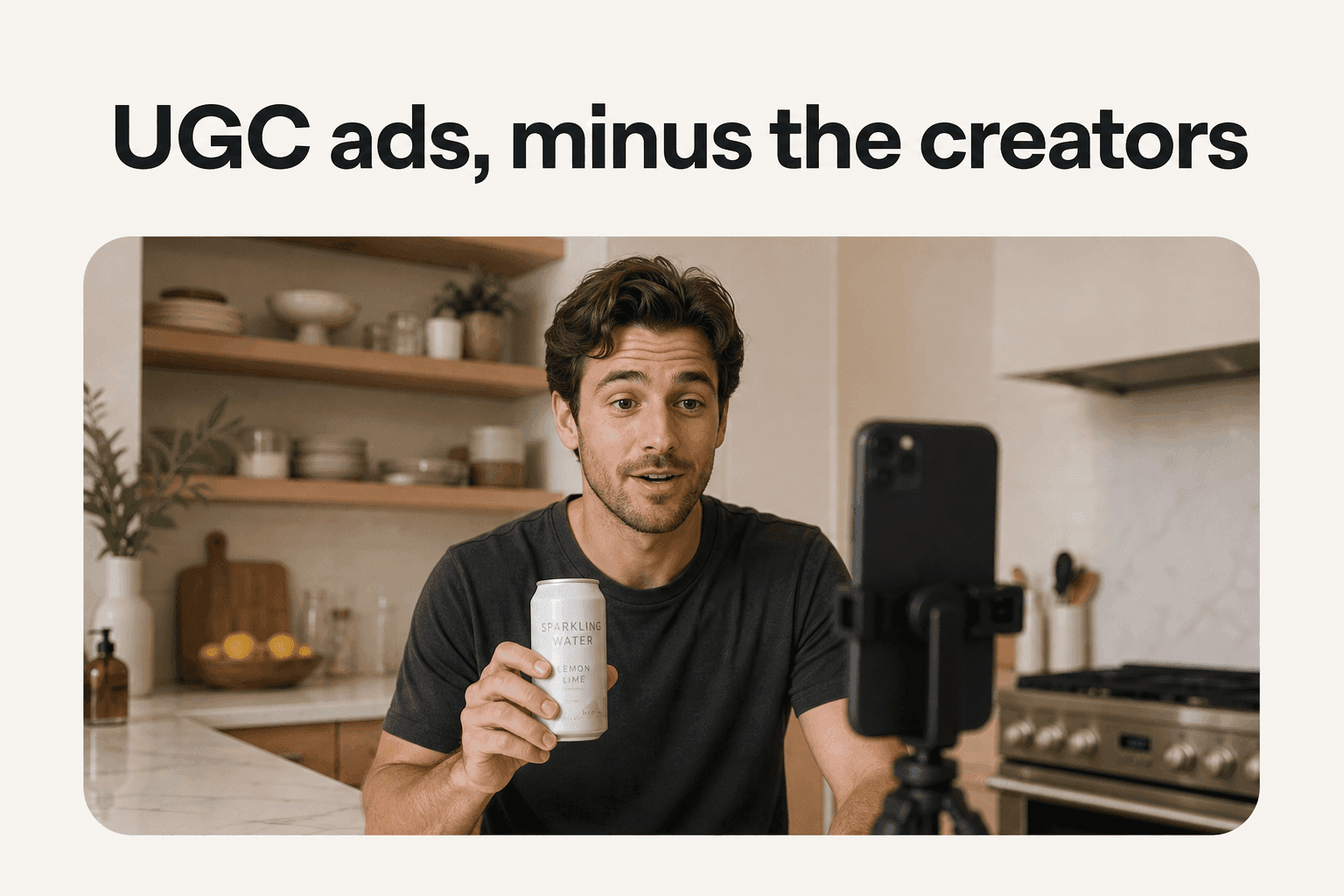
Novoads turns a product photo and a script into a UGC-style video ad with an AI actor, so a concept goes from written to watchable the same afternoon instead of the same fortnight. That is the specific bottleneck this plan runs into: building twelve distinct arguments used to mean twelve creator bookings, and the summer is not long enough for twelve rounds of shoot, review and reshoot.
Upload the product image, write or auto-generate the script, pick an actor, and you have a variant for a couple of dollars. Re-cut the same argument with a different actor or a different opening line and you have the second execution. You can try it for $49/month, which includes 50 credits every month. Cancel any time.
The point is not that the render is cheap. It is that the cost of being wrong in August drops far enough that you can afford to be wrong eleven times before November.
You cannot buy a cheaper auction, only a better ad
Every advertiser in your category will face the same prices in late November, and none of you can negotiate them. What you can decide, months in advance, is whether you arrive with an argument that has already been proven at your own expense, or one that is still being tested at the year's highest rates. The creative library is the only part of a Black Friday campaign that has to exist before the season, and it is the only part still worth building in July.
If your Q4 plan currently starts in October, move the production half of it to this month and give the testing half the whole autumn.
Frequently Asked Questions
When is the most expensive time to advertise on Meta?
The late-November corridor around Black Friday and Cyber Monday. In Gupta Media's Social CPM Tracker, ISO week 48 of 2024 (25 November to 1 December, the week containing Thanksgiving and Black Friday) was the most expensive week of that year at a $13.42 average CPM, and Cyber Monday, 2 December 2024, was the single most expensive day at $17.70. Treat those numbers as one agency's sample rather than a platform-wide rate, and note that ISO week 48 contained Black Friday in 2024 specifically. The week number shifts with the calendar.
When should I start making Black Friday video ads?
Start producing in July and start testing by August. The goal is not to have ads ready in November, it is to know which angle already works before November, because the corridor is too short and too expensive to be your discovery window. A concept that needs three rounds of iteration needs those rounds to happen while a wasted impression costs you nothing important.
How many Black Friday ad variants do I actually need?
Plan around a shelf, not a launch. Eight to twelve distinct concepts, each with two or three executions, gives you roughly 20 to 35 assets, which is enough to keep the corridor stocked as winners fatigue. Distinct means a different argument for the product, not a recolored button. Ten versions of one idea count as one concept.
Do Meta ad costs really spike every Black Friday?
The seasonal shape is well corroborated across independent datasets: Gupta Media, Skai and Birch all report a late-November peak from separate client portfolios and separate methodologies. Your own account is a different question. A national average is not your auction, and outcomes depend on your vertical, geography and bidding. Plan for a more expensive corridor, do not treat any specific percentage as a promise.
Should I pause my ads during Black Friday if CPMs are high?
Not on the CPM alone. A higher CPM bought against much higher purchase intent can still return better than a cheap impression in February. The decision belongs to your cost per acquisition and your margin, not to the impression price. What a high CPM does change is the cost of experimenting, which is why the experiments belong to the months before.
What should I hold back for the peak week itself?
Three things: the offer reveal cut, which drops the actual discount onto an angle that already proved itself, a retargeting-only set aimed at people who watched or added to cart during the build-up, and a shipping-deadline cut for the week after Cyber Monday. Holding them back keeps something fresh in the auction when your best evergreen creative starts to fatigue.
Key Takeaways
- The late-November corridor is a pricing peak, not a volume peak. Skai's client data showed Meta's Cyber Five growth came mostly through higher CPM, with impressions up only 2%, and Birch's three-year Facebook dataset finds seasonal CPM peaks at the end of November.
- In Gupta Media's tracker sample, the peak week and the peak day sat in different ISO weeks: week 48 of 2024 (Thanksgiving and Black Friday) averaged $13.42, while Cyber Monday, 2 December 2024, hit $17.70 as the single most expensive day.
- Those dollar figures are one agency's proprietary panel, not Meta's rate card, and the tracker's most recent Black Friday reading is still the 2024 cycle.
- The bid and the audience are commoditized in a hot auction. The creative is the only input still capable of changing your cost per outcome, and it takes weeks of testing to find one that does.
- Build 8 to 12 distinct concepts through the summer, prove the angle before October while a failed test costs you nothing, and keep the offer reveal and the shipping-deadline cut in reserve.