
How to Scale Ad Campaigns Without Resetting Learning: Budgets, Structure and the 50-Result Bar
Scaling ad campaigns means adding spend without paying for needless relearning: Meta restarts an ad set's learning phase after significant edits and large budget changes, so raise budgets in small steps, put new creative in new ad sets and keep each ad set near 50 results a week.

Mauricio Valdivia
·13 min

Scaling is a series of edits, and some restart learning
On a Friday, a skincare founder doubles the daily budget on the ad set that sold her serum all week. On Monday the cost per purchase is up. The Delivery column says "Learning" again.
Nothing broke. She made an edit Meta treated as new.
Meta's rule fits in one sentence: "Only a significant edit causes an ad set to reenter the learning phase." Its learning-phase page adds the bar for getting out: an ad set usually leaves learning after about 50 results in the week after its last significant edit. Scaling ad campaigns well is the craft of adding spend and reach while paying for as little relearning as possible.
The best practices for scaling an ad strategy follow from those two rules:
- Scale only ad sets that already reach about 50 results a week.
- Raise budgets in steps small enough that Meta does not read them as significant.
- Put new creative and new audiences in new ad sets, not inside the winner.
- Combine ad sets that split one audience, so each can reach the bar.
- Have new creative ready before the winner fatigues.
The rest of this guide takes each rule apart, using Meta's own Help Center wording, then runs a worked example from $100 a day to $400.
What Meta counts as a significant edit
Meta sorts edits into three groups. Its Help Center is explicit that "every edit you make (during the learning phase or after it) has some effect on delivery, but not every edit causes the ad set to reenter the learning phase." What matters for scaling is which group a move falls into.
The six edits that always restart learning
Meta's list of significant edits, verbatim:
- Any change to targeting
- Any change to ad creative
- Any change to optimization event
- Adding a new ad to your ad set
- Pausing your ad set for 7 days or longer (the ad set reenters the learning phase once you unpause the ad set)
- Changing bid strategy
The same page adds two cases. For ads about social issues, elections or politics, changing the disclaimer on the ad is also significant. And with Advantage+ campaign budget, switching the campaign's bid strategy "might cause multiple ad sets within the campaign to reenter the learning phase."
Two of those six are scaling moves by nature. A marketer who scales by dropping five fresh ads into the winning ad set has made a significant edit to the one ad set that was working.
Three amounts that depend on the size of the change
The second group is conditional. Meta says "a change to any of the following areas may or may not be significant, depending on the magnitude of the change":
- Ad set spending limit amount
- Bid control, cost per result goal or ROAS goal amount
- Budget amount
Its only calibration is one example: "if you increase your budget from $100 to $101, that isn't likely to cause one or more ad sets to reenter the learning phase. However, if you change your budget from $100 to $1000, one or more ad sets may reenter the learning phase." That brackets the answer between a 1% raise and a 900% raise. Everything in between is Meta's call.
The 20% rule is a heuristic, not Meta's threshold
Media buyers often repeat a rule of raising budgets about 20% at a time. Meta's significant-edits page publishes no percentage, so treat any step size as a hypothesis your account tests, not a promise.
Frequency matters as much as size. The learning-phase page tells advertisers to "avoid frequent budget changes (which can cause an ad set to re-enter the learning phase)." Five small raises in five days are five chances to trip the same wire.
The one 20% figure in Meta's budget help is a different feature. Ad set budget sharing lets you share up to 20% of your daily budget with other ad sets, for campaigns that do not use a campaign budget. It is a structure option, not a scaling speed limit.

Best practices for scaling ad strategy start with 50 results a week
Before any budget moves, check whether the ad set has a signal worth multiplying. Meta is blunt that "during the learning phase, ad sets are less stable and usually have a higher CPA." Scaling an ad set that has not left learning multiplies noise.
Read two columns before you touch the budget
Meta tells you where to look: "Look for the Last significant edit column. This shows when you last made a change that could reset the learning phase." The check takes a minute:
- Open Ads Manager and select the ad set you want to scale.
- Add the Last significant edit column if it is not in your view, and note the date.
- Read the Results column for the week since that date.
- If it shows about 50 results, the ad set has cleared Meta's usual bar.
For Shops ads the bar is different: Meta requires a minimum of 17 purchases through your website and 5 through Meta for learning to complete.
Learning limited means the ad set cannot reach the bar
Meta marks an ad set Learning limited "when it is unlikely to receive about 50 optimization events in the week after your last significant edit." The page stresses that this is not a penalty. It is a sign that the budget is not being spent effectively with the current setup.
Meta's fixes for it read like a scaling checklist:
- Combine ad sets and campaigns.
- Expand your audience.
- Raise your budget.
- Raise your bid or cost control.
- Change your optimization event to one that happens more often, for example from purchases to add to cart.
Notice the order. Consolidation comes first, and raising the budget is third.
The budget each ad set needs to clear the bar
The ad set floor: daily budget needed ≈ cost per result × 50 ÷ 7. At a $12 cost per purchase, one ad set needs about $86 a day to reach 50 purchases in a week. At $30, it needs about $214. This is our arithmetic on Meta's 50, not a Meta figure, and it matches Meta's own advice to "set a budget large enough to get enough total results."
The floor also explains why scaling a small account by splitting it rarely works. Three ad sets at $50 a day each, with a $12 cost per purchase, produce about 29 purchases a week apiece. None of them clears the bar.
Vertical scaling: raise the budget in steps Meta reads as small
Vertical scaling keeps everything that works (the audience, the creative, the optimization event) and changes one thing: the money. That makes it the simplest move, and the one where the magnitude rule bites hardest.
Where the increase lands: campaign budget or ad set budget
The same raise carries a different risk depending on where the budget lives:
- Ad set budget: a raise touches one ad set, and only that ad set can reenter learning.
- Advantage+ campaign budget: Meta warns that "adjusting your campaign budget might cause multiple ad sets within the campaign to reenter the learning phase."
A large campaign-level raise can put several ad sets back into learning at once, so step sizes on a campaign budget deserve more caution than on a single ad set.
If your campaign uses maximum spend limits on its ad sets, raise them too. Meta's spend-limit help says to "increase your maximum spend limit if you increase your campaign budget," because the campaign cannot spend new money that the old limits still cap.
A daily budget is an average, so plan for the peak day
Meta's pricing page says it "may spend up to 75% over your daily promotional budget to maximize advertising opportunities," while spend averages out over the week and "will not be greater than seven times your daily budget." For a daily budget raised to $200:
- A single day can reach $350.
- The week cannot pass $1,400.
Plan cash flow on the week, not the day. Our breakdown of what Meta ads cost walks through how that auction pricing works.
When vertical scaling stops paying
A budget raise buys more delivery to the same audience with the same ads. At some point the cheaper results in that audience are used up and each extra dollar buys less. You see it as a cost per result that keeps climbing after the ad set is out of learning. That is the signal to stop raising and start adding.
Horizontal scaling: add ad sets, leave the winner alone
Horizontal scaling grows the campaign sideways: new ad sets with new audiences or new creative, next to the ad set that works. The winner keeps its learning because nobody edits it.
A duplicate starts its own learning phase
Meta's learning phase applies "when you either create a new ad or ad set or make a significant edit to an existing one." A duplicated ad set is a new ad set, so it goes through learning on its own, however well the original performed. Budget for that when you plan a duplicate, and give it the floor from the section above.
What goes into a new ad set's audience (broad, lookalike, custom) is its own subject; our guide to targeting audiences in Meta Ads covers the options.
Under Advantage+ campaign budget, a new ad set leaves the others alone
Meta's significant-edits FAQ answers the question directly: "No, adding an ad set to a campaign with Advantage+ campaign budget won't cause other ad sets within the same campaign to reenter the learning phase." Two more answers on the same page support the structure:
- Budget moving between ad sets does not restart learning: "ad sets within the campaign won't reenter the learning phase as budget is distributed."
- Edits stay local: as long as an edit is made at the ad set level, other ad sets in the campaign do not reenter learning.
Meta says Advantage+ campaign budget "is best suited for campaigns with at least 2 ad sets," and its product page adds that every ad set must share the same budget type, the same bid strategy and standard delivery to be eligible.
The catch: the budget may never reach the new ad set
A campaign budget chases the lowest-cost opportunities in real time. Meta says it "may not spend your budget equally for each ad set," and gives the example of two active ad sets where it might spend most of the budget on one. A new ad set with no history can sit next to a proven winner and barely spend.
Meta's tool for that is a minimum spend limit, with two caveats in its own words: "A minimum spend limit is a target range, not a guarantee," and Meta recommends "using the least amount of spend limits, because such limits can prevent a campaign budget from taking advantage of the best opportunities available." Use a minimum only on the ad set you are deliberately funding to learn, set it near that ad set's floor, and remember that changing a spending limit later is itself one of Meta's size-dependent edits.
Scale vertically when:
- The ad set is out of learning and its cost per result is stable.
- The audience is large enough that more delivery reaches new people.
- You have no new creative or audience ready to test.
Scale horizontally when:
- Cost per result keeps rising after each budget step.
- You have new creative or a new audience worth its own learning phase.
- The campaign budget can fund another ad set at the floor.

Consolidate before you multiply ad sets
Horizontal scaling has a failure mode: so many ad sets that none of them learns. Meta's help on combining ad sets puts it plainly: "When you run too many ad sets at the same time, each one gets fewer opportunities to learn and therefore fewer results."
Splitting one audience slows every ad set
Meta's example is three ad sets with the same objective and creative, aimed at people interested in dogs, dog toys and dog collars. It says splitting them "could decrease performance because your total audience size is split across multiple ad sets," and suggests one ad set with all three interests instead.
The same logic applies to other common splits. Meta's ad-volume page recommends combining each of these so conversions and delivery learnings add up in one place:
- Small geographic areas: combine them into larger areas.
- Placements: combine them and use Advantage+ placements with asset customization.
- Languages: combine them and set multiple languages in a single ad set.
Report with breakdowns, not with ad sets
Many accounts split ad sets only to read results by age, country or region. Meta's advice: "Instead of fragmenting audiences for reporting purposes, consider using breakdowns in ads reporting." The breakdown gives you the same table without cutting the learning signal into slices.
Fewer ads per ad set, more assets per ad
Meta's ad-volume page asks advertisers to "decrease ads per ad set, but maintain diverse creative assets per ad set," and notes that "one ad can contain multiple (up to 10) creative assets." How many creatives an account can actually resolve is a separate calculation; our piece on how many ad creatives you need works through Meta's limits and the event math.
Creative supply decides how far a campaign scales
Budget and structure decide how much learning an account can afford. Creative decides how long a winner keeps winning at higher spend. At scale, the question is not whether an ad will fatigue but whether the next one is ready.
New creative is a new ad, so give it a new ad set
"Any change to ad creative" and "adding a new ad to your ad set" are both significant edits. Refreshing creative inside the winning ad set therefore restarts it. Under Advantage+ campaign budget, a new ad set carries the new creative without touching the winner, and budget shifts toward whichever one performs.
That is not a case for avoiding learning altogether. Meta says "you shouldn't try to avoid the learning phase completely," and that "testing new creative and marketing strategies is essential for improving your performance over time." Relearning is a cost. Spend it on purpose, in the ad set built to absorb it. A clean ad creative testing setup is how you read which new ad actually earned its budget.
Fatigue follows the creative across campaigns
Meta's creative fatigue diagnosis counts exposure by the asset, not the campaign: "We consider all recent exposures of the ad's image or video, including those from other campaigns from your Page." Copying a tired video into a fresh campaign does not make it fresh.
In ad sets that run a single creative, Meta labels the stages by cost:
- Creative limited: cost per result is higher than your past ads, but less than twice as much.
- Creative fatigue: cost per result is twice as much as your past ads, or more.
- Before launch: Meta warns you if it predicts fatigue in the first 7 days.

Materially different, not a new hook on the same shot
Meta's first fatigue recommendation is to "create a new ad with a new image or video that is materially different from the original creative," and it adds that keeping the original ad active instead of pausing it may maximize results. Materially different is the hard part: Meta's ads system groups look-alike ads and treats them as variations of one creative, which is why creative diversity in Meta Ads is about new people, messages and formats rather than more hooks on one shot. A different format altogether clears that bar more easily than another talking-head variant, which is why a concept like a miniature world built around the product is worth a slot in the supply. Teams that keep a steady weekly supply usually run it as a pipeline; our guide to creative operations shows one.
Worked example: a $100-a-day serum campaign scaled to $400
Assume a serum brand runs one campaign on Advantage+ campaign budget with one ad set, $100 a day, a $12 cost per purchase and about 58 purchases in the last seven days. The goal is $400 a day. All figures here are illustrative inputs, not benchmarks.
Step by step
- Readiness. 58 purchases in the week after the last significant edit clears the bar of about 50. The ad set can be scaled.
- Vertical steps. Raise the campaign budget in steps and let each one run about a week, because Meta's bar is measured over the week after an edit. After each step, read Last significant edit and Delivery. If Learning comes back, the step was too big for this campaign.
- Horizontal step. Once the campaign budget passes about $171 a day (two floors at $12), add a second ad set with materially different creative. Adding it does not reset the first.
- Structure check at $400. Before adding a third or fourth ad set, check the ceiling below.
The ad set ceiling
The ad set ceiling: weekly budget ÷ (cost per result × 50) = the number of ad sets that can each reach the bar.
| Daily budget | Weekly spend | Results at $12 | Results at $16 | Ad sets at ~50 each |
|---|---|---|---|---|
| $100 | $700 | 58 | 43 | 1 or 0 |
| $200 | $1,400 | 116 | 87 | 2 or 1 |
| $400 | $2,800 | 233 | 175 | 4 or 3 |
| $800 | $5,600 | 466 | 350 | 9 or 7 |
The first number in the last column assumes the cost per purchase holds at $12; the second assumes it drifts to $16 as spend grows.
What the table says
- At $400 a day this campaign can feed three or four ad sets, not ten. A plan with eight ad sets is eight learning phases that are unlikely to finish.
- A cost per purchase that rises from $12 to $16 removes one ad set's worth of learning at $400 a day. Watch cost per result as a structure signal, not only as a profit signal.
- The ad sets you can afford are the slots your new creative has to fill. That is where scaling turns into a creative-supply problem.
The same logic on Google Ads
Google Ads uses different words for the same mechanism. Its automated bid strategies show a Learning status while they recalibrate, and the triggers look familiar.
What puts a bid strategy back into Learning
Google's help on the learning period names three main reasons (plus ad group target changes on Shopping campaigns):
- New strategy: the bid strategy was recently created or reactivated.
- Setting change: a setting for the bid strategy was changed.
- Composition change: campaigns, ad groups or keywords were added to or removed from the bid strategy.
Its number will look familiar too: "It can take up to around 50 conversion events or 3 conversion cycles for the bid strategy to calibrate to the new objective."
Scaling spend means moving targets, one cycle at a time
Google's help on target adjustments gives three rules that map onto vertical scaling:
- The lever: "If you would like to increase spend, you can raise CPA targets or lower ROAS targets as needed."
- The size: "a major change in targets can have a similarly sized impact on spend or volume."
- The frequency: "Unless there is a true business need, avoid making multiple ROAS target changes within a single conversion cycle."
The lesson matches Meta's: size and frequency of changes both matter. If you run target-based bidding, our note on Google's target-based bidding change covers what moved in August.
How Novoads solves the creative supply side of scaling
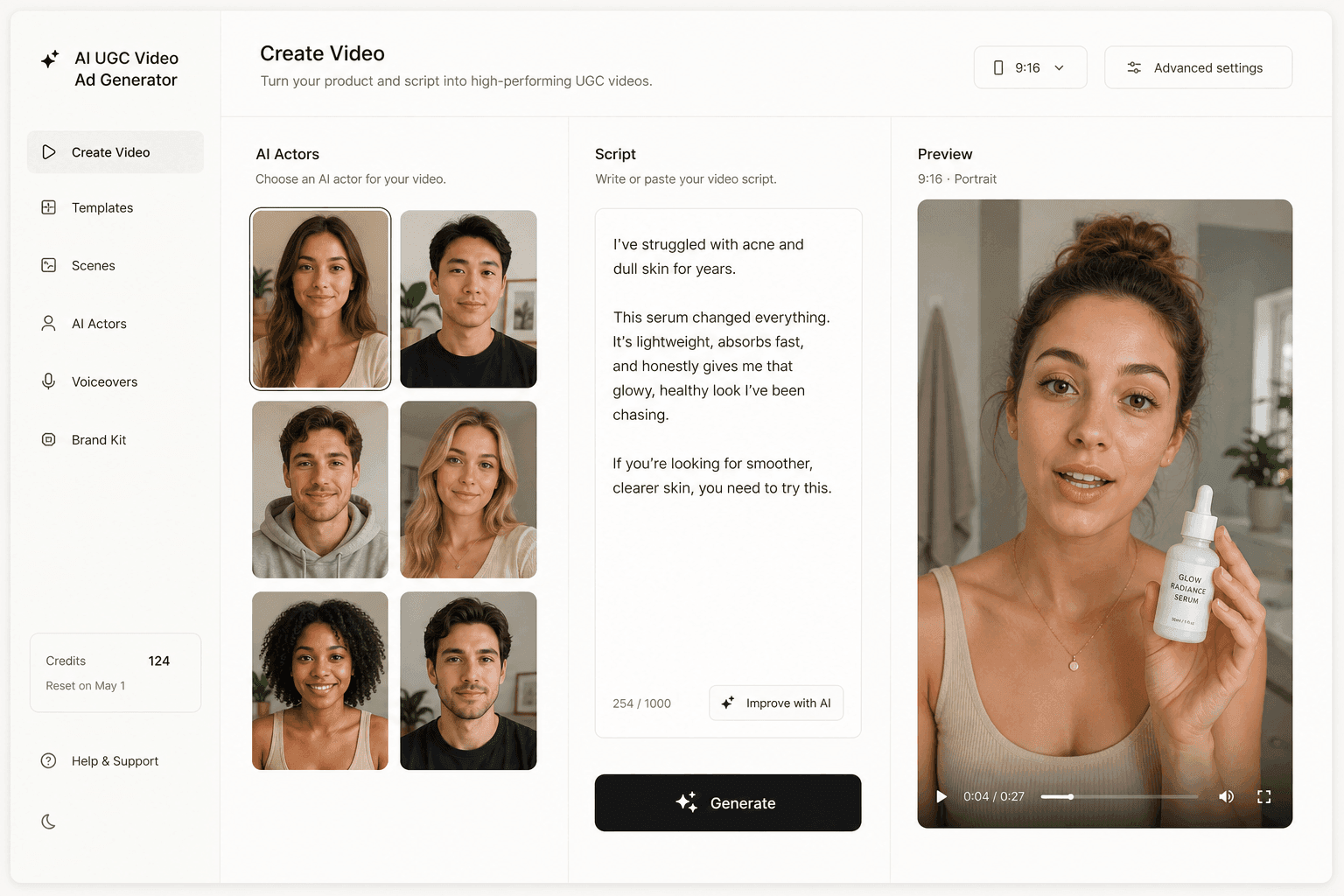
Novoads turns a product image or a script into UGC-style video ads with AI actors, exported as 9:16, 1:1 or 16:9 files for any ad platform, so the new ad sets a scaling plan calls for have creative to hold.
What a batch of new creative costs
Novoads starts at $49/month (Starter, 50 credits per month). All plans are published on /pricing. A clip costs from about a dollar for a five-second Seedance 2.0 Mini clip to about $8 for an eight-second Seedance 2.5 clip, and about $26 for a full 30-second Seedance 2.5 take. In credits, a five-second Seedance 2.0 Mini clip is 1.5 credits, so one Starter month covers up to 33 of them.
If the ad needs your product in someone's hand, there are two routes: a custom actor made from an uploaded photo of a person holding it, or one of the Discover product templates. You can start building a batch in Novoads and drop each set of materially different clips into its own ad set.
What it does not do
Novoads is the creative half of a scaling plan, not the plan. It does not:
- Pick your budget steps, your ad set count or your audiences.
- Make a weak offer or a slow landing page scale.
- Make ten versions of one shot count as ten concepts to Meta.
What it does is make the next materially different ad cheap enough that creative supply stops being the reason a campaign stalls.
Budget is the last lever, not the first
The founder who doubled her budget on a Friday did not have a budget problem. She had one ad set, no second one ready, and no new creative waiting. A campaign scales as far as its structure can feed learning and its creative supply can outrun fatigue; the budget only decides how fast you reach that limit.
Build the second ad set and the next batch of creative before you raise the number.
Frequently Asked Questions
What are the best practices for scaling an ad strategy?
Scale only ad sets that already reach about 50 results a week, which is the level at which Meta says an ad set usually leaves the learning phase. Raise budgets in steps small enough that Meta does not treat them as significant edits, put new creative and new audiences into new ad sets instead of the winning one, combine ad sets that split one audience, and have new creative ready before the winner fatigues.
How much can I increase my Meta ad budget without resetting the learning phase?
Meta publishes no percentage. Its Help Center says a budget change may or may not be significant depending on its size, and gives an example: raising a budget from $100 to $101 is not likely to send ad sets back into learning, while changing it from $100 to $1000 may. The widely repeated 20% rule is a practitioner heuristic, not Meta's threshold, and Meta separately advises against frequent budget changes.
Does adding a new ad reset the learning phase?
Yes. Meta lists adding a new ad to your ad set as a significant edit, along with any change to targeting, ad creative or optimization event, changing bid strategy and pausing for 7 days or longer. Adding a new ad set to a campaign that uses Advantage+ campaign budget does not send the other ad sets in that campaign back into learning.
What is the difference between vertical and horizontal scaling?
Vertical scaling raises the budget on an ad set or campaign that already works, so the only thing that changes is the spend. Horizontal scaling adds new ad sets, with new audiences or new creative, next to the winner. Vertical scaling is a budget edit whose risk grows with its size; horizontal scaling starts a new learning phase for each new ad set but can leave the winner untouched.
How many results does an ad set need to exit the learning phase?
Meta says ad sets usually exit the learning phase after about 50 results in the week after the ad set's last significant edit. An ad set that is unlikely to reach about 50 optimization events in that week is marked Learning limited. For Shops ads, Meta requires at least 17 purchases through your website and 5 through Meta.
Does Google Ads have a learning phase too?
Yes. Google Ads shows a Learning status on automated bid strategies after a new strategy, a setting change or a composition change, meaning campaigns, ad groups or keywords added to or removed from the strategy. Google says it can take up to around 50 conversion events or 3 conversion cycles for the bid strategy to calibrate.
Key Takeaways
- Meta restarts an ad set's learning phase only after a significant edit: any change to targeting, ad creative or optimization event, adding a new ad, changing bid strategy, or pausing for 7 days or longer.
- Budget, spending limit and bid or ROAS goal amounts count as significant only depending on the size of the change; Meta gives no percentage, so the 20% rule is a heuristic, not Meta's rule.
- An ad set usually leaves learning after about 50 results in the week after its last significant edit, which means your budget divided by your cost per result caps how many ad sets can learn at once.
- Under Advantage+ campaign budget, adding an ad set does not reset the others, which makes a new ad set the safe place for new creative and new audiences.
- A campaign scales as far as its structure can feed learning and its creative supply can outrun fatigue; the budget only decides how fast you reach that limit.
Sources
- •Meta Business Help Center: Significant edits and learning phase
- •Meta Business Help Center: About the learning phase
- •Meta Business Help Center: About Advantage+ campaign budget
- •Meta Business Help Center: Combine ad sets and campaigns to reduce audience fragmentation
- •Google Ads Help: Duration of the learning period for campaigns and what affects it