Creative Diversity in Meta Ads: Why Meta Treats Look-Alike Ads as One Creative
Meta's ads system groups ads that share key visual and thematic attributes and treats them as variations of the same creative, so creative diversity means distinct personas, messages and formats, not more hooks on one shot.

Mauricio Valdivia
·12 min

Twenty new ads, one creative in Meta's eyes
A skincare brand's media buyer uploads twenty new ads on a Monday. Same creator. Same bathroom counter, the same serum bottle held at the same angle, and twenty different opening lines. The launch note calls it a twenty-ad test.
Meta's ads system reads that upload differently. In guidance dated December 16, 2025, Meta says its system "groups together ads that share key visual and thematic attributes," and that "when multiple ads look or feel alike," "these are seen as variations of the same creative." Twenty hooks on one shot hand the system one idea, dressed twenty ways.
That is what creative diversity in Meta ads comes down to: how many genuinely different ideas you give the system, not how many ad objects you upload. The scale explains why it matters. When someone opens Instagram or Facebook, Andromeda, Meta's retrieval technology, scans "tens of millions of ads" and keeps a few thousand candidates. This guide covers what Meta has actually published about grouping similar ads, how it scores diversity in Ads Manager, and how to plan concepts that stay distinct when they get there.
What Meta's system does with look-alike ads
Similar ads share learnings at the creative level
Meta's post "Demystifying Creative Diversification" is the clearest place to start, and the end of its key sentence matters as much as the beginning. Learnings and delivery optimizations for look-alike ads are "shared at the creative level," Meta writes, "not just the individual ad level."
Read that carefully. The passage does not say look-alike ads are removed or blocked. It says the system treats them as variations of one creative, so what it learns about one carries over to the others. The practical reading is that each near-copy stops being an independent bet. You run twenty ads and learn roughly what one concept can do.
The same paragraph states the upside. "By uploading ads that are truly distinct in their visuals, messaging, and formats, marketers expand the range of options our system can use to reach different audiences." It names three dimensions:
- Visuals: what the ad looks like, frame by frame
- Messaging: the argument the ad makes
- Formats: the kind of asset it is, from a Reels video to a static image
Keep those three in mind. The rest of this post is about moving at least one of them for real.
Where Andromeda sits in the pipeline
Andromeda is the first filter, not the final judge. Meta's engineers described it in a December 2, 2024 post as the retrieval stage, "tasked with selecting ads from tens of millions of ad candidates into a few thousand relevant ad candidates." They add that retrieval "processes three orders of magnitude more ads than subsequent stages." After retrieval, Meta's December 2025 post says "models like GEM choose and rank the ads most likely to resonate with each person."
Two consequences follow for anyone planning creative:
- Distinctness counts at the first cut. Meta describes Andromeda keeping candidates "so only the most relevant and distinct creatives move forward."
- The pool is getting more crowded. The same engineering post expected the number of ad creatives in Meta's systems "to grow significantly" as advertisers adopt generative AI tools. Another near-copy in a bigger pool is one more version of something the system already has.
What Meta's own numbers measure
Meta attaches numbers to this story. Each one measures something narrower than it first appears to.
- 8% better ads quality. Meta's April 22, 2025 post says "Meta Andromeda has already led to an 8% improvement in ads quality." The engineering post gives the fuller version: a 6% recall improvement and "+8% ads quality improvement on selected segments."
- 11% higher CTR and 7.6% higher CVR. The December 2025 post lists these under advertisers who "lean into creative diversification," and both posts tie them to one feature. The April 2025 version spells out the comparison: campaigns "using our image generation feature within Advantage+ creative see an 11% higher click-through-rate and 7.6% higher conversion rate, compared to campaigns not using these features."
That second figure compares campaigns that used a generative AI feature with campaigns that did not. It measures the feature, not diverse creative against uniform creative. Neither number undermines the grouping mechanism. Just treat them as Meta describing its own system, not as a benchmark your account should expect.
Iteration and diversification are two different jobs
Meta's December 2025 post leads its key takeaways with a sentence worth pinning above every brief: "Creative diversification and creative iteration are two separate concepts." Plenty of accounts that believe they have a diversity problem actually have an iteration habit.
What Meta counts as iteration
Meta defines creative iteration as "manual A/B testing to refine assets, formats, and messages." Its example is precise: iteration "might produce two ads with identical visuals, but different text CTAs." The post's best practices describe the same habit from the other side, warning against "making small, subtle tweaks to the same ad."
In a video ad account, these usually count as iteration, because the visual stays the same:
- A new hook line spoken over the same opening shot
- A different headline, primary text or CTA button
- New captions or a new music bed on the same footage
- The same video trimmed to a shorter length
What Meta counts as diversification
Diversification, in Meta's words, is "the creation of distinct campaign assets tailored to different personas or use cases." Its example is two pieces of creative that share almost nothing: "a Reels ad tailored for GenZ and a separate partnership ad featuring a creator who connects with new moms." Different audience, different messenger, different format, different reason to care.
The April 2025 post frames it from the targeting side, saying "the focus has shifted from niche targeting to creative diversification as the best lever to find the most relevant audiences." Put simply, the creative now does part of the work that audience settings used to do.
Keep iteration, in its own lane
None of this makes iteration useless. Meta says "Creative iteration can inform new ad concepts for a diversification strategy, but should not replace true creative diversification." Iteration answers a narrow question inside one concept, such as which hook holds attention, and it needs a clean setup to answer it, which is what controlled ad creative testing is built for.
Holding the messenger fixed is correct when the test is about the script. That is the logic behind keeping one AI actor consistent across ad variations. It is the wrong move when the goal is range.
Similarity and fatigue are not the same problem
When an ad set stalls, many teams say the creative is fatigued and make more of it. Meta separates two causes, and they call for different fixes.
Fatigue is overexposure
Meta's definition: "Creative fatigue occurs when your target audience is overexposed to the same creative (image or video), leading to declining engagement and higher cost per result." The ad did its job. The audience has simply seen it too often.
Similarity is a lack of range
Meta says "creative similarity refers to when ad images are visually too alike, even if technically different assets." The two problems connect, because "high similarity can also drive fatigue, as users perceive ads as repetitive, reducing engagement." Meta's one-line distinction is the one to remember: "fatigue is about overexposure, while similarity is about a lack of visual diversity."
Why the diagnosis changes the fix
| Fatigue | Similarity | |
|---|---|---|
| What it is | Overexposure to one creative | Ads visually too alike |
| Where it shows | One creative's results decay | The set looks like one ad |
| Refresh that backfires | A near-copy of the tired ad | New text on the same visual |
| Refresh that works | Rotate in distinct creatives | New persona, format or setting |
The trap sits in the bottom two rows. A refresh built from near-copies looks like a cure for fatigue while it adds to the similarity problem, which is why repurposing a winning ad means rebuilding it as a new concept. Meta's own advice for fatigue points the same way as its advice for similarity: "By rotating distinct creatives, you keep things fresh and relevant."
How Meta scores creative diversity in Ads Manager
What the label compares
Meta's Business Help Center has an article for a metric called Creative diversity. According to that page, read on September 17, 2026, the metric compares the images and video thumbnails inside an ad set against each other to measure how similar they are. It turns that similarity into a score and labels the ad set High, Medium or Low by applying thresholds.
Meta says the label exists to show when an ad set needs more varied images and videos, to help prevent creative fatigue and improve performance. It also marks the metric as estimated and in development, so read the label as a prompt to look closer, not as a verdict.
Meta's news post points the same way. In December 2025 Meta said it was continuing to test expanded creative insights in Ads Manager "to help diagnose and address both creative fatigue and similarity," including flagging fatigued ad sets and formats and offering example creatives "across humor, nostalgia, savings and more."
Why a thumbnail comparison matters for video
The label compares images and video thumbnails, not scripts. For a video ad, that is one still frame, whichever one the thumbnail shows. Twenty talking-head videos with the same person, framing and background produce twenty near-identical thumbnails, whatever the voiceover says. By Meta's description of the calculation, that set is an easy candidate for a Low label, however varied the scripts feel.
The rule that follows is simple. If an ad should register as different, change something the first frame shows:
- A different person on screen
- A different setting or time of day
- A product close-up instead of a face
- A static image beside the videos
The thresholds you will see quoted
Meta's article says the label uses thresholds. Some practitioner guides put numbers on the similarity behind it. Billo, a creator marketplace that competes with Novoads for UGC ad budgets, wrote on September 16, 2026 that once two ads cross "roughly a 60% Creative Similarity Score" they fold into the same fingerprint, and that "the practical target is to keep that score under 40%." Billo describes that fingerprint as "an idea most media buyers now call an Entity ID." Those percentages are Billo's working numbers. Treat them as a rule of thumb from one vendor, not as a Meta specification.
What actually makes two ads different
Meta's best practices set the bar: "develop ads that are truly different in look, feel, storyline, and message." Across its two posts, that comes down to three questions each concept should answer in its own way.
Who it is for, and who is on screen
Meta's definition of diversification starts with personas and use cases. A persona change is only real if the ad changes with it: a different person on camera, a different situation, a different problem. Meta's own example sets a Gen Z Reels ad beside a creator partnership ad aimed at new moms, and those two would never be mistaken for each other in a feed.
What argument it makes
"Create ads that speak to different audience motivations or use cases," Meta writes, with the example that "one ad focuses on 'emotional appeal,' another focuses on 'product features.'" A new motivation changes the storyline, not only the first sentence. A rewritten hook that leads into the same argument is still iteration, which is why writing sharper ad hooks belongs inside a concept rather than in place of one.
What it looks like in the first frame
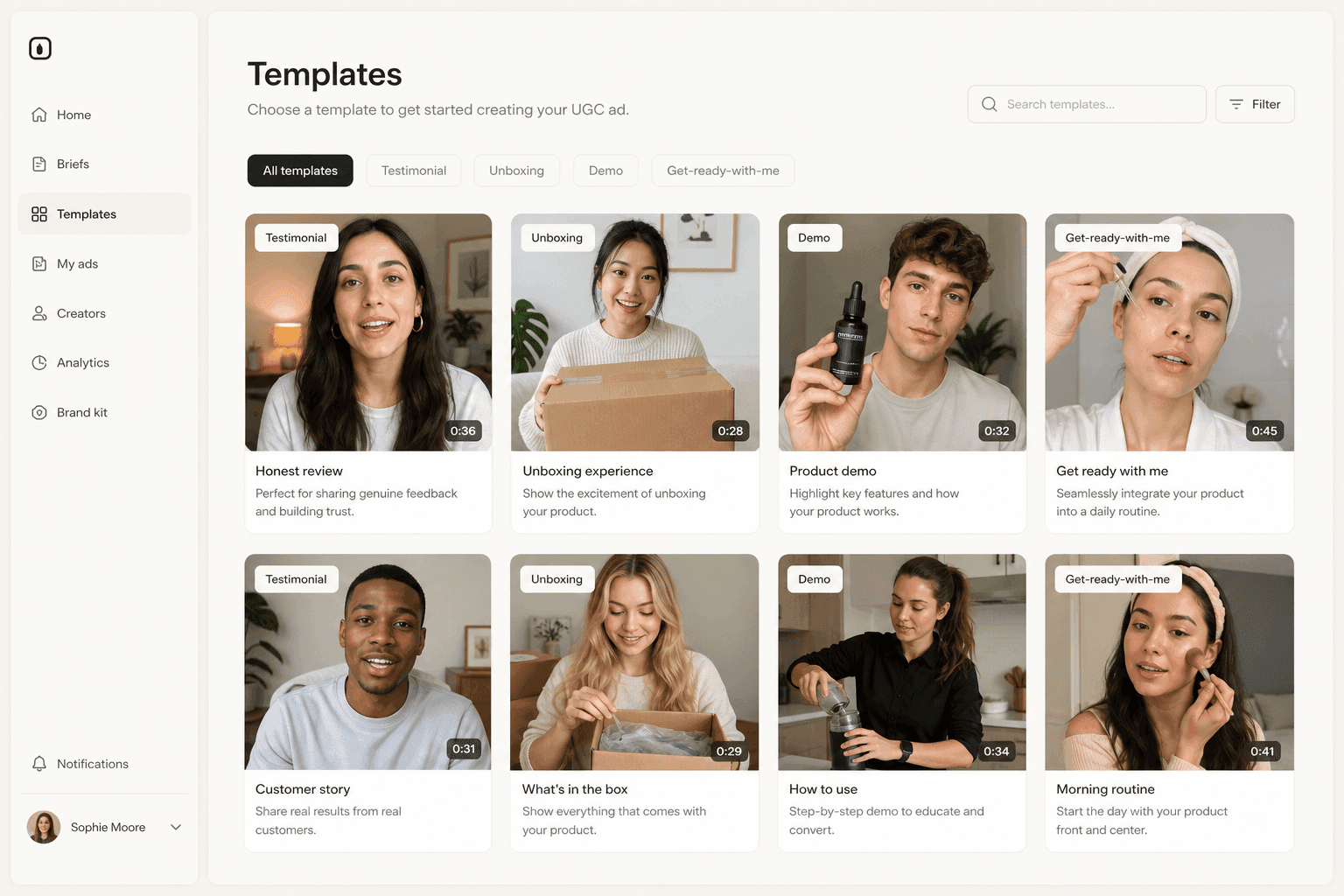
Format and visual are where an image comparison can actually see a difference. Meta recommends "a broad portfolio of assets that take more creative liberty across text, image, and video." In a UGC-heavy account, the format options usually include:
- A talking-head testimonial
- A product demo with hands and no face
- A static product image
- An unboxing or gifting moment
- A day-in-the-life routine clip
A quick check before launch: mute the ad and look only at its first frame. If you cannot tell it apart from another ad in the set at a glance, a thumbnail comparison is unlikely to either.
Plan the concept matrix before you brief a single ad
Start from personas and motivations, not hooks
A concept is one persona, one motivation and one format. Hooks, CTAs and edits are executions of a concept. Write the concepts first, as our ad creative strategy guide lays out, then give each a small number of executions. That keeps both of Meta's jobs in play, diversification across concepts and iteration within them, and it makes the results readable: reading creative analytics per concept tells you which idea worked, not only which ad.
Volume still has a role, as long as it serves the concepts. In Meta's April 2025 post, Dribbleup's head of ecommerce says the brand "maintained steady performance while ramping from 3-4 new creatives a week to almost 50 on average." Read the claim closely: more than ten times the output held performance steady, and the brand describes the point of that volume as putting "many new, diversified concepts into market." The volume was a way to ship more concepts, not a substitute for them.
Worked example: one serum, twenty ads, counted two ways
Take the skincare brand from the top of this post, with a budget for twenty new ads this month.
Plan A is the original upload: one creator, one bathroom, one bottle angle, twenty hooks. By Meta's description of look-alike ads, that is one creative with twenty variations. One concept gets tested.
Plan B spends the same twenty ads on five concepts with four executions each:
| Concept | Persona | Motivation | Format |
|---|---|---|---|
| Busy mornings | New mom | Five-minute routine | Talking head, kitchen |
| Show me proof | Skeptic in her 40s | Ingredient evidence | Dropper close-up demo |
| Cost per use | First-time buyer | Value for money | Static product image |
| After the gym | Gym regular | Holds up after sweat | Talking head, locker room |
| The gift | Gift buyer | Unboxing moment | Unboxing clip |
Twenty ads either way. Plan A gives Meta one idea to match against every audience. Plan B gives it five, each with four executions whose hooks you can still compare. If one concept wins, next month's iteration budget goes there, and the losing concepts are replaced with new ones. How many concepts your conversion volume can actually read is its own question, covered in how many ad creatives you actually need.
Where concept plans quietly collapse
Even a good matrix can slide back into iteration during production. Watch for these:
- One messenger for every persona. Five scripts for five personas, delivered by the same person in the same room, share a first frame.
- Formats in name only. A "demo" and a "testimonial" shot from the same angle in the same setting look alike to an image comparison.
- Generator defaults. A tool left on the same settings, prompt style and reference image drifts toward one look, the sameness risk behind Meta's end-to-end AI ad suite.
- Executions counted as concepts. Four hooks inside one concept are four executions, which our guide to ad hook variations tests against each other. Report them that way, or the plan reads diverse on paper and uniform in Ads Manager.
Refilling concepts on a schedule, rather than in a panic when results drop, is the core of creative operations.
How Novoads solves the concept supply problem
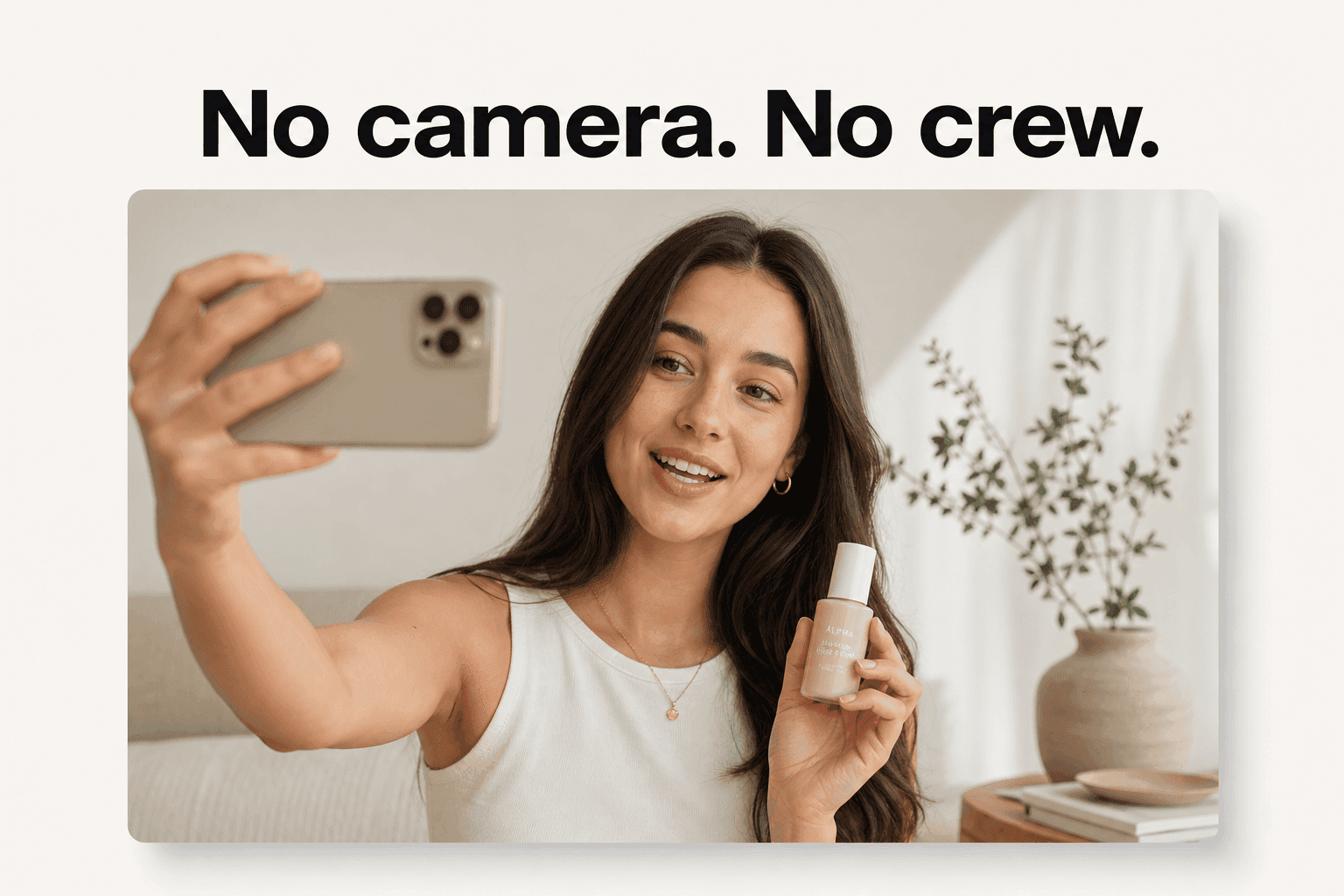
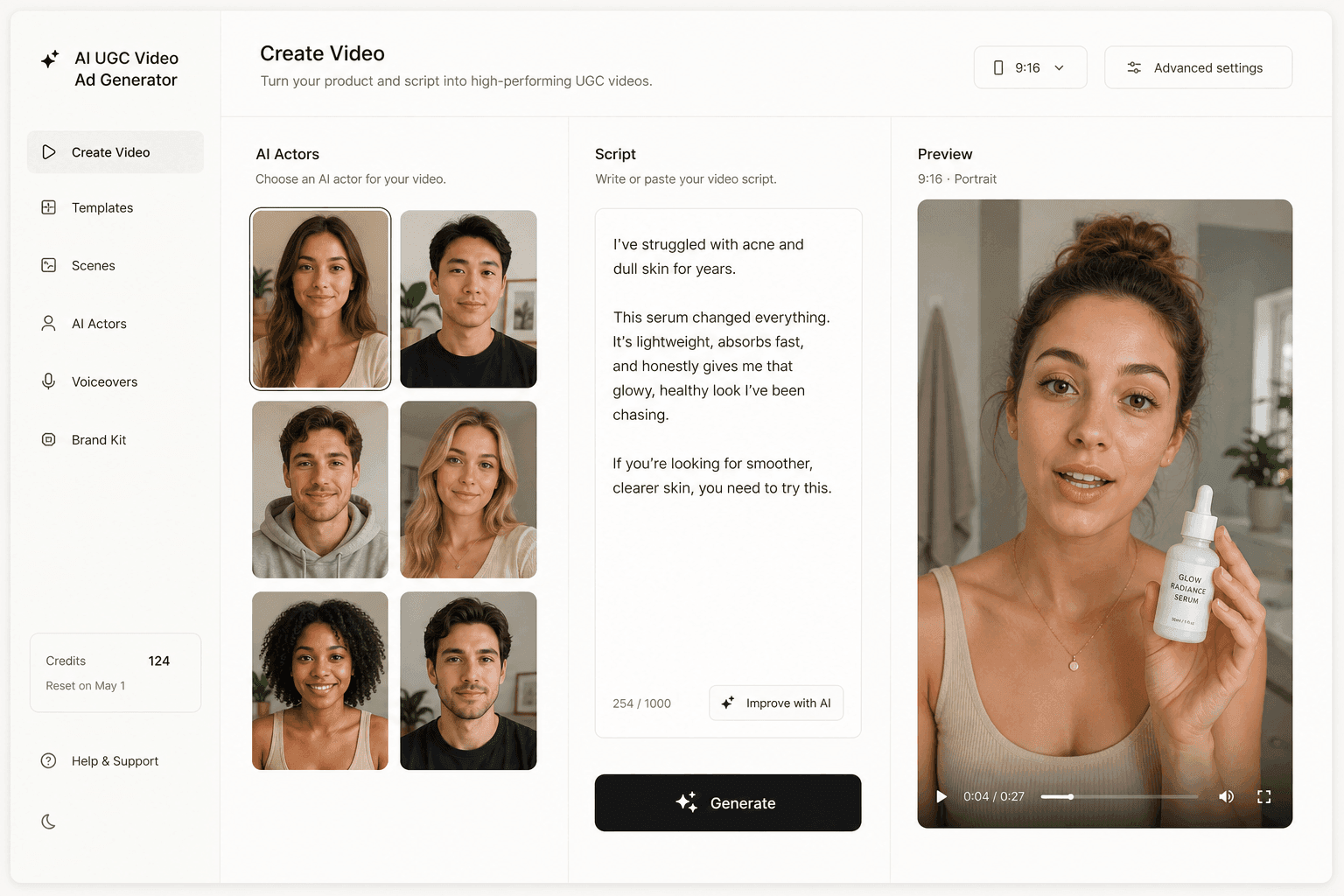
Novoads generates UGC-style video ads and ad images from a script and a product photo, so moving a concept to a new persona, format or setting is a new render rather than a new shoot. Mapped to the three axes:
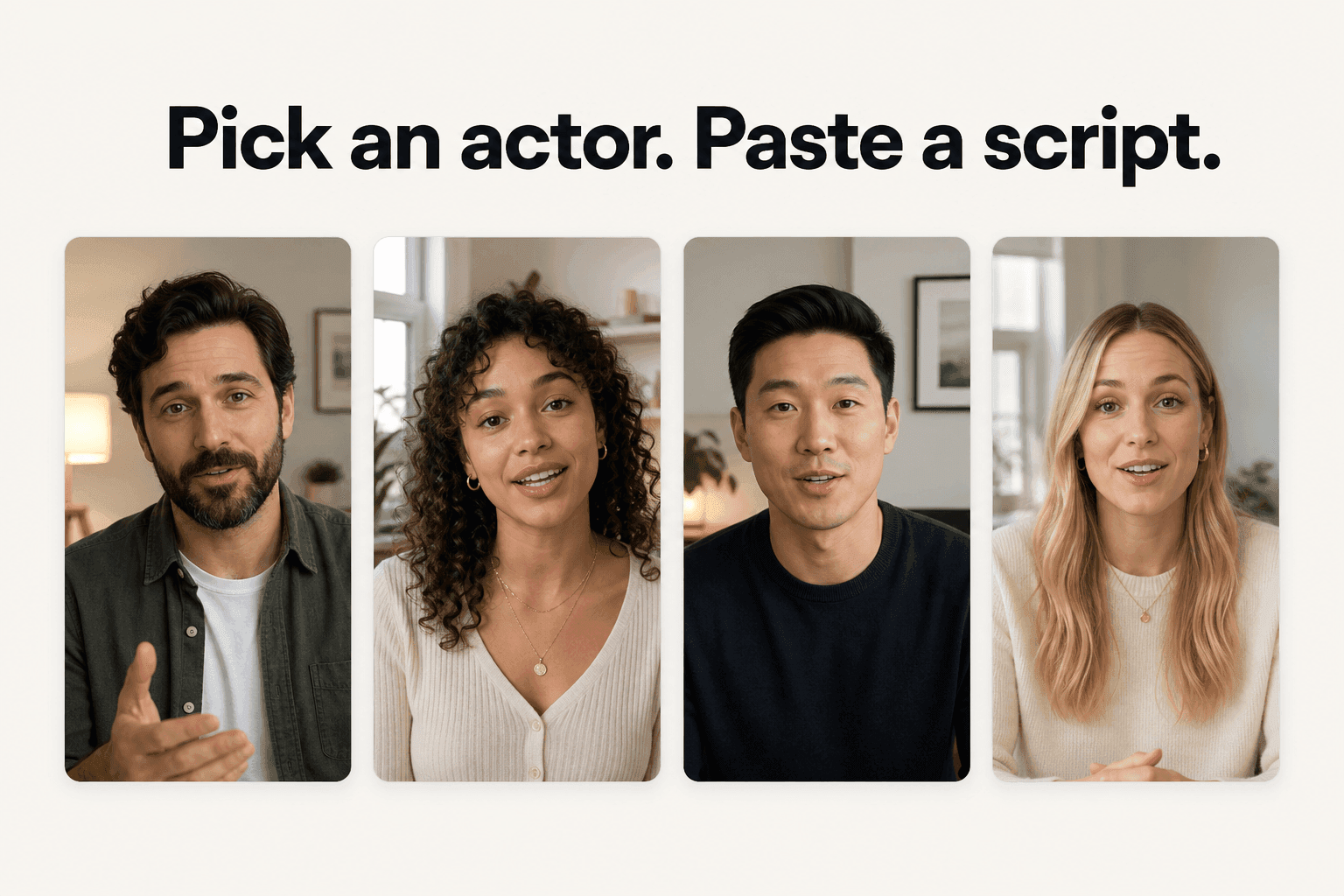
- Persona and messenger. Pick a different actor from a library of 100+ AI actors for each concept, or turn a photo into a talking actor with Create Actor > Upload. A stock library actor has empty hands, so for a concept that needs the product in hand, upload a photo of a person holding your product to create a custom actor, or use a Discover product template, which places your uploaded product in a template creator's hand and animates it as a 15-second Seedance 2.0 clip.
- Format. Talking-actor videos, product video clips from Seedance 2.0, Seedance 2.0 Mini, Seedance 2.5, Kling v3 Pro, Google Veo 3.1 and Omni Flash, and static ad images from Product-to-Ad, which turns an uploaded product image into an ad creative. Outputs come in 9:16, 1:1 and 16:9 sizes.
- Message. The script carries the argument, so a new motivation is a new script, not a new production day.
Here is Plan B's lead asset for each concept, in credits. A talking-actor video of up to a minute costs 10 credits, a five-second Seedance 2.0 Mini clip costs 1.5 credits and a Product-to-Ad image costs 0.3 credits. Two talking-actor concepts, two Mini clips and one product image come to 23.3 credits. A second rendered hook for each talking-actor concept adds 20 credits, for 43.3 in total. Headline, primary text and CTA variants are fields you set in Ads Manager and need no render at all.
Novoads starts at $49/month (Starter, 50 credits per month). All plans are published on /pricing. Novoads renders the assets; the upload, the Creative diversity label and the read stay in Ads Manager. If you want to put five distinct concepts in front of Meta this month, you can build them in Novoads.
Meta can only choose among the ideas you give it
Meta put the whole argument in one line of its April 2025 post: "The biggest constraint you can put on your Meta strategy is the constraints you place on your creative process." The retrieval system is built to sort a pool of tens of millions of ads, the ranking models pick for each person, and the Creative diversity label shows how visually alike an ad set's images and thumbnails are. None of that machinery can invent a persona, a motivation or a format you never made.
Twenty versions of one idea are one choice. Five ideas are five.
Frequently Asked Questions
What is creative diversity in Meta ads?
In Meta's own definition, creative diversification is a strategy where marketers create unique campaign assets tailored to different customer personas or use cases. It matters because Meta says its ads system groups ads that share key visual and thematic attributes: when several ads look or feel alike, they are seen as variations of the same creative. Creative diversity is therefore about how many genuinely different ideas you run, not how many ads you upload.
Does Meta group similar ads together?
Yes. In its December 16, 2025 post 'Demystifying Creative Diversification', Meta says its ads system analyzes creatives and groups together ads that share key visual and thematic attributes. Look-alike ads are treated as variations of the same creative, and learnings and delivery optimizations are shared at the creative level, not just the individual ad level. The post describes shared learnings, not ads being switched off.
What is the difference between creative iteration and creative diversification?
Meta defines creative iteration as manual A/B testing to refine assets, formats and messages, for example two ads with identical visuals but different text CTAs. Creative diversification produces distinctly different pieces of creative, such as a Reels ad tailored for Gen Z and a separate partnership ad with a creator who connects with new moms. Meta says iteration can inform new concepts but should not replace diversification.
How does Meta's Creative diversity label work?
According to Meta's Business Help Center, the Creative diversity metric compares the images and video thumbnails in an ad set to each other to determine similarity, converts that into a score, and gives the ad set a High, Medium or Low label by applying thresholds. Meta says it is used to decide whether more varied images and videos should be added to help prevent creative fatigue, and it marks the metric as estimated and in development.
Is there a similarity percentage that makes Meta treat two ads as the same?
Meta's help article says the Creative diversity label is applied using thresholds. The percentages that circulate come from practitioners: Billo's September 16, 2026 post says two ads that cross roughly a 60% Creative Similarity Score fold into the same fingerprint and suggests keeping the score under 40%. Those are Billo's working numbers, so treat them as a rule of thumb rather than a Meta specification.
Does a new hook count as a new creative on Meta?
Not on its own. Meta's example of iteration is two ads with identical visuals and different text CTAs, and its best practices ask for ads that are truly different in look, feel, storyline and message rather than small, subtle tweaks to the same ad. A new opening line over the same shot, person and setting is iteration. To make a new creative, change the persona, the motivation the ad argues, or the format and what the first frame shows.
Key Takeaways
- Meta's guidance dated December 16, 2025 says its ads system groups ads that share key visual and thematic attributes and treats look-alike ads as variations of the same creative, with learnings and delivery optimizations shared at the creative level, not just the individual ad level.
- Meta calls creative iteration and creative diversification two separate concepts. Two ads with identical visuals and different text CTAs are iteration; distinct assets tailored to different personas or use cases are diversification.
- Andromeda, Meta's retrieval step, narrows tens of millions of ads to a few thousand candidates before ranking models such as GEM choose what each person sees, so distinct creative matters from the first cut.
- Meta's Creative diversity metric compares the images and video thumbnails in an ad set and labels it High, Medium or Low using thresholds, and Meta marks it as estimated and in development. For video ads, that makes the thumbnail, not the script, the thing being compared.
- Plan concepts as persona, motivation and format first, then iterate hooks inside each concept. Twenty hooks on one shot test one idea; five concepts with four executions each test five.
Sources
- •Meta for Business: Demystifying Creative Diversification (December 16, 2025)
- •Meta for Business: The Creative Advantage: Unlocking the Power of Diversification with Meta Andromeda (April 22, 2025)
- •Engineering at Meta: Meta Andromeda, the next-gen personalized ads retrieval engine (December 2, 2024)
- •Meta Business Help Center: Creative diversity