Meta's New AI Ad Suite Promises 4x ROI: Why You Still Own the Creative
On June 24, 2026, Meta unveiled an end-to-end AI suite that creates, tests, and launches ads inside its own platform, with Meta reporting 4x ROI. Here is what it changes for ad makers, and why the creative you own still wins.

Mauricio Valdivia
·10 min

Meta Now Runs the Entire Ad. Inside Its Own Walls.
On June 24, 2026, Meta announced an end-to-end suite of AI advertising and marketing tools that handles the whole job: creating the ad, testing it, and launching it. The pitch is blunt. Meta wants advertisers to stop worrying about running ads at all, and it says the early results are 4x ROI. Here is the part the headline skips. Every one of those steps happens inside Meta. The ad is generated by Meta's models, tuned by Meta's optimization, and shipped into Meta's auction, which is excellent right up until you want that same idea to run somewhere else. This is what the launch actually changes for ad makers, and why the creative you own ends up mattering more than the platform that delivers it.
What Meta Actually Announced
Strip away the conference language and the news is a single, large claim: Meta is trying to remove the human from every step of the ad pipeline except the credit card. It is worth being precise about what that includes before deciding what it leaves out.
An end-to-end pipeline
The suite covers the three jobs that used to belong to three different people or tools:
- Creation: AI generates the ad itself, copy and visuals.
- Testing: AI spins up variations and reads which ones perform.
- Launching: AI pushes the winners into delivery and keeps tuning.
On its own newsroom, Meta describes going all in on using AI to make it easier for businesses to launch and improve their ad campaigns, and says AI is now powering stronger ad creative across the platform. The throughline is automation that compounds: the same system that writes the ad also decides who sees it.
The number Meta is leading with
The figure doing the heavy lifting is ROI. Meta says advertisers are already seeing 4x ROI running through the new tools. Take it as a directional signal rather than a guarantee, because it is Meta's own reported result, not an independent audit. A vendor-reported return tells you the automation works for a lot of advertisers in aggregate. It does not tell you what it will do for your offer and your margins, which is the only number that pays your bills. Aggregate ROI also flatters the platform that reports it: it blends the brands with strong creative and the ones coasting on Meta's targeting, and the average looks great even when the median advertiser is closer to break-even. Read the headline as proof the machine works, then go measure your own funnel before you believe the multiple applies to you. If you want a grounded baseline for what media actually costs before you layer automation on top, our breakdown of how much Meta ads cost is the place to start.
What "access to context" buys
Meta's other headline is that, with access to context, ads can be highly customizable. In practice that means the system reads signals it already has (your catalog, the user, the placement) and assembles a version of the ad tuned to each. That is genuinely powerful, and it is the same engine behind smarter audience targeting in Meta ads. It is also the quiet tell of the whole launch: the customization is powered by Meta's data, for Meta's surfaces. The more the ad is shaped by context only Meta holds, the less of it travels.
Why "End to End" Means "Inside Meta"
The word doing the most work in the announcement is not "AI." It is "end to end." End to end sounds like a convenience, and it is. It is also a boundary. The pipeline starts and ends inside one company's platform, and that has three consequences worth naming.
The automation lives where the spend lives
Meta's optimization is good precisely because it is fused to Meta's auction. It watches delivery in real time, reallocates budget, and trims losers faster than a human could. None of that is portable. The intelligence is not a setting you export. It is a service that runs only while your money is flowing through Meta, on Meta's inventory, against Meta's competition. That is a fine trade when Meta is where you want to be. It is a dependency the moment it is not.
One creative, tuned for one auction
A creative built by Meta's tools is shaped for Meta from the first frame: the aspect ratios it favors, the hooks its model has learned convert in its feed, the placements it can fill. Hand that same asset to TikTok or YouTube and you have a file optimized for the wrong room. The thing that made it strong inside Meta (deep tuning to one auction) is exactly what makes it generic everywhere else.
What you cannot carry out the door
When the ad, the test data, and the optimization all live inside the platform, what you keep at the end is the invoice. Three things you would normally bank from a campaign quietly stay behind:
- The creative library, so a winning ad cannot be redeployed next quarter or in a different channel.
- The learning, so what you discovered about your hook does not transfer to TikTok or YouTube.
- The leverage, so renegotiating with an agency or moving budget off-platform means starting the creative from scratch.
That is the real cost of end to end, and it is not measured in dollars. It is measured in optionality, and optionality is the thing a single platform is least incentivized to sell you.
The Sameness Problem Automation Cannot Fix
Here is the unhedged version: when every advertiser uses the same generator, the ads converge, and convergence is death in a feed that rewards the unexpected. Automation can make a thousand competent ads. It cannot make yours look like it came from someone else.
When everyone pulls from the same generator
A generator trained on what already performs will keep producing variations of what already performs. Multiply that across every advertiser on the platform and you get a feed of ads that rhyme: same pacing, same on-screen text style, same safe hooks. The tool optimizes each ad against the average, so the ads regress toward the average. That is fine for a brand that just needs presence. It is fatal for a challenger trying to be noticed, and it is the gap AI versus a human UGC creator has always turned on: not who is cheaper, but who feels real.
Differentiation is still a creative decision
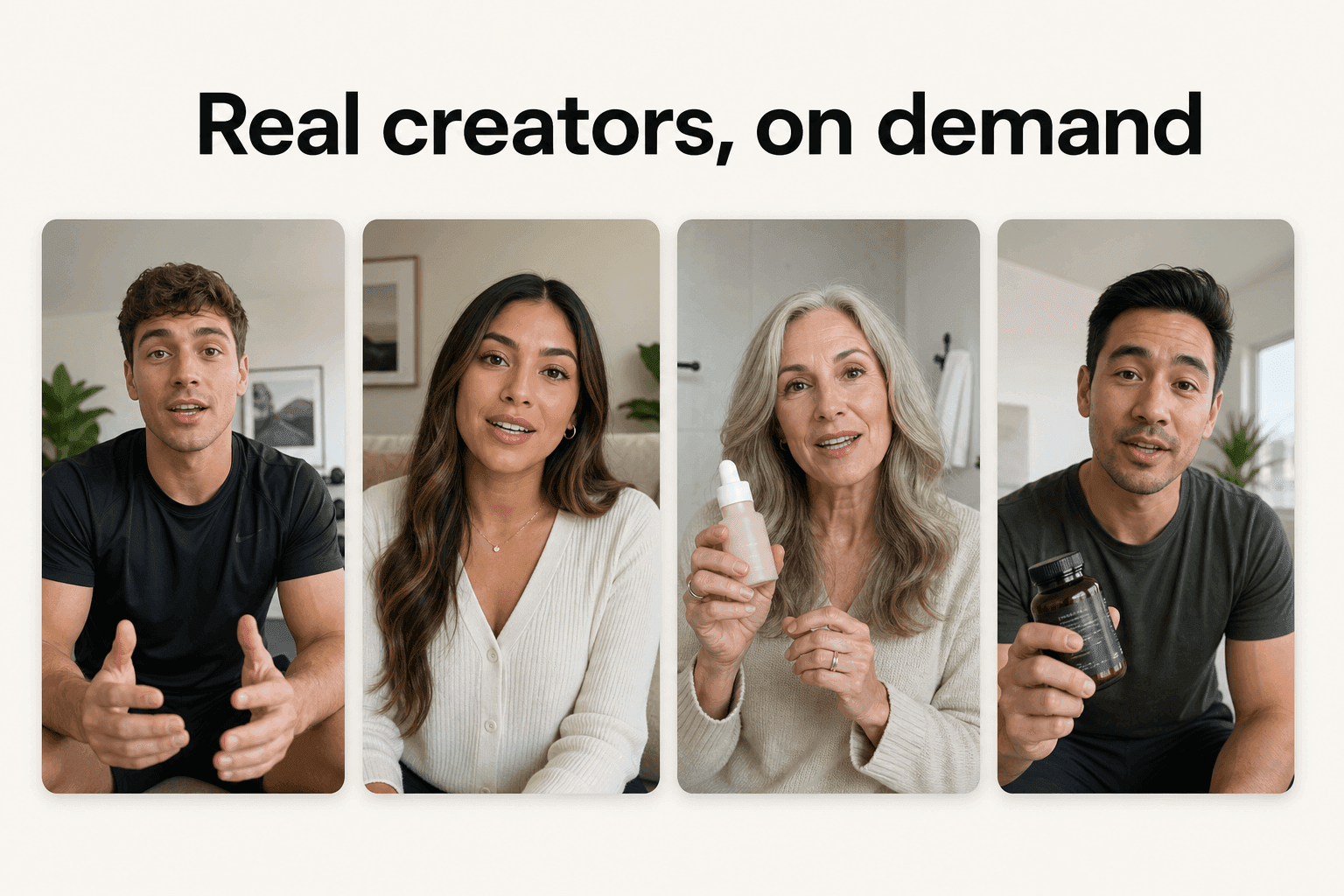
No model picks your angle for you. The decision that a serum ad should open on a tired 6am face instead of a product beauty-shot is a creative judgment, and it is the part that actually moves ROAS with UGC. Meta's suite executes a brief brilliantly. It does not write the brief, and on a platform where the execution is commoditized, the brief is the whole edge. A real-feeling, scripted UGC ad with a distinct actor and a point of view is differentiation the average-seeking generator structurally cannot produce.
A worked example
Put numbers on it. Say you want to test 10 ad angles for a skincare serum and run the winners across Meta and TikTok. Generate them inside Meta's tools and you get 10 variations built for Meta, by the same engine every competitor is using, and they do not leave the platform. Build the same 10 as UGC clips you own and the math changes. A 5-second clip runs about 3 credits, roughly $2, so 10 distinct variations cost around $20 in generation, a fraction of the $200 to $500 a single human creator charges per deliverable. Re-voice the winner for five markets and that is five more generations, not five more shoots. And every one of those files runs on Meta, on TikTok, and on YouTube, because you exported an asset instead of renting a feature.
The One Layer That Stays Yours
If Meta is going to own creation, testing, and launching, the question for an ad maker is simple: what is left to own? The answer is the only layer that has ever really differentiated an advertiser. The creative itself.
A portable asset beats a platform feature
A platform feature works where the platform works. An asset works everywhere you take it. When you generate a UGC ad as a downloadable file, you hold the thing of value: the hook, the actor, the script, the look. You can run it through Meta's optimization and also through TikTok's, and also through a creator partnership, and also in an email. The same idea, many rooms. That portability is why a clear view of the best AI video ad platforms matters more than ever: the tool that makes an asset you keep is worth more than a feature that makes an ad you rent.
One concept, every channel
The channels do not reward the same cut. A TikTok ad wants a faster, scrappier hook than a polished Meta placement. When you own the creative, adapting is a re-edit, not a rebuild. When the creative is locked inside one platform's tooling, every new channel is a fresh start. Owning the asset turns a multi-platform strategy from a series of separate productions into one concept you repackage, which is the whole point of creating UGC ads in the first place.
Native-accent local versions
The clearest example is language. A global advertiser does not want one English master dubbed badly into eight markets. It wants an ad that sounds like a real local creator in each one. That is a creative asset you own and re-voice, not a context signal a single platform fills in for you. Generating the same concept in 30+ languages with real regional accents is the kind of differentiation no in-platform generator hands you, because it is not optimizing your creative, it is replacing it with the average. Take a supplement brand expanding from Mexico into Brazil and Spain: the same 30-second concept, re-voiced by an actor who actually sounds Mexican, then Brazilian, then Castilian, reads as three local creators rather than one dubbed master. That is an asset you own and version, and it runs identically whether Meta, TikTok, or YouTube is delivering it.

How the Two Layers Actually Fit
None of this is a reason to skip Meta's automation. The honest read is that the launch splits the ad job into two layers, and the smart move is to put each in the hands best suited to it. This is not Meta versus you. It is Meta plus you, with a clear line between them.
| Meta's in-platform tools | A creative you own | |
|---|---|---|
| Where it runs | Meta surfaces only | Any platform |
| Who optimizes it | Meta's auction | Each platform's engine |
| What you keep | The invoice | The asset |
| Differentiation | Average-seeking | Your point of view |
| Best at | Delivery and budget | Standing out |
Let Meta optimize the delivery
Meta is genuinely excellent at the media-buying layer: ranking, delivery, budget allocation, finding the next marginal conversion in its own auction. That work is hard, data-hungry, and exactly the kind of thing automation should own. Handing it to Meta's system is not a concession. It is delegation to the party with the most signal. Use it, and use it fully.
Bring your own creative
What you should not delegate is the part that makes the ad recognizably yours. Decide when each layer is doing its job:
- Let Meta's automation drive when the task is delivery: who sees the ad, in what placement, at what budget, optimized against its auction in real time.
- Keep the creative yours when the task is differentiation: the angle, the script, the actor, the look, and the file you can carry to every other channel.
A clean division of labor
Read that way, the launch is clarifying rather than threatening. The commodity layer (production and distribution mechanics) is being automated and priced toward zero, which is good for everyone. The scarce layer (a distinct creative point of view, owned and portable) is the one place an advertiser can still build an edge. The advertisers who lose the next two years are the ones who treat Meta's suite as the whole job and let the platform make every decision for them, because their ads end up indistinguishable from their competitors' ads, fighting for the same impressions with the same average creative. The ones who win treat the automation as a powerful delivery engine and keep their hands on the one input it cannot generate. AI does not erase that line. It sharpens it, the same way it does across the whole toolkit for advertising.
How Novoads Fits Around Meta's Automation
Novoads solves the layer Meta's suite deliberately does not: the creative you keep. It makes a UGC-style video ad you own and can run anywhere, so Meta's automation has something distinct to optimize instead of another average-seeking variation.
Make the asset once, run it anywhere
The flow is built to skip the studio and the editing timeline. Upload a product photo and write or auto-generate a script. Pick an AI actor from more than 100, or, to have the actor hold and present the product on camera, create a custom actor from a photo of someone holding it, since a stock actor's hands are empty. Generate a vertical or horizontal ad with voice, lip-sync, and captions in about four minutes, then download the file. You can build them in Novoads and run the same asset through Meta's optimization, into a TikTok campaign, and onto YouTube, because what you walk away with is a file, not a platform feature.
What it costs and how fast
The cost is concrete rather than estimated. A 5-second clip is about 3 credits, roughly $2, and heavier models land above it: an eight-second Seedance 2.5 clip is about $8 and a full 30-second Seedance 2.5 take about $26, still a fraction of the $200 to $500 a human creator charges per deliverable. You choose the model per spot, the same way you would weigh a new release like Seedance 2.5 against what ships today, so the creative is never bottlenecked on one engine. Make it once, own it, and let every platform's automation compete to deliver it.

Start for $49/month. Cancel anytime. It is a paid plan, not a free tier, and it grants 50 credits a month, which is enough to see your own product in an ad you own rather than in somebody else's demo reel.
Own the creative, rent the distribution
The instinct when a platform automates your whole job is to feel cornered. The better read is that Meta just told you which half of the work is being commoditized. Production and distribution are being automated and priced toward zero, and that is genuinely good news. What is left, the only thing that was ever scarce, is a creative point of view that is recognizably yours and that you can carry anywhere. Let Meta run the delivery. Own the asset that makes the delivery worth running.
Frequently Asked Questions
What did Meta actually announce?
On June 24, 2026, Meta unveiled an end-to-end suite of AI advertising and marketing tools that, in TechRadar's words, takes care of creation, testing, and launching. Meta frames it as letting advertisers stop worrying about running ads, and says advertisers are already seeing 4x ROI. On its own newsroom, Meta describes going all in on using AI to make it easier for businesses to launch and improve their ad campaigns.
Does Meta's AI replace my creative team?
No. It automates production and delivery inside Meta: generating creative, testing variations, and pushing them into the auction. It does not decide your angle, your offer, or what makes your brand recognizable. Differentiation is still a human and creative job, and on a platform where everyone uses the same generator it matters more, not less.
Can I run Meta's AI-made ads on TikTok or YouTube?
Meta's in-platform tools are built to create and optimize ads for Meta's own surfaces. A creative asset you generate and own is different: you export the file and run the same idea on Meta, TikTok, YouTube, or anywhere else, instead of rebuilding it per platform.
Is the 4x ROI number reliable?
Treat it as directional. The 4x figure is Meta's own reported result, relayed by TechRadar, not an independent audit. Vendor-reported ROI is useful as a signal that the automation works for many advertisers, but your own result depends on your offer, creative, and margins, so measure it against your numbers, not the headline.
Where does Novoads fit alongside Meta's automation?
Novoads is the creative layer you own. You make a UGC-style video ad once (your script, your AI actor, your product on camera) and download a file you can run on any platform. Meta's tools then optimize how it gets delivered. The two are complementary: own the creative, let the platform handle distribution.
How much does an AI UGC ad cost to make?
It depends on the model. On Novoads a 5-second Seedance clip is about 3 credits, roughly $2, while heavier models like Veo or a one-minute talking actor run closer to $7. The range is from about a dollar for a five-second Seedance 2.0 Mini clip to about $8 for an eight-second Seedance 2.5 clip, and about $26 for a full 30-second Seedance 2.5 take, still a fraction of the $200 to $500 a human UGC creator charges per deliverable. The entry plan is $49/month, and you can cancel anytime.
Key Takeaways
- On June 24, 2026, Meta announced an end-to-end suite of AI advertising and marketing tools that handles ad creation, testing, and launching, and Meta says advertisers are already seeing 4x ROI.
- The automation lives inside Meta: those ads are generated, optimized, and run within Meta's own platform and auction, not as assets you can carry to another channel.
- When every advertiser uses the same in-platform generator, creative drifts toward sameness. A distinct, real-feeling UGC ad is still the thing that stops the scroll.
- The creative you own is portable. One concept, re-voiced in native accents, can run on Meta, TikTok, and YouTube, while a platform feature only optimizes for that platform.
- Use both. Let Meta's automation optimize delivery, and bring your own creative made in Novoads: upload a product photo, write or auto-generate a script, and ship in 30+ languages from about $2 a clip.