
Creative Fatigue: Meta's 2x Cost Signal, TikTok's Refresh Triggers, and What to Change
Creative fatigue is an audience seeing the same ad too many times. Here is how Meta's Creative limited and Creative fatigue statuses, frequency and TikTok's refresh triggers flag it, and what to make next.

Mauricio Valdivia
·11 min

When your best ad costs twice what it used to
Picture a skincare brand's best UGC video, six weeks into its run. Same script. Same creator. Then the Delivery column in Meta Ads Manager starts to read Creative fatigue. On eligible ad sets, Meta's Business Help Center says, as of September 2026, that it shows that status once the audience has seen an ad too many times and its cost per result is more than or equal to twice as much as ads you ran in the past.
Meta's Business Help Center defines the problem in one line: "Creative fatigue occurs when an audience has seen the same creative too many times." People may be less likely to engage with the ad, Meta adds, "which can lead to a higher cost per result." Marketers also call it ad fatigue, and Meta's own frequency article uses that phrase.
A lot of fatigue advice runs on rules of thumb: a frequency number, a day count, a gut feeling that the ad has gone stale. Start from the platforms instead. Meta and TikTok both document how they spot a tiring ad and what they want you to do about it. This guide reads those signals as the platforms write them, as of September 2026, then turns them into a refresh playbook for video ads.
What creative fatigue is, in the platforms' own words
Exposure is the cause, cost is the symptom
Meta's definition has two parts, and the order matters. The cause is exposure: the audience "has seen the same creative too many times." The symptom is cost: lower engagement that "can lead to a higher cost per result."
That split is the whole diagnosis. A rising cost per result on its own can come from the auction, the offer, a seasonal dip or a broken landing page. Rising cost together with heavy repeat exposure to the same image or video is the pattern Meta calls fatigue. Keep both halves in view and you will stop refreshing ads that were never tired.
Two names, one complaint
"Ad fatigue" and "creative fatigue" get used interchangeably, and Meta uses both. Its Ads Manager article is titled "About creative fatigue recommendations in Meta Ads Manager." Its frequency article says: "If performance begins to drop as your frequency numbers rise, your target audience may be experiencing ad fatigue, and it may be wise to change your ad creative or targeting."
Note the last clause. Meta names two levers, the creative and the targeting, and the playbook later in this guide uses both.
Look-alike ads are a separate problem with a separate fix. Meta draws the line in one sentence: "fatigue is about overexposure, while similarity is about a lack of visual diversity." Our guide to creative diversity in Meta ads covers similarity; this one stays on fatigue.
How Meta flags fatigue in Ads Manager
Before launch: a seven-day forecast
Meta's first signal can arrive before you spend anything. Its help article says: "If we predict creative fatigue may occur in the first 7 days of your campaign, we will warn you before you publish your ad."
Take that warning seriously when you relaunch a video that already ran elsewhere on your Page. A new campaign does not give an old video a clean slate, for the reason in the next section.
After launch: two statuses in the Delivery column
Once a campaign is active, Meta says: "When we believe that your audience has seen the same ad too many times, you will see Creative limited or Creative fatigue in the Delivery column status for your ad set or ad." It names two inputs to that judgment.
- Exposure. "We consider all recent exposures of the ad's image or video, including those from other campaigns from your Page."
- Cost. Meta also considers the ad's cost per result, and grades it against your history in two tiers.
The tiers, in Meta's words as of September 2026:
- Creative limited: "When cost per result is more than ads you ran in the past but less than twice as much, you will see a Creative limited status."
- Creative fatigue: "When cost per result is more than or equal to twice as much as ads you ran in the past, you will see a Creative fatigue status."
So the 2x figure is one input next to exposure, not a standalone trigger. A cost spike on a video your audience has barely seen is a different problem.
Who sees these statuses, and who does not
The statuses are not universal. Meta's article opens with the limit: "This feature is only available for ad sets with one creative except those with Advantage+ catalog ads (previously dynamic ads), dynamic creative, or Meta Advantage+ app campaigns." It adds: "It is not available with the sales objective before an ad set is active."
If you run several creatives in one ad set, or dynamic creative, you will not get the label. You still get the underlying numbers, which is where the next two sections come in. Meta's help pages are living documents, so treat every threshold here as current as of September 2026.
The baseline is your own history, not an industry number
What "ads you ran in the past" changes
Meta's threshold is relative. Both tiers compare the ad's cost per result against "ads you ran in the past," the advertiser's own record, not a category benchmark.
That has two consequences. A brand with cheap history gets flagged at a lower absolute cost than a brand with expensive history. And no benchmark from a blog post can tell you whether your ad is fatigued. Benchmarks like the ones in our video ad benchmarks roundup tell you where you stand against other advertisers; Meta's fatigue status tells you where you stand against yourself.
Worked example: one cost per purchase, two verdicts
Take two hypothetical DTC brands on eligible single-creative ad sets. Both now pay $50 per purchase on their top video.
- Brand A (a serum). Its past ads bought a purchase for about $24. Twice that is $48, so $50 sits in the tier Meta calls Creative fatigue.
- Brand B (a protein powder). Its past ads bought a purchase for about $60. At $50 it is paying less than its own history, so the cost input alone puts it in neither tier.
Same $50, opposite readings. The arithmetic is ours, built from Meta's two sentences, and it only shows where the tiers fall. Meta runs its own comparison and also weighs exposure, so use your trailing cost per result as a working reference, not a prediction of the day the label flips.
Why there is no magic frequency number
Frequency is the metric people most often turn into a cutoff. Meta's frequency article describes a range instead: "Frequency may average 1 to 2 per ad set or may be much higher, depending on your budget, audience size and schedule."
A range that depends on budget, audience size and schedule is not a trigger. If you see a single frequency figure presented as the fatigue line, check whose figure it is. The Meta pages this guide cites describe a range and a trend, not a line.
The numbers that move before the label does
Frequency, read next to results
Frequency: impressions divided by reach. Meta's wording is "Frequency is calculated as the number of impressions divided by the reach," and it flags the metric as estimated.
Meta's instruction is to read it in company, not alone: "it's important to monitor frequency along with your results and ad relevance diagnostics to make sure that no Meta Account is seeing your ads too often during a campaign." A frequency line that climbs while cost per result holds is an ad still finding people. A frequency line that climbs while cost per result climbs with it is the shape Meta describes as fatigue.
If you track hook rate, put it on the same chart. It is the attention-side view of the same question: are people still stopping for this video?
Ad relevance diagnostics: which part to fix
Meta's ad relevance diagnostics rank each ad on three things against ads competing for the same audience:
- Quality ranking: perceived quality.
- Engagement rate ranking: expected engagement rate.
- Conversion rate ranking: expected conversion rate, against ads with the same optimization goal.
Meta says the diagnostics help you "understand whether adjustments to your creative assets, post-click experience or audience targeting could improve performance." They "aren't available for ads with fewer than 500 impressions." Our reading: a slipping engagement ranking points at the creative, while a conversion ranking that lags an engagement ranking that holds points past the ad, at the landing page or the offer. A new video will not fix the second case.
Opportunity score: Meta's own recommendations
Meta routes its fatigue advice through opportunity score. The fatigue article says: "When eligible, you can get experimentally proven creative fatigue recommendations in opportunity score." The opportunity score article describes a score on a 0 to 100 point scale that "represents how optimized your campaigns, ad sets and ads are."
"Experimentally proven" is Meta's description of its own tool. The same article says the score "does not reflect your actual or future performance," and that "Opportunity score is in development and may evolve." Treat it as a queue of suggestions to consider, not a verdict on the ad.
How TikTok tells you to spot and refresh fatigue
Two triggers, no numbers
TikTok's creative best practices article, last updated June 2025, frames fatigue as a trend: "We recommend checking ad performance regularly and refreshing your ad group creatives when delivery results exhibit a consistently declining trend, or when daily new users are low."
Neither trigger comes with a number in that article, so do not borrow Meta's 2x rule for TikTok. It is Meta's rule, for Meta's statuses. A named fatigue status in TikTok Ads Manager was not found on the TikTok help pages we checked (the creative best practices and Smart Creative articles); that is not evidence TikTok has none.
Refresh inside the ad group, not beside it
TikTok is specific about where new work goes: "When refreshing creatives, add new creatives to an existing ad group instead of creating a new ad group to extend its lifetime."
The same article sets the supply side. It suggests 3 to 5 different creatives per ad group and 3 to 5 diversified ad groups per campaign, adds that "it is always better to use creatives with big differences, especially when testing," and says "Having a consistent supply of creatives to refresh is one way to keep your campaigns going."
Smart Creative's automatic refresh
TikTok also sells automation for the problem. Its Smart Creative article, last updated November 2025, describes "a TikTok automated creative solution that optimizes ad creative combinations through ad group fatigue detection and auto-refresh strategies." It works in three steps:
- Combination. It combines videos or images, text and call-to-action into multiple ad variations.
- Selection. It first prioritizes "the most differentiated videos as assessed by scene similarity," observing them for 3 to 5 days and "allocating no more than 10% of the ad group's total budget."
- Anti-fatigue refresh. It pauses initial videos that show signs of fatigue within the first 3 to 5 days and puts new videos on a waiting list to replace them.
Two limits matter. The page lists traffic, app promotion, conversion and lead generation as the supported objectives, and split tests as "Not supported yet." It also notes that "Select advertisers may see a new version of this solution called Automate Creative," so what you see in your account may carry a different name.
Meta and TikTok side by side
The comparison below uses only the pages cited in this guide: Meta's creative fatigue and frequency articles, and TikTok's creative best practices and Smart Creative articles.
| Meta | TikTok | |
|---|---|---|
| Named status | Creative limited, Creative fatigue | Not found on pages checked |
| Performance trigger | Cost per result vs your past ads | Consistently declining delivery results |
| Audience signal | Recent exposures of image or video | Low daily new users |
| Pre-launch warning | Fatigue predicted in first 7 days | Not on pages checked |
| Automated option | Advantage+ creative | Smart Creative |
| Tired ad | Keeping it active may maximize results | Add new creatives to the existing ad group; Smart Creative (opt-in) pauses initial videos that fatigue in its first 3 to 5 days |
| Page date | Read September 2026 | Updated June and November 2025 |
The last two rows are the ones to remember. Meta's article leans toward keeping the original ad running and adding a new one beside it, and TikTok's manual advice has the same shape: add new creatives to the existing ad group. Only TikTok's Smart Creative pauses videos on its own, and only the initial videos it is observing in its first 3 to 5 days.
A refresh playbook for fatigued video ads
Step 1: confirm it is fatigue
Before you brief anything, check the diagnosis against the signals above:
- Meta, eligible ad set: is the Delivery column showing Creative limited or Creative fatigue?
- Meta, any ad set: is frequency rising while cost per result rises with it?
- Meta, any ad with 500+ impressions: is the engagement rate ranking slipping, or only the conversion rate ranking?
- TikTok: are delivery results in a consistent decline, or are daily new users low?
If the answer points past the ad, fix the offer or the page first. Then judge the refresh on the business number as well as the platform one: marketing efficiency ratio shows whether total revenue moved, not just the ad's cost per result.
Step 2: on Meta, add before you cut
Meta's fatigue article lists three recommendations it may give, "Depending on your ad setup":
- Create another ad. "Create a new ad with a new image or video that is materially different from the original creative." Meta attaches a note: "Keeping your original ad active instead of pausing or turning it off may maximize results."
- Expand your audience. "Increase your audience size and reach new people who have not seen your ad too much yet."
- Try Advantage+ creative. Meta says it "automatically creates variations of your ad using a single image or video," and that it "is only available for campaigns using the traffic or sales objectives with website destination."
The first one carries the weight. "Materially different" is the phrase to take literally: a new edit of the same shot is still the same creative to an audience that has seen it too often. Our guide to repurposing winning ads turns the four changes Meta's creative-fatigue lesson names into briefs: "You can highlight a different product benefit, show a new use case, offer a fresh perspective or feature different people and situations in your ads."
Step 3: on TikTok, refresh in place
TikTok's version of the playbook is shorter:
- Add, do not rebuild. New creatives go into the existing ad group, per TikTok's own instruction.
- Keep a library. TikTok suggests "maintaining a library of creative assets" so new versions are quick to assemble.
- Automate where it fits. TikTok tells advertisers to "Consider Smart Creative for a more hands-off approach to managing creative fatigue," within the objectives it supports.
Every one of those steps assumes the next video already exists. Advantage+ creative and Smart Creative both work from assets you supply, so the materially different video still has to come from you. That supply is the real constraint. Our guide to how many ad creatives you need covers the volume side.
How Novoads solves the creative supply problem behind fatigue
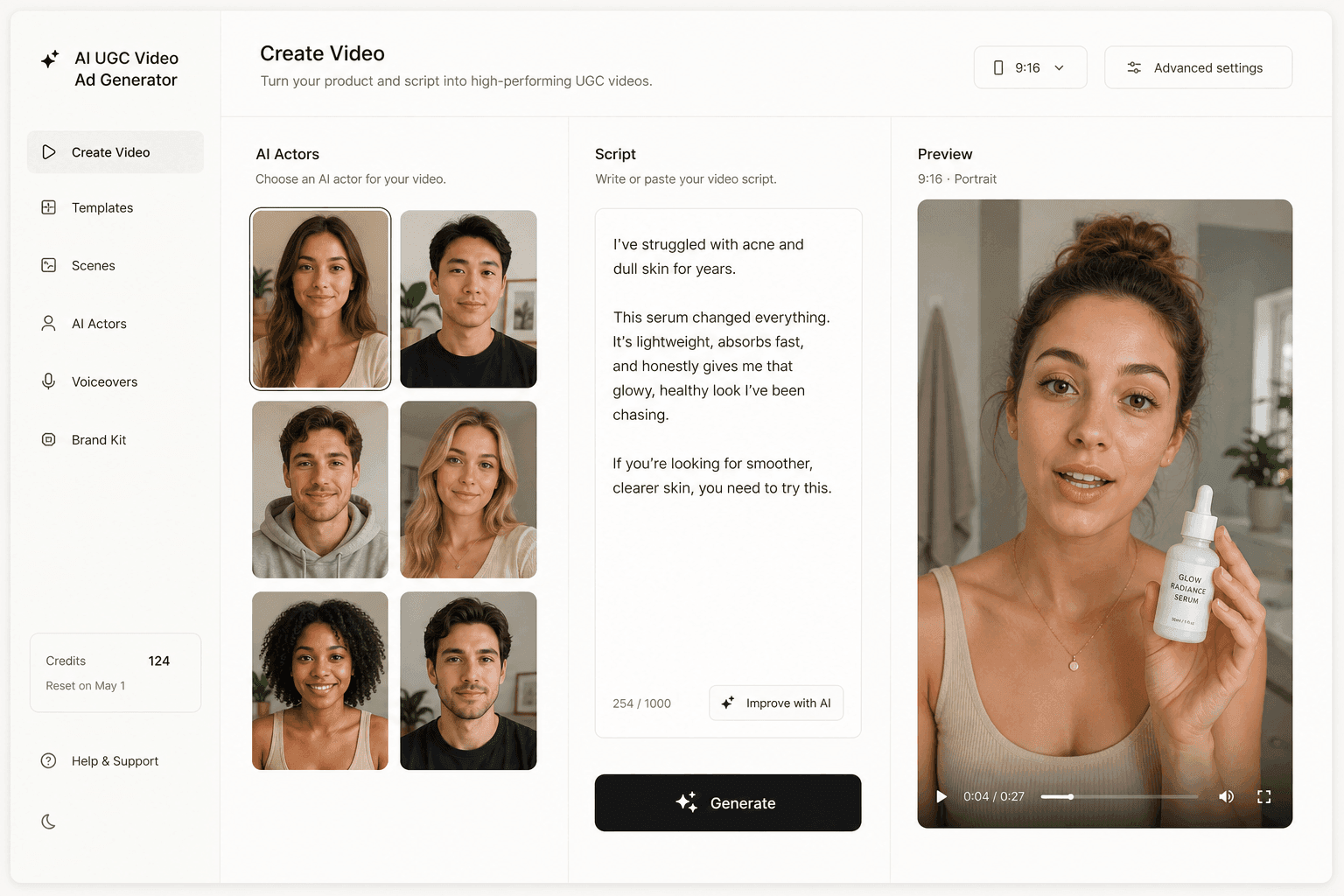
Novoads is an AI UGC video-ad generator: upload a product image or write a script, pick an AI actor, and get an ad-ready video.
That maps onto the refresh playbook directly. Meta asks for a new video that is materially different from the tired one, and the fastest visible differences in a UGC ad are the person on screen, the setting and the opening line. With a shoot, each of those is a new booking. In Novoads, it is a different actor, a new script and another render, on video engines that include Seedance 2.5, Google Veo 3.1 and Kling v3 Pro. So you can keep the next three concepts in the queue before the Delivery column changes.
Plans and credits are listed on the pricing page.
The platform tells you when, you decide what comes next
Creative fatigue is not a mystery and not a failure. Meta prints its thresholds, TikTok prints its triggers, and both point to creative that is genuinely different rather than more of the same. What neither platform prints is the next video. Build that before the label appears, because the platforms will tell you when an ad is tired, but only you decide what your audience sees next.
Frequently Asked Questions
What is creative fatigue?
Meta's Business Help Center says creative fatigue occurs when an audience has seen the same creative too many times. People may be less likely to engage with the ad, which can lead to a higher cost per result. Marketers also call it ad fatigue, and Meta's own frequency article uses that phrase.
What is the difference between Creative limited and Creative fatigue in Meta Ads Manager?
As of September 2026, Meta's help article says that once it believes an audience has seen the same ad too many times, it shows Creative limited in the Delivery column when cost per result is more than ads you ran in the past but less than twice as much, and Creative fatigue when cost per result is more than or equal to twice as much. The comparison is against your own past ads, not an industry benchmark, and Meta also considers recent exposures of the ad's image or video. The statuses are only available for ad sets with one creative, excluding Advantage+ catalog ads, dynamic creative and Advantage+ app campaigns.
Is there a frequency number that means an ad is fatigued?
The Meta pages cited in this guide describe a range and a trend, not a cutoff. Meta's frequency article says frequency may average 1 to 2 per ad set or may be much higher, depending on budget, audience size and schedule, and that if performance begins to drop as frequency rises, the audience may be experiencing ad fatigue. Read frequency next to your results rather than against a fixed number.
Should I pause an ad that shows creative fatigue?
Meta's creative fatigue article recommends creating a new ad with a new image or video that is materially different from the original, and notes that keeping the original ad active instead of pausing or turning it off may maximize results. Its other suggestions are expanding the audience and trying Advantage+ creative. On TikTok, the creative best practices article says to add new creatives to the existing ad group. Advertisers who choose Smart Creative (page last updated November 2025) get a feature that pauses initial videos showing signs of fatigue within its first 3 to 5 days.
How does TikTok handle creative fatigue?
TikTok's creative best practices article, last updated June 2025, recommends refreshing ad group creatives when delivery results show a consistently declining trend or when daily new users are low, and adding the new creatives to the existing ad group instead of creating a new one. Its Smart Creative feature, described on a page last updated November 2025, detects ad group fatigue and refreshes creatives automatically. Select advertisers may see a newer version called Automate Creative.
Is ad fatigue the same as creative fatigue?
In practice, yes. Both describe an audience that has seen the same ad too often and responds less. Meta uses 'creative fatigue' for its Ads Manager status and recommendations, and 'ad fatigue' on its frequency article, where it says it may be wise to change the ad creative or targeting.
Key Takeaways
- Meta's Business Help Center defines creative fatigue as an audience that has seen the same creative too many times, which can lead to a higher cost per result. Exposure is the cause; cost is the symptom.
- As of September 2026, Meta says Ads Manager shows Creative limited when cost per result is above ads you ran in the past but under twice as much, and Creative fatigue at twice as much or more. The baseline is your own history, and Meta weighs it alongside recent exposures of the image or video.
- The statuses only cover ad sets with one creative, not Advantage+ catalog ads, dynamic creative or Advantage+ app campaigns, and not the sales objective before an ad set is active. Everyone else reads frequency and cost per result directly.
- TikTok says to refresh when delivery results show a consistently declining trend or when daily new users are low, and to add new creatives to the existing ad group. Its Smart Creative observes new videos for 3 to 5 days on no more than 10% of the ad group's budget.
- Meta's fatigue article says keeping the original ad active instead of pausing it may maximize results. Add a materially different video beside the tired one; the supply of new videos is the real constraint.