
ChatGPT Ads Conversion Bidding: You Set a CPA Bid, OpenAI Still Charges Per Click
Conversion-optimized campaigns in ChatGPT Ads optimize delivery toward one tracked event while billing stays per valid click. Here is what the CPA bid controls, what has to be live before you can use it, and the cost math OpenAI leaves to you.

Mauricio Valdivia
·11 min

The bid you set is not the bill you pay
A media buyer opens ChatGPT Ads Manager, switches a campaign to the conversions objective, and types a target cost per purchase into the bid field. Then the spend report comes back counted in clicks. Nothing broke. That is the design.
Conversion-optimized campaigns, oCPC in OpenAI's shorthand, change what the auction chases without changing what you are charged for. The system pushes delivery toward one conversion event you select. Billing stays exactly where it was, at whatever price the auction lands on for each valid click. The CPA number you typed is an instruction to the optimizer, not a price you agreed to pay, and OpenAI puts that in the plainest available language: "Treat the CPA bid as an optimization input, not as a conversion charge."
That one sentence is the whole feature. Everything else follows from it: which prerequisites are non-negotiable, which setup decisions are permanent, and which arithmetic the platform leaves on your desk. Ads inside ChatGPT went from an announcement to a self-serve auction with a conversions objective quickly enough that a lot of the coverage is already describing a product that changed underneath it, so it is worth being precise about which parts are real.
What an oCPC campaign actually changes
The three goals, side by side
ChatGPT Ads campaigns run on one of three goals, and OpenAI's own guide lays them out as a single decision table.
| Goal | Best for | How you pay | What delivery optimizes for |
|---|---|---|---|
| Impressions (CPM) | Reach and awareness | Per 1,000 impressions | Broad delivery at scale |
| Clicks (CPC) | Engagement and traffic | Per valid click | Clicks from likely engagers |
| Conversions (oCPC) | A tracked action after a click | Per valid click | Clicks likely to convert |
The third row is where the misreading happens, which is why OpenAI spells out the billing basis inside the table itself: "Per valid click, not per conversion." Two of the three goals bill on clicks. If you have bought media on CPM and on CPC before, the conversions objective is not a third pricing model. It is the CPC model with a smarter targeting instruction attached.
What the CPA bid controls
Mechanically, an oCPC campaign is created with bidding_type set to conversions and one conversion event setting attached. Its ad groups are then created with the billing event type set to click, and the bid value goes into a field called max_bid_micros. That field is where the confusion is manufactured, and OpenAI defuses it directly: for an oCPC campaign, max_bid_micros "is the CPA bid even though billing uses valid clicks."
So the number does real work. It just does not do the work instinct assigns it. It tells the auction how hard to compete for the clicks the system predicts will end in your chosen event. OpenAI describes the inputs behind that prediction as your selected conversion event "together with ad quality, relevance, click likelihood, and conversion likelihood." Your creative and your relevance are half of that list.
What does not change at all
Billing. The docs repeat the point three separate times, in the subtitle, in the body and again in the FAQ, which is usually a sign a platform has watched people get it wrong: "OpenAI charges you only when a valid click occurs, and the auction determines the actual CPC."
Two consequences worth stating before you set a budget:
- A campaign that produces zero conversions still spends its full budget on clicks.
- A click that buys and a click that bounces cost you the same amount.
That is not a criticism of the design. Every major auction works this way, and it is the honest trade for having a system predict intent on your behalf. It just means the risk of a bad landing page or a weak offer stays entirely with you.

What has to be true before you can turn it on
Three conditions gate the objective, and OpenAI lists all three on the same page. Check them in this order, because each one fails in a different place:
- Account enablement. Conversion bidding has to be switched on for the ad account, or campaign creation is rejected outright.
- Live measurement. Conversions have to be flowing through the JavaScript Pixel, the Conversions API, or both.
- One qualifying goal. Exactly one active standard conversion event, connected to one active conversion source in the same ad account.
Tracking has to be live first
An optimizer cannot chase a signal it never receives. OpenAI requires conversion tracking to be running before an oCPC campaign will work, through the JavaScript Pixel, through the server-side Conversions API, or through both. The docs also state a preference between them: "The Conversions API is a more reliable tracking source than the pixel alone." Server-side events do not get eaten by ad blockers or cookie restrictions, which is the same reason other platforms have pushed advertisers toward server-side measurement.
There is also an account-level gate that is easy to hit and hard to diagnose. If the account does not support conversion bidding, campaign creation returns a 403 carrying the message "Conversion bidding is not enabled". The fix for that one is a conversation with OpenAI, not a setting you can flip. The Advertiser API is built around approved partners in the first place, and OpenAI's own framing assumes it: "API partners should use the key associated with the client account they are configuring."
Exactly one standard event, and only one
This is the constraint that shapes your account structure. OpenAI's requirement reads: "You have exactly one active standard conversion event to use as the optimization goal. Custom events cannot be oCPC optimization goals."
One event. Not a weighted basket, not a primary with fallbacks, and nothing you defined yourself. Standard events cover the usual commercial outcomes such as an order created, a lead created or a registration completed, so the practical work is deciding which single moment in your funnel is the outcome worth buying. If your cost per acquisition is calculated on purchases but your campaign optimizes toward registrations, the auction will get very good at something you are not measuring.
The decisions you cannot undo
More of this setup is permanent than most ad platforms would leave permanent, so it is worth listing:
- The goal and the selected conversion event are fixed. In OpenAI's words, "you cannot change the goal or event after campaign creation."
- The bidding model is fixed too. The Campaigns API reference states you cannot update
bidding_type. - An existing CPM or CPC campaign cannot be converted. You create a new campaign.
- Product-feed campaigns can now use oCPC. This one changed after publication: OpenAI's product-feed documentation states that "oCPC is in open beta for both standard and product-feed campaigns," and documents setting
bidding_typetoconversionson a product-feed campaign. If your catalog campaigns are the ones you most want optimized toward purchases, that route is open.
Read together, these turn campaign naming and structure into a decision you make once. Build a separate campaign per conversion event you care about, and expect to rebuild rather than retune when the goal changes.
The math the platform leaves to you
The number nobody reports for you
ChatGPT Ads reporting covers impressions, clicks, conversions, spend, click-through rate and average CPC. Cost per conversion is not in that list. OpenAI hands the calculation back: "You can calculate cost per conversion by dividing spend by conversions."
That sounds like a footnote. It is the entire scoreboard for this bidding model, because the metric you bid in and the metric you are billed in are different, and only the division reconciles them. The same gap between a reported number and a decidable one is why creative testing needs its own protocol rather than a glance at platform reporting.
A worked example at 1,000 clicks
ChatGPT Ads launched CPC buying with a recommended starting maximum bid of between $3 and $5 per click, so take the low end and run three scenarios on the same thousand clicks.
- Before optimization. 1,000 clicks at a $3 CPC is $3,000 of spend. A 2% conversion rate gives 20 sales, so spend divided by conversions is $150 per sale. A $100 CPA bid did nothing to prevent that, because it was never a cap.
- The optimizer earns its keep. Same $3 CPC and the same $3,000, but delivery now favors clicks more likely to convert and the rate climbs to 3%. Thirty sales. Cost per conversion drops to $100, which is the outcome the feature exists to produce.
- The case to watch for. The optimizer competes harder for better clicks and the auction charges $4 for them. Now 1,000 clicks costs $4,000, the 3% rate still gives 30 sales, and cost per conversion is $133. Conversion rate improved. Cost per conversion got worse.
That third case is not a malfunction. It is what happens when a system bidding on quality wins more expensive inventory, and it is invisible if you are watching conversion rate alone.
The metric that actually moves
Watch cost per conversion week over week, and read it against your break-even rather than against last month's CPC. Three readings cover almost every case:
- CPC up, cost per conversion down. The optimization is doing its job. Paying more per click is simply the price of better clicks.
- CPC flat, cost per conversion up. Traffic quality slipped, or the landing page did. The auction is not where to look.
- CPC down, cost per conversion up. The most reassuring dashboard and the most misleading one. Cheaper clicks that do not buy are not a saving.
This is the same trap that makes a high click-through rate look like proof an ad works when it is proof of nothing on its own. If you are not already tracking outcomes down to margin, the metric ladder in creative analytics is the structure to borrow, and your ROAS break-even floor is the number that decides whether a $133 sale is good news.

The API is narrower than the coverage
What the changelog actually dates
Trade coverage has a habit of bundling several weeks of platform changes into one announcement-shaped story. OpenAI's Ads API changelog is a colder read, and it is the only surface that dates this feature at all. Conversion bidding appears there as one dated line, on June 16th, 2026: added conversion-optimized campaign bidding, with bidding_type set to conversions and one standard conversion event setting. Reporting from late May had already described the rollout plan, with any account that had conversions configured by June 1 receiving early access by June 5.
The most recent dated entry is narrower still: "July 16th, 2026 Added support for passing the Pixel browser reference as events[].user.obref in Conversions API requests." A measurement field, not a bidding change. The oCPC guide page itself carries no publish or updated stamp anywhere on it, which is why the changelog, and not the guide, is the thing to check when you need to know how old a capability is.
Location targeting is an include list
OpenAI's Campaign Targeting page defines the whole targeting surface in two sentences: "Use campaign targeting to control where your ads can deliver. OpenAI Ads supports country, region, and DMA targeting." What that means in practice:
- The targetable set is country, region and DMA, each resolved to a numeric location ID through a geo lookup endpoint.
- Those IDs go into a single include array on the campaign, and the Campaigns API field table lists the same include parameter with no exclusion counterpart.
- Skipping targeting is not neutral. In OpenAI's words, "If you do not provide location targeting, the campaign can target all available locations."
As of this writing, the Advertiser API documents inclusion only, and that distinction matters more than it sounds, because an interface and an API are different products shipping on different schedules. Whatever controls you find in Ads Manager, the API is what your scripts inherit, and it is the only surface with a published contract.
Why this matters if you are automating
Treat the documented API as the floor of what is guaranteed and the interface as a preview of where the platform is heading. Three habits follow from that:
- Build campaign automation against the changelog, not against a screenshot of the interface.
- Keep a manual path for anything the API does not expose yet, and label it as manual so nobody assumes the script covers it.
- Re-read the field tables before you assume a control exists just because you clicked one last week.
That discipline is the difference between a build that survives the next release and one that quietly stops matching what buyers set up by hand. It is the same operational hygiene that keeps scaled campaigns from breaking ROAS when a platform moves under them.
Where conversion bidding pushes the work
An optimizer needs something to choose between
Look again at the inputs OpenAI names: the conversion event, ad quality, relevance, click likelihood, conversion likelihood. You control exactly two of those, and they are the same two: what the ad says and how well it matches the moment. A conversion objective cannot rescue a weak offer. It can only find the people most likely to accept the one you already have.
That is the real shift when any auction gets a conversion objective. The bidding lever stops being where the leverage is, because the platform is now doing that part better than you can by hand. What is left is supply: how many genuinely different angles you can put into the auction for it to sort.
Clicks that convert start before the click
A conversion-optimized system is trained on what happens after the click, which means your landing page is quietly part of your bid. An ad that overpromises buys clicks that never convert, teaches the optimizer that your traffic is bad, and gets you less delivery at a higher price. Tightening that loop costs nothing:
- Say the same offer in the ad's closing line and on the page's first screen.
- Keep the conversion event you selected within one action of the landing page, not three.
- Retire any ad whose best-performing hook promises something the page does not actually sell.
The volume problem this creates
One ad gives an optimizer nothing to optimize. Three near-identical ads give it almost nothing. Platforms that reward conversion signals reward accounts that can feed several honestly different creative angles into the same campaign and let delivery sort out which one earns the impressions. That is why self-serve split testing keeps showing up across ad platforms, and why UGC-style ads tend to survive this kind of sorting: they are cheap enough to make in variants, and they carry a specific claim a real buyer can act on.
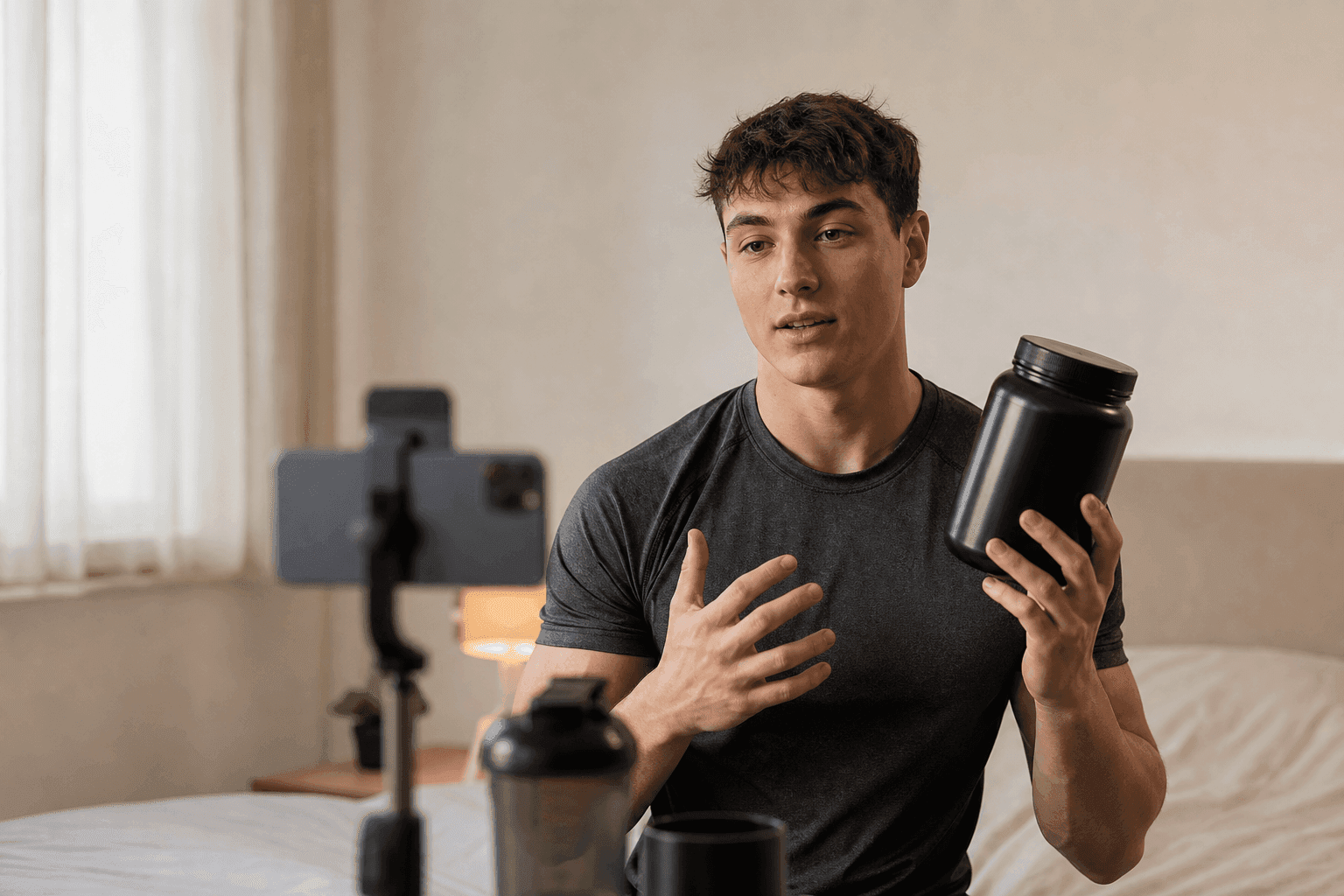
How Novoads solves the creative supply problem behind conversion bidding
Novoads generates ad-ready UGC-style video from the assets you already have. Upload a product image or write a script, pick an AI actor, and you get a vertical video you can download and upload to any ad platform, including the campaigns you are optimizing toward conversions. The point is not one hero video. It is being able to put several genuinely different angles into an auction that is now good enough to tell you which one converts, instead of shipping the single ad your production budget allowed.
You can try it from $49/month on the Inicial plan. Cancel whenever you want.
Bid on the outcome, budget for the click
Conversion bidding in ChatGPT Ads is a genuinely useful upgrade with a name that oversells it. The auction now optimizes for something closer to your business outcome, and the invoice still arrives measured in clicks. Read the CPA field as a steering input, keep your budget planning in click math, and divide spend by conversions every week to find out which story is true. The platform got better at picking who sees your ad. It has no opinion at all about whether the ad is worth seeing, and that half of the job did not move.
Frequently Asked Questions
Does ChatGPT Ads charge per conversion in a conversion-optimized campaign?
No. OpenAI's documentation is explicit that billing does not change to pay per conversion. You are charged only when a valid click occurs, and the auction determines the actual CPC. The conversions objective changes which clicks the system tries to win, not the unit you are billed in.
What is the CPA bid for, if OpenAI bills per click?
It tells the optimizer how aggressively to compete for clicks it predicts will lead to your selected conversion event. You set it at the ad group level in the max_bid_micros field, and OpenAI describes that value as the CPA bid even though billing uses valid clicks. It is an optimization input, not a price guarantee.
What do I need before I can run a conversion-optimized campaign?
Three things. The ad account has to support conversion bidding, or campaign creation returns a 403 saying conversion bidding is not enabled. Conversion tracking has to be running through the JavaScript Pixel, the Conversions API, or both, and OpenAI notes the Conversions API is a more reliable tracking source than the pixel alone. And you need exactly one active standard conversion event to serve as the optimization goal.
Can I switch an existing ChatGPT Ads campaign to conversion bidding?
No. OpenAI's docs say you cannot change an existing CPM or CPC campaign to oCPC, and the Campaigns API reference states you cannot update bidding_type. You create a new campaign with bidding_type set to conversions. The same permanence applies to the goal itself: the selected conversion event cannot be changed after campaign creation.
Can product-feed campaigns use conversion bidding?
Yes, as of August 2026. This changed after the post was first published: OpenAI's product-feed documentation now states that oCPC is in open beta for both standard and product-feed campaigns, and documents setting bidding_type to conversions on a product-feed campaign. When this post first ran, the documentation said the opposite.
How do I know whether conversion bidding is working?
By dividing spend by conversions. OpenAI points advertisers to exactly that calculation, because the platform reports impressions, clicks, conversions, spend, click-through rate and average CPC, and leaves cost per conversion to you. Average CPC on its own will not tell you whether the optimization is paying for itself.
Key Takeaways
- Conversion-optimized campaigns (oCPC) change what the auction chases, not what you are billed for. OpenAI's docs state that billing does not change to pay per conversion and that you are charged only when a valid click occurs.
- The CPA figure you enter goes in the ad group's max_bid_micros field, and OpenAI describes it as the CPA bid even though billing uses valid clicks. It is an input to the optimizer, not a ceiling on what a sale costs you.
- Prerequisites are strict: conversion bidding enabled on the ad account, tracking live through the JavaScript Pixel or the Conversions API, and exactly one active standard conversion event as the goal. Custom events cannot be optimization goals.
- Several decisions are permanent. The goal and the selected event cannot change after creation, bidding_type cannot be updated, and an existing CPM or CPC campaign cannot be converted. Product-feed campaigns can now use oCPC, which changed after this post was first published.
- The Advertiser API is narrower than the coverage suggests. OpenAI's Campaign Targeting page documents country, region and DMA targeting through an include list, and the changelog dates conversion bidding to June 16, 2026, not to any July announcement.

![OpenAI Announces Ads in ChatGPT: Everything You Need to Know [2026]](/_next/image?url=%2Fblog%2Fchatgpt-anuncios.jpg&w=3840&q=75)