Reddit's 15-Second Engaged Video Views: When to Optimize for 15 Seconds, Not 6
Reddit opened 15-second Engaged Video Views to every advertiser in public beta on September 1, 2026. Here is what the counting rule changes about how you cut a video ad, and when the 6-second goal is still the right call.

Mauricio Valdivia
·11 min

Six seconds buys a glance. Fifteen buys the argument.
A skincare brand has a 24-second demo it likes. The founder holds the bottle, explains why the texture is different, shows the pump on camera, and lands the offer at second nineteen. Every video goal that sells attention by the glance has been charging that brand for people who left at second four. On September 1, 2026, Reddit put a different thing on the shelf.
Reddit launched 15-second Engaged Video Views, which its own announcement describes as "a new optimization goal and billing option for video advertisers on Reddit." It is live in public beta for all advertisers globally, and it sits beside the 6-second views goal Reddit shipped a year earlier rather than replacing it. The launch is a line item. The decision it forces is not. For the first time on this platform you have to say, before you cut the film, whether you are buying a glance or buying fifteen seconds of somebody's attention. Those two answers produce different ads.
What Reddit Shipped, and What the Counting Rule Actually Says
The mechanic is small enough to fit in one sentence and consequential enough to change a storyboard.
Two branches, one metric
Reddit's rule reads: "For videos 15 seconds or shorter, a completed view counts as an engaged video view. For videos longer than 15 seconds, an engaged video view is counted once someone watches for at least 15 seconds."
| Your video length | What counts as an engaged view | What the number really reports |
|---|---|---|
| 15 seconds or shorter | A completed view | The whole ad was watched |
| Longer than 15 seconds | 15 seconds watched | The setup was cleared |
One column in your report. Two different events underneath it. Hold on to that, because it is the part most media plans will get wrong.
It is a billing basis, not only a reporting column
Reddit calls it an optimization goal and a billing option in the same breath, and both halves matter. As an optimization goal it changes who sees the ad: the new goal "is designed to show your video ads to Reddit users who are more likely to keep watching," so the auction starts hunting for a different person on your behalf. As a billing option it changes what you are charged for. Reddit's phrasing is blunt: "You only pay for meaningful views."
Bidding moves with it. The goal ships with automated bidding, and Reddit frames that as the point: "Automated bidding options, including Lowest cost and Cost cap, help remove the guesswork of constantly adjusting manual CPV bids."
The practical read is that switching goals is not a reporting preference you can flip after the fact. It re-points the targeting and the meter at the same moment, so a mid-flight change makes your before and after incomparable. Treat a goal switch as a new campaign, not a setting.
The numbers Reddit published, and who they came from
The post carries two headline figures: "Alpha testers saw huge gains, including +51% 15 second view-through rate (VTR15) and +71% video completion rate (VCR) on average." Read the footnote before you build a forecast on them. It says "Reddit Internal Data, May - July 2026," and the testers were in a private alpha, not the public beta you are being invited into.
So these are vendor-reported averages from a small group that Reddit selected and supported, measured before the feature reached anyone else. They are decent evidence that the goal does something. They are not an independent benchmark, they are not a number to put in a media plan, and they are not what your account will do. The same caution applies to the case study Reddit cites alongside them: a vendor-chosen success story is an existence proof, not a distribution.
The 6-Second Goal and the 15-Second Goal Buy Different Films
Reddit's own framing is the cleanest summary anyone has written of this fork: "Use 6-second views when you want to capture attention at scale. Use 15-second views when you want to capture attention that lasts." That is a media instruction on the surface and a creative brief underneath.
What a 6-second goal pays for
A 6-second goal pays for the moment of noticing. The entire ad, in the eyes of the meter, is the opening beat, because the opening beat is the product you are selling into the auction. Everything after second six is unbilled generosity: nice if it happens, invisible to the optimizer.
That rewards a specific kind of craft:
- One idea wide, and the idea visible in the first frame
- An opening line that states the stake instead of teasing it
- Sound-off legibility, because a feed is a muted place
- A product that appears early, since nobody is staying for the reveal
It is the discipline behind every ad hook that stops the scroll, and its failure mode is an ad that is all doorway and no room.
What a 15-second goal pays for
A 15-second goal pays for staying. Reddit draws the distinction itself: "A 6-second video view is a strong signal that someone noticed your ad. A 15-second view signals that someone stayed engaged long enough to absorb more of your story, product value, or brand message."
The creative consequence is a demotion for the hook and a promotion for the middle. The opening three seconds stop being the whole ad and become the entry cost. What has to be good is second four through second fourteen, which is exactly the stretch most ad edits treat as connective tissue between the hook and the logo. If your storyboard has a strong open, a strong close, and a shrug in between, this goal will find the shrug and charge you for it.
Which one your campaign actually wants
Use the 6-second goal when:
- The message lands in one line and one image.
- The creative is short by design, and length is not the constraint.
- You want breadth: many people noticing, cheaply.
- Reddit agrees, in its own words: "If your message lands almost immediately, or you have a shorter creative, 6-second views may still be the better fit."
Use the 15-second goal when:
- The proof takes time to show, because seeing it is the argument.
- The buyer needs context before the offer means anything.
- The key message builds, which is Reddit's own phrase for it.
- You are buying consideration, not recognition.
The Length Decision Comes Before the Creative Decision
The counting rule quietly makes runtime a media variable. Most teams pick a length for editorial reasons and then choose a goal. Under this rule, the order flips.
A 15-second cut turns an engaged view into a completion
Cut to fifteen seconds or under and the strict branch applies: every engaged view you buy is a full watch. That is a clean, unusually honest signal. Nobody is credited for abandoning halfway, and your view count and your completion count converge. The cost is that the whole argument has to fit in fifteen seconds, and a real demonstration in fifteen seconds is hard.
A longer cut turns an engaged view into a checkpoint
Run thirty seconds and an engaged view means somebody reached the halfway mark. Run forty-five and it means they cleared the first third. The number goes up, the achievement it describes goes down. A long ad accumulating engaged views has proven that its opening works, and has said nothing whatsoever about its ending. That is still useful information, as long as you know that is the information you bought.
Why a 15-second view rate does not compare across lengths
Two ad groups, one cut at 14 seconds and one at 40, will both report a 15-second view-through rate, and those two rates describe different accomplishments. Averaging them, or ranking creative by them across mixed runtimes, produces a leaderboard that mostly measures how short each ad is.
If you want to learn something about length, make length the variable and hold everything else still. And read a downstream number next to the view rate. This is the metric ladder problem in miniature: a rate is only comparable between two things it measures the same way. It is worth checking your per-platform video specs at the same time, because the version you cut for one network is rarely the version another one wants.
What Has to Happen in Each Beat of a 15-Second Ad
Once you know you are buying fifteen seconds, the edit has a shape. Here is the one I would brief.
Seconds 0 to 3: the entry cost has not changed
The hook still has to work. Nothing about this goal excuses a weak open, because a viewer who leaves at second two never becomes an engaged view under either rule. What changes is the job description. The open is no longer trying to deliver the message; it is trying to buy the next twelve seconds. A question, a visible problem, a face mid-sentence, a product doing something unexpected. Promise a specific payoff rather than a vague one.
Seconds 3 to 10: give a reason that is not curiosity
Curiosity decays fast. If seconds three to ten are withholding rather than showing, most people leave and you have paid for the withholding. Put the substance here instead:
- The texture, the fit, the finish, shown at a size the phone can resolve
- The app screen actually responding to a tap, not a mockup panning
- The side-by-side, framed so the difference is visible without a caption
- One number said out loud, because a number is the cheapest form of proof
This is where a scripted demo earns its keep, and it is why a talking creator who says something concrete outperforms a montage with a beat under it.
Seconds 10 to 15: land the payoff before the meter stops
Here is the counterintuitive part. The paid event fires at second fifteen. Everything after it is unbilled retention, which is lovely and is not what you bought. So the payoff, the demonstration that closes the case, the before and after, the price, belongs before the fifteen-second line rather than after it. An ad that saves its best frame for second twenty-two has bought fifteen seconds of setup and given the argument away unmetered. Finding that line across a back catalogue used to mean watching everything yourself, which is exactly the cost agentic video analysis is now cutting.
That is a reading of the mechanic rather than advice from Reddit, so treat it as a hypothesis worth testing on your own account. But the incentive is plainly there in the counting rule.
The Creative Types Reddit Named, and What Each One Needs
Reddit did not leave the fit to guesswork. It recommends the 15-second goal "for creative that benefits from longer watch time," and then names the formats it built this for:
- Film, TV, gaming and entertainment trailers
- Product demos
- Feature explainers
- Testimonials
- Brand storytelling
- Longer-form creative where the key message builds over time
Three of those are ordinary performance formats rather than entertainment marketing, and each one fails in its own way.
Product demos and feature explainers
A demo has a natural fifteen-second arc, and it is almost always these three beats in this order:
- The state the buyer recognizes, shown rather than described
- The mechanism, on screen and doing its job in real time
- The result, close enough to the camera to be believed
The common failure is opening on the mechanism, because the person who built the product finds the mechanism interesting and the buyer does not yet. If you are making product videos with AI, that ordering is the difference between a demo and a spec sheet reading itself aloud.
Testimonials
A testimonial is a fifteen-second format by nature, and it is the one that suffers most under a 6-second goal, because praise in the first three seconds reads as an ad and gets skipped. Given fifteen seconds it can do the thing it is good at: a specific before, a specific after, an ordinary voice. The four beats that separate proof from praise are the structure to steal here, and none of them fit in six seconds.
Trailers and brand storytelling
Trailers are the format this goal was obviously built for, and they are also the least transferable to a performance advertiser. If you are not selling a film, the useful borrowing is structural: trailers escalate. Each beat is bigger than the last, and nothing is repeated. Most brand videos do the opposite and restate the same idea three ways, which is precisely what a 15-second meter punishes.
What It Costs to Answer This Honestly
Reddit's suggested way to settle the 6-versus-15 question is its own experiment tool, and it is worth pricing that out before you agree to it.
The media side of a clean test
Reddit's guidance: "During the beta, advertisers can use Reddit Split Testing to measure 15-second video views against the existing 6-second video views goal." The conditions are specific. "For eligible split tests, campaigns should run at the ad group level for at least two weeks, with automated bidding," lowest cost preferred, and the campaigns should not be paused during the test period.
That tool is the same one Reddit made self-serve for every advertiser in July 2026, and as announced then it carries a $1,000 per day minimum spend. Two weeks at that floor is at least $14,000 of media before the experiment tells you anything. This is not a cheap question to answer properly. It is also the kind of decision increasingly made outside the ad platform's own interface, which is its own emerging problem: see what happens when PPC work moves into agent connectors and nobody is watching the change log.
The creative side of a clean test
The other half of that test is two videos. A finished UGC-style clip generated with a tool like Novoads costs roughly $2 to $11 depending on which engine renders it. Two cuts of the same script, one at fourteen seconds and one at twenty-eight, is a rounding error against a five-figure media floor.
Where the leverage actually sits
Put those two numbers beside each other and the strategy writes itself: the expensive input is the media, not the film, so the mistake is bringing too few variants to an experiment you are already paying for. If both your cuts are the same idea at two lengths, the test will faithfully report that they perform the same, and you will have spent five figures learning nothing. Before you start the clock, settle four things:
- The variable. Length, or goal, or hook. One of them, not all three at once.
- The constant. Same actor, same script spine, same offer, same landing page.
- The downstream metric. Which number decides the winner if the view rates tie.
- The stop rule. What result would make you keep the 6-second goal after all.
None of that is specific to Reddit. The discipline of testing ad creative properly matters more here than the goal you picked, and it is worth being honest about how many creatives a test actually needs before you commit the budget.
A Public Beta Is Not a Settled Playbook
Two cautions, both boring, both the kind that costs money when ignored.
Mechanics and eligibility can still move
Reddit describes this as a public beta, which is a real status and not a marketing adjective. In practice that means a handful of specific things can move under you:
- The threshold itself, or how a partial view is credited
- Which objectives, placements and ad formats are eligible
- The bidding options attached to the goal
- The names and definitions of the reported columns
Anything you build on top of it, a naming convention, a bid strategy, an internal benchmark, should be cheap to revise. Do not rewrite your whole video buying approach around a metric whose definition is still allowed to move.
A view is still not a conversion
A 15-second view is a better proxy than a 6-second view, and a proxy is what it remains. Optimizing hard for a mid-funnel metric can buy you an excellent view rate and a worse cost per acquisition, because the audience most likely to watch a video to the end is not automatically the audience most likely to buy. The same trap catches teams every year with click-through rate, and the fix is the same: judge the ad on what happened after the view, not on the view. Reddit's own beta reporting offers view-through rate and cost per view, which are the right diagnostics and the wrong scoreboard.
How Novoads Solves the Two-Cuts Problem
The honest answer to "6 or 15" is to cut both and let the platform tell you. That is only reasonable if producing the second cut is close to costless, which is the part that used to break.
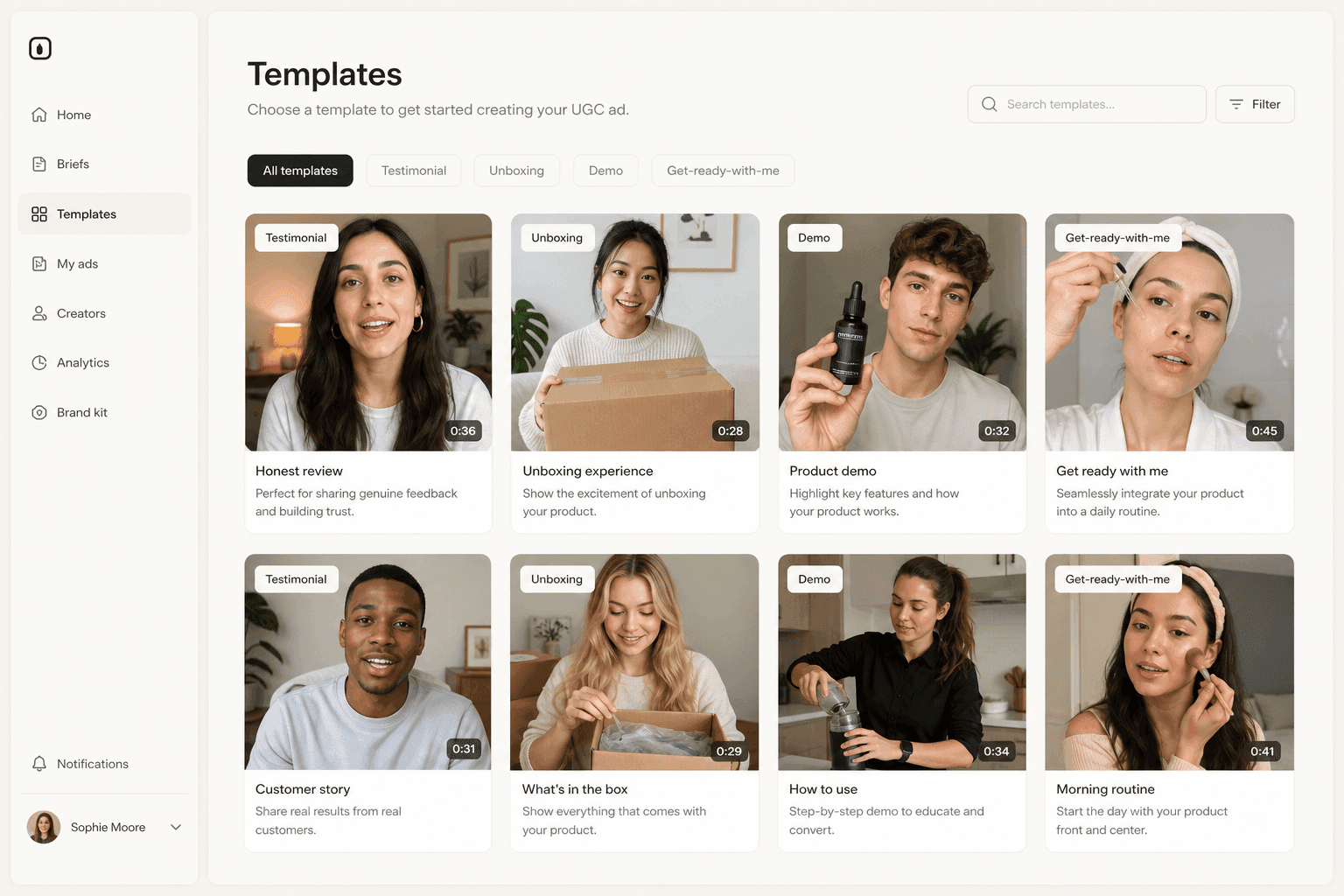
Novoads generates UGC-style vertical video ads from a written or auto-generated script plus an AI actor you choose by age, gender and accent, with voice, lip-sync and captions, in about four minutes. Because the actor, the script and the setting are inputs you control, you can hold all three constant and change only the length, which is what a clean length test requires and what a reshoot makes impractical. A finished clip runs roughly $2 to $11 depending on the model, and you can start for $1: a recurring $1 every three days that becomes the $49 per month Starter plan, with enough credits for about one video, cancel anytime. Reddit also has an ad copy generator of its own, in beta for select advertisers, which is a useful reminder that the platform will happily automate the words while the footage stays entirely your problem.
Attention Is Now Something You Buy in Two Lengths
Reddit did not just add a checkbox to Ads Manager. It made runtime a purchasing decision, and it put a price on the middle of your ad for the first time. The 6-second goal asks your video to be noticeable. The 15-second goal asks it to be worth staying for. Those are different briefs, and the second one is harder, which is exactly what makes it the more interesting thing to be able to buy. Decide which one you are selling before you decide how you shoot it.
Frequently Asked Questions
What is Reddit's 15-second Engaged Video Views goal?
It is a video optimization goal and billing option that Reddit launched on September 1, 2026, in public beta for all advertisers globally. Instead of paying for a short view, you bid for people who watch your ad to completion or for at least 15 seconds, and Reddit shows the ad to users it judges more likely to keep watching. It complements the 6-second engaged video views goal Reddit shipped a year earlier; the older goal is still available and is still the better fit for short creative.
How does Reddit count a 15-second engaged video view?
There are two branches. For videos 15 seconds or shorter, a completed view counts as an engaged video view. For videos longer than 15 seconds, an engaged video view is counted once someone watches for at least 15 seconds. That means the same metric describes a full watch on a 12-second ad and a partial watch on a 40-second one, so the number is only comparable between ads of similar length.
Should I use the 6-second or the 15-second views goal?
Use the 6-second goal when the message lands almost immediately or the creative is short, which is Reddit's own guidance. Use the 15-second goal when the argument needs time: a product demo, a feature explainer, a testimonial, a trailer, or brand storytelling where the key message builds. Reddit sums it up as capturing attention at scale with 6-second views versus capturing attention that lasts with 15-second views.
Are the +51% and +71% results what I should expect?
No. Those figures are a 15-second view-through rate lift and a video completion rate lift that Reddit reports from alpha testers, footnoted to Reddit internal data from May to July 2026. They are vendor-reported averages from a small, selected group during a private alpha, not an independently measured benchmark and not a forecast for your account. Treat them as evidence that the goal changes something, then measure your own result.
How long should a Reddit video ad be for this goal?
Decide what you want the metric to mean before you decide the runtime. Cutting to 15 seconds or less makes every engaged view a completed view, which is a clean, strict signal. Running longer makes an engaged view a checkpoint that proves your opening third works and says nothing about the rest. Both are valid; they answer different questions, and mixing them inside one ad group makes the report hard to read.
Can I test the 15-second goal against the 6-second goal?
Yes. Reddit says advertisers can use Reddit Split Testing during the beta to measure 15-second video views against the existing 6-second video views goal. For eligible split tests, campaigns should run at the ad group level for at least two weeks with automated bidding, lowest cost preferred, and should not be paused during the test period. Post-campaign reporting for the beta can include view-through rate and cost per view.
Key Takeaways
- Reddit launched 15-second Engaged Video Views on September 1, 2026, in public beta for all advertisers globally. It is an optimization goal and a billing option at the same time, and it sits alongside the existing 6-second views goal rather than replacing it.
- The counting rule has two branches: a video of 15 seconds or less counts an engaged view only on a completed view, while a longer video counts one the moment somebody reaches 15 seconds. Same report column, two different achievements.
- The real fork is creative, not media. A 6-second goal pays for the hook; a 15-second goal pays for the middle of the ad, which is the stretch most edits treat as filler.
- Reddit's headline numbers, +51% VTR15 and +71% VCR, are vendor-reported averages from alpha testers, footnoted to Reddit internal data from May to July 2026. They are not a forecast for a new account.
- It is a public beta, so mechanics and eligibility can still change. Test the two goals as a variable, read a downstream metric next to the view rate, and cut two versions of the same script rather than guessing which length wins.