Gemini Agentic Video Understanding Cuts Long-Form Analysis Costs Up to 66%, Google Says
Google launched agentic video understanding on September 1, 2026, letting Gemini hunt through a video instead of sampling every second. The savings land on hours of footage, not on six-second ads, and the numbers are Google's own.

Mauricio Valdivia
·11 min
The savings live in the hour, not the ad
A growth lead pulls 240 competitor ads out of the Meta Ad Library on a Monday, drops them in a folder, and by Friday somebody has watched eleven of them. The rest sit there as a folder nobody opens. Not because the team is lazy. Because watching is the one part of creative research that never got cheaper, and neither did paying a model to watch on your behalf.
On September 1, 2026, Google shipped something aimed squarely at that folder. It launched agentic video understanding across Gemini 3.7 Flash, Gemini 3.6 Flash and Gemini 3.5 Flash-Lite: a mode where the model navigates a video timeline on purpose instead of ingesting it frame by frame at a fixed rate. Google reports up to 88% fewer tokens, up to 66% lower cost, and up to 7% better quality. Those are real numbers with a real asterisk, and the asterisk is where this post lives.
What Google actually shipped
The announcement came from Rohan Doshi and Mario Lučić at Google DeepMind, and it is narrower and more useful than the headline suggests.
The three models and the one setting
Google's post opens with the scope: "Today, we're launching agentic video understanding across our latest models: Gemini 3.7 Flash, 3.6 Flash and 3.5 Flash-Lite". There is no new model here and no new SKU. It is a mode you request on an existing one.
Turning it on is a single field. In the API configuration, a video input's processing value is set to agentic instead of the default static. Google's developer docs go further and let you mix the two inside one request, so a ninety-minute recording can run agentic while a short clip in the same call runs static. Google also says it uses standard Gemini API token pricing with no additional feature fee, which matters more than it sounds: the whole pitch is that you spend fewer tokens, so a surcharge would have eaten the point.
Where it is available today, and where it is not
This is the line most coverage blurs. Google states that "The feature is available today for video uploads and YouTube videos via the Gemini API in Google AI Studio and the Gemini Enterprise Agent Platform". That is the entire surface right now.
- Live today: the Gemini API in Google AI Studio, and the Gemini Enterprise Agent Platform. Both accept file uploads and public YouTube URLs.
- Announced, not shipped: the consumer Gemini app, which Google says will get it on Flash and Flash-Lite models soon, and the Ask YouTube feature on the watch page, described as arriving in the coming months.
- Input limits worth knowing before you architect: YouTube inputs have to be public videos, not private or unlisted ones, and a single request tops out at ten videos.
- Context ceiling: Google's docs put models with a 1M context window at videos up to three hours long at the default low media resolution, or up to one hour at high media resolution.
An ad team planning this quarter around the app or the YouTube integration is planning around a roadmap. The API is the only door that is actually open, which also means somebody on your side has to write code or wire an agent to walk through it. That is the same shape as the shift happening in campaign management, where PPC work is moving out of the Google Ads interface and into agent connectors: the capability arrives as an API long before it arrives as a button.
The numbers, and whose numbers they are
The deck on Google's post reads that the feature "cuts token consumption by up to 88%, reduces costs by up to 66%, and boosts quality by up to 7%". Three things about that sentence deserve saying out loud.
- They are up to figures, which is a ceiling, not an average.
- They are Google's own, produced on standard video analysis benchmarks, its 1H-VideoQA evaluation among them, alongside LongVideoBench.
- At the time of writing, no independent evaluator has replicated them.
None of that makes them false. It makes them a vendor benchmark, which is a claim about direction rather than a guarantee about your workload. If you are building a budget on this, build it on your own measured token counts after a week of real queries, the same discipline you would apply to any creative analytics number that arrives pre-rounded.

Static sampling versus an agent with a scrubber
The mechanism is the interesting part, because it explains exactly which jobs get cheaper and which do not.
What one frame per second costs you
Google describes the old behaviour plainly: static processing extracts frames at a fixed rate, one frame per second by default, and places them into context in a single pass. The docs put a price on that. Each second of video runs about 100 tokens at the default low media resolution, or about 300 tokens at high media resolution, counting frames, audio and metadata together.
That is a flat tax on duration. It does not care whether the answer to your question sits at 00:04 or 41:20; you pay for the whole timeline either way. It is also why long video has historically forced a bad trade: either swallow the token bill or pre-chop the file and risk cutting out the moment that mattered.
What the agent does instead
In agentic mode the model runs a loop. Google's description is that it pairs the model's reasoning with native video tools to "dynamically search, scan, and inspect target video segments across visual frames, audio, and transcripts". It decides what to watch, at what speed, and through which modality, then pulls only those pieces in.
The token accounting changes shape with it. Navigation reasoning shows up as thought tokens; the frames, audio and transcript it actually loads show up as tool-use tokens. The docs summarise the payoff as up to "88% more token-efficient and ~7% higher quality on long-form content".
| Static | Agentic | |
|---|---|---|
| How it reads | 1 fps, one pass | Navigates on demand |
| Cost driver | Clip duration | Query complexity |
| Best on | Short clips | Long-form video |
| Models | All Gemini models | 3.7 Flash, 3.6 Flash, 3.5 Flash-Lite |
Why short clips are the exception
Here is the part that kills the tempting headline. Google's own docs recommend the old mode for exactly the content an ad team handles most:
- Use agentic when you have long-form video, or a query hunting for specific moments in a timeline.
- Use static when the query is latency-sensitive on short clips under five minutes, or when frame-level precision across the entire clip is what you need.
The docs also warn that agentic navigation "may slightly increase time to first token (TTFT) on short clips (<5 minutes) due to internal reasoning and tool round-trips before generation begins". So on a six-second hook, the new mode can be the slower one. Reading a single ad did not get 66% cheaper. Reading the archive did.
The arithmetic on a real ad archive
Multiply Google's own stated rate out and the shape of the opportunity gets obvious.
A six-second ad is already cheap to read
At roughly 100 tokens per second of video at the default resolution, a six-second creative costs around 600 tokens to ingest. A thirty-second cut costs around 3,000. Those are rounding errors against the prompt and the response. There was never a budget crisis in reading one ad, which is why no amount of efficiency work shows up on that line.
An archive is not
Now scale it the way research actually arrives. That folder of 240 competitor ads, averaging fifteen seconds each, is 3,600 seconds of footage, or roughly 360,000 tokens under static processing, before you have asked a single question. One sixty-minute customer interview is the same 3,600 seconds and the same rough number. Three months of weekly UGC review sessions is a figure nobody was ever going to put through a model at all.
That arithmetic is derived from Google's published per-second rate, not measured by us, and your real bill moves with media resolution and prompt length. But the ratio is the point: the cost of reading video scales with how much footage exists, and footage is the one thing an ad team has an unreasonable amount of.
Where the 88% lands
If the vendor ceiling held on a 360,000-token sweep, the same job lands near 43,000 tokens. The honest reading is softer, and it splits by question type:
- Compresses hard: find the one moment where the speaker names a price. The model can skip almost everything, which is the needle-in-a-haystack case Google leads with.
- Compresses somewhat: summarise the argument of a ninety-minute recording. It still has to touch most of the timeline, just not at full resolution.
- Does not compress: count every cut in a reel, or inspect frame by frame. Google points that case straight back at static mode, and so should you.
So the ceiling is a property of the question, not of the file. Pick queries that let the model skip, and the number moves toward Google's; ask for exhaustive coverage and you have paid for a scenic route to the same bill.
Four jobs an ad team can now afford
This is where a mechanism becomes a workflow. Each of these is a job that was technically possible before and practically skipped.
Sweeping a competitor ad library
The Meta Ad Library will hand you hundreds of live ads for one brand in a minute. Watching them is the bottleneck, so most teams sample the top ten and call it a landscape. A sweep that reads all of them turns cloning competitor ads from an act of taste into an act of coverage. Long-form here does not mean one long file; it means one very large pile, and the same "load only what you need" logic applies when the question is narrow. Reading the library is only half of it, because the platforms keep changing what a good result even means: Reddit's 15-second engaged video views goal rewrites the view metric you would be measuring those competitors against.
The questions worth standardising, so every sweep returns the same columns:
- The first three seconds, transcribed and described, because that is the only part most viewers see.
- The offer as spoken, not as written on the landing page, which is where the two usually diverge.
- The format, meaning talking head, product demo, screen recording, or voiceover over stock.
- The proof device, meaning before and after, a number on screen, a testimonial, or nothing at all.
- The close, meaning what the ad literally asks the viewer to do in its final two seconds.
Mining webinars, sales calls and podcasts for hooks
The best ad lines in most companies are already spoken out loud, in a founder interview or a support call, and they die in a recording nobody indexes. Google specifically calls out long-form needle-in-a-haystack search across multi-hour videos as a target capability. That is a hook library hiding in the archive, and it pairs naturally with the transcript and caption workflows most teams already run on their finished cuts.
Reviewing a whole UGC session instead of the picks
A creator sends forty minutes of raw takes and you use ninety seconds. The other thirty-eight and a half minutes contain the unscripted line that would have outperformed the scripted one. Reading the full session for candidate moments, rather than reading the creator's own selects, changes which ad creative you end up testing.
What to ask a full session for:
- Every unscripted aside, meaning anything the creator said that was not on the page you sent them.
- The takes where the product is clearly in frame and in focus, which is a visual question a transcript alone cannot answer.
- The moments the creator flagged out loud, the "wait, let me say that again" markers that mean somebody already knew a line was better.
Finding the exact frame where attention drops
Google lists sub-second moment retrieval and precise counting as capabilities that static one-frame-per-second sampling misses outright. Pair a retention curve with the frames around the drop and you get a specific diagnosis instead of a vibe. That is a more useful answer than most of what teams currently ask of a dashboard, and it is a good antidote to the trap of reading a high CTR as proof of a good ad.
What it does not do
An honest read of a launch includes the ceiling.
Vendor benchmarks are not independent results
The 1H-VideoQA evaluation behind the pareto-frontier chart is Google's own. LongVideoBench is a published benchmark rather than a house one, but the reported scores still come from Google's runs of it. A second lab has not confirmed the 88%, the 66% or the 7%. That is normal for a launch-day post and it is still the reason to treat the figures as a hypothesis you test on your own footage in week one.
The test is cheap to run, and it is three columns:
- Total tokens per query, agentic against static, on the same file and the same prompt.
- Time to first token, because the docs already warn this can move the wrong way on anything short.
- Answer quality, judged by a human on a fixed set of twenty questions whose answers you already know.
Run that on ten of your own files and you will have a better number than any benchmark, because it is measured on your footage and your questions.
Latency moves the wrong way on short clips
Google's docs are unusually candid that agentic navigation can add time to first token on clips under five minutes. If you were hoping to swap the mode on globally and walk away, the docs are telling you not to. The right default is per-input: agentic on the archive, static on the creative.
The archive problem nobody solved
Public YouTube is readable. Your private ad archive, your call recordings and your unlisted creator uploads are not readable from a URL, which means real plumbing before any of this touches a real library. That is creative operations work, not model work, and it is usually the part that stalls.
Three decisions come before the first useful query:
- Where the footage lives, and whether a model can reach it without a human dragging files into a browser every Monday.
- What you keep, because a raw creator session is heavy, and a policy of keeping everything forever is a storage bill masquerading as a research strategy.
- Who is allowed to read it, which turns into a consent question the moment customer calls or creator raw footage enter the pipeline.
None of those are hard problems. They are just the unglamorous ones that decide whether a launch like this changes your week or stays a demo you nodded at.
How Novoads solves the half that comes after the read
Novoads does not run Gemini 3.7 Flash, 3.6 Flash or 3.5 Flash-Lite, and nothing in this launch is a feature we shipped. We sit on the other side of the workflow: once the analysis tells you which angle, which opening line and which format are working, somebody still has to produce enough variants to test the finding.
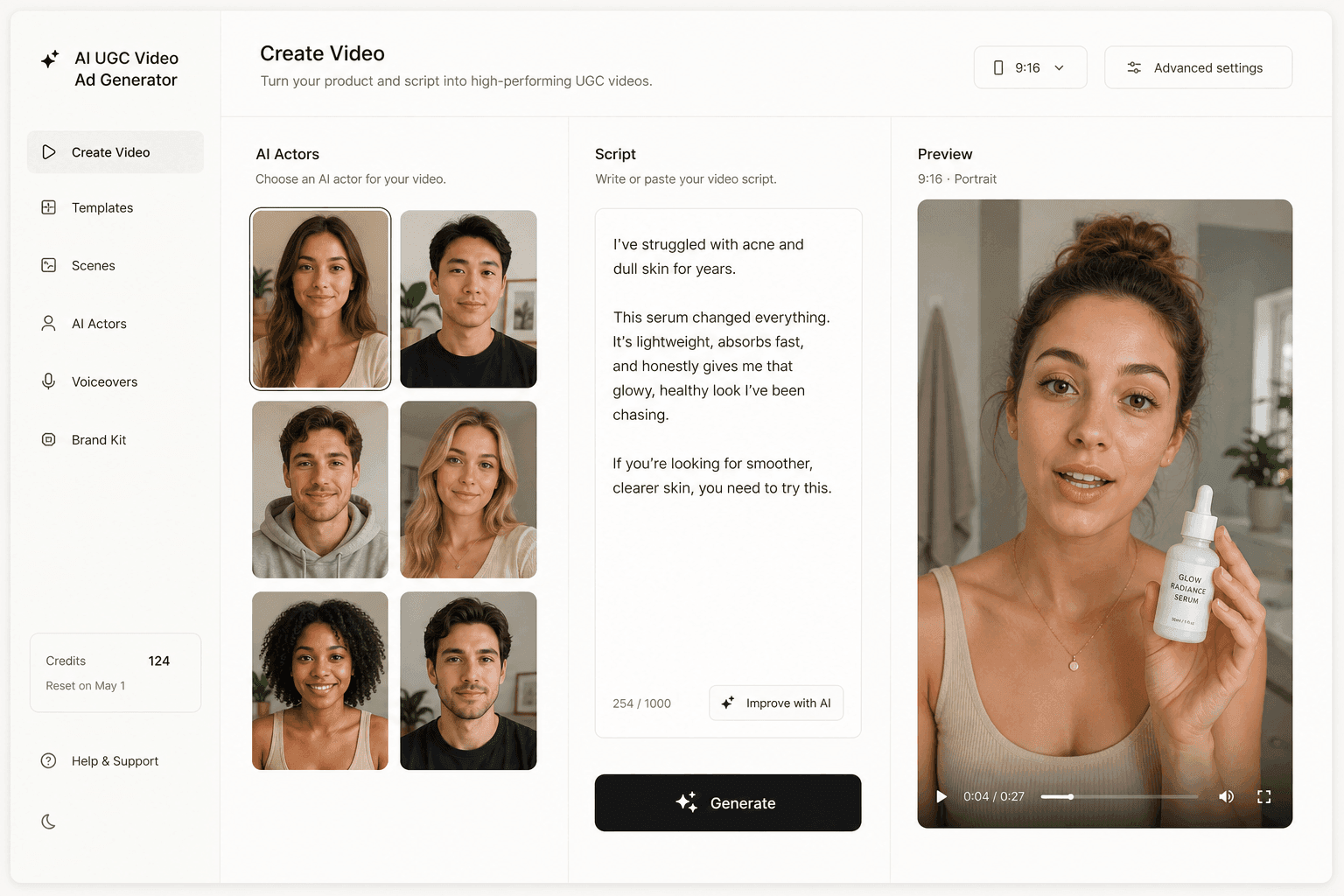
That is the job Novoads does. You upload a product image or write a script, pick an AI actor, and get an ad-ready vertical, square or horizontal video. The engines behind it are the same frontier ones everyone rents, including Google Veo 3.1 and Gemini Omni Flash. Worth separating those two names carefully: Gemini Omni Flash is a video generation model available in Novoads today, and it has nothing to do with the video reading modes this post covers, beyond a shared brand. We also run a transcribe tool in-app for your own clips, which is the small, adjacent version of the read.
Where the two halves meet is volume. A sweep that reads 240 competitor ads only pays for itself if you can act on it, and acting on it means shipping variants at the rate the finding suggests, which is the real argument behind how many ad creatives you actually need. You can try it on your own product for $1 for 3 days of access. Cancel anytime.
Reading got cheap. Deciding did not.
The interesting thing about a 66% cost reduction on long-form video analysis is not the 66%. It is what happens to a habit ad teams have had for a decade, once reading everything stops being the expensive part: sample the library, trust the sample, move on. The bottleneck moves from watching to asking a good question, and then to producing enough creative to answer it. Google made the first part cheaper. The second part is still yours.
Frequently Asked Questions
What is Gemini's agentic video understanding?
It is a processing mode Google launched on September 1, 2026 in which a Gemini model actively navigates a video timeline instead of ingesting it at a fixed frame rate. The model decides which moments to look at, at what speed, and through which modality (frames, audio or transcript), and loads only what it needs to answer the prompt. Google describes the alternative, static processing, as extracting frames at one frame per second and placing them into context in a single pass.
Which Gemini models support it, and how do you turn it on?
Google lists Gemini 3.7 Flash, Gemini 3.6 Flash and Gemini 3.5 Flash-Lite. You enable it per video input by setting the processing field to agentic in the API configuration. Google says it uses standard Gemini API token pricing with no additional feature fee, and you can mix modes inside a single request, running one video agentic and another static.
Does this make analysing a short video ad cheaper?
No, and Google does not claim it does. Google places the efficiency gains on long-form video, from ten-minute how-to guides to ninety-minute lectures and multi-hour recordings. Its own developer documentation recommends static processing for latency-sensitive queries on short clips under five minutes, and warns that agentic navigation can slightly increase time to first token on clips that short. A six-second ad is already cheap to read.
Are the 88% and 66% figures independently verified?
Not yet. They are Google's own up-to numbers, reported across standard video analysis benchmarks, including Google's own 1H-VideoQA evaluation and LongVideoBench, which Google describes as a long-form video understanding benchmark. No independent evaluator has published a replication at the time of writing. Treat them as a vendor claim about a direction of travel rather than a measured guarantee for your workload.
Where can you actually use it today?
The feature is available for video uploads and YouTube videos through the Gemini API in Google AI Studio and on the Gemini Enterprise Agent Platform. Google says it will roll out to the Gemini app on Flash and Flash-Lite models soon, and that it will power the Ask YouTube feature on the watch page in the coming months. Those two are announced, not shipped. YouTube inputs must be public videos, not private or unlisted ones.
Does Novoads use Gemini 3.7 Flash for this?
No. Novoads does not run Gemini 3.7 Flash, 3.6 Flash or 3.5 Flash-Lite, and this post is industry coverage rather than a product announcement. Novoads does run a Google model on the generation side, Gemini Omni Flash, alongside Seedance, Kling and Google Veo 3.1, but that is a video generation model and a different thing from the text-and-video reasoning models this launch covers.
Key Takeaways
- On September 1, 2026, Google launched agentic video understanding for Gemini 3.7 Flash, 3.6 Flash and 3.5 Flash-Lite. Instead of ingesting every frame at a fixed rate, the model navigates the timeline and loads only the transcript, frames or audio it needs to answer the prompt.
- The headline figures of up to 88% fewer tokens, up to 66% lower cost and up to 7% better quality are vendor numbers, produced by Google's own runs of 1H-VideoQA and LongVideoBench. No independent lab has replicated them yet, so read them as a claimed ceiling, not as a settled result.
- Google puts the gains on long-form video, from ten-minute how-to guides to multi-hour recordings. Its own developer docs still recommend the old static mode for short clips under five minutes, which is exactly where an ad creative sits. Nothing here made reading a six-second ad cheaper.
- Availability today is the Gemini API in Google AI Studio plus the Gemini Enterprise Agent Platform, for uploads and public YouTube URLs. The Gemini app and the Ask YouTube integration are still future. You turn it on by setting a video input's processing to agentic, at standard token pricing.
- Novoads does not run these models. Our roster is the generation side of the job (Seedance, Kling, Google Veo 3.1, Gemini Omni Flash, GPT Image 2, Nano Banana Pro and more), so this is an industry story about how you research creative, not a feature we shipped.