How to Clone a Competitor's Ad Without Copying It: Structure Transfers, Footage Doesn't
Cloning a competitor's ad means rebuilding the four things you can observe (the hook, the beat order, the offer and the format) with your own footage and your own claims, because structure is what transfers between two ad accounts and the asset never does.

Mauricio Valdivia
·12 min

The part worth stealing is not the video
A competitor's ad keeps appearing in your feed. Same actor, same opening line, three slightly different endings. You watch it four times, screenshot it, drop it in a channel and type "let's make one like this." That is where most competitor research quietly ends, because nobody can execute that instruction.
The impulse is right. An advertiser who has spent six weeks pushing the same concept at the same audience has already paid for information you would otherwise have to buy. The unit is what is wrong. "One like this" copies the layer you can see instead of the layer that travels, and those are not the same layer. What travels between two ad accounts is a skeleton: which promise arrives first, in what order the beats land, what the ad is actually asking for, and the envelope it was cut to fit. What does not travel is the thing on your screen, which is their footage, their creator, their script and their claims.
This is the method for separating the two. Where a competitor's live ads actually are, how to narrow twenty of them to the three worth an hour, the four lenses that turn a video into a written spec, and how to rebuild that spec into something that is yours in every respect that matters. It also draws the line, plainly, at the point where a clone stops being a clone.
What the Ad Library shows, and what it holds back
A public web page, not a data feed
Meta's Ad Library is the reason any of this is possible without insider access. The Transparency Center describes it as a searchable database for ads transparency, where people can look up the ads they see across Meta technologies. On that same page, the Ad Library API is listed for authorized users and the Ad Targeting dataset for approved researchers. The Ad Library itself carries no equivalent gate. You type an advertiser's name into a web page and you get their live creative.
Anyone who has ever written a scraper will now reach for the API. Do not. Meta's own Graph API reference for the ads archive draws the boundary in a single sentence: "Ads that did not reach any location in the EU will only return if they are about social issues, elections or politics." A direct-to-consumer brand running only in the US, Mexico or Chile returns nothing at all. The web interface is not the poor cousin of a programmatic pipeline. It is the surface.
That split is not new. When Meta widened the library beyond politics on 28 March 2019, the announcement described "Bringing in all active ads any Page is running," while API access was scoped to political and issue ads and gated behind a process you had to clear first: "Go through the Facebook Identity Confirmation process, create a Facebook Developer account, and agree to our platform terms of service." Seven years later the shape of the thing is unchanged. Broad public browsing, narrow programmatic access.
Active is doing all the work
The most important word in the feature is the one everybody skims. Meta's Help Center scopes the library to ads of any type that are currently active across Meta products. For an ordinary product ad, that is the entire offer. The advertiser pauses it and it is gone.
The seven-year archive people quote at each other is real, and it is not for you. Retention splits three ways:
- Social issue, election and political ads: kept for seven years, visible whether active or inactive. That is the category the retention was built for from the start. The 2019 announcement describes a library that "offers information about who saw the ad, as well as its spend and impressions, and houses ads for seven years," in a paragraph explicitly about political and issue advertising.
- Ads that delivered an impression in the EU or associated territories: archived for one year after their last impression.
- Ordinary commercial ads everywhere else: no archive at all.
An ordinary skincare ad running in Santiago or Austin therefore gets neither the history nor the numbers.
The consequence is small, annoying and worth building a habit around. You cannot reconstruct what a competitor ran last Black Friday unless you were watching last Black Friday. Screen-record everything the moment you find it. A teardown you did not capture is a teardown you did not do.
Three more edges nobody mentions
Three things are missing from most write-ups of this tool, and each one changes how much weight you put on what you see:
- Some ads are absent by design. Meta's Help Center lists ads removed for serious violations of Community Standards, or at government request, as excluded. The most aggressive creative in a category can be the creative you never see.
- Your location changes the tool. Meta notes different options for people in the European Region and the UK.
- There are no performance columns. Spend, impressions and audience data are the political-ad product, not a general feature.
So the library hands you creative and withholds performance. Everything you conclude about what is working is an inference. The rest of this post is about making it a disciplined one rather than a flattering one, which is the same discipline creative analytics applies to your own account.
Pick the ads worth an hour
Repetition is the only signal on screen
With no spend column, the read has to be structural. Two things are genuinely observable, and neither of them is a metric:
- Variant count. Five near-identical cuts of one concept means the account decided that concept was worth iterating on. One concept with one execution might be a first test that dies on Friday.
- Persistence between visits. An ad still sitting there when you check again a fortnight later is an ad somebody chose not to kill.
Neither proves revenue. Together they take twenty ads down to three, which is the only job this step has. Be honest with yourself about the status of the inference: you are ranking candidates for attention, not reading results.
Build a watchlist, not a swipe file
A swipe file is where competitor research goes to die. Folders fill up, nobody revisits them, and the material ages out of relevance before anyone builds anything. A watchlist is the same instinct with a cadence attached:
- Pick five advertisers, not thirty. Three direct competitors, one category leader, one brand from an adjacent category whose creative you admire.
- Check on the same day every fortnight. Consistency is what turns snapshots into a series.
- Screen-record anything new immediately, because nothing here is archived for you.
- Log the date you first saw an ad and the date it vanished.
That last line does more work than it looks like. The gap between first sighting and disappearance is the closest thing to a performance number the Ad Library will ever hand you, and it costs you four minutes a fortnight to collect.
The cadence is also the part most worth handing to a machine, since it is the same five searches every fortnight. That is exactly the shape of work our own five-stage agent workflow for Meta ad creative picks up, with the shortlist still approved by a person before anything gets scraped.
What to skip
Not every ad in the list deserves the hour. Three categories are safe to pass over:
- Brand films from companies forty times your size. Different job, different budget, and usually no offer in them at all.
- Anything you could not produce twice. A structure you can execute once is not a structure, it is a stunt.
- The ad you already believed in. Confirmation is the cheapest thing on the internet.
You are hunting for the concept that survives your skepticism, not the one that flatters the plan you already had.
Four lenses that turn an ad into a spec
Lens one: the hook
Watch the first two seconds and write down three things: the literal first line, what is physically in the first frame, and the mechanism the hook is using. Mechanisms are a short list in practice:
- Problem stated out loud. The ad names the discomfort before it names itself.
- Contradiction. It denies something the viewer already believes.
- Demonstration mid-action. It opens on the thing already happening.
- Callout. It names the audience in the first clause.
- Result first. It shows the outcome, then explains it backwards.
The line is theirs. The mechanism is not. "Demonstration mid-action" is a pattern you can execute with your own product tomorrow, and the mechanics of doing that well are the subject of writing ad hooks that stop the scroll.
Lens two: the beat order
Structure is nothing more exotic than the order in which an ad spends attention. Scrub through with a timer and mark when each beat arrives. Most UGC-style ads that work run something close to this:
- The hook.
- The problem, restated in the viewer's own words.
- The product entering the frame.
- One demonstration.
- One piece of proof.
- A single ask.
Write down the timestamps, not just the sequence. A product that enters at second three is a different ad from one that enters at second eleven, even when the beat list is identical. Note what is missing too. An ad with no proof beat is telling you the category does not need one, or that the offer is carrying it. The Instagram ad examples worth studying mostly differ from each other on ordering rather than on ingredients.
Lens three: the offer
This is the lens most teardowns skip, and it is the one that moves results the most. What is the ad actually asking for, and what does it give back in exchange? A discount, a bundle, a sixty-day guarantee, a quiz, a first-order trial.
Get this on the page before you admire the hook, because the offer often explains the hook's confidence. An advertiser who can promise a sixty-day money-back guarantee can afford a blunt claim in second one. If your offer is a five percent code, the same blunt claim lands differently, and the ad you build will underperform for a reason that has nothing to do with the creative.
Lens four: the format envelope
Finally, the mechanical layer: aspect ratio, total length, captions burned in or absent, on-screen text density, and whether the promise survives with the sound off. These are cheap to match, cheap to vary, and they are the axes platforms themselves name as testable, which is why they belong in your first round of ad creative testing rather than your fifth. The same envelope reading applies to whatever you are studying, whether that is Facebook video ad examples or the trend surface inside TikTok's Creative Center.
Put the four lenses together and one video becomes a one-page spec:
| Lens | What you write down | Transfers to your ad |
|---|---|---|
| Hook | First line, first frame, mechanism | The mechanism, not the line |
| Structure | Beat order with timestamps | Almost entirely |
| Offer | The ask and the risk reversal | Only what you can honour |
| Format | Ratio, length, captions, sound-off | Mechanically, in full |
| Asset | Their actor, footage, script, claims | Never |
Where a clone becomes a copy
The test is whether their asset ends up in your ad
The bottom row of that table is the whole ethics of this practice, and it needs no legal vocabulary to apply. If a frame of their footage, a line of their script, their creator's face or a claim about their product ends up in your ad, you did not clone anything. You took a thing somebody else made and paid for. A structure is a pattern that dozens of advertisers in your category are already converging on. An asset has one owner, and it is not you. That distinction has started arriving in courtrooms as well as style guides, which is the backdrop to the copyright suit filed against an AI ad generator.
Here is the part that should convince you before any of that does. A near-duplicate loses on the merits anyway. Their ad is tuned to their price, their guarantee, their audience's specific objections and the credibility their brand has already banked. Ported whole into your account it inherits all four assumptions and matches none of them, and the version that reaches your audience is a slightly worse copy of an ad that was never built for them.
Rewrite every claim, without exception
The highest-risk thing to transfer is not a shot. It is a claim. Clinically proven. Results in fourteen days. A specific percentage on screen in bold. Those sentences belong to somebody else's substantiation file, and lifting one means you are now making a promise you cannot document.
Take the claim's shape instead. What makes "results in fourteen days" effective is that it is specific, time-bounded and checkable, not that it says fourteen days. Fill that shape with something of your own:
- A number from your own returns or reorder data.
- The sentence customers repeat most often in your reviews.
- A guarantee your finance side has already agreed to honour.
It is more work than copying, and it is the only version you get to keep.
The provenance layer is arriving
There is a second reason to care about whose material is in your ad, and it is being built right now. Meta says it began labeling ads that were "created or significantly edited using our generative AI creative features," and in an update published on 1 June 2026 it went further: it "will also begin automatically detecting ads created or edited using third-party AI tools through industry-standard signals," surfacing the result inside a new unified "About this ad" destination in the three-dot menu on every ad.
Read that correctly. It is not an argument against producing ads with AI, and the disclosure rulebooks across the major platforms are mostly about labeling rather than restriction. It is an argument that the surface you are studying is quietly becoming a provenance surface, and yours is too. The safe position under that regime is not secrecy. It is that everything in your ad is genuinely yours to show.
Rebuild the spec as yours
Write the spec before you write the script
Open a blank page and write the four lenses down as instructions to yourself: hook mechanism, beat order with target timestamps, the offer you can honour, the format envelope. If the page contains their actor, their sentences or their claim, you did not write a spec. You wrote a transcript, and a transcript is the thing you were trying not to make.
A finished spec is short and boring, which is how you know it is right:
- Hook: demonstration, product in frame by second two.
- Problem: in the customer's own words by second four.
- Body: one demonstration through second eleven, one proof line.
- Ask: a single call to action at second eighteen.
- Envelope: vertical, twenty-two seconds, captions burned in, legible with the sound off.
Nothing in that list is anybody's property. It is a set of instructions you could hand to five different people and get five legitimately different ads back.
Produce more than one version of the same spec
A spec is a hypothesis, and one execution cannot test a hypothesis. If your single attempt underperforms you have learned nothing, because "the structure is wrong" and "that delivery was flat" produce identical numbers. Three to five executions of the same beat order, varying the hook line, the actor and the opening frame, separate the two explanations for you.
This is the step where the economics decide whether the method survives contact with a real week. At agency rates you make one and hope. When a variant costs a couple of dollars, which is the arithmetic AI-generated ads changed, you can make five, screen them yourself on the things that cost nothing to judge, and send only the survivors into a paid split. That is the practical argument for producing UGC-style ads at volume, and it is a different argument from the one about saving money on production.
How you know it came out right
Four checks, in order, before anything gets a budget:
- Sound off, first two seconds. Does the promise land from the frame alone? If it needs audio, your hook is a voiceover with a picture attached.
- Timestamps side by side. Are your beats landing within a second or two of the spec you wrote? Drift here usually means the script got long, not that the structure was wrong.
- The stranger test. Show it to someone who has seen neither ad. Can they say what is being sold and what they are meant to do next?
- The side-by-side test. Play both. If they could mistake yours for theirs, you copied. If they would call them the same kind of ad, you cloned.
How Novoads solves the rebuild step
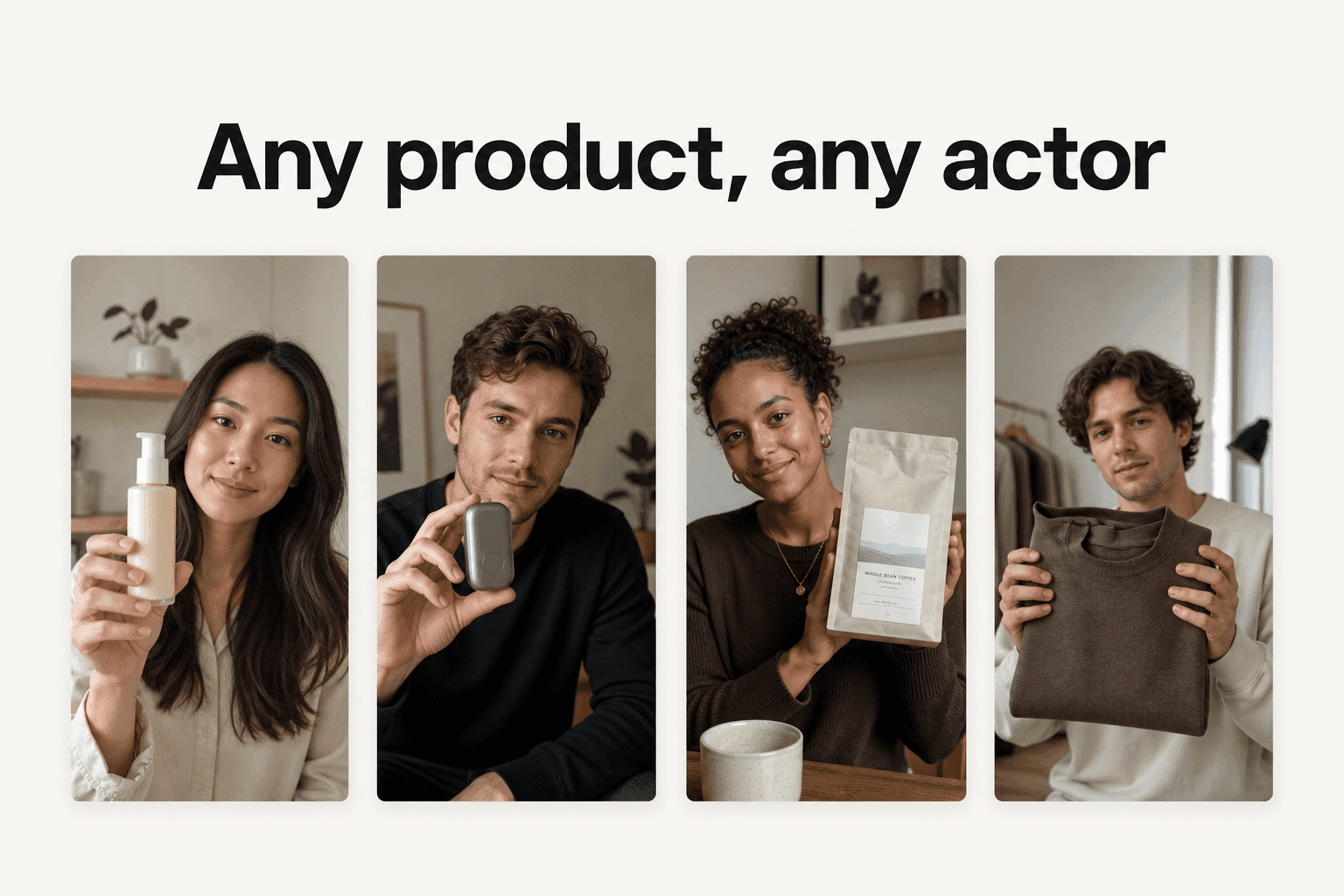
Novoads turns a written script and an AI actor, or an uploaded product image, into a UGC-style video ad, and exports 9:16, 1:1 and 16:9 from the same source. That maps onto the spec directly: the beat order becomes the script, the hook mechanism becomes the first line, and the format envelope becomes an export setting rather than a reshoot. Producing five executions of one structure stops being a production request and becomes an afternoon. A generated video runs roughly $2 to $11 depending on the model, which is what makes screening candidates before you spend media money realistic rather than aspirational.
You can try it for $1 for 3 days. Cancel any time.
A teardown is a hypothesis, not a shortcut
The Ad Library will hand you a competitor's current creative and absolutely nothing else. No spend, no results, no reason. The temptation is to fill that silence with certainty, decide their ad is working because it exists, and rebuild it as if you had read a case study. What you actually have is a candidate.
That is still an enormous amount. Most advertisers are guessing at which structures their category responds to; you can watch the ones your competitors are willing to keep paying for and test the pattern for yourself, on your own offer, with your own footage. The discipline is in remembering which half of that sentence is evidence. Their ad proves a structure earned attention in your category. It does not prove it will earn yours, and finding out is what the split test is for.
Frequently Asked Questions
Is it legal to copy a competitor's ad?
This post does not give legal advice, and the practical line sits well before the legal one. Reusing their footage, their creator's face, their script or a claim backed by their substantiation means you took an asset somebody else made and paid for. Rebuilding the structure you observed, with your own product, your own script and claims you can support yourself, is ordinary competitive practice. If you are unsure where a specific ad sits, ask a lawyer rather than a blog post, and in the meantime treat every frame and every sentence of theirs as off limits.
Can I see a competitor's Facebook and Instagram ads?
Yes, through the Meta Ad Library. Meta's Transparency Center describes it as a searchable database where people can look up the ads they see across Meta technologies, and the library itself carries none of the eligibility gates that the Ad Library API and the Ad Targeting dataset do. You search by advertiser, you see what that advertiser is currently running, and you get the creative itself rather than a summary of it.
Does the Meta Ad Library have an API I can use to pull competitor ads?
There is an Ad Library API, but it will not do this job. Meta's own Graph API reference for the ads archive states that ads which did not reach any location in the EU will only return if they are about social issues, elections or politics. A direct-to-consumer brand advertising in the US, Mexico or Chile therefore returns nothing through it, and the Transparency Center lists the API for authorized users. The public web interface is the surface, not the fallback.
How far back does the Meta Ad Library go?
It depends entirely on the type of ad. Ads about social issues, elections and politics are kept for seven years and are visible whether they are active or not. Ads that delivered an impression in the EU or associated territories are archived for a year after their last impression. Ordinary commercial ads elsewhere are searchable only while they are running, which is why any teardown you care about needs to be screen-recorded the day you find it.
What should I actually write down when I tear down an ad?
Four things, in this order. The hook, meaning the literal first line, the first frame and the mechanism it uses. The beat order, with rough timestamps for when the problem, the product, the demonstration, the proof and the ask each arrive. The offer, meaning what the ad asks for and what it gives back in exchange. And the format envelope: aspect ratio, length, whether captions are burned in, and whether the promise survives with the sound off. That page is a spec. A transcript of their script is not.
How many versions of a cloned structure should I make?
More than one, because a single execution cannot tell you whether the structure worked or whether that particular delivery worked. Three to five versions of the same beat order, varying the hook line, the actor and the opening frame, separate those two explanations. Screen them internally on the things you can judge for nothing, such as sound-off legibility and thumbnail readability, then put your best two into a controlled split.
Key Takeaways
- Public browsing of any advertiser's active ads happens in the Ad Library's web interface, not through an API. Meta's own Graph API reference says ads that did not reach a location in the EU only return if they are about social issues, elections or politics, so an ordinary US or LATAM commercial advertiser is invisible to it.
- The word doing all the work is active. Meta's Help Center scopes the library to ads of any type that are currently active. The seven-year archive covers social issue, election and political ads, so an ordinary product ad disappears from the library the day it is paused.
- The library gives you creative, not performance. Spend and impressions are the political-ad product, so every read of what is working is an inference. Variant count and how long an ad survives between visits are the only signals actually on screen.
- Four lenses turn a video into a written spec: the hook mechanism, the beat order with timestamps, the offer being asked for, and the format envelope. All four transfer between accounts. Their footage, their creator and their substantiated claims do not.
- The side-by-side test settles it. If a stranger could mistake your ad for theirs, you copied. If they would call them the same kind of ad, you cloned.