AI ads: how to create video ads that convert
What AI ads are, the types that actually work for paid social, and how to create high-converting UGC video ads with AI — without a camera, crew, or editor.

Mauricio Valdivia
·11 min

The Bottleneck in Paid Social Isn't Budget. It's Creative.
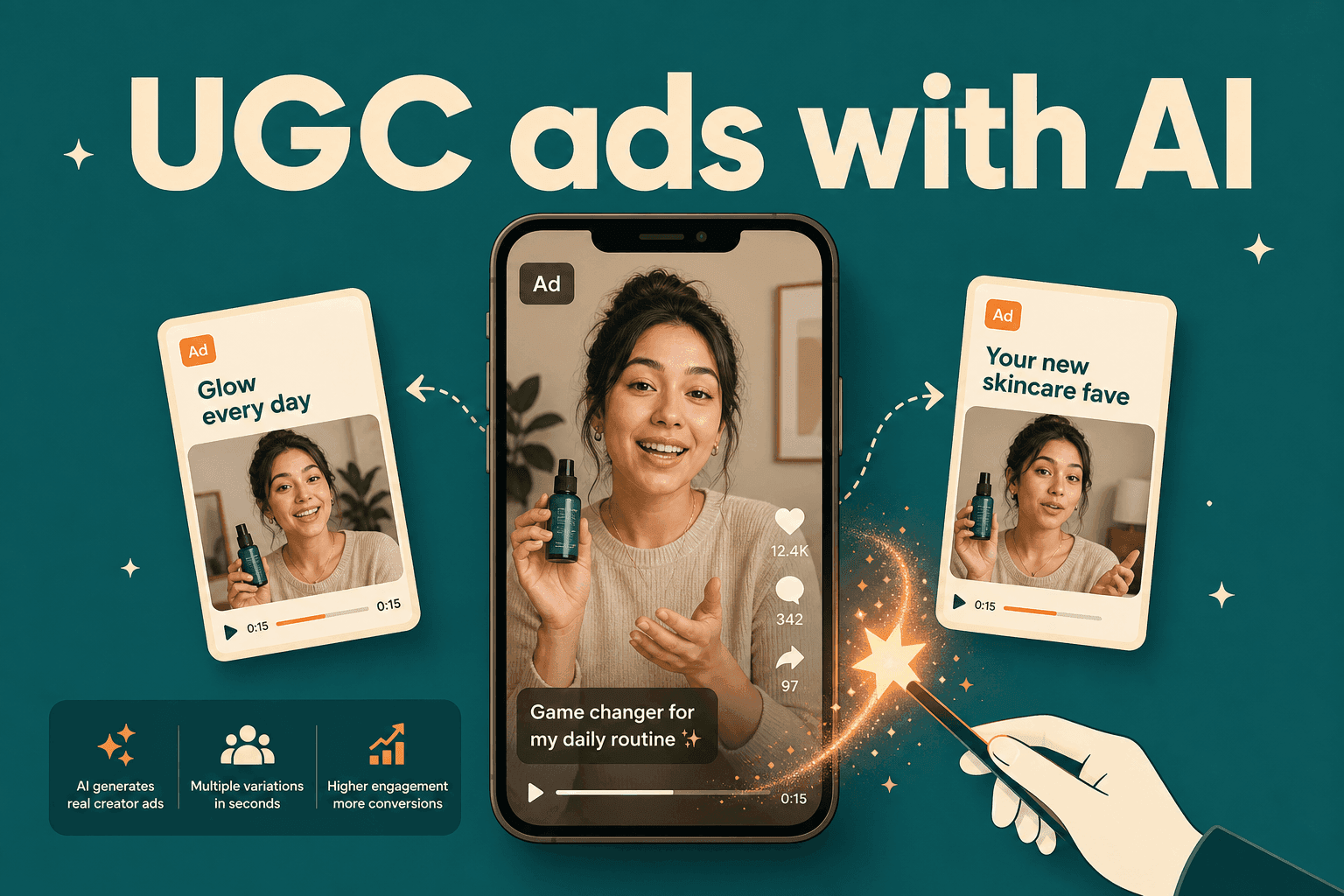
An AI ad is a paid ad whose copy, image, or video is generated by AI instead of produced by a copywriter, designer, or film crew. The kind reshaping paid social is the AI video ad: a UGC-style clip where an AI actor delivers your script, with synthetic voice, lip-sync, and captions handled automatically.
For most brands, the bottleneck in paid social isn't budget or targeting — it's creative. You can only test what you can produce, and producing a single good video ad has traditionally meant briefing a creator, waiting a week or two, and paying $200–$500 a clip. At that price, testing ten angles is a luxury.
AI ads break that math. With the right tool you can turn a script into a finished video ad in minutes, for a few dollars, without a camera. This guide covers what AI ads actually are, why they work for paid social, and how to create UGC-style video ads with AI that hold up against the real thing.
What "AI ads" actually means
"AI ads" is a loose umbrella. In practice it covers three different things: ad copy written by AI, static creative generated by AI, and video ads produced by AI. They share a premise — that the expensive, slow parts of making an ad can be handled by a model — but they solve very different problems.
The category getting the most attention is video, and for good reason: video is the format that performs on TikTok, Reels, and Meta, and it's also the most expensive and slowest to produce the old way. An AI video ad collapses scripting, casting, filming, and editing into a single text-to-video step.
Why they work for paid social
The honest answer isn't "AI makes better ads." It's that AI makes more ads, cheaply — and in performance marketing, volume of testing is what wins.
A human creator is a bet: you pay up front, wait, and hope the one clip lands. AI flips that. When each variation costs a few dollars, you can run a dozen hooks against the same offer, find the one that beats your benchmark, and scale it. The creative that wins is rarely the one you'd have guessed, which is exactly why being able to test cheaply matters more than any single "perfect" ad.
The platforms also reward what these tools produce. TikTok and Meta favor native, UGC-style content — a real-feeling person talking to camera — over polished brand films. AI actor tools are built to generate exactly that.
The three kinds of AI ad
AI ad copy
Models write headlines, primary text, and hooks. Useful for scaling variations of text, but copy alone rarely moves a paid-social campaign — the creative does.
AI static creative
Image models generate product shots, backgrounds, and graphics. Good for display and simple feed ads; limited where motion and a human presence drive performance.
AI video / UGC ads
An AI actor delivers your script to camera, with synthetic voice, lip-sync, captions, and vertical formatting handled automatically. This is the highest-leverage kind for paid social, and the focus of the rest of this guide. (If you're new to the format, our guide to making UGC ads covers the fundamentals.)
How to make an AI video ad, step by step
The flow is the same across tools. The whole thing takes minutes once you have an angle.
- Start from your product. Paste a URL or a short description; the tool proposes angles (problem-solution, testimonial, offer).
- Pick a hook. Choose or generate the first three seconds — the part that decides whether anyone watches.
- Choose an AI actor. Match age, gender, and accent to your target audience.
- Generate and export. The tool produces the video with voice, captions, and a 9:16 format, ready to drop into your campaign.
For more on the writing side, our guide to ads that convert goes deep on hooks and structure.
What separates a good AI ad from generic AI video
Not every AI tool makes ads. A general video generator produces a clip; an ad tool is built to produce something that sells. The difference shows up in a few specifics:
| What to look for | Why it matters |
|---|---|
| Ad-first workflow | Hooks, scripts, and formats built for paid social — not a blank canvas |
| Realistic actors + accents | A native-sounding person converts; a robotic avatar doesn't |
| Speed | You need to test many variations per week, so render in minutes |
| Cost per video | Defines how many tests you can afford (aim for a few dollars) |
| Native output | 9:16, captions, and a UGC feel by default |
AI ads vs hiring UGC creators
The most useful comparison isn't AI vs "real" video — it's AI vs the creator economy you'd otherwise pay.
| UGC creators | AI video ads | |
|---|---|---|
| Cost per video | $200–$500 | from ~$2–3 |
| Turnaround | 1–2 weeks | Minutes |
| Variations | Limited by budget | Dozens, cheaply |
| Consistency | Varies by creator | Repeatable |
| Best for | A few hero pieces | Volume testing at scale |
Creators still have a place for flagship content. But for the relentless testing that paid social demands, the economics favor generating variations and letting performance decide. Our comparison of AI ad platforms breaks down specific tools.
Where most advertisers go wrong
- Chasing one perfect ad. Paid social rewards volume of tests, not a single masterpiece. Generate many.
- Ignoring the hook. If the first three seconds don't land, the rest doesn't matter.
- Using a neutral accent for a local market. A native-sounding actor builds trust a generic voice can't.
- Not iterating. Generating ten ads and never reading the data wastes the entire advantage of AI.
Making AI video ads with Novoads
If you want to turn the approach in this guide into actual ads — without a camera, crew, or editor — that's where Novoads comes in.
Novoads is an AI video-ad generator built for marketers, not editors. You write or auto-generate a script, pick an AI actor that matches your audience's age, gender, and accent, and it produces a UGC-style vertical ad with voice, lip-sync, and captions — ready for TikTok, Reels, and Meta.
Because each ad costs a few dollars instead of $200–$500, Novoads is built for the one thing that actually moves paid social: volume. You can spin up ten variations of a concept — different hooks, actors, and angles — in an afternoon, then let the data decide which ones to scale.
A practical example: take one product, generate three hooks, pair each with two AI actors for a native-sounding accent, and export six 9:16 ads in a single sitting. Launch them as a test, kill the losers, and put budget behind the one that beats your benchmark — no reshoots, no waiting on a creator.
You can start creating your own AI video ads with Novoads from $49/month at novoads.ai.
Frequently Asked Questions
What exactly counts as an AI ad?
An AI ad is any ad where AI does the heavy lifting — writing the copy, generating the visuals, or producing the video. In practice the term usually means an ad you create with an AI tool instead of a copywriter, designer, or film crew. The fastest-growing kind is the AI video ad: a UGC-style clip with an AI actor, generated from a script in minutes.
Do AI video ads actually perform on TikTok and Meta?
Yes, when you treat them like any other creative: test many variations and let the data pick the winners. AI doesn't guarantee a hit; it makes producing 15 variations cheap enough that you can find one. The platforms reward fresh, native-looking UGC, which is exactly what AI actor tools produce.
How much does it cost to make an AI ad?
A UGC-style AI video ad costs a few dollars — from around $2–3 for the cheapest models — versus $200–$500 and one to two weeks for a human creator. The savings come from removing filming, talent, and editing. That low cost is the whole point — it lets you test angles you'd never pay a creator to shoot.
Do I need design or editing skills to create AI ads?
No. Modern AI ad tools are built for marketers, not editors. You write (or auto-generate) a script, pick an AI actor, and the tool handles the voice, lip-sync, captions, and vertical formatting. The skill that matters is marketing judgment — hooks, angles, and reading the results.
How many AI ad variations should I run?
Start with 5–15 variations per concept: different hooks, actors, and angles. The advantage of AI is volume, so a single product can justify a dozen creatives in an afternoon. Kill the losers fast and scale the one or two that beat your benchmark.
Do I need to label AI ads as AI-generated on TikTok and Meta?
Often, yes — and it doesn't hurt performance. TikTok automatically labels videos made with its own AI tools, and both TikTok and Meta ask advertisers to disclose realistic AI-generated or AI-altered media. Audiences already expect UGC to be lightly produced, so a disclosure label rarely dents results. The rule of thumb: keep claims truthful, disclose when the platform requires it, and never imply a real person endorsed you when they didn't.
Key Takeaways
- An AI ad is one where AI writes the copy, generates the visuals, or produces the video — the fastest-growing kind is the AI video ad.
- They win on paid social because they make producing many creative variations cheap, and testing volume is what finds winners.
- A UGC-style AI video ad costs a few dollars (from around $2–3 for the cheapest models) versus $200–$500 for a human creator, and takes minutes instead of days.
- The tool is half the job; the other half is marketing judgment — hooks, angles, and reading the data.
- For performance, pick a tool built for ads rather than generic video, generate variations in volume, and let the results decide what to scale.

![How to Create Ads with AI: Complete Guide [2026]](/_next/image?url=%2Fblog%2Fcrear-anuncios-con-ia.jpg&w=3840&q=75)