
UGC Ads: What They Are, Why They Work, and How to Create Them with AI
Complete guide to UGC ads (User Generated Content): what they are, why they outperform polished brand ads, the formats that carry paid social, and how to create them with AI in minutes.

Mauricio Valdivia
·11 min
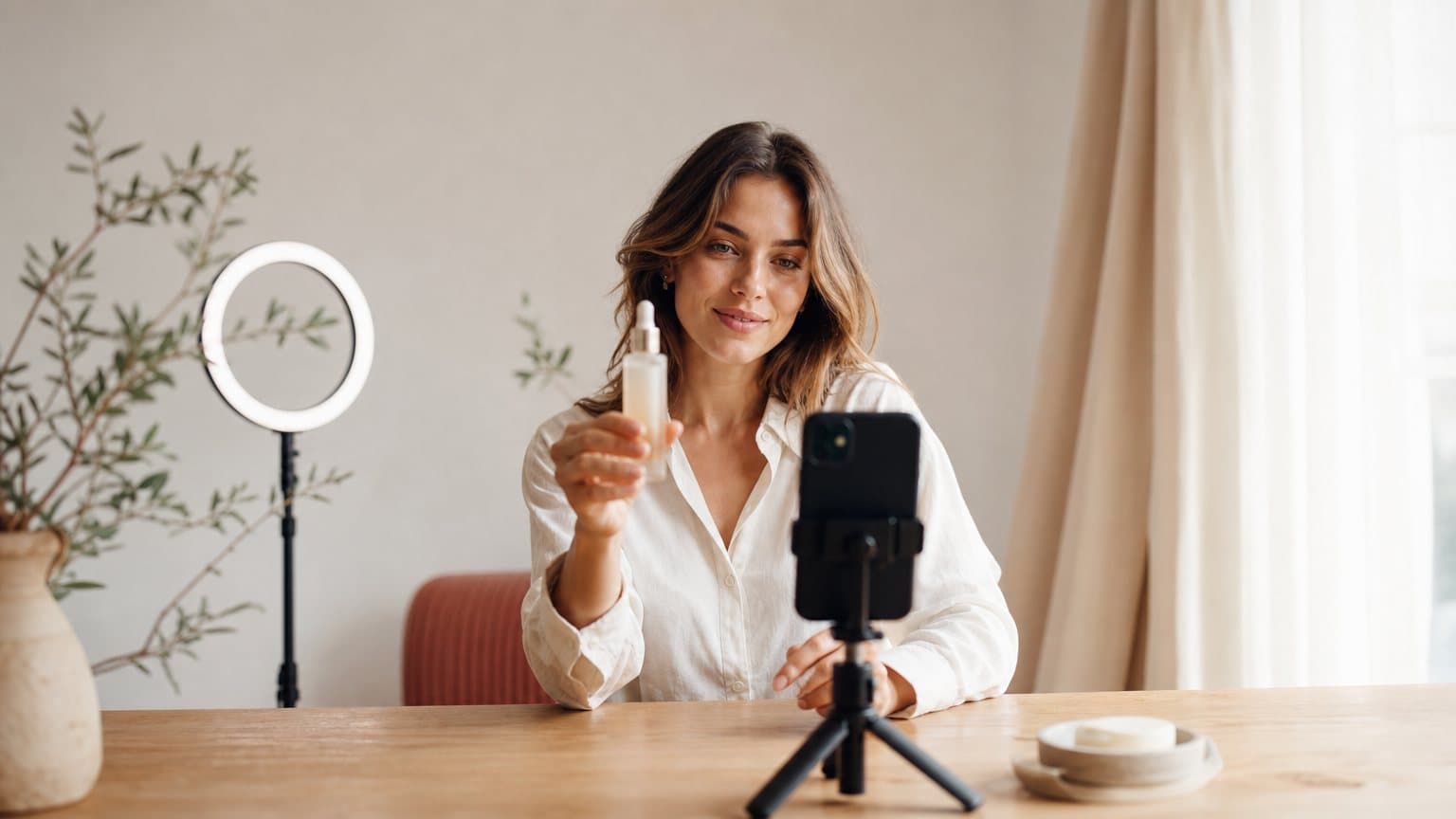
You skip the ads that look like ads
Open TikTok or Instagram and start scrolling. Count how many video ads you clock as ads inside the first second. The ones with a corporate logo, a studio voiceover, polished product graphics: gone, thumbed past before they finish a sentence. The ones that stopped you were probably a person talking to camera like a friend who found something good.
That second kind is a UGC ad, and it wins for a reason worth naming. 92 percent of consumers say they trust earned media, such as recommendations from friends and family, above all other forms of advertising. A UGC ad is a way to rent that signal on a schedule. This guide covers what UGC ads are, why they clear a bar that branded ads cannot, the formats that actually carry paid social, and how AI now lets you produce them by the dozen instead of one at a time.
What a UGC ad actually is
Made to look unpaid
UGC stands for User Generated Content. A UGC ad is a paid video engineered to look like something a real person posted: handheld, natural light, conversational, talking straight into the lens. The craft is making commissioned content read as spontaneous. If it looks produced, it stops being UGC and goes back to being an ad people skip. For the underlying concept, see what UGC is and what a UGC creator does.
A UGC ad vs. organic UGC
The word "user" is doing slippery work. Organic UGC is unpaid: a customer films themselves because they want to. A UGC ad manufactures that same look on purpose, and the brand owns the file and runs it as a paid placement. The aesthetic is identical; the intent and the rights are not. That ownership is the whole point, because you cannot scale a feeling you do not control.
The contrast in one table
The gap between a traditional ad and a UGC ad is not budget, it is posture.
| Traditional ad | UGC ad | |
|---|---|---|
| Look | Studio, lit, branded | Handheld, natural light |
| Presenter | Voiceover or none | Person to camera |
| Script | Feature list | Personal experience |
| Read as | "This is an ad" | "This is a tip" |
| Best home | Broadcast, hero spots | TikTok, Reels, feed |
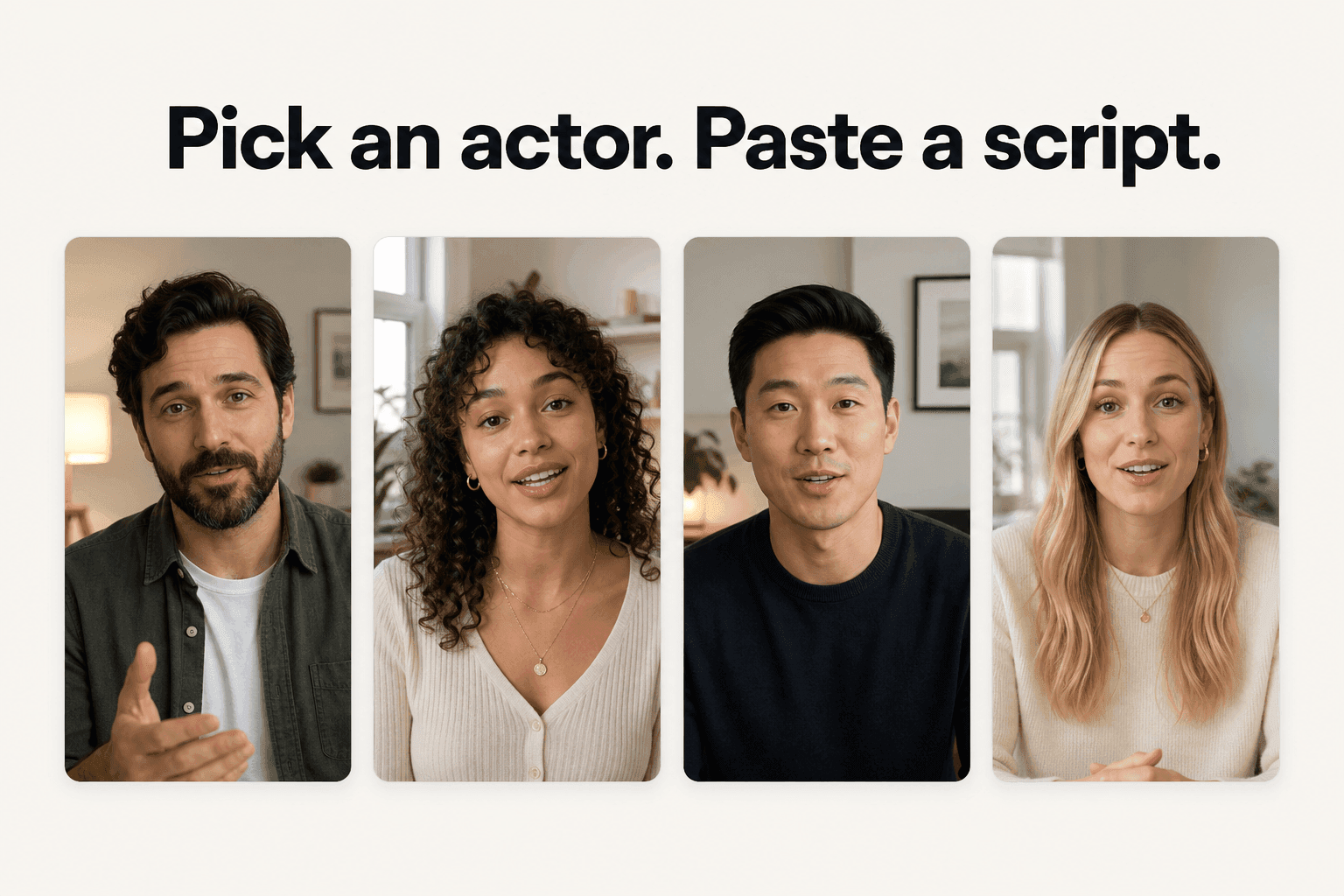
The Authenticity Arbitrage
Here is the idea this whole article turns on. A UGC ad runs an arbitrage: it buys the trust of unpaid, peer-to-peer content while being, in fact, paid advertising. Call it the Authenticity Arbitrage, the gap between how much credibility a real-seeming person earns and how little that performance actually costs to stage.
Trust the feed gives away for free
Word-of-mouth has been the most trusted form of persuasion for as long as anyone has measured it, and the feed is now where word-of-mouth lives. 65% of US consumers rely on UGC when making buying decisions, and 86% of shoppers engage with creator content before buying. A UGC ad is a deliberate attempt to stand inside that trust rather than outside it.
Why the brand voice gets discounted
A brand talking about itself is discounted on arrival, because everyone knows it is selling. A person who reads as a peer is not. The same sentence ("this fixed my dry skin in a week") carries more weight from a face in a kitchen than from a logo over stock footage. The arbitrage works because the listener applies a steep trust discount to one source and almost none to the other.
Where the arbitrage breaks
It is not free money. The arbitrage collapses the moment the content looks staged. The tells that hand back the discount are consistent:
- A set that looks art-directed instead of lived-in.
- A delivery with on-camera polish no friend would use.
- A claim so strong it reads as marketing, not experience.
Each one re-flags the video as an ad, and the discount you were capturing snaps back. The unhedged version: polish is the enemy here, and most brands lose the arbitrage by trying to make UGC look "nicer."
Why UGC ads clear the bar branded ads can't
The Scroll Tax
Every ad on a feed pays a tax in the first second: survive, or get thumbed away. Branded production pays it at the worst possible rate, because the cues that signal "ad" (logo, voiceover, gloss) are exactly what the scrolling brain is trained to skip. A UGC ad pays a lower Scroll Tax because it looks like the content around it. The first three seconds do all the work, which is why the hook matters more than the production.
Social proof on autoplay
Once the viewer stays, the format keeps paying off. A peer demonstrating the product is social proof delivered in motion, before the "Sponsored" label even registers. This is the same instinct that makes shoppers hunt for real photos and reviews: 60% of US consumers always search for customer images and videos before committing to a purchase. A UGC ad puts that proof in front of them instead of making them go look for it.
Lower resistance to the message
"Our product has 15 powerful features" triggers immediate resistance. "I have used this for a month and stopped reaching for anything else" sparks curiosity. The personal narrative disarms the defenses that a feature list raises. You are not arguing with the viewer; you are letting them overhear someone like them.
The formats that carry paid social
Most winning UGC ads are a small, repeatable set of shapes. Learn the five and you can brief almost anything.
- Direct testimonial. A person to camera on what changed for them. Simplest, often the strongest. Structure: "I had [problem], I tried [product], now [result]."
- Unboxing and first impression. The package, the reveal, the reaction. Best for physical products that look better in motion than in a photo.
- Tutorial and how-to. The product solving the exact problem it is sold against. Built for apps, SaaS, and anything with a learning curve.
- Day-in-the-life. The product woven into a routine. Longer, higher engagement, good for daily-use and subscription products.
- Comparison and before-after. A direct contrast or a visible change. Use it when your advantage is clear and demonstrable.
Match the format to the product
The format is not a coin flip; the product points to it.
- Physical and visual products. Unboxing and demo, where motion sells what a photo cannot.
- Apps and SaaS. Tutorial and problem-solution, showing the result in the interface.
- Daily-use and subscription. Day-in-the-life, weaving the product into a real routine.
Pick the angle before the script
The variables are few, which is exactly why the format is built to test. Choose the angle first (testimonial, demo, problem-solution), then write to it. The same product can support all five, and the winner is rarely the one you would have bet on.
The hook is the product
Across every format, the first three seconds decide whether the rest is seen. A good angle with a weak hook dies on the feed; a sharp hook buys attention for an average angle. Treat the opening line as the real deliverable. Three openers tend to clear the first second:
- The blunt result. "This cleared my skin in a week" before any setup.
- The pattern interrupt. A visual or claim that does not belong in the feed.
- The callout. "If you run paid ads, stop scrolling," naming the exact viewer.
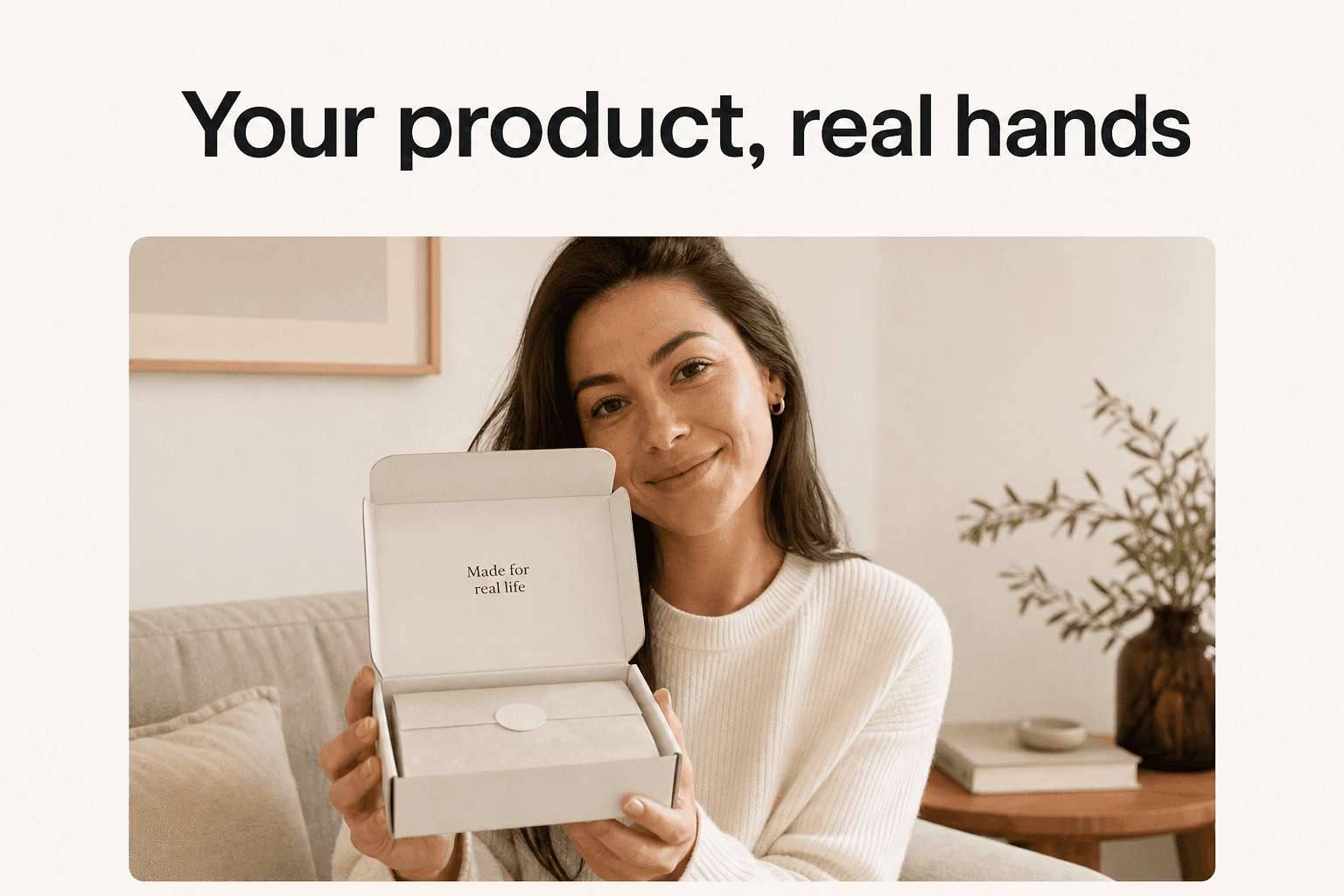
The Variation Gap
Why one perfect ad is the wrong goal
UGC's advantage is testing, not perfection. Because the winner is unpredictable, you have to run many to find it. But producing each variation the human way (a brief, a creator, a week of revisions) makes volume the most expensive thing you can do. That distance between the volume the format demands and the volume your budget allows is the Variation Gap, and it is where most UGC strategies quietly stall.
A worked example: cost per winner
Say you want one winning ad and decide to test ten angles. Suppose each hired creator clip costs you around $200, plus a brief and a round or two of revisions. That is roughly $2,000 and one to two weeks before a single ad goes live. So most brands skip it, ship one or two precious clips, and call it a campaign, using a testing medium to do no testing.
Now run the same ten angles with AI. In Novoads each clip lands in about four minutes and costs from about a dollar for a five-second Seedance 2.0 Mini clip to about $8 for an eight-second Seedance 2.5 clip, and about $26 for a full 30-second Seedance 2.5 take, so ten variants is about $10 to $80 in an afternoon. Same goal, a fraction of the budget and time. Put differently, the hired route makes each tested angle cost roughly $200; the AI route makes it cost a few dollars, so your cost per winner falls by the same multiple, and the experiment you used to ration becomes the default. The full production cost breakdown runs the numbers further, but the conclusion is plain: when each variation costs dollars instead of hundreds, you finally test the way the format always demanded.
How AI closes the gap
AI does not promise a better single video than a gifted creator. It closes the Variation Gap. When the tenth angle costs the same as the first, the math that forced you to bet on one ad disappears, and the relentless variation that paid social actually rewards becomes routine. For the head-to-head on when each route fits, see AI versus UGC creators.
When a human creator still earns the brief
Closing the gap does not retire human creators. It changes what you hire them for.
Hire a human creator when:
- You need one specific, recognizable face as a long-term ambassador.
- The piece is a flagship where the person is the message.
- A real lived demo (a sport, a craft, a physical transformation) is the proof.
Reach for AI when:
- You are testing many angles and need volume cheaply.
- You localize the same ad across markets, languages, and accents.
- You need a winner this week, not in three.
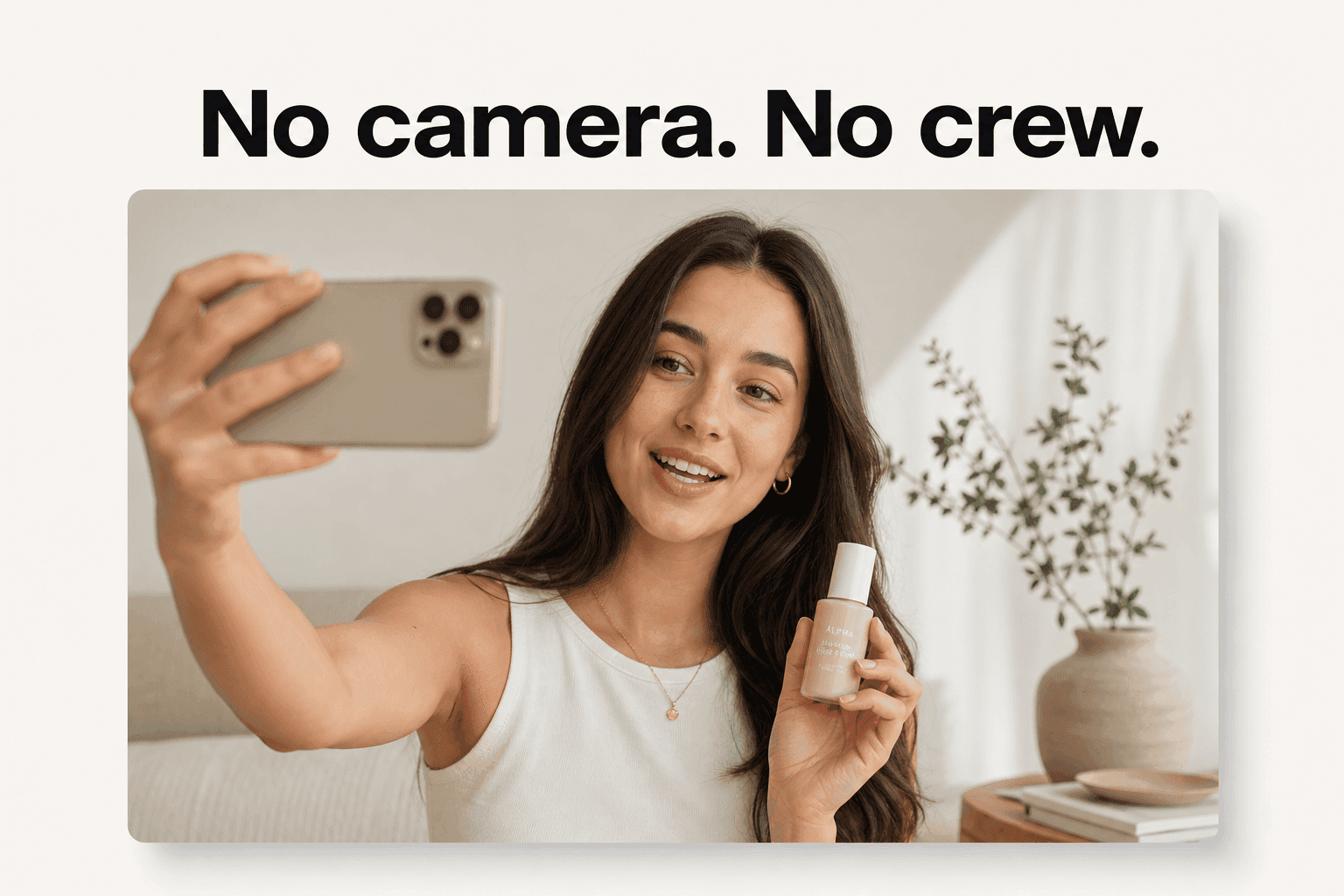
How to make a UGC ad with AI
The four-step flow
The traditional path means sourcing creators, sending briefs, and waiting days per revision. With AI the loop compresses to minutes:
- Write or auto-generate the script (a couple of minutes).
- Pick an AI actor that matches your audience's age, gender, and accent.
- Generate the video with voice, lip-sync, and captions (a few minutes of processing).
- Review and export in the aspect ratio your platform wants.
The advantage is iteration speed: ten variants in a sitting, testing the same day. Our step-by-step guide to creating UGC ads walks the whole flow.
Match the format to the platform
The same script gets cropped and paced differently per surface.
- TikTok. Vertical 9:16, 15 to 30 seconds, the fastest scroll. Shoot at least 720p, lead with the hook, keep it ultra-casual. TikTok's own creative guidance stresses making content native to the platform and earning attention in the first seconds.
- Instagram Reels. Also 9:16, 15 to 60 seconds, a slightly older and more aesthetic audience, a three-second grace window before the skip.
- Facebook feed. Square or vertical, broader age range, often watched on mute, so captions are mandatory.
- YouTube Shorts. Vertical and growing, a useful overflow surface for the same vertical cuts once TikTok and Reels are running.
Read the data, kill the losers
Launch the batch as a test, then let the numbers decide. Four metrics carry the read:
- Hook rate. Retention past the first three seconds. The cheapest signal that an angle is working.
- CTR. Clicks per impression. Tells you the hook earned the click, not just the view.
- CPA. Cost per acquisition. Compare it head-to-head against your branded ads.
- ROAS. Return on every ad dollar, and the only number that ends an argument.
Kill the losers fast, put budget behind the variant that beats your benchmark, and feed what you learned into the next batch. Our guide to improving ROAS with UGC goes deeper, and the broader tool landscape compares the platforms that do this.
How Novoads turns the arbitrage into a workflow
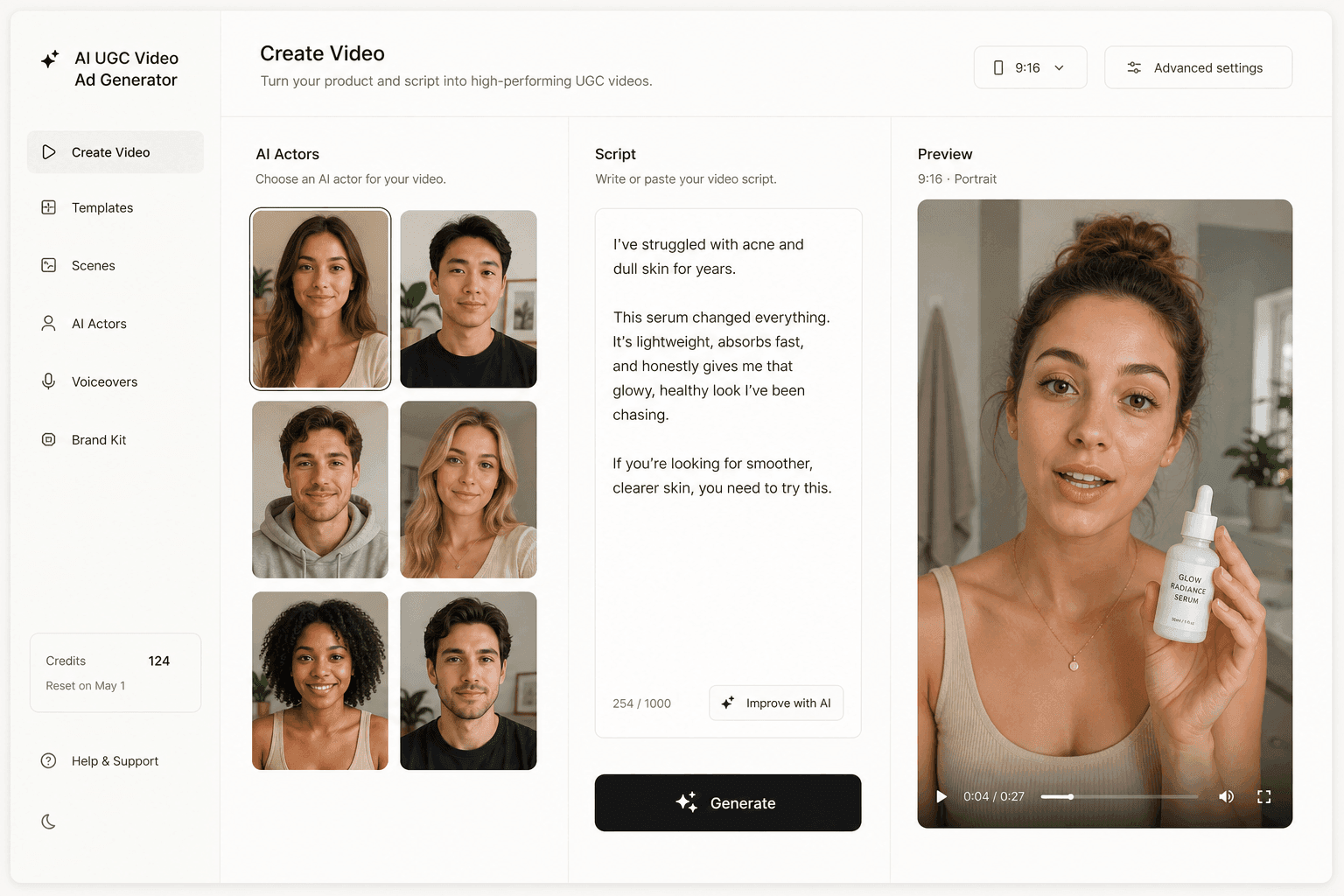
Novoads is a global AI UGC video-ad generator built to make the Authenticity Arbitrage repeatable. In Novoads, the input is a product photo plus a script, and the output is a finished ad:
- Pick from 100+ AI actors to talk about your product on camera. Library actors have empty hands, so for the product in hand, create a custom actor from a photo of someone holding it (Create Actor > Upload).
- HD, ad-ready output with voice, lip-sync, and captions in 9:16, 1:1, or 16:9, downloadable for any platform.
- About four minutes per clip, about a dollar to $8 per clip of up to eight seconds, from a five-second Seedance 2.0 Mini clip to an eight-second Seedance 2.5 clip, or about $26 for a full 30-second Seedance 2.5 take.
- Seedance, Kling, and Veo under the hood, in 30+ languages with real regional accents, so a Mexican, Argentine, and Castilian cut are three exports, not three shoots.
From product photo to ad in minutes
The product image plus a script is the whole input. That keeps the loop short enough to run the volume the format needs: brief an angle, generate it, and move to the next one before a hired creator would have replied to your email. Because the actor, accent, and aspect ratio are all knobs rather than reshoots, one approved angle becomes a dozen market-specific cuts without leaving the editor.
Where it fits next to other tools
The category has good options, and the right one depends on your workflow. Arcads runs multiple frontier video models (it names Sora 2 Pro) and localizes into more than 30 languages, with a premium, commit-first posture and pricing behind a sign-up. Creatify builds ads from a product URL and offers a watermarked free plan with affordable paid tiers, which suits high-volume URL-to-ad ecommerce. Novoads' fit is product-image-to-ad with real accents and a fast loop. For deeper reads, see our best Arcads alternatives and Novoads vs. Arcads.
Synthetic content, genuine trust
A UGC ad was never about the video. It was about the Authenticity Arbitrage: borrowing the trust people give a peer and putting it behind your product, in a format the feed actually rewards. That is why it converts, and it is why the brands winning on social are the ones running many variations instead of polishing one.
What changed is the price of running it. The trust signal used to be locked behind a creator's calendar and a few-hundred-dollar invoice per clip. Now it can be generated from a script in minutes, which means the testing the format always demanded is finally affordable. You can create your first UGC ad with Novoads for $49 a month. Cancel anytime.
Frequently Asked Questions
What does UGC mean in advertising?
UGC stands for User Generated Content. A UGC ad is a paid video built to look like organic content a real person would post: informal, shot on a phone, talking straight to camera. The difference from organic UGC is intent. A real customer makes organic UGC because they want to; a brand commissions a UGC ad and runs it as a paid placement, while keeping the unpolished, peer-to-peer look that earns trust.
Why do UGC ads outperform polished brand ads?
Because they do not read as ads. People filter out anything that looks like advertising in the first second of a feed, so a glossy brand spot gets skipped before its message lands. A UGC ad blends into the organic feed and is consumed as a recommendation, not a pitch. The mechanism is trust: 92 percent of consumers say they trust earned media, such as recommendations from friends and family, above all other forms of advertising, and a real-seeming person borrows that credibility in a way a brand talking about itself cannot.
Is it legal to create UGC ads with AI?
Yes. AI actors do not depict real, identifiable people, so there are no image-rights issues with the presenter. What still has to be true is the claim: whatever the actor says about your product must be accurate, exactly as it would for a human spokesperson. Some platforms are rolling out AI-disclosure rules for synthetic media, so check Meta and TikTok policy before you launch.
How many UGC ad variants should I run per campaign?
Run at least three to five live variants per ad set, because the winner is rarely the one you would have predicted. The practical play is to produce ten angles, launch them all on a small daily budget for a few days, keep the two or three that beat your benchmark, and scale only those. Refresh creative every couple of weeks before fatigue sets in. With AI you can generate that batch in an afternoon, so there is no longer a production excuse to test only one or two.
Which platforms work best for UGC ads?
TikTok and Instagram Reels, because their native organic format is already vertical, on-camera, and informal, which is exactly the UGC shape. Facebook feed works well in a square or vertical crop with captions, since much of that audience watches on mute. YouTube Shorts is a growing option. LinkedIn fits only specific B2B niches.
How much does it cost to make a UGC ad with AI?
A UGC ad generated with AI typically costs a few dollars rather than the few hundred a hired creator clip runs. In Novoads, a video lands in about four minutes and costs from about a dollar for a five-second Seedance 2.0 Mini clip to about $8 for an eight-second Seedance 2.5 clip, and about $26 for a full 30-second Seedance 2.5 take. The savings is not only per clip; it is that testing ten angles becomes affordable instead of a luxury. See our video ad production cost breakdown for the full math.


![How to Improve Your ROAS with AI-Generated UGC Video [2026]](/_next/image?url=%2Fblog%2Fcomo-mejorar-roas-con-ugc.jpg&w=3840&q=75)