
What Is a UGC Creator? Definition, Cost, and the AI Alternative
A UGC creator is someone a brand pays to make authentic-style videos and photos for the brand to post itself. Here is what they do, what they charge, and how AI now produces the same trust signal.

Mauricio Valdivia
·10 min

Why Brands Pay Strangers to Talk About Their Products
Ask a shopper whose opinion moves them on a product, and it is not the brand's. 79% of consumers say user-generated content heavily influences what they buy, versus 12% for a brand's own content and just 9% for influencers. The person who produces that content on purpose, for a brand to use, is a UGC creator.
If you have scrolled past a phone-shot clip of someone unboxing a product in their kitchen and felt it was more believable than the glossy ad next to it, you have already met the format. The creator behind it is not famous, is not necessarily posting to a big following, and may never appear on their own account. They were hired to make something that looks like it was not hired at all.
This guide is written for the brand side: what a UGC creator actually is, what they cost, why the content works, and how AI now produces the same effect at a fraction of the price and time.
What a UGC creator actually is
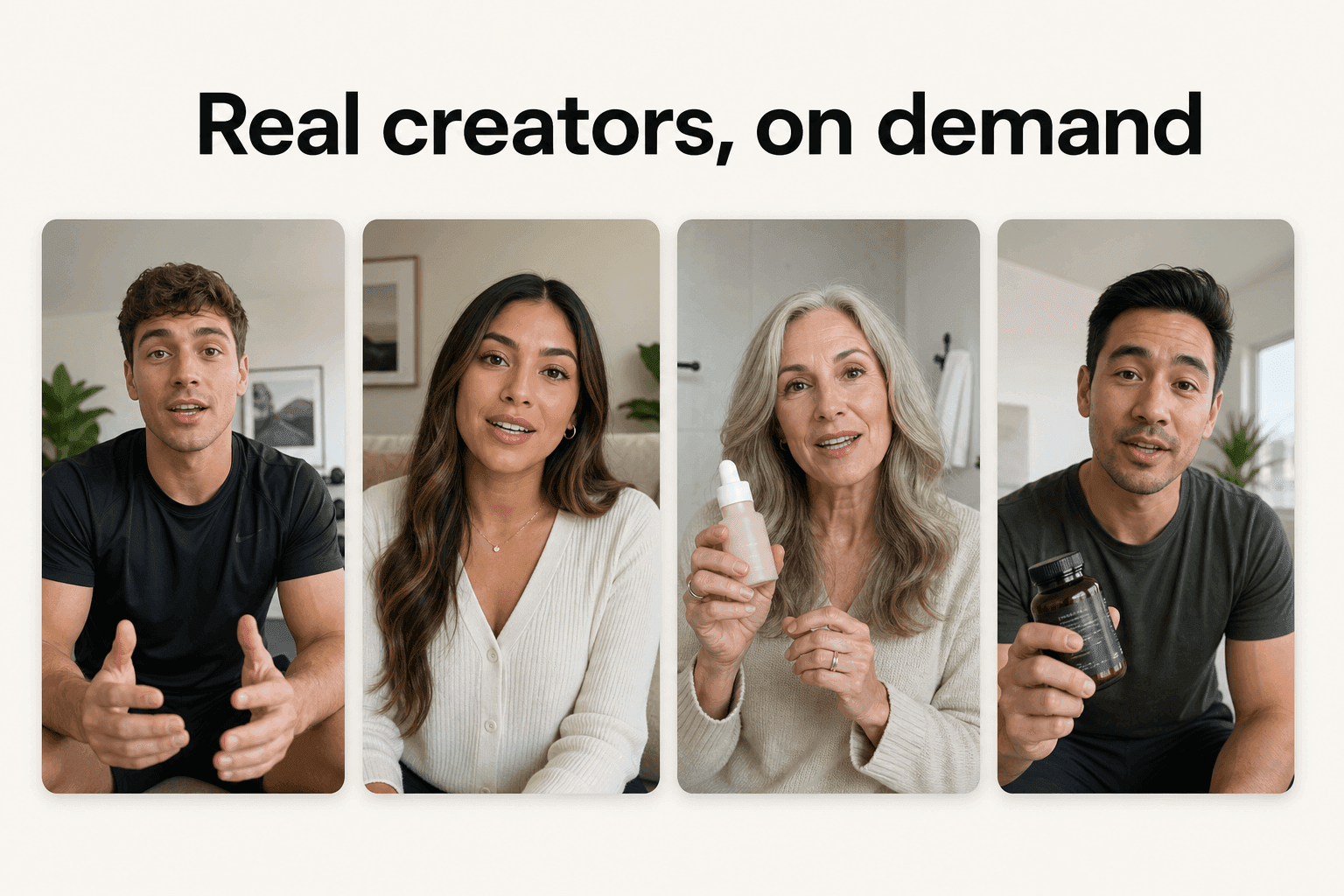
A UGC creator is someone a brand pays to produce authentic-style content (short videos, photos, or testimonials) for the brand to post on its own channels. The term is short for user-generated-content creator, and UGC creators are defined by the look of what they make, not by whether they are real customers. The content itself is user-generated content: material that reads as if it came from a real person rather than a marketing department.
The word "user" is doing something slippery here. Real UGC is unpaid: a customer films themselves and posts it because they want to. A UGC creator manufactures that same look on demand. The output is the same casual, handheld, talking-to-camera feel; the difference is that a brand commissioned it and owns the file.
That distinction matters because the entire value of the format rests on looking unpolished. A UGC creator's craft is making paid content read as unpaid.
The Trust Transfer: what you are actually buying
Here is the idea worth naming, because it explains every number in this article. When you hire a UGC creator, you are not buying a video. You are buying a Trust Transfer: the credibility of a real-seeming person, moved onto your product.
A brand talking about itself is discounted on arrival. Everyone knows it is selling. A person who looks like a peer is not. Consumers are roughly 3 times more likely to call content authentic when it comes from a person rather than a brand, and 59% name UGC the most authentic kind of content there is. Word-of-mouth has been the most trusted form of advertising for as long as anyone has measured it. A UGC creator is a way to buy that trust signal on a schedule.
Every tactic that follows, the unboxing, the testimonial, the "get ready with me," is just a vehicle for the Trust Transfer. Once you see the role this way, the question stops being "how do I get a video" and becomes "how do I produce this trust signal often enough to matter."
UGC creator vs influencer
The two get confused constantly, and the difference is the whole point. An influencer's product is distribution: you pay for access to their audience. A UGC creator's product is the asset: you pay for footage you own and post yourself. Our deeper breakdown of AI versus UGC creators goes further, but the short version:
| UGC creator | Influencer | |
|---|---|---|
| What you pay for | A content asset you own | Access to their audience |
| Who posts it | You, on your channels | They, on theirs |
| Where the value sits | The footage | The following |
| Typical use | Ads, product pages, organic | A sponsored post or story |
| You can run it as an ad | Yes, freely | Only with extra rights |
A creator with a large following can be both. But when a brand says "we need UGC," they almost always mean the asset, not the audience.
What UGC creators actually make
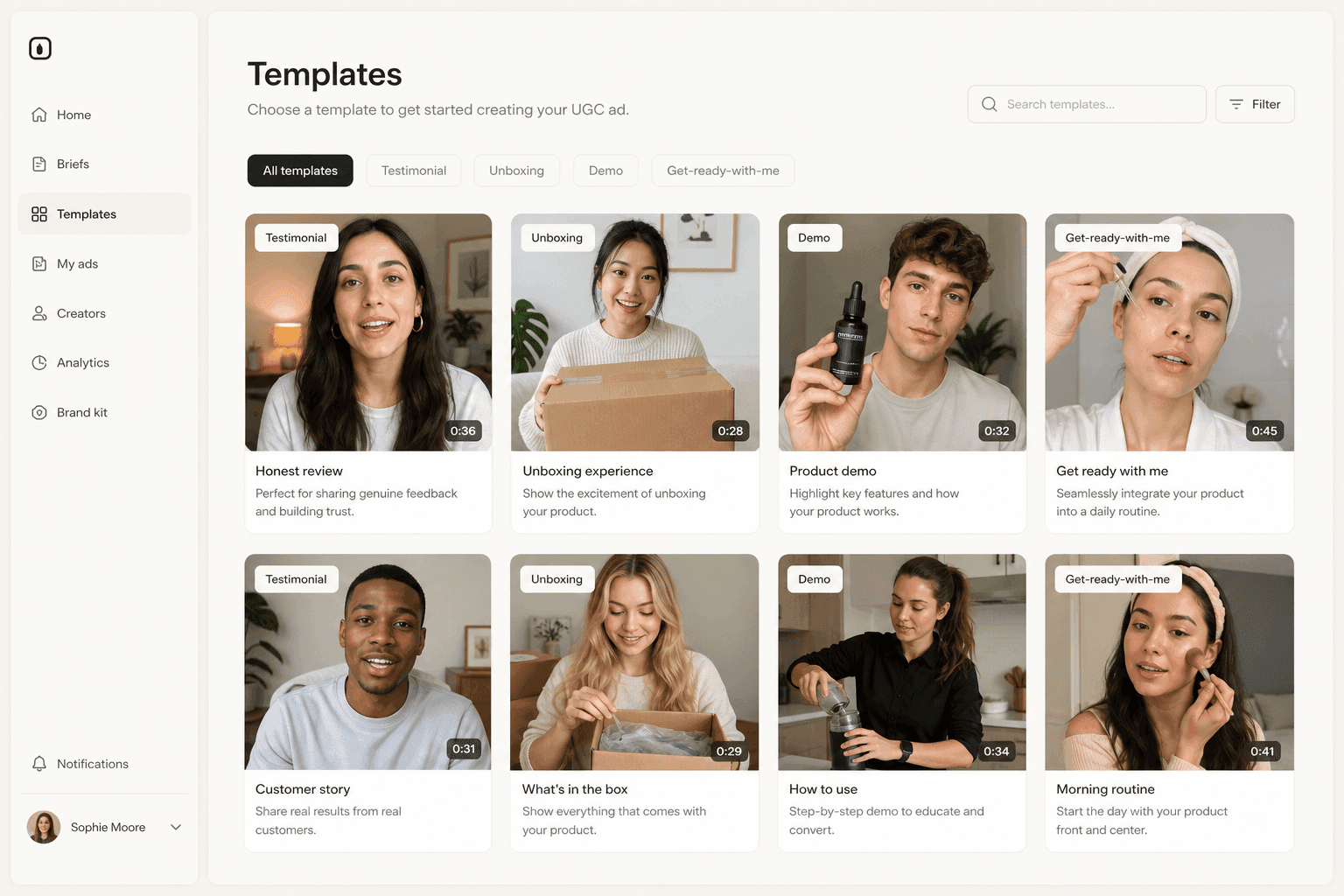
The deliverables are a small, repeatable set, because the format rewards familiarity:
- Testimonials. A person to camera explaining what changed for them.
- Unboxings and first impressions. The package, the reveal, the reaction.
- Demos and how-tos. The product solving the exact problem it is sold against.
- "Get ready with me" and day-in-the-life. The product woven into a routine.
- Problem-solution skits. A frustration in the first three seconds, the product as the turn.
None of these are hard to film. The skill is in the hook and the angle, not the production. That is also why the format is so easy to test: the variables are few, and the winners are unpredictable.
What it costs to hire one
Rates vary widely. A beginner clip runs around $50 to $100; mid-tier creators charge $150 to $500 per video; established creators go well past that, and the 2025 industry average lands near $198 per deliverable (Collabstr). Usage rights, revisions, and exclusivity all add on top.
But the sticker price is not the real cost. The real cost is what it does to testing. Say you want to try ten angles for one product. At roughly $198 each, that is about $2,000 and one to two weeks of briefs, drafts, and revisions before a single ad goes live. Our video ad production cost breakdown runs the full math, but the conclusion is simple: at human-creator prices, testing ten angles is a luxury most brands skip. They shoot one or two, hope, and call it a campaign.

Why UGC works: the performance case
The trust numbers show up in performance. Social posts featuring UGC drove over 10 times higher conversion than posts without it in Q3 2025. On the buying side, 95% of shoppers regularly read reviews and 60% search for customer photos and videos before they purchase. The demand is so strong that the number of UGC creators grew 93% year over year in 2025.
The takeaway is not "UGC is magic." It is that a real-seeming person clears the credibility bar that brand content cannot, and the platforms (TikTok, Reels, Meta) surface that native look over polished brand films. If you want the ROAS mechanics, our guide to improving ROAS with UGC goes deeper.
The Volume Bottleneck
Here is the trap. UGC's advantage is testing. The winning ad is rarely the one you would have guessed, so you need to run many to find it. But the human way of producing UGC makes volume the most expensive thing you can do. Each new variation is another brief, another creator, another week.
So brands get the format exactly backwards: they use a testing medium to ship one or two precious ads. The bottleneck is not creativity or budget. It is production throughput. The Trust Transfer is cheap to design and expensive to manufacture, and that gap is where most UGC strategies quietly stall.
How AI changes the Trust Transfer
This is the part that has shifted in the last two years. If what you are buying is a trust signal, a real-seeming person reading a script to camera, then the question is whether that signal has to come from a specific human. For volume testing, increasingly it does not.
AI UGC tools reproduce the same look from a script. In Novoads, you write or auto-generate a script, pick an AI actor that matches your audience's age, gender, and accent, and it produces a UGC-style vertical video with voice, lip-sync, and captions, formatted 9:16 for TikTok, Reels, and Meta. The headline time is about four minutes, and a clip runs from a few dollars rather than a few hundred. (You can also upload a product photo and turn it into an ad creative.) Our walkthrough on how to create UGC ads with AI covers the full flow.
The point is not that AI makes a better video than a talented creator. It is that AI removes the Volume Bottleneck. When each variation costs a few dollars and takes minutes, the testing the format was built for finally becomes affordable.
When to hire a human, when to generate with AI
Both have a job. A human creator is the right call when you need a specific real face, a long-term brand ambassador, or a flagship piece where the person is the message. AI is the right call when you need to run the relentless volume of variations that paid social actually rewards.
Most brands need far more of the second than they admit. One hero video does not make a testing program; thirty cheap variations do. The honest stance: if your UGC budget is going to a handful of expensive clips a quarter, you are paying creator prices for a job that is mostly about volume, and that is the exact mismatch AI was built to fix. For the head-to-head, see AI versus UGC creators, and our comparison of AI video ad platforms for the tools.
How to start, if you are a brand
A practical way in, whichever route you take:
- Pick one product and write three angles. A problem-solution, a testimonial, and a demo. Angles, not scripts, first.
- Write or generate a hook for each. The first three seconds decide whether the rest is seen.
- Produce variations, not one ad. Pair each angle with two actors or accents. Hiring, that is six briefs; with AI, it is six clips in a sitting.
- Launch them as a test, then read the data. Kill the losers fast, put budget behind the one that beats your benchmark, and feed what you learned into the next batch.
The full version of this loop lives in our guide to creating ads with AI.
The Trust Transfer, unlocked
A UGC creator was never selling video. They were selling the Trust Transfer: a real person's credibility, rented onto your product, in a format people actually believe. That is why it converts, and it is why the role exists at all.
What changed is the price of running it. The trust signal used to be locked behind a human's calendar and a $200 invoice per clip; now it can be generated from a script in minutes, which means a brand can finally test the way the format always demanded. You can produce your first AI UGC ad with Novoads from $49/month at novoads.ai. Cancel anytime.
Frequently Asked Questions
What is a UGC creator in simple terms?
A UGC creator is someone a brand pays to produce authentic-style content, usually short vertical videos but also photos and written testimonials, that the brand then posts on its own channels and ads. The point is that it looks like a real customer made it, not a polished studio. The creator hands over the footage; the brand owns and runs it.
What does UGC creator mean?
UGC creator is short for user-generated-content creator: a person a brand pays to make content that looks like a real customer made it, then hands over for the brand to post itself. The word user refers to the casual, real-person look of the content, not to whether the creator actually bought the product. So the meaning is a paid maker of unpaid-looking content.
What do UGC creators do?
UGC creators produce authentic-style content on demand for brands to post as their own: testimonials to camera, unboxings and first impressions, product demos, get-ready-with-me routines, and problem-solution skits. Unlike an influencer, they usually do not post to their own audience; they deliver a raw asset the brand owns and runs itself, most often as an ad.
What is the difference between a UGC creator and an influencer?
An influencer posts to their own audience, so you are paying for distribution and their followers' trust. A UGC creator usually does not post anything; they create content for you to post, so you are paying for a raw asset you own and can run as an ad. Many people do both, but the roles are different: reach versus content.
How much does a UGC creator cost?
Rates range from around $50 for a beginner clip to $500 or more per video for established creators, with the 2025 industry average landing near $198 per deliverable (Collabstr). Packages, usage rights, and revisions push it higher. The real cost, though, is time and volume: testing ten angles means ten briefs and one to two weeks of back-and-forth.
Do UGC videos actually convert better?
Yes, when used well. Social posts featuring UGC drove over 10 times higher conversion than posts without it in Q3 2025, and 79% of consumers say UGC heavily influences their purchases versus 12% for branded content. The mechanism is trust: a real-seeming person reads as more credible than a brand talking about itself.
Can AI replace a UGC creator?
For volume testing, increasingly yes. AI UGC tools let you write or auto-generate a script, pick an AI actor that matches your audience, and produce a UGC-style vertical video with voice, lip-sync, and captions in minutes for a few dollars. Human creators still matter for a specific face or flagship content, but for running many ad variations cheaply, AI is the practical tool.
How do you become a UGC creator?
Most start by filming a handful of spec videos for products they already own, building a small portfolio, and pitching brands directly or through creator marketplaces. This guide is written for the brand side (how to understand, hire, and increasingly automate UGC), not the creator-career side.
Key Takeaways
- A UGC creator is someone a brand pays to produce authentic-style content (short videos, photos, testimonials) for the brand to post on its own channels.
- What you actually buy is the Trust Transfer: a real-seeming person's credibility moved onto your product, and 79% of consumers say that kind of content drives their purchases versus 12% for a brand's own.
- It is not an influencer. An influencer rents you their audience; a UGC creator hands you a raw asset that you post yourself.
- Hiring runs roughly $50 to $500+ per video (about $198 average per deliverable in 2025), and the cost is what makes testing many angles slow and expensive.
- AI UGC reproduces the same trust signal from a script in minutes for a few dollars, which is what makes testing at volume finally affordable.

![What Is UGC? A Complete Guide to User-Generated Content [2026]](/_next/image?url=%2Fblog%2Fque-es-ugc.jpg&w=3840&q=75)