
Video Ad Production Cost in 2026: Traditional, AI, and the Cost-to-Test
Traditional video ad production runs from a few thousand to tens of thousands per project. AI tools produce a finished ad for a few dollars. Here are the real 2026 ranges, and the cost math that actually decides your creative budget.

Mauricio Valdivia
·11 min
The expensive part was never the video
Video is used by 91% of businesses, and it is the format every major ad platform rewards. Yet most small advertisers still ration it. They ask what a single video costs, see a four- or five-figure quote, and quietly decide that video advertising is for companies with bigger budgets.
That instinct prices the wrong thing.
The expensive part of video advertising was never the video. It is finding the one ad that actually converts, and finding it takes many tries. A studio that sells you a single beautiful clip has solved the cheap problem and left you the costly one.
This guide breaks down the real video ad production cost ranges in 2026, traditional and AI side by side, then introduces the cost math that should actually drive your budget: not what one video costs, but what it costs to find the one that works.
What "video ad production cost" actually includes
Before comparing numbers, it helps to see what the number is made of. A quote is rarely just "a video." It is a stack of line items, most of which are people and time.
The five things you are really paying for
A traditional video ad bundles five distinct costs:
- Scripting and concept. The idea, the hook, the shot list.
- Talent and casting. Actors, voiceover, or a hired creator. Often the single largest line.
- Filming. Crew, equipment, location, and the day rate that comes with them.
- Editing. Cutting, pacing, and assembling the raw footage.
- Post-production. Color, sound, motion graphics, captions, and reformatting for each platform.
Any one of these can dominate the bill. The reason a 15-second clip and a 60-second explainer cost so differently is that each step scales with length and complexity.
Why the sticker price understates the bill
The quote you are given is for one finished video. Real campaigns rarely need just one, and the extras are rarely in the headline number. Sitting on top of the base price, usually billed separately:
- Variations. The same idea in several hooks, lengths, and aspect ratios.
- Usage rights. Paying again to run the footage as a paid ad, or to keep running it.
- Revisions. Each round of changes after the first cut.
- Refreshes. New creative every few weeks as the old set fatigues.
The headline figure is the floor, not the ceiling. A studio that quotes you a clean number for one video has, in effect, quoted you for the cheapest part of the job.
The number that actually matters
Here is the shift in thinking the rest of this guide builds on. The useful unit is not cost per video. It is cost per winning ad: how much you spend, across an entire test, to surface the one creative that beats your benchmark. A cheap video that loses costs you more than an expensive one that wins. Hold that thought; it reappears as the framework below.

What traditional production costs in 2026
The honest range is enormous, which is part of why the question feels so hard to answer. Here are real 2026 figures, grouped by what you are making.
Social and UGC-style clips
For short, social-first content, social media content runs $1,500 to $5,000 per piece in a typical production engagement. If you hire a freelancer rather than an agency, freelancers charge $600 to $1,200 per filming day, and a single day usually yields one or two finished clips after editing. That is the floor of the market, and it is already enough to make an SMB hesitate before testing anything.
What moves you within that band is mostly scope. A single talking-head setup with one creator sits near the bottom; multiple locations, props, or a scripted scenario push toward the top. Either way, you are committing real money to a shoot before you know whether the concept works, which is the part that should worry you most.
For context on what these clips are and why they convert, see our explainer on what a UGC creator is.
Explainers, demos, and brand films
Move up the production ladder and the numbers climb fast:
- Explainer videos: about $4,500 to $20,000 for a finished piece.
- Commercials and brand films: the top of the band, with multi-day shoots and a full professional crew.
- All project types combined: $1,500 to $50,000+ per project, depending on scope.
These are real prices for real value, and for the right moment they are worth every dollar. They are simply the wrong tool for weekly creative testing, where the job calls for many cheap shots on goal rather than one expensive masterpiece.
Freelancer vs agency vs in-house
The structure you choose mostly shifts who carries the overhead, not whether it exists:
- Agency. Highest rate, but project management and reliability come included.
- Freelancer. Cheaper per day, though you coordinate the moving pieces yourself.
- In-house team. Trade cash for salaried capacity and a fixed monthly cost.
Outsourcing is still the norm. 42% of businesses rely on external video creators in some capacity, which tells you most companies have never internalized this cost at all. Whichever route you take, the variable that breaks budgets is not the rate. It is how many videos you actually need.
What AI video production costs
This is the line item that has changed most in the last two years. AI does not make the five-part cost stack cheaper. It removes most of it.
From a script to a finished ad
With an AI UGC tool like Novoads, you upload a product image, write or auto-generate a script, and pick an AI actor from a library of over a hundred to talk about your product on camera (library actors have empty hands, so to show the product in hand you upload a photo of someone holding it as a custom actor). The output ships ad-ready, with voice, lip-sync, captions, and 9:16, 1:1, or 16:9 formatting, in about four minutes, at about a dollar to $8 per clip of up to eight seconds, from a five-second Seedance 2.0 Mini clip to an eight-second Seedance 2.5 clip, or about $26 for a full 30-second Seedance 2.5 take. Because nothing has to be re-shot, swapping the actor, the accent, or the hook is a new generation rather than a new project, so the second variation costs the same few dollars as the first. Adoption has followed the math: 63% of businesses now use AI to create videos, up sharply year over year. Our walkthrough on how to create UGC ads with AI covers the full flow.
What you stop paying for
The price drops because the line items disappear, not because the work is skipped. With AI you no longer pay for:
- Casting and talent. No actor, voiceover artist, or hired-creator day rate.
- Crew and studio. No camera operator, lighting, location, or shoot day.
- Editing. No separate editor assembling and pacing the raw footage.
- Post-production. Captions, lip-sync, and per-platform reformatting are produced automatically, not billed as a separate stage.
You are paying for compute and a script, not for a calendar full of people. That is the whole reason the per-video number falls from thousands to a handful of dollars.
The honest catch
AI is not the better tool for every job. It does not give you:
- a specific, recognizable human face your audience already trusts;
- the lived texture of a real customer telling their own story;
- a director's control over a one-off, on-set creative moment.
For a flagship film where the person is the message, that matters. For the relentless volume of variations that paid social rewards, it does not. We compare the two cases directly in AI versus UGC creators.

The Cost-to-Test: the framework that changes the math
If you remember one idea from this guide, make it this one. Call it the Cost-to-Test: the total cost of running enough creative variations to find an ad that beats your benchmark. It, not the price of a single video, is what your budget actually has to cover.
Why one ad is a guess
Run a single ad and you are not advertising, you are guessing with conviction. Three forces make that guess unreliable:
- Unpredictable winners. The best-performing hook is almost never the one the team predicted.
- A platform bias for fresh. Meta, TikTok, and YouTube reward native, novel creative and surface it over polished films.
- Creative fatigue. Even a winner decays as the audience sees it, so the test never fully ends.
Winners are found by testing angles, not by polishing one. Our guide to writing ad hooks goes deeper on why the first three seconds decide the test.
The Variation Tax
Traditional production charges what is best described as a Variation Tax. Every new hook is another script and another take; every new cut is another editing pass; every new aspect ratio is another reformat. Because each variation is re-quoted, the cost of testing scales linearly with the number of ideas you want to try. The medium whose entire advantage is testing becomes the one where testing is most expensive.
Worked example: testing ten angles
Say you want to test ten angles for one product before committing budget. Watch what the Cost-to-Test does to each method.
| Approach | Cost per video | Ten variations | Turnaround |
|---|---|---|---|
| Agency or freelancer | $1,500 to $5,000 | $15,000+ | Days to weeks |
| AI (Novoads) | About a dollar (five-second Seedance 2.0 Mini) to $8 (eight-second Seedance 2.5); about $26 for a 30-second Seedance 2.5 take | $10 to $80 | Minutes each |
The Cost-to-Test makes the gap impossible to ignore:
- Traditional: a five-figure commitment over several weeks of briefs and revisions, which is why most small advertisers never run the test. They shoot one or two, hope, and call it a campaign.
- AI: less than the cost of a single freelance day, generated in one afternoon, with the losers killed the same week and budget moved behind the winner.
The Cost-to-Test, not the cost per video, is what moves a real testing program from impossible to routine. It reframes the budget question from "can I afford a video" to "can I afford to keep guessing." The downstream payoff shows up in how testing volume improves ROAS.
When traditional production still earns its price
A balanced answer matters here, because "AI is always cheaper" is true and useless. Cheaper at what?
The hero film and the real customer
When you need a flagship brand film, a real customer's genuine testimonial, or content shot on a specific location, traditional production is the right call and the cost is justified. These are the pieces where the person and the place are the point, and no generated stand-in replaces them.
Brand moments where polish is the message
For a launch centerpiece, a homepage hero, or a campaign meant to signal that the brand has arrived, production value itself communicates. That is exactly the job the $4,500-to-$20,000 explainer band exists to do. A skincare brand launching a hero serum, for example, might commission one cinematic film for the homepage and the launch, then generate dozens of AI variations to actually run and test as ads. Spend on production value deliberately, for the moment that needs it, not by default for every clip.
The hybrid budget
The practical model is a split, not a switch:
- Use AI for the roughly 80% of creative that needs to be fresh, fast, and tested at volume: hooks, social variations, product demos, and retargeting cuts.
- Reserve traditional production for the rare flagship where it is the message: a brand film, a real customer's testimonial, or a location shoot.
Run the cheap variations first and let the data tell you which concept deserves a real shoot. If your entire video budget is going to a handful of expensive clips a quarter, you are paying production prices for a job that is mostly about volume. For a fuller comparison of the AI tools available, see our roundup of the best AI video ad platforms.
How Novoads solves the Cost-to-Test
Demand for this kind of content is still climbing: the number of UGC creators surged by 93% year over year, and 65% of US consumers rely on UGC when making buying decisions. The bottleneck was never appetite. It was the cost of producing enough of it to test. That is the gap Novoads is built to close.
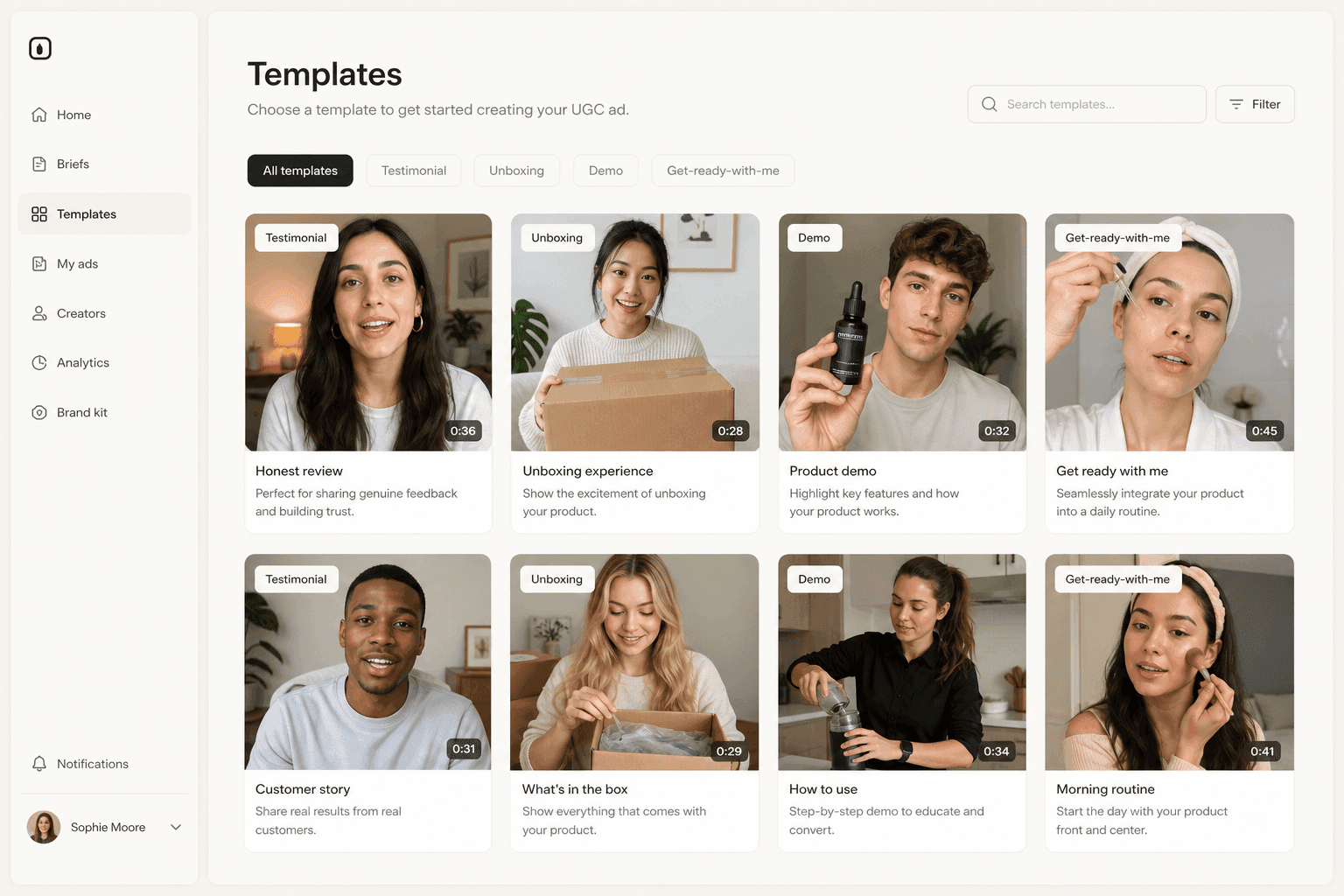
From a product photo to a finished ad
The loop is four steps, with no filming and no editing software:
- Upload a product image and write or auto-generate the script.
- Pick an AI actor who matches your audience by age, gender, and accent.
- Generate the ad with voice, lip-sync, and captions, in 30+ languages with real regional accents.
- Download it in 9:16, 1:1, or 16:9, ready for any ad platform.
You can produce your first one in Novoads in about four minutes. The deeper view of why this format converts lives in our guide to UGC ads.
Why a few dollars per video unlocks volume
At about a dollar to $8 per clip of up to eight seconds, from a five-second Seedance 2.0 Mini clip to an eight-second Seedance 2.5 clip, or about $26 for a full 30-second Seedance 2.5 take, ten variations cost the price of lunch rather than a quarter's creative budget. That is the whole point: a low per-video cost is what makes the Cost-to-Test affordable, and an affordable Cost-to-Test is what finally lets a small brand test the way paid social actually rewards. Access starts at $49/mo, with cancellation any time.
Where it fits, and where it does not
Novoads is the volume engine, not the flagship-film studio. It is the right tool for the dozens of UGC-style variations a testing program needs, and a deliberately wrong one for the single hero shoot built around a specific real person. Used that way, it does not replace your production budget; it stops you from spending it on the cheap problem.
Cost is a testing problem, not a production problem
The question "how much does a video ad cost" has a misleading answer, because it asks about the cheap problem. One video has always been affordable to someone. What was never affordable, at traditional prices, was running enough variations to learn which video wins.
That is the real shift in 2026. The trust signal of a believable person reading a script to camera used to be locked behind a casting call and a four-figure invoice; now it can be generated from a script in minutes for a few dollars, which means the Cost-to-Test finally drops to where a small brand can pay it. Test cheaply, find the winner, and spend your production budget only where it is the message. You can produce your first AI video ad with Novoads from $49/month at novoads.ai. Cancel anytime.
Frequently Asked Questions
How much does a video ad cost to produce in 2026?
It depends entirely on the method. Traditional production ranges from about $1,500 to $50,000+ per project, with social-style clips around $1,500 to $5,000 and explainers around $4,500 to $20,000 (Vidico). AI video tools produce a finished UGC-style ad for a few dollars; with Novoads a clip costs from about a dollar for a five-second Seedance 2.0 Mini clip to about $8 for an eight-second Seedance 2.5 clip, and about $26 for a full 30-second Seedance 2.5 take. The gap is not small: it is the difference between affording one video and affording thirty.
Is an AI video ad as effective as a traditionally produced one?
For performance marketing (paid social, retargeting, direct response), AI-generated UGC-style ads compete well, because what wins on those surfaces is a believable person and a strong hook, not cinematic polish. For a brand film built on emotional storytelling or a specific real customer, traditional production still has the edge. Most advertisers need far more of the first than they run.
How much does it cost to make a video ad with AI?
With Novoads, a finished UGC-style video ad costs from about a dollar for a five-second Seedance 2.0 Mini clip to about $8 for an eight-second Seedance 2.5 clip, and about $26 for a full 30-second Seedance 2.5 take, and takes about four minutes from script to download. You start on the Starter plan at $49/month, which includes 50 credits. There is no separate casting, crew, studio, or editing bill, because voice, lip-sync, captions, and platform formatting are produced automatically.
Why do I need so many video variations?
Because the winning ad is rarely the one you would have guessed. Ad platforms reward fresh creative and the best-performing hook is unpredictable, so you find it by testing several angles, not by perfecting one. That is the Cost-to-Test: your real budget is the cost of running enough variations to surface a winner, which is exactly where a high per-video price hurts most.
Can AI replace my video production agency?
For the volume layer of performance marketing, largely yes: UGC-style ads, product demos, and social variations are well within reach of AI tools at a fraction of agency cost. For a flagship brand film, a location shoot, or content built around a specific real person, an agency still earns its fee. The practical model is hybrid, not all-or-nothing.
How long does it take to make a video ad with AI?
About four minutes for a UGC-style ad in Novoads: you upload a product image, write or auto-generate a script, pick an AI actor, generate, and download. The whole loop fits in one sitting with no filming, no editing software, and no technical skills, which is what makes producing ten variations in an afternoon realistic.
Key Takeaways
- Traditional video ad production costs are wide: social-style clips run roughly $1,500 to $5,000 each, and full projects span $1,500 to $50,000+, per Vidico's 2026 breakdown.
- AI tools collapse the per-video cost. With Novoads a finished UGC-style ad takes about four minutes and costs from about a dollar for a five-second Seedance 2.0 Mini clip to about $8 for an eight-second Seedance 2.5 clip, and about $26 for a full 30-second Seedance 2.5 take, because you stop paying for casting, crew, and most post-production.
- The Cost-to-Test is the number that actually decides your budget: not what one video costs, but what it costs to find the one ad that converts, which always takes several tries.
- Traditional production charges a Variation Tax: every new hook or cut is another shoot or edit, so testing ten angles is priced out of reach for most small advertisers.
- The honest answer is a hybrid: AI for the high volume of variations performance marketing rewards, traditional production for the rare flagship film where a specific real person is the message.


![How to Improve Your ROAS with AI-Generated UGC Video [2026]](/_next/image?url=%2Fblog%2Fcomo-mejorar-roas-con-ugc.jpg&w=3840&q=75)