
Arcads Alternatives for AI UGC Ads: 7 Tools and What a Test Month Costs
Arcads keeps its price behind a sign-up. Seven alternatives, each entry price paired with the billing basis it is quoted on, and what a five-angle test really costs.

Mauricio Valdivia
·14 min

The cheapest tier advertised is rarely the cheapest sold
A performance marketer wants to test whether AI UGC can sell a new skincare serum. She opens Arcads, picks an actor, writes a hook, and the preview is genuinely good: natural delivery, lip-sync she has to look twice to clock. Then she goes to check what a month costs, and there is no public price. Checked again on 2026-09-19, www.arcads.ai/pricing returned HTTP 404 and the homepage navigation offered Features, Industries and a sign-up. To see plans, she has to create an account.
So she does what every marketer does next and lines the alternatives up by price. That is where the second problem starts, and it is the one this post exists to fix. The entry numbers in this category are printed on four different billing bases, and lining them up as if they were the same number produces a ranking that is wrong on its face. Captions is the sharpest case. Its pricing page leads with Max at $24.99/mo, and the same page footnotes "Features and prices reflect iOS plans only." Follow that footnote into Captions' own help centre and you find two cheaper paid plans the pricing page never shows.
Arcads earned its reputation. It makes some of the most believable AI UGC talking-head ads in the category, with a homepage that markets "1,000+ Captivating AI Actors", the option to "create your own AI Avatar", actors that can hold and present a physical product, and frontier video models under the hood. The question is rarely whether Arcads is good. It is whether it fits your product, and what a month of finding out costs on each of the alternatives, stated honestly.
The seven alternatives, and what each one charges to start
Every price below is paired with the basis it is quoted on, because that pairing is the whole comparison. A monthly list price, a yearly rate divided by twelve, an App Store subscription and a trial door are four different products wearing the same dollar sign.
| Tool | Best for | Entry price as published | The basis it is quoted on |
|---|---|---|---|
| Novoads | Native-accent UGC, product in hand via a custom actor | $15/month (Starter) | Monthly list price, published on the pricing page, no trial |
| Creatify | Paste-a-URL ecommerce volume | $39/month | Monthly list, Starter, 100 credits (2026-09-19) |
| MakeUGC | The biggest advertised actor library | $59/month | Monthly list, Start up, 500 credits (2026-09-19) |
| Captions | An actor plus a built-in editor | $24.99/mo | iOS in-app price, per the page's own footnote (2026-09-19) |
| HeyGen | Spokesperson and avatar video | $29/month | Monthly list; $24/month if paid annually (2026-09-19) |
| Synthesia | Corporate training, 160+ languages | $29/month | Monthly list; $18/month, $264/year, billed yearly (2026-09-19) |
| HeyFish | Price-led, high-volume output | $24.99/mo at our last reading | Last verified 2026-06-26; unverifiable on 2026-09-19, see below |
| Arcads | The realism benchmark | Not published | www.arcads.ai/pricing returned HTTP 404 on 2026-09-19 |
Pick the category before you pick the price
The first filter is not money, it is output, and picking the wrong category is the expensive mistake, because no plan tier fixes a tool that makes the wrong kind of video.
Reach for a UGC-actor tool (Novoads, MakeUGC, Creatify) when:
- The ad should feel handheld and native, like a real customer filmed it.
- The creator should hold, wear or demonstrate your product on camera.
- You are running paid social and need many angles cheaply.
Reach for an avatar or corporate tool (HeyGen, Synthesia) when:
- You want a polished spokesperson or presenter, not a phone-shot vibe.
- You are making training, explainer or internal-comms video.
- Studio-clean delivery matters more than looking unscripted.
If you are still deciding whether AI can replace a hired creator at all, our guide on AI versus UGC creators is the better starting point, and what a UGC creator actually is covers the format itself.

Four entry prices, four different billing bases
Every roundup in this category, including an earlier version of this one, prints a column of dollar figures and invites you to read down it. That column is not a ranking. Here is what each kind of number actually promises.
Monthly list, yearly rate, app store, trial door
- A monthly list price is what your card is charged thirty days from now if you change nothing. Creatify's Starter and MakeUGC's Start up are quoted this way: Creatify's page reads "Starter For creators and solopreneurs $39 / month 100 credits / mo", MakeUGC's reads "Fixed amount of 500 credits/mo $59 $59 per month".
- A yearly rate shown as a monthly figure is a twelve-month commitment divided by twelve. Synthesia publishes both on one page, Starter at $29 a month billed monthly and $18 a month billed yearly, and its FAQ states the arithmetic plainly: "Synthesia costs $29 per month or $264 if you go with an annual plan." HeyGen does the same: "the Creator plan costs $29/month (or $24/month if you pay annually)".
- An app-store price is a subscription bought through a phone, which is why it can differ from what the same vendor charges on the web. That is Captions, and it is the case worth reading closely.
- A trial door is a first-payment figure, not a plan price. MakeUGC's Pro card carries the strings "$149", "$1 per month", "Renews at $149" and "Start for $1" together, which is the honest shape of a trial: a cheap first month attached to a $149 plan.
Both of Synthesia's numbers are true, and only one of them is what a single test month costs. That is the whole problem in one line.
Captions: the footnote, and the two tiers it hides
Captions' pricing page, fetched live on 2026-09-19, shows Max at $24.99/mo with 500 credits, then Scale at $69.99, $139.99 and $279.99, then Enterprise. Its FAQ confirms a zero-cost tier exists: "Yes, there is a free version of Captions." At the bottom of the plan cards sits one line of small print: "Features and prices reflect iOS plans only."
That footnote is doing real work. Captions' own help centre, on the same domain, documents two paid plans the pricing page never lists. Basic, formerly called Pro, "costs $9.99 USD per month and comes with 200 credits that renew monthly". Lite "is available on Captions Android and costs $4.99 USD per month", and the same page adds that "The Lite subscription plan can only be restored and used on Android."
So $24.99 is the cheapest tier Captions advertises, not the cheapest tier it sells. For a buyer sizing a test month that gap is the most useful fact on the page, and the pricing page alone will never tell you. The tiers are not equivalent, Basic carries 200 credits against Max's 500 and a narrower feature set, but a reader who only needs to see whether the actor lands can find out for $9.99 instead of $24.99. A deeper read of that ladder lives in our Captions alternatives comparison.
A correction, because this post got it wrong first
Until today this article carried "paid plans from $24.99" in its own title, and its own body refuted that twice. It listed HeyFish's entry plan at the same $24.99, so the figure was never uniquely lowest even inside our own table. And it described MakeUGC's $1 first month as a published paid entry, which is below $24.99 on any reading. A floor price an article contradicts twice is not a floor, it is a headline. The title now sells the comparison rather than a number, every row carries its basis, and that is the rule worth taking with you into any other roundup you read: a "from $X" claim is only meaningful when every X was checked on the same basis on the same day.
Why Arcads' own number is missing from that table
What we fetched, and what it returned
We checked rather than assumed. On 2026-09-19, www.arcads.ai/pricing returned HTTP 404. The homepage at www.arcads.ai loaded normally and its navigation offered Features, Industries, Login and Sign up, with no plans, billing or pricing entry. This matches what we found on 2026-09-08 and again on 2026-09-17. There is no public plans page to read before you create an account. That is not a criticism of the product, it is a description of the funnel, and it is the single biggest reason marketers price the alternatives first.
What Arcads does publish
Arcads is not opaque about the meter, only about the plan. Its public help centre article on how credits are counted prices talking actors at 800 credits per minute, per actor, and prices video generation models per generation rather than per minute, with separate rows for tools like captions and translation. You can therefore work out relative consumption inside Arcads before you know what a credit costs you, which is a strange place to be left. We keep a running read of that meter in our Arcads pricing breakdown.
The three days behind the sign-up
One thing sits behind the sign-up that is worth naming, because it changes the shape of a first test. Arcads' help centre article on requesting a refund says that "If your 3-day trial ended without you cancelling, your saved card was automatically charged for the Starter plan", and it tells you to cancel from Billing settings before the seventy-two hours are up. So there is a short evaluation window, it is documented, and it converts into a paid plan by default. That is a fair offer and a real deadline. It is also not a published price, which is the thing a buyer is trying to compare.
What Arcads actually does well
Before ranking alternatives it helps to be precise about what you are replacing, because Arcads does more than the talking-head label suggests, and a one-sided comparison is worth nothing.
Realism and actor depth
This is the real reason Arcads commands a premium, and it shows up in three places: performance realism, with micro-expressions and lip-sync most viewers cannot flag as synthetic; actor depth, a library its homepage puts at "1,000+ Captivating AI Actors" plus the option to "create your own AI Avatar"; and hook testing, one script batched across many actors in a single run.
For pure spokesperson-style UGC the output quality is the benchmark other tools are measured against. Weigh the alternatives on fit and on what a test costs, not on an expectation that they beat Arcads on raw realism. Realism is largely a property of the rendering engines, and the serious tools in this list rent the same frontier engines as each other.
Multiple models, and product on camera
Two capabilities matter for this comparison. Arcads runs multiple frontier video models, and on 2026-09-19 its homepage was headlining "Seedance 2.5 is live", so its output is not tied to a single rendering engine. And its actors can hold and present a physical product through a custom-actor workflow, not only talk about one, while localizing into "more than 30 languages" by its own count. The alternatives below do not win by filling a gap Arcads has. They win, where they win, by doing a specific job better for a specific situation, or by telling you the price first.
The seven alternatives in detail
1. Novoads, best for product-led UGC in many languages
Novoads is a global AI UGC video-ad generator built around the part of the job ecommerce cares about: the actor presents your actual product. You write or auto-generate a script and pick an AI actor; for a vertical ad where the creator holds the item, you create a custom actor from a photo of someone holding it (Create Actor > Upload), because a stock library actor's hands are empty. It runs multiple frontier models (Seedance, Kling and Veo), and it ships ads in 30+ languages with real regional accents, not just translated captions.
- Best for: native-accent UGC where the product is on camera.
- Start at: $15/month, Starter, 200 credits per month, monthly list price.
2. MakeUGC, best for the biggest advertised actor library
MakeUGC is the closest direct comparison to Novoads: a script-first generator with a very large advertised creator library, "1000+ realistic AI creators" on its own pricing page, and actors that can present your product. Its published ladder on 2026-09-19 is Start up at $59 a month for 500 credits, Growth at $79 for 1,000, and Pro at $149 for 2,000, where "Product in hand videos" appears as a listed feature. MakeUGC also sells a trial door: the Pro card reads "$1 per month", "Renews at $149" and "Start for $1" in one block, so the cheap entry is a first payment against a $149 plan, not a plan.
- Best for: maximum actor variety, if you are buying the monthly plan rather than the trial.
- Start at: $59/month monthly list, or a $149 plan opened through a one-dollar first month. A fuller read sits in our MakeUGC alternatives comparison.
3. Creatify, best for paste-a-URL ecommerce volume
Creatify's signature is workflow speed for ecommerce: point it at a product URL and it generates an AI-avatar ad, with batch generation for running many at once, and its higher tier adds a competitor ad tracker. Its pricing page on 2026-09-19 served three cards, Starter at $39 a month with 100 credits, Pro at $99 with 300, and Enterprise on request. The zero-cost route still exists, but as an answer rather than a card: the same page's FAQ says "The Free Plan includes 10 monthly credits" and that "Exports include a watermark." It leans more avatar-and-template than native-handheld, but for paste-and-go catalog volume it is hard to beat.
- Best for: URL-to-ad batch volume.
- Start at: $39/month monthly list, with a watermarked zero-cost plan described in its FAQ.
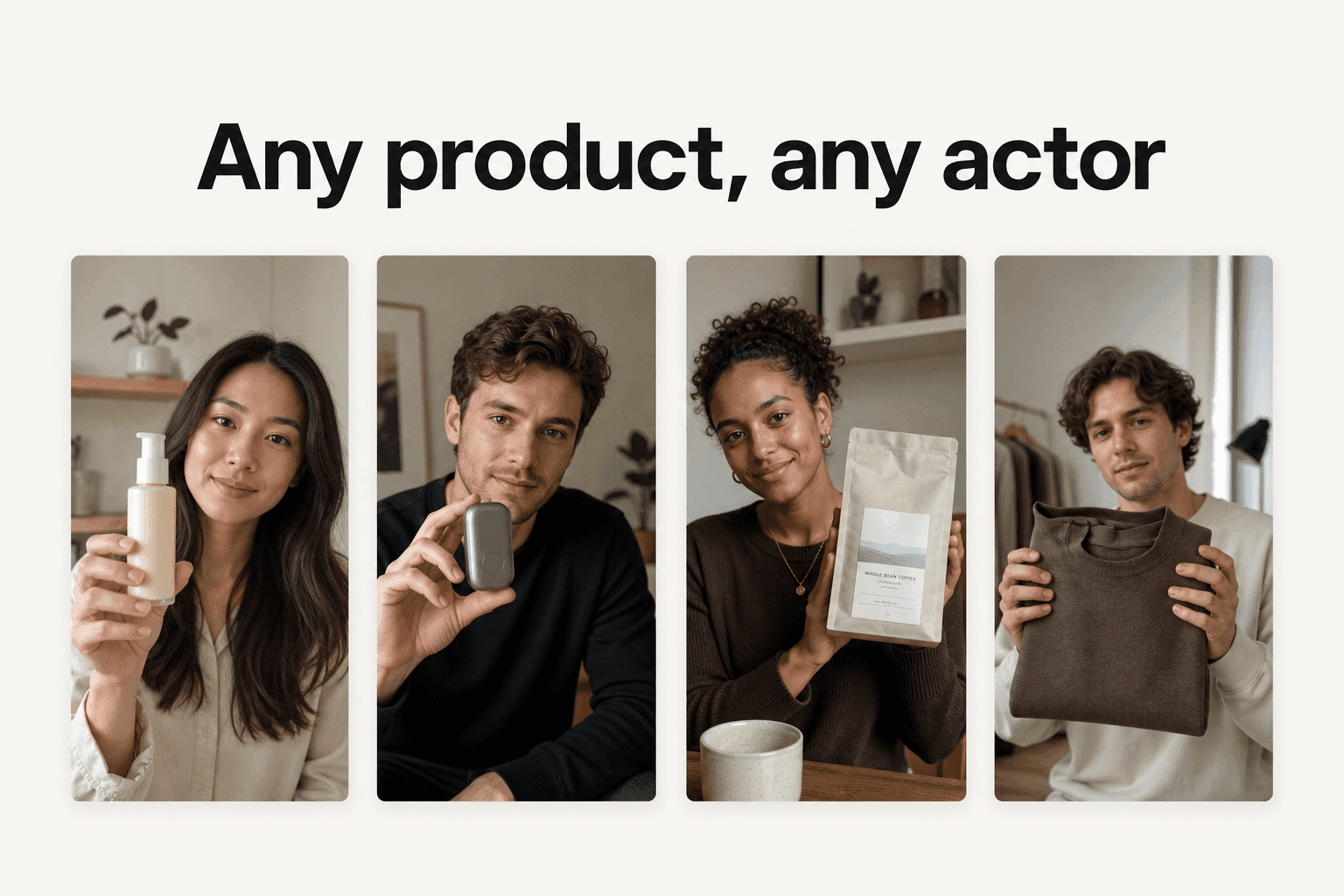
4. Captions, best for an all-in-one actor plus editor
Captions (by Mirage) pairs AI creators with a built-in, chat-based AI video editor in one app, so the clip and the edit live in the same place instead of bouncing to another tool. Its pricing page leads with Max at $24.99/mo for 500 credits, and that figure is scoped by the page's own footnote to iOS plans. If you want generation and editing without a second subscription, it is the most complete single workflow here, and the cheapest way to sample it is the $9.99 Basic tier its help centre documents rather than the $24.99 the pricing page shows.
- Best for: one app for actor and edit.
- Start at: $24.99/mo advertised, quoted as an iOS price; $9.99/month Basic and an Android-only $4.99/month Lite documented in the help centre.
5. HeyGen, best for spokesperson and avatar video
HeyGen is built around AI avatars and spokesperson-style delivery rather than handheld, phone-shot UGC. It is excellent for a clean presenter reading a script, for explainer video, and for personalized video at scale. Its published ladder on 2026-09-19 starts with a zero-cost plan capped at "3 videos per month", then Creator at $29 a month, which its FAQ prices at $24 a month if you pay annually. For an ad that should look like a real customer in a kitchen it is the wrong category; for a polished talking head representing the brand it is a strong pick.
- Best for: polished spokesperson and avatar video.
- Start at: $29/month monthly list, $24/month on the annual commitment.
6. Synthesia, best for corporate training and reach
Synthesia is the enterprise end of AI video: studio-clean avatars, deep localization across "160+ languages", and a feature set aimed at training, onboarding and internal communications. On 2026-09-19 its page showed a Basic plan at $0 a month and Starter at $29 a month billed monthly, with the yearly equivalent at $18 a month and the FAQ stating "Synthesia costs $29 per month or $264 if you go with an annual plan." It is not built to look unscripted, so it is a poor fit for native social UGC, but for polished, multilingual corporate video it is a category leader.
- Best for: training and 160+ language reach.
- Start at: $29/month monthly list, $264 a year on the annual plan.
7. HeyFish, the one we could not reach
HeyFish belongs in this list on the record: it is a direct AI UGC video-ad generator with price-led positioning, and at our last verification, on 2026-06-26, its entry paid plan was $24.99/mo. We could not confirm anything about it today. On 2026-09-19, heyfish.ai returned HTTP 522, a Cloudflare connection timeout between the edge and the origin, and www.heyfish.ai and its pricing path timed out without answering, checked three times from two machines.
We are not going to tell you what that means. A 522 is an origin that did not answer a request on one day, and it is equally consistent with a migration, an outage and something worse. What we can say is the only thing we can source: the figure above is a June reading, nobody should plan a test month around it, and until the site answers again, treat any HeyFish price you see quoted anywhere, including here, as unverified.
- Best for: unverifiable today.
- Start at: not confirmable on 2026-09-19.
A worked example: five angles on one skincare serum
Say you want to find a winning angle for a single serum, and you plan to test five: a problem-solution hook, a testimonial to camera, a morning-routine clip, an ingredient explainer, and an unboxing. The format rewards running all five, because the winner is rarely the one you would have guessed. The only real question is what it costs to find out, and now that every price carries its basis, the arithmetic is honest.
What the five angles cost on a stated basis
- The zero-cost route: Creatify's FAQ-described plan gives 10 monthly credits with watermarked exports, HeyGen's caps you at three videos a month, and Captions and Synthesia each publish a limited tier. Between them you can get rough cuts of several angles for nothing out of pocket, enough to judge whether the actor and the hooks land, not enough to run them.
- The smallest real paid month: $9.99 on Captions Basic, if editing plus a limited credit pool is what you need, or $24.99 on Captions Max for the generative actor features, both quoted as iOS prices. Neither puts your product in a creator's hand.
- The product-in-hand month: $15 on Novoads (Starter) with a custom actor built from a photo of someone holding the serum, or $149 on MakeUGC's Pro tier where product-in-hand sits, reachable through its one-dollar first month. These are the paths where the demo is the ad.
- The commitment path: on Arcads you take the documented 3-day window, then a Starter charge you have not seen priced in advance.
Where the arithmetic usually goes wrong
Two mistakes do most of the damage. The first is comparing an annual-equivalent number against a monthly one, which makes HeyGen and Synthesia look roughly $5 cheaper than a single test month on either actually is. The second is treating a trial door as a plan price, which is how a one-dollar entry gets ranked below a $24.99 subscription when the plan behind it is $149. Read the basis column, not the dollar column, and rank the tools that can make your kind of ad. For the wider economics of the format, our video ad production cost breakdown runs the math against hiring a creator, and improving ROAS with UGC covers what to do once an angle wins.

How Novoads solves product-led UGC
Novoads is built for the exact job that makes ecommerce teams leave a talking-head tool: an ad where the creator holds your actual product, in a language your audience actually speaks. You write or auto-generate a script, pick an AI actor or create a custom one from a photo of someone holding your product (a stock actor's hands are empty), and get a vertical UGC ad with voice, lip-sync and captions, formatted for TikTok, Reels and Meta. It runs multiple frontier models so you are not betting on one engine, and it produces ads in 30+ languages with real regional accents rather than a flat translation. The headline time is about four minutes.
The price is one line, on one basis: $15/month, Starter, 200 credits every month, published on our pricing page, cancel anytime. There is no free tier and no trial here, which is a worse headline and a more comparable number. Our comparison of AI video ad platforms goes broader, and Novoads versus Higgsfield covers a closer head-to-head.
Fit beats realism, and a stated basis beats a low number
The best Arcads alternative is not the one with the most lifelike actor, and it is certainly not the one with the smallest number on a pricing page. It is the one that makes the ad your product needs, at a price you can actually compare, for the least it costs to find out. Arcads is the realism benchmark, and for a team that already knows it wants polished talking heads, it is a fair premium to pay. For everyone still testing whether AI UGC moves the needle, the smarter move is to read the basis under every price, start at the cheapest point that can show your product, and let the data pick the tool. You can produce your first product-in-hand AI UGC ad with Novoads, using a custom actor made from a photo of someone holding your product, from $15/month at novoads.ai.
Frequently Asked Questions
What is the best Arcads alternative?
It depends on what Arcads is missing for you, not on a single winner. For product-led ecommerce UGC where the creator should hold and present your product (in Novoads, through a custom actor made from a photo of someone holding it), and for native-accent delivery across many languages, Novoads is the closest fit. For the largest advertised AI-actor library, MakeUGC. For paste-a-product-URL volume, Creatify. For spokesperson video, HeyGen; for corporate training, Synthesia; for an actor plus a built-in editor, Captions. Pick the category first, then compare prices on a stated basis, because the printed entry numbers in this category are quoted on four different ones.
How much does Arcads cost?
Arcads does not publish a self-serve price. Checked on 2026-09-19, www.arcads.ai/pricing returned HTTP 404 and the homepage navigation offered Features, Industries and a sign-up, so plans are visible only inside the product. What Arcads does publish is the meter: its help centre article on how credits are counted prices talking actors at 800 credits per minute, per actor, and prices video models per generation. Its refund article also documents a 3-day trial, stating that if the trial ends without you cancelling, your saved card is charged for the Starter plan. Specific monthly figures circulate on third-party blogs; they are not confirmed on Arcads' own site, so treat any exact number with caution.
Can an Arcads alternative show a product in the creator's hands?
Yes, and so can Arcads itself through its custom-actor workflow. Among alternatives, Novoads is built around product-in-hand UGC through two routes: a custom actor made from a photo of someone holding your product (Create Actor > Upload), or a Discover product template, which swaps your uploaded product image into the creator's hand. A stock library actor's hands are empty, so pick one of those two for the demo. MakeUGC lists "Product in hand videos" on its Pro card, and Creatify's avatar page says "You can even have them hold your product." For ecommerce, where the demo often is the ad, that product-on-camera capability matters as much as raw realism.
Which Arcads alternatives publish their prices, and on what basis?
Most of them, but on different bases, which is the trap. Checked live on 2026-09-19: Creatify lists Starter at $39 a month with 100 credits, MakeUGC lists Start up at $59 a month with 500 credits, HeyGen lists Creator at $29 a month and says the same plan is $24 a month paid annually, Synthesia lists Starter at $29 a month and $18 a month billed yearly, and Captions lists Max at $24.99/mo under a footnote reading "Features and prices reflect iOS plans only." Creatify, HeyGen, Synthesia and Captions each also describe a zero-cost tier on their own pages. Novoads has no free tier and no trial: it starts at $15/month.
Arcads vs Creatify: which is better?
They solve different jobs. Arcads produces more realistic talking-head performances and markets a large library of natural AI actors, which is why agencies that have validated the format pay its premium. Creatify is built for paste-a-product-URL workflows and high-volume batch generation, and it publishes its ladder: Starter at $39 a month for 100 credits, Pro at $99 a month for 300, checked 2026-09-19. Its pricing page now serves three plan cards, and the watermarked zero-cost plan survives on the same page as an FAQ answer rather than a card. If realism is the priority, Arcads. If speed, published pricing and ecommerce volume are, Creatify.
Do AI UGC ads actually perform?
User-generated content is the format shoppers trust, because a real-seeming person reads as more credible than a brand talking about itself. AI UGC reproduces that trust signal from a script in minutes for a few dollars, which is what makes testing many ad angles affordable. The tool you pick decides how close the output gets to a real creator and whether you can show your product on camera.
Key Takeaways
- Arcads is the realism benchmark for AI talking-head ads: its homepage markets a library of "1,000+ Captivating AI Actors", the option to "create your own AI Avatar", frontier video models, and "more than 30 languages". Its actors can also hold and present a physical product.
- The reason most teams look past Arcads is rarely quality, it is price visibility. On 2026-09-19 www.arcads.ai/pricing still returned HTTP 404, so plans appear only after you create an account. Arcads does publish its credit mechanics, and its help centre describes a 3-day trial that charges your saved card for the Starter plan if you do not cancel.
- The entry prices in this category are not comparable as printed. Creatify's $39/month and MakeUGC's $59/month are monthly list prices; HeyGen's $29/month and Synthesia's $29/month each sit beside a cheaper yearly rate on the same page; Captions' $24.99/mo is footnoted as an iOS price.
- Captions' $24.99 Max is the cheapest tier its pricing page advertises, not the cheapest tier it sells. Captions' own help centre documents Basic at "$9.99 USD per month" with 200 credits, and an Android-only Lite at "$4.99 USD per month", neither of which appears on the pricing page.
- Match the tool to the ad. Novoads, MakeUGC and Creatify make native handheld UGC; HeyGen is built for spokesperson video; Synthesia for corporate training; Captions bundles an actor and an editor.
- Novoads fits product-led UGC best: upload a photo of someone holding your product and a custom actor holds it on camera, it runs multiple frontier models, it ships ads in 30+ languages with real regional accents, and it starts at $15/month (Starter, 200 credits per month).