Arcads Pricing in 2026: Plans, the 800-Credit Talking Actor, and the 3-Day Trial
Arcads has no public pricing page, but its help centre publishes the meter: 8,000 credits a month on Starter, 16,000 on Creator, and 800 credits per talking-actor minute, or per Arcads 1.0 video of up to 2 minutes, depending on the article. Here is what that buys, where Arcads shows its prices, and how the 3-day trial bills.

Mauricio Valdivia
·Updated ·13 min

Ten talking-actor videos a month, priced behind a signup
A growth lead at a supplement brand has until Friday to put Arcads into next month's creative budget. She types arcads.ai/pricing into her browser. It returns a 404.
That is not a broken link. Arcads publishes no pricing page, and its site navigation offers Features, Industries and a sign-up button. The price list lives inside the app, on a billing page you reach after you sign up with an email.
Here is the short version, as Arcads' in-app billing page showed it on October 6, 2026:
- Starter: €100 a month for 8,000 credits, or €80 a month billed yearly.
- Creator: €200 a month for 16,000 credits, or €160 billed yearly.
- Pro: €500 a month for 40,000 credits, or €400 billed yearly.
- Scale: €1,000 a month for 80,000 credits, or €800 billed yearly.
- Business: €2,000 a month for 160,000 credits, or €1,600 billed yearly.
- Custom: priced on request ("Tailored to you", with a Contact us button).
Yearly billing is 20% off every plan, with the same credits. The billing page says talking-actor video runs about 800 credits a minute, so Starter's 8,000 credits cover up to 600 seconds, ten minutes, of talking avatar a month; Arcads' pricing article, updated October 14, 2026, prices an Arcads 1.0 video of up to 2 minutes at 800 credits, which would make that ten videos of up to two minutes each. A 3-day trial charges your saved card for Starter unless you cancel before the 72 hours are up.
A disclosure before the detail: we make Novoads, an AI UGC ad tool that competes with Arcads for the same buyers. How we read the prices: on Arcads' in-app billing page, after signing up, on October 6, 2026. arcads.ai has no public pricing page, and the billing page showed euros to a visitor in Spain, so prices may differ by region; we did not see the US-dollar figures. Every other Arcads figure below comes from Arcads' own help centre, terms and homepage, read on September 18, 2026 and checked again on October 22, 2026, and carries the date of the page it came from.
Arcads' plans: prices, credits and limits
Five plans, from €100 to €2,000 a month
This is the plan table on Arcads' in-app billing page as of October 6, 2026, with monthly billing, in euros as shown to a visitor in Spain:
| Plan | Price a month | Yearly, per month | Credits a month | Talking avatar (up to) | AI video clips (up to) | Natural AI Actors | Avatar reactions (up to) | Free NanoBanana images a month |
|---|---|---|---|---|---|---|---|---|
| Starter | €100 | €80 | 8,000 | 600 sec | 50 | 300 | None | 200 |
| Creator | €200 | €160 | 16,000 | 1,200 sec | 100 | 1,000 | 100 | 1,000 |
| Pro | €500 | €400 | 40,000 | 3,600 sec | 300 | 1,500 | 100 | 3,000 |
| Scale | €1,000 | €800 | 80,000 | 7,200 sec | 600 | 1,500 | 100 | 5,000 |
| Business | €2,000 | €1,600 | 160,000 | 14,400 sec | 1,200 | 1,500 | 100 | 10,000 |
| Custom | On request | On request | Custom | Custom | Custom | Custom | Custom | Custom |
Every plan lists a maximum resolution of "Up to 4K" and a maximum video length of "Model's max", which Arcads defines as the longest single clip a plan can generate, across every model. Each paid plan has its own Choose button, so Pro, Scale and Business are bought from the same page as Starter; only Custom says Contact us. Arcads' help article "How to buy more credits?", dated July 30, 2026, lists the same 8,000 and 16,000 allowances for Starter and Creator.
Arcads' newer public article "How does Arcads pricing work?", updated October 14, 2026, agrees on Starter and Creator but lists Pro at 48,000 credits a month, Scale at 96,000 and Business at 192,000. It names no prices ("Current prices are on the pricing page in the app") and says Arcads tests new pricing from time to time, so your account may use different rates or plan sizes. Our reading: those larger allowances are exactly what the billing page's own talking-avatar row implies at 800 credits a minute (3,600 seconds on Pro, 7,200 on Scale, 14,400 on Business), so check the credit figure on your own billing page before you budget.
What each tier adds
The features block under the table adds three steps:
- Every plan: access to all models (Arcads says every current image and video model, including new releases), access to MCP ("connect Arcads to Claude, Cursor & more") and access to the Agent.
- Creator and up: Workflows to automate full-video pipelines, plus remove background and AI captions.
- Pro and up: unused credits roll over, API access, team collaboration (seats), the ElevenLabs integration, Custom Actors (clone your own) and direct Slack and calls with the Arcads team.
Rollover, overage, upgrades and cancelling
The pricing FAQ on the same billing page sets the rules, as of October 6, 2026:
- Starter and Creator are capped. They stop at their monthly credits, and to get more you upgrade from the Billing page; the new credits apply immediately. Their credits reset each cycle and do not roll over.
- Pro, Scale and Business roll over and bill overage. Credits you haven't used by your renewal date carry into the next cycle, and usage past the monthly credits is added to your next invoice.
- Upgrades charge the full new price that day. The new credits are added on top of your current balance, and your billing date resets to the day you upgrade.
- No pay-per-video. Arcads runs on monthly or yearly subscriptions only.
- Cancel any time. Cancel from Billing in your account settings and you keep full access until the end of your current cycle. Unused credits are lost if you cancel or downgrade.
The July 30 help article tells the same story in its own words: Starter and Creator accounts are temporarily blocked at the monthly limit, and on Pro, Scale and Business unused credits accumulate while the subscription stays active and extra usage is charged per credit.
Standard offers and customized offers in the terms
Arcads' terms and conditions, in force since October 16, 2026, describe the same split in contract language. Standard offers are the plans described on the platform. A customized offer is made after a call and summarized at the time of purchase. Three pricing rules hang on that split:
- Running out. On a standard offer, exceeding your credits means waiting for the subscription to renew or requesting a customized offer. On a customized offer, Arcads invoices the additional credits each month.
- API access. The terms say the API is only accessible to a client who subscribes to a customized offer. The October 6 billing page lists API access on Pro and up, and so does the October 14 pricing article, so ask which of the two applies to your plan before you build on it.
- Currency and tax. Prices are in US dollars unless otherwise specified, and fees exclude local, national or foreign taxes.
If you plan to drive Arcads from code, that API line is the first pricing question to ask, before any per-minute math. The assistant route works differently, and our guide to Arcads' MCP and Claude Code skills covers it.

Where Arcads shows its prices
Prices on the in-app billing page, after signup
Arcads shows its prices after you create an account, on a billing page inside the app (Settings, then Billing), and its help centre sends plan upgrades through the in-app paywall. That is why a search for Arcads pricing turns up no price list on arcads.ai: the figures are real, but they sit downstream of a signup. Arcads' own pricing article says as much: "Current prices are on the pricing page in the app."
We read them there on October 6, 2026 and dated every one. The page served euros to a visitor in Spain, so a visitor elsewhere may see another currency or other prices, and the figures on your own billing page are the ones that bind. For how that compares with a vendor that posts its whole ladder on a public page, see our Arcads vs HeyGen comparison.
A countdown discount is an offer, not a price
The billing page we read on October 6 showed no promotion and no countdown. If yours shows a struck-through price under a countdown timer, read it for what it is. A timed discount tells you what Arcads is willing to charge that week, not what a plan costs month after month. Budget on the undiscounted price, and treat any discount as a bonus that may not be there at renewal.
What a talking-actor minute costs on each plan
Arcads states the minute itself. The billing page's tooltip says talking avatars run at "0.075 sec/credit (~800 credits/min), consistent across all tiers", and its table turns that into seconds: up to 600 a month on Starter, 1,200 on Creator, 3,600 on Pro, 7,200 on Scale and 14,400 on Business. Arcads' pricing article, updated October 14, 2026, prices an Arcads 1.0 video of up to 2 minutes at 800 credits instead, so on that model each 800 credits can buy up to two minutes.
- Credits rise in step with price; the seconds row does not. On the credit figures the billing page showed us, Creator is twice Starter's price for twice the credits, and Business twenty times the price for twenty times the credits, so a bigger plan buys more credits, not cheaper ones. The seconds row reads differently: 3,600 seconds on Pro for €500 is 20% more talking-avatar time per euro than Starter's 600 for €100, the same ratio the larger allowances in Arcads' public article would give at these prices.
- Yearly billing is where the rate drops. The 20% yearly discount applies to every plan with the same credits.
- The higher tiers change the terms, not the meter. Pro and up add rollover and bill overage instead of stopping you, which matters more in an uneven month than the price per credit.
Arcads' FAQ says higher plans and yearly billing lower your effective cost per video, and that the cost per 1,000 credits for each plan is shown on the plan comparison. For a method that works on any vendor's credits, our explainer on how AI video credits work walks through it.
How Arcads counts credits
The credits article: 800 credits a minute, per actor, rounded up
Arcads' article "How Are Credits Counted?", last updated October 6, 2026, prices all three of its talking-actor models, Arcads 1.0, Audio-Driven and OmniHuman 1.5, at 800 credits per minute, per actor. Two rules change the bill:
- Every actor counts. If you use multiple actors in the same video, credits are counted per actor. A two-actor dialogue costs twice what a monologue of the same length costs.
- Length rounds up. The article says length is always rounded up, and its example bills a 1 minute 45 second video with two actors as 2 minutes times 2 actors, or 3,200 credits.
That example rounds to the next whole minute, and it is the only rounding example Arcads gives. If the rule works the same way on short clips, a 20-second hook costs the same 800 credits as a full-minute testimonial. Starter's 8,000 credits then buy 10 talking-actor videos, not 10 minutes you can cut into any lengths you like. Plan on that reading until your own credit balance shows otherwise.
Arcads' other pages use different credit scales
Arcads' model guide "Understanding Omnihuman 1.5, Audio-Driven, and Arcads 1.0", dated July 2, 2026, says of each of the three models: "Cost is 1 credit per minute." That is 800 times lower than the credits article's rate. Arcads' terms describe credits in a similar unit, as a number of credits corresponding to a number of videos, where one video can cost more or less than one credit.
Two newer help articles, both updated October 14, 2026, give a third reading for one model. "AI Video Models in Arcads" says Arcads 1.0 animates an actor speaking your script, up to 2 minutes, for 800 credits per video, and "How does Arcads pricing work?" lists an Arcads 1.0 talking-actor video of up to 2 minutes at 800. Both keep Audio-Driven and OmniHuman 1.5 at 800 credits per started minute, and the pricing article says Arcads tests new pricing from time to time, so your account may use different rates.
None of these pages reconciles the scales. The billing page rules out the July one: as of October 6, 2026, its tooltip says talking-actor video runs about 800 credits a minute, and at 1 credit a minute Starter's 8,000 credits would buy more than 130 hours. For Arcads 1.0, the per-minute and per-video readings both stand on Arcads' own pages. They agree on anything up to a minute, 800 credits, and part ways above it: a 90-second Arcads 1.0 video is 1,600 credits on the credits article and 800 on the pricing article. The pricing article says the generate button shows the cost before you start, so check it before a batch of longer videos.
Video models, presets and tools, per generation
Everything that isn't a talking actor is priced per generation, from the same credit pool. Here is part of the credits article's table, with a column for how many of each one Starter's 8,000 credits would buy if you spent the whole month on it:
| Generation | Credits | On Starter alone |
|---|---|---|
| Kling 3.0 | 176 to 560 | 14 to 45 a month |
| Veo 3.1 | 800 | 10 a month |
| Seedance 2.0, 720p | 192 to 720 | 11 to 41 a month |
| Product showcase preset | 800 | 10 a month |
| Unboxing POV preset | 400 | 20 a month |
| Translate video | 240 | 33 a month |
| Add captions | 80 | 100 a month |
Three notes on reading it:
- It has no Seedance 2.5 row. Arcads' "AI Video Models in Arcads" article, updated October 14, 2026, lists Seedance 2.5 as its default video model at 75 to 3,930 credits per generation, but the credits article, last edited October 6, still has no row for it.
- Images cost no credits within a limit. Arcads' platform guide says image generation is free up to 100 images per day, and the October 6 billing page lists a monthly allowance of free NanoBanana images on each plan, from 200 on Starter to 10,000 on Business.
- Some tools cost nothing. Change voice, transcribe and remove background are each listed at 0 credits.
The credits article also offers a way to stop guessing: Arcads' support team says it is happy to help you estimate a project's credits before you generate.

The 3-day trial and the refund rules
How the trial turns into a Starter charge
Arcads' refund policy, last updated September 16, 2026, describes the trial in one sentence: if your 3-day trial ended without you cancelling, your saved card was automatically charged for the Starter plan. The heading above it calls it a free trial. To avoid the charge, the policy says, cancel your trial from your Billing settings before the 72 hours are up.
So the trial runs on a saved card, and it converts to Starter, listed at €100 a month on the billing page we read on October 6, 2026. Two details matter for anyone testing inside those 72 hours:
- Trial usage is separate. Credits consumed during the trial itself don't count as subscription credits.
- The first render after the charge counts. Once subscription credits have been used since the charge, it isn't eligible for a cash refund.
When a charge can come back as cash
The policy separates cash refunds from credit reimbursements. Cash comes back in four cases:
- An unused period. If you used zero generation credits in a billing period, Arcads refunds the full amount, requested within 30 days of the charge.
- A trial-end charge. With no subscription credits used since the charge and a request within 24 hours, it may qualify as a one-time courtesy refund.
- A change of mind. Within 24 hours of your first charge, with no credits used, once per account.
- The wrong plan. If you bought a lower plan and upgraded because you needed a specific feature, you can ask within 7 days for the lower-tier charge back. The credits that plan added are removed.
The policy calls its 30-day limit firm and says approved subscription refunds take 5 to 10 business days. A separate help article, dated August 19, 2026, adds that renewals happen automatically at the start of each billing cycle, and tells you to save your cancellation confirmation email. With it, Arcads refunds every charge from your cancellation date onwards. Without it, only the most recent charge.
Failed renders come back as credits, not cash
When a generation fails because of a platform issue, Arcads may restore credits, not cash, for requests made within 30 days of the generation, and it reviews them case by case. An error saying used credits were not counted refunds automatically, and Arcads' pricing article, updated October 14, 2026, puts it more broadly: "Failed generations are refunded automatically." Disappointment doesn't qualify: the policy says poor output quality alone, such as unsatisfying lip sync, does not qualify for credit reimbursement.
The terms put the same idea in contract language. The client acknowledges that several videos requiring several credits may be necessary to achieve the expected result. Retries are part of the price, and they come out of your pool.
Unlimited promotions: what Arcads' terms say they cover
The Seedance 2.5 offer ended on August 14, 2026
Arcads promoted Seedance 2.5 with a timed homepage offer: 7-day unlimited generations of the model in Arcads Studio for anyone who subscribed before the offer ended, with fair use terms applying. The page's own countdown ended it on August 14, 2026, and the page has hidden it since, although its text is still in the page's code. The model stayed: Arcads' "AI Video Models in Arcads" article, updated October 14, 2026, lists Seedance 2.5 as its default video model, priced in credits like the rest. If Seedance 2.5 is new to you, our explainer on what Seedance 2.5 does covers the model itself.
Arcads' terms keep a whole article for promotions like that one, and it is worth reading before the next.
What "unlimited" means in the terms
Article 12.5 of Arcads' terms defines the word narrowly. Unlimited refers to access without consumption of your credits, and not to generation speed, processing priority, the number of simultaneous generations, or the surfaces, resolutions or output durations covered. Three more rules come with it:
- It is a separate allowance. Promotional credits sit apart from your plan's credits, have no monetary value, and are not refundable or carried forward.
- It ends. After the usage period, the same models consume credits from your plan in the ordinary way.
- It changes nothing on price. A promotional offer gives no right to a reduction, refund or compensation on the subscription price.
Workflows, the Agent, the API and MCP still spend credits
The terms also limit where unlimited applies. Any generation outside the covered surfaces, including via Workflows, the Agent, the API or MCP, consumes credits from your plan in the ordinary way. Arcads' MCP guide adds that the connector needs an active subscription with remaining credits, and that generation requests fail without one.
The practical reading: if a future unlimited window tempts you to batch variants through a workflow or an AI assistant, that window is not part of your budget. Price that work at the plan's credit rate.

A month of talking-actor tests on Starter and Creator
The brief
Back to the supplement brand. It wants 12 distinct talking-actor ads for a creative test, one actor each, every one under a minute. Why twelve? A test needs enough distinct variants to find a winner, and our guide to how many ad creatives you need explains where that floor comes from.
Each keeper may need more than one render. Arcads' own terms concede that several videos may be needed to get the result you want, so the math below runs at one, two and three takes per keeper.
The credit math at one, two and three takes
At 800 credits a render, which a clip under a minute costs on either of Arcads' talking-actor readings:
| Takes per keeper | Renders | Credits needed | Covered by |
|---|---|---|---|
| 1 | 12 | 9,600 | Creator |
| 2 | 24 | 19,200 | Pro |
| 3 | 36 | 28,800 | Pro |
Starter's 8,000 credits stop at the tenth render, and the account pauses until renewal. Creator's 16,000 credits buy 20 renders, which is 12 keepers plus eight retries. Creator covers this test only if eight retries are enough. Anything past that means waiting a month or upgrading to Pro. Add a product showcase (800 credits) or a translation (240) to each ad, and the pool drains faster still.
What it costs in plan terms
As of October 6, 2026, the one-take version fits Creator at €200 a month. The two-take and three-take versions need more than Creator's 16,000 credits, so they land on Pro, €500 a month for 40,000 credits, with the unused balance rolling into the next cycle.
The order matters. Arcads' FAQ says an upgrade charges the new plan's full price that day and resets your billing date, so a team that starts on Creator and runs out mid-month pays for Creator and then for Pro in full. If the brief already needs two takes per keeper, start on Pro.
Billing rules that change the real monthly cost
No rollover on Starter and Creator, and a hard stop
Starter and Creator reset credits every cycle, and Arcads' pricing FAQ says both are capped at their monthly credits rather than billing extra. A quiet month is lost budget, and a launch month can stall in week three. To be fair about it, Novoads works the same way on rollover: its monthly credits refresh on the billing date and don't roll over either. That is a trait of the category's entry plans, not a flaw peculiar to Arcads. What the cap means in practice is that a busy month ends in a wait or an upgrade, and there is no pay-per-video option to bridge the gap. Arcads' MCP guide also mentions topping up credits from the billing page, though the October 6 FAQ names only the upgrade.
Upgrades carry credits; downgrades and cancellations don't
Arcads' terms treat plan changes asymmetrically:
- Upgrade. The old subscription ends the day you subscribe to the new one, and unused credits carry over to the new period. Promotional credits are the exception. The October 6 pricing FAQ adds that you pay the new plan's full price that day and your billing date resets.
- Downgrade. The lower plan begins at the next renewal date, and credits unused at the end of the period are lost.
- Cancellation. Unused credits are not refunded or carried forward.
So if you are torn between Starter and Creator, start small and upgrade: the credits come with you, though the upgrade charges Creator's full price that day. Going the other way forfeits them.
Renewal, cancellation and taxes
Subscriptions renew tacitly for periods of the same length as the first one. Cancellation takes effect at the end of the period in progress, and any period started is due in full; the pricing FAQ puts it as keeping full access until the end of your current cycle. The terms say prices are in US dollars unless stated otherwise and exclude taxes. The billing page we read stated euros, and the tax line still applies, so the listed figure may not be the final number on your invoice.
How Novoads solves pricing a talking-actor month before you sign up
One published price, and the same per-minute math
Novoads is an AI UGC video-ad generator: upload a product image or write a script, pick an AI actor, and get an ad-ready video. Novoads starts at $15/month (Starter, 200 credits per month). Plus is $49/month (1,000 credits), and Ultra starts at $129/month (3,000 credits) for more volume. All plans are published on /pricing. There is no trial: the first charge is the plan's monthly price. A talking-actor video costs 200 credits per started minute, so a short clip bills as a full minute here too. Starter's 200 credits carry one talking-actor minute a month, and Plus's 1,000 carry five, or $9.80 a minute.
Put that next to Arcads as of October 6, 2026. Arcads' cheapest plan is Starter at €100 a month, with up to 600 talking-avatar seconds, ten minutes, more than any Novoads plan below Ultra; on its October 14 pricing article's per-video reading, the same Starter month holds ten Arcads 1.0 videos of up to two minutes each, which would top our Ultra 3,000's fifteen minutes too. Novoads' entry is $15 a month for one talking-actor minute, and Plus is $49 for five. The two price lists are in different currencies, and Arcads' may differ by region, so we do not convert one into the other: read Arcads' billing page in your own currency, and set it against ours. One more difference is where the prices live. Ours sit on a public page; Arcads' sit behind a sign-up.
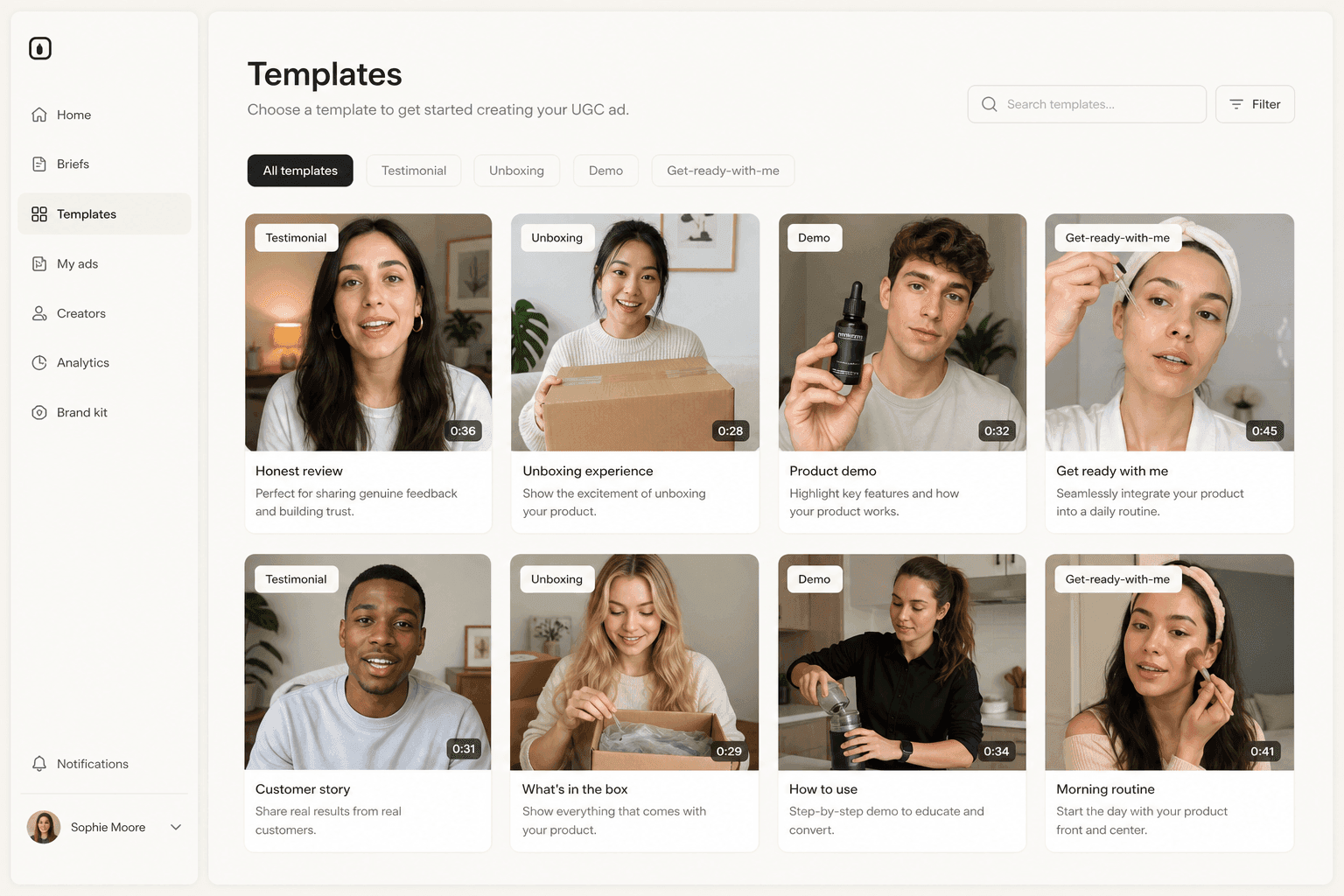
The video engines are the frontier ones the category rents: Seedance 2.5, Seedance 2.0 Mini, Kling v3 Pro and Google Veo 3.1 are all in Novoads, each at its own published credit cost. To put your product in a creator's hand, create a custom actor from a photo of someone holding it, or start from one of Discover's product templates. You can check the math on the pricing page before you start a Novoads plan.
Where Arcads is the better buy
- Library depth. Arcads markets a library of 1,000+ AI actors, plus the option to create your own AI avatar, and our full review of what that library and its three talking-actor models deliver walks the limits buyers hit.
- Minutes per plan. Arcads' Starter carries up to 600 talking-avatar seconds a month and Creator 1,200 on its billing page's meter, or ten and twenty Arcads 1.0 videos of up to two minutes each on its pricing article, against one talking-actor minute on Novoads' Starter and five on Plus.
- A test window. Arcads lets you try it for 72 hours before the first charge. Novoads has no trial.
- Rollover at scale. On Pro and above, unused Arcads credits roll into the next cycle, and usage past the allowance goes on the next invoice instead of stopping you.
For a side-by-side on everything besides cost, see our Novoads vs Arcads comparison, and our list of Arcads alternatives compares seven tools on what a test month costs.
Price the minute, then open the paywall
Arcads' pricing is more open than its missing price page suggests. The allowance, the meter, the rounding rule, the trial and the refund terms are all public and dated, and the price list, though it sits behind a sign-up, is above with its date. So work out your month in minutes first: how many renders, how many actors, how many retries. Then open the billing page with one number in mind. A credit plan is only as cheap as the minute it buys.
Frequently Asked Questions
How much does Arcads cost?
As of October 6, 2026, Arcads' in-app billing page lists five monthly plans: Starter at €100 a month (8,000 credits), Creator at €200 (16,000), Pro at €500 (40,000), Scale at €1,000 (80,000) and Business at €2,000 (160,000). Yearly billing is 20% off, which makes them €80, €160, €400, €800 and €1,600 a month, and a Custom plan is priced on request. Arcads has no public pricing page: the billing page appears after you sign up, and it showed euros to a visitor in Spain, so prices may differ by region. The billing page says talking-actor video runs about 800 credits a minute, so Starter covers up to 600 seconds a month; Arcads' pricing article, updated October 14, 2026, prices an Arcads 1.0 video of up to 2 minutes at 800 credits, so on that model Starter covers ten such videos. The same article lists Pro, Scale and Business at 48,000, 96,000 and 192,000 credits and says plan sizes may differ by account.
How many videos do you get on Arcads' Starter plan?
Starter carries 8,000 credits a month. Arcads' credits article, last updated October 6, 2026, prices its talking-actor models at 800 credits per minute, per actor, and says length is always rounded up; its only worked example rounds to the next whole minute, so plan on about 10 single-actor videos of up to a minute each. Its pricing article, updated October 14, 2026, prices an Arcads 1.0 video of up to 2 minutes at 800 credits, which makes the same month 10 Arcads 1.0 videos of up to two minutes each, and keeps Audio-Driven and OmniHuman 1.5 at 800 per started minute. Two actors in one video halve the count on the credits article's per-actor rule, and B-roll models, presets and tools spend the same credit pool.
Does Arcads have a free trial?
Yes. Arcads' refund policy, updated September 16, 2026, describes a 3-day trial that runs on a saved card. If you do not cancel from your Billing settings before the 72 hours are up, the card is charged for the Starter plan. Credits used during the trial itself do not count as subscription credits, but once subscription credits are used after that charge, it is not eligible for a cash refund.
Do Arcads credits roll over?
Not on Starter or Creator. Arcads' pricing FAQ, read on its in-app billing page on October 6, 2026, says Starter and Creator credits reset each cycle and do not roll over, and those two plans are capped at their monthly credits. On Pro, Scale and Business, credits you haven't used by your renewal date carry into the next cycle, and usage past the monthly credits is added to your next invoice. Unused credits are lost if you cancel or downgrade.
Can you pay per video on Arcads?
No. Arcads' pricing FAQ, as of October 6, 2026, says Arcads runs on monthly or yearly subscriptions, and that higher plans and yearly billing lower your effective cost per video. On the credit figures the billing page showed us, credits rise in step with price on every plan, so the visible saving there is the 20% yearly discount; the larger Pro, Scale and Business allowances in Arcads' public pricing article (October 14, 2026) would give those plans 20% more credits per euro, if your account gets them at the same prices. The cheapest way in is Starter at €100 a month, or €80 a month billed yearly, on the billing page shown in euros to a visitor in Spain.
Can I get a refund from Arcads?
Sometimes. Arcads refunds the full charge for a billing period in which you used zero generation credits, if you ask within 30 days. It also offers a one-time refund within 24 hours of your first charge if no credits were used, and a refund of a lower-tier charge within 7 days if you upgraded for a specific feature. Failed generations caused by a platform issue may be reimbursed in credits, not cash, and poor output quality alone does not qualify.
Is Arcads' unlimited Seedance 2.5 offer still running?
No. Arcads' homepage offered 7-day unlimited Seedance 2.5 generations in Arcads Studio to anyone who subscribed before the offer ended, with fair use terms, and the page's own countdown ended it on August 14, 2026. Seedance 2.5 is now Arcads' default video model, priced in credits: its AI Video Models article, updated October 14, 2026, lists 75 to 3,930 credits per generation. For any future unlimited promotion, Arcads' terms say generations made through Workflows, the Agent, the API or MCP still consume plan credits, that unlimited does not cover speed or priority, and that the model spends credits normally once the usage period ends.
Key Takeaways
- As of October 6, 2026, Arcads' in-app billing page lists Starter at €100 a month for 8,000 credits, Creator at €200 for 16,000, Pro at €500 for 40,000, Scale at €1,000 for 80,000 and Business at €2,000 for 160,000. Yearly billing takes 20% off (€80, €160, €400, €800 and €1,600 a month), and Custom is priced on request. Arcads' public pricing article, updated October 14, 2026, lists Pro, Scale and Business at 48,000, 96,000 and 192,000 credits and says plan sizes may differ by account.
- Arcads' credits article prices a talking actor at 800 credits per minute, per actor, rounded up: 10 talking-actor minutes a month on Starter and 20 on Creator, and a second actor doubles the cost. Its pricing article, updated October 14, 2026, prices an Arcads 1.0 video of up to 2 minutes at 800 credits, which makes Starter ten such videos and Creator twenty.
- Starter and Creator are capped at their monthly credits and do not roll over. Pro, Scale and Business roll unused credits over and add extra usage to the next invoice. An upgrade charges the new plan's full price that day and resets the billing date, and there is no pay-per-video option.
- arcads.ai has no public pricing page. These prices come from Arcads' billing page inside the app, read after an email sign-up from Spain, so they were shown in euros and may differ by region.
- The 3-day trial charges the saved card for Starter unless you cancel from Billing settings before the 72 hours are up. A cash refund needs zero credits used in the billing period, requested within 30 days, and failed generations come back as credits, not cash.
- Arcads' unlimited Seedance 2.5 offer in Arcads Studio ended on August 14, 2026. Its terms still govern any such promotion: generations through Workflows, the Agent, the API or MCP spend plan credits, and unlimited means no credit consumption, not faster or priority rendering.
Sources
- •Arcads in-app billing page (sign-up required, read October 6, 2026)
- •Arcads Help Center: How to buy more credits? (July 30, 2026)
- •Arcads Help Center: How Are Credits Counted? (updated October 6, 2026)
- •Arcads Help Center: How does Arcads pricing work? (updated October 14, 2026)
- •Arcads Help Center: AI Video Models in Arcads (updated October 14, 2026)
- •Arcads Help Center: Arcads Refund Policy (updated September 16, 2026)
- •Arcads Terms & Conditions (in force October 16, 2026)