Claude Video Editing: Caption and Assemble a Vertical Ad From Claude for 17 Credits
What Claude does with a video file, the three ways people edit video from it, and the captioned ad we assembled from Claude Code for 17 credits.

Mauricio Valdivia
·11 min
Claude uses only the first frame of an animation
In one Claude Code session, we turned a six-second selfie clip into a captioned vertical ad for 17 credits. Claude got the clip's spoken words from a transcript, used ffmpeg to save its last frame as a picture for an end card, and had our connector put the pieces together.
Claude worked from words and stills, both of which it can read. Anthropic's vision guide says "Claude supports JPEG, PNG, GIF, and WebP images," and about animated ones it says "Animations are unsupported, and only the first frame is used." That limit has been in the guide since at least April. An Internet Archive copy from April 19, 2026, already says "only the first frame will be used," and the wording above is what the guide said when we read it on November 10, 2026.
None of the top search results we opened for "claude video editing" breaks down what an edit costs step by step, so we priced ours one call at a time.
On November 10, 2026, we read Anthropic's docs, Claude's help center and pricing page, and each vendor's own posts, and we ran one edit from Claude Code through our own connector. We didn't run Kapwing's skill, the two GitHub repos, the MCP Market skill or any other vendor's connector for this post.
What Claude does with a video file
Pictures go in, and an animation counts as one frame
Anthropic describes Claude as "an image understanding model only" that "can interpret and analyze images, but it cannot generate, produce, edit, manipulate, or create images." So in the setups below, Claude works from what it can read, such as still frames or a transcript of what's said in a video.
We checked what Claude Code does with an animated file. Its file reader opened a three-frame GIF, each frame a different color with that color's name written on it, and showed only the first frame. Claude read a still of the third frame correctly. That test covers only Claude Code's own reader. For the API, all we have is the guide's sentence.
What you can upload in the chat
Claude's help article on uploads, dated July 23, 2026, lists documents such as PDF, DOCX, CSV and TXT, along with the image formats JPEG, PNG, GIF and WebP. That image list matches the vision guide's.
Kling's guide to using its connector with Claude, from August 27, 2026, has you send representative frames from a reference video because, in the guide's words, "Claude's standard file uploads support images rather than video files."
Where video does show up in Claude
When you record a skill in Cowork in Claude for Mac, you can send Claude a video. The help article on that feature says "You send Claude a video of your screen, clicks, typing, and voice, and Claude proposes a skill for you to review before you save it." Recording a skill "is available on Pro, Max, Ultra, and Team plans, in Cowork in Claude for Mac," and "It isn't available in chat, on Windows, or on Free and Enterprise plans."
With Claude Motion, Claude makes video instead of reading it. Its help article, dated October 8, 2026, says Claude builds each animation "as code that animates the text, charts, shapes, and images in it," and that "Claude Motion doesn't use a video generation model, so it doesn't create realistic footage or people." You can export an animation as an MP4. Claude Motion is in beta on Team and Enterprise plans.
On the API side, Anthropic's code execution page says image, video and audio files that Claude produces in its sandbox carry C2PA Content Credentials when you download them through the Files API, and MP4 and MOV are on its list of those formats. The same page says the container has no internet access, "so Claude can't download or install additional packages at runtime: only the pre-installed libraries are available."
Three ways people edit video from Claude
In each setup below, another program does the cutting. Claude plans the edit, runs the program, or both.
Claude Code running ffmpeg on your computer
Anthropic calls Claude Code "an agentic assistant that runs in your terminal" and says it "can help with anything you can do from the command line," then adds, "If you can do it from the command line, Claude can too." Since ffmpeg runs from the command line, Claude does the edit itself in this setup, on your files and your machine.
Kapwing published a Claude Code editing skill on November 4, 2026. The company says its own test produced "a finished 70-second video in about 40 minutes" and that its team "didn't make a single manual edit to the result." Running the skill "requires Claude Code and may involve usage costs depending on your subscription or API configuration," and Kapwing's test "cost approximately $10 at API list prices." You'll also need to install FFmpeg, Whisper, Node.js and HyperFrames, and Kapwing warns that "Whisper can misinterpret brand names and technical terms."
Three community projects take the same route, and none of their pages lists a price.
- The tenfoldmarc/video-edit-skill repo on GitHub describes itself as a "Claude Code skill: turn raw talking-head clips into a finished, premium Instagram reel," and its README says "This skill renders video on your computer, so it needs Claude Code; a regular chat can't run it." Its page doesn't state a license for the code.
- The assafkip/claude-video-editor repo on GitHub gives its license as "MIT + Commons Clause," says "Claude never watches the video frame by frame," and comes with an installer that checks for ffmpeg, Node, headless Chrome and Python.
- MCP Market lists a video-editing skill from the ecc collection that, in the listing's words, "Streamlines professional video editing pipelines by using AI to organize, cut, and augment real footage through tools like FFmpeg and Remotion," and you install it with one npx command.
We've covered the Arcads skill repo for Claude Code in its own post.
A connector to a video tool
A connector lets Claude call a video tool's servers, so the footage is processed there and Claude works from what the tool sends back.
InVideo's guide to editing from a script in Claude, published October 16, 2026, has you add "https://mcp.invideo.io/mcp as the server URL." The guide says "Ordinary editing through invideo MCP, including footage analysis, cuts, subtitles and audio cleanup, does not consume invideo credits," and that "Generating new images, video or audio uses invideo credits."
You add Kapwing's connector to Claude Code with one command, claude mcp add --transport http kapwing https://www.kapwing.com/mcp, and Kapwing's post of November 5, 2026, says the connector "supports free accounts, although AI generation and other features consume workspace credits."
In OpenArt's walkthrough for video ads, published October 26, 2026, Claude needs "the OpenArt connector and the ability to create files, because Claude builds the motion graphics with code and hands you MP4 files." In that walkthrough, Claude exports four files. They come in 9:16 and 4:5, each with titles or with subtitles only. OpenArt's post on scheduled runs, from October 29, 2026, reports that its routine "spent credits without asking anyone, because it ran with automatic approval." OpenArt's FAQ says the previous version of OpenArt retires on November 16, 2026, at 11:59 PM PST.
Anthropic's own connector directory lists Descript, which it describes as "a video editor you can direct through conversation." We compared more of these in our list of video MCP servers, and Higgsfield's connector has a post of its own. Ours is the connector we ran, and the next section walks through that edit with the price of each call.
An edit plan for you or your editor
The third way leaves the cutting to a person. Kapwing's November 5 post says you "can also ask it to produce an edit decision list, including the intended sequence, suggested transitions, and B-roll opportunities." It also warns that "Without timestamps, an AI assistant can still suggest what to remove, but it won't know the location of each section," and says "Some tasks, such as reviewing transcripts and planning edits, can be completed on free AI assistant plans, subject to usage limits."
OpenArt's ad walkthrough also lists a video editor among the things you need, and says "Adobe Premiere Pro, or any editor you already use, adds the music and sound effects at the end."
A transcript with timestamps for every word gets around Kapwing's warning, and that's what our connector's transcript call returned in the run below. If you'd rather cut by hand, ask for that transcript first and the edit list second. For a longer Claude Code workflow built on files and steps, see how we build Meta ad creative with Claude Code skills.
Prices as of November 10, 2026, as each vendor states them. Claude's prices are what its pricing page showed a visitor from Spain, in dollars and before tax.
| Way | Where it runs | What it can do to an ad | What it can't do | Cost, as each vendor says |
|---|---|---|---|---|
| Claude Code with ffmpeg | Your computer, from a terminal | Cut, join, caption and mix with local tools | Run in a regular chat | Kapwing calls FFmpeg free and open source; Kapwing's skill test cost about $10 at API list prices; Claude Code comes with Claude Pro, $17 a month billed annually or $20 monthly |
| A connector to a video tool | The tool's servers, called from Claude | What the tool offers: edits, subtitles, new footage | Go past what the tool offers | InVideo says ordinary edits use no InVideo credits and new images, video or audio do; Kapwing says AI generation uses workspace credits |
| An edit plan | Claude's chat | A sequence, transitions, B-roll ideas and a cut list | Cut anything, or place cuts without timestamps | Kapwing says planning can run on free assistant plans, within usage limits |
How Novoads captioned and assembled one ad from Claude Code
The clip we started from
We started with a clip we already had, the selfie video we made for our Claude ads skill walkthrough, which also shows how to connect Novoads to claude.ai or Claude Code. We made it with Seedance 2.0 Mini on October 20, 2026, for 6 credits. This edit didn't make any new footage.
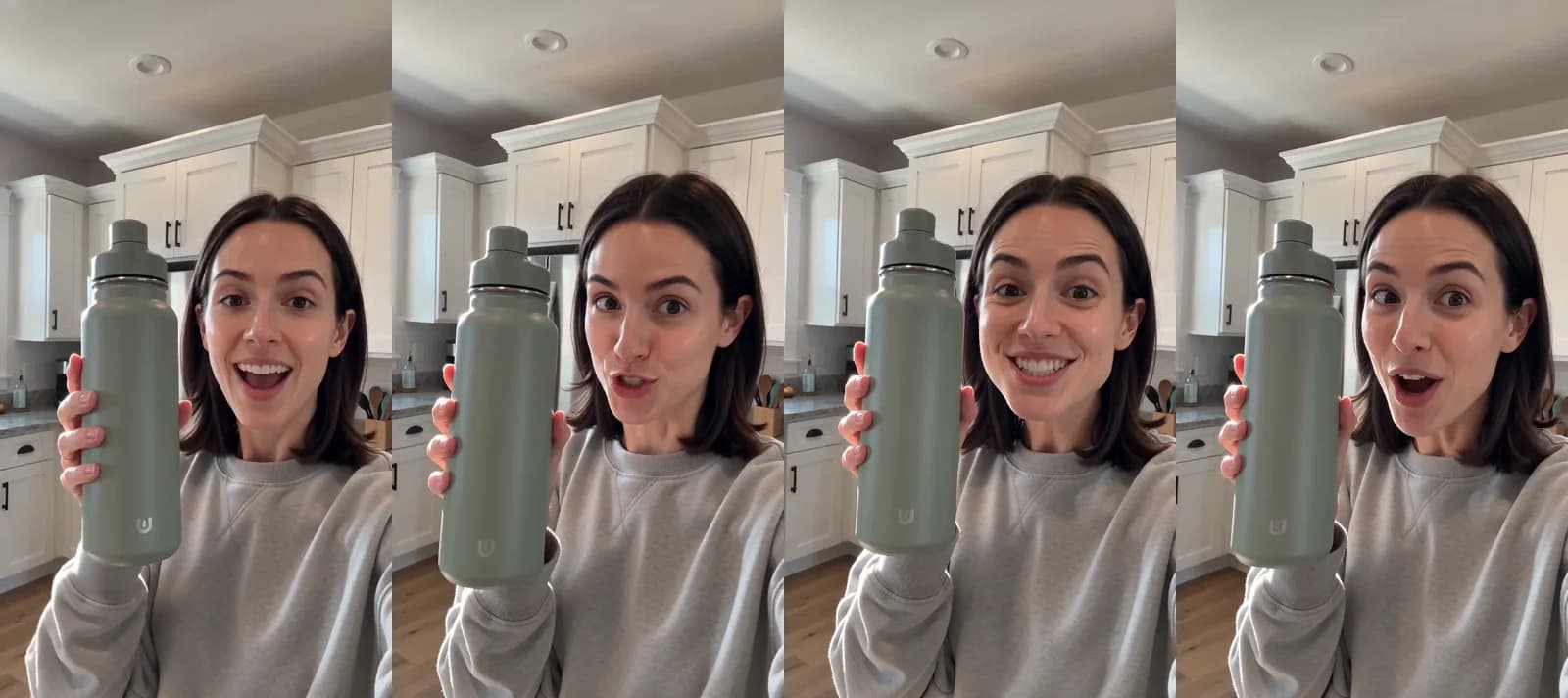
Made in Novoads with Seedance 2.0 Mini · the source clip, a 6-second 9:16 selfie of a woman holding a sage-green bottle, no captions · 6 credits · 2026-10-20
Each call Claude made, and what it cost
Claude made every connector call in this list from one Claude Code session, and three of the steps ran on the computer. Lookups, quotes and the upload link cost 0 credits.
get_generationfound the clip and returned a link to download it.estimate_costpriced the transcript at 1 credit and the music at 2 before either ran.- On the computer, Claude downloaded the clip with curl.
transcribe_videoreturned the line "I filled this with ice yesterday morning. Still ice. I'm not kidding" with a start and end time for every word, the segments and an SRT file, all in one response, for 1 credit.generate_musicturned a written brief for a bright acoustic bed into two takes, for a single charge of 2 credits.- On the computer, ffmpeg saved the clip's last frame as a picture for the end card.
list_voicesreturned the stock voices, and Claude picked an American one.estimate_costpriced the voice-over at 1 credit.list_caption_presetsreturned the caption styles with their prices, and Claude picked Casper, a basic style.generate_voiceoverread "Still ice after a full day. Tap the link to get yours." in that voice and returned the MP3. The 54 characters cost 1 credit.upload_assetreturned a signed upload link, and Claude used curl on the computer to send the end-card picture to it.confirm_assemble_adpriced the ad before anything was charged, quoting 13 credits for an 11-second plan. The plan had the clip, then the end card with the voice-over playing over it, the first music take under both, Casper captions, a 9:16 frame and the pauses cut.assemble_adcharged those 13 credits and started the job, andget_generationshowed it finished in under a minute, going by our two checks.
The paid calls came to 17 credits, and our workspace balance dropped by exactly that much.
The ad came back 9 seconds long, shorter than the 11-second plan, because the assembly step cut the silence before the first word and the pause after "morning." In the finished ad, the clip plays its line with captions, then the end card holds the clip's last frame while the voice-over plays with its own captions, and the music runs under all of it. The connector's description says the music is lowered while someone talks and faded at the end, but we didn't measure that.

Made in Novoads with Seedance 2.0 Mini · the same clip put together from Claude Code through our connector, with Casper captions, a voice-over end card and music · 17 credits · 2026-11-10
What 17 credits cost on our plans
A credit costs $0.075 on Starter and $0.049 on Plus, by our arithmetic from the plans on our pricing page. At those rates, the edit came to about $1.28 on Starter or about 83 cents on Plus. With the clip's 6 credits, the ad took 23 credits in all. That's about $1.73 on Starter or $1.13 on Plus.
The assembly step costs 10 credits, plus captions priced on the ad's planned length, and the connector quotes that price before anything is charged. In that step, captions are priced per started minute, at 3 credits in a basic style or 5 in a dynamic one. Our plan ran under a minute, so Casper added 3 credits to the 10. Every plan is paid from the first month, and they're all on that pricing page.
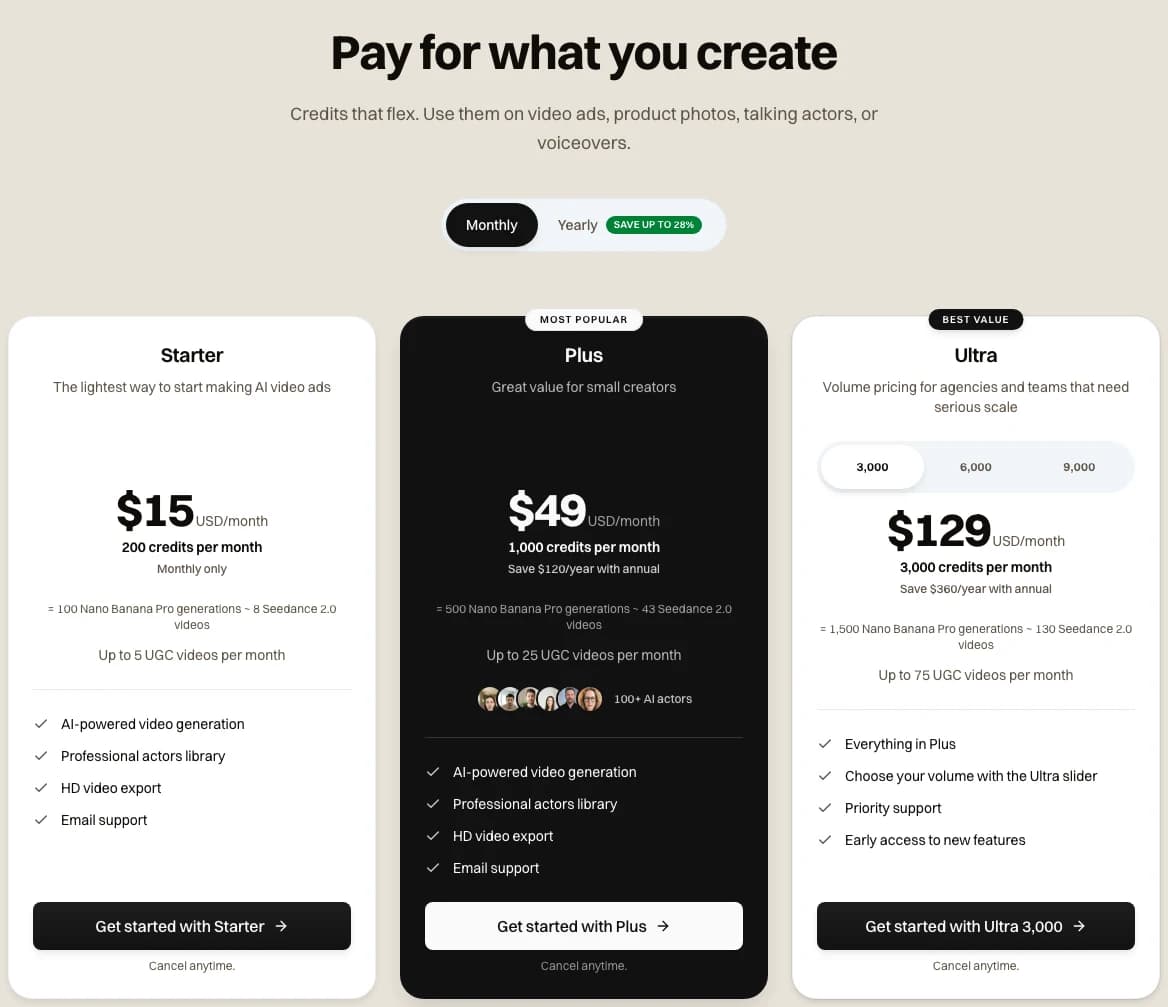
Our pricing page on monthly billing, read 2026-11-10: Starter, Plus and Ultra, each with its monthly credits.
What the assembly step won't do
The step joins clips that already exist. In the connector's own words, "Nothing new is made here: pictures, video, voice-over and music come from the other tools first."
It doesn't reframe a clip around a person. An upload wider than the ad plays at full width over a blurred copy of itself, and only an upload as wide as the ad or narrower gets cropped to fill the frame. So a 16:9 video won't come back as a 9:16 shot framed on the person in it. An ad can hold up to 20 clips and run up to 180 seconds.
The three steps we ran on the computer matter if you work in claude.ai. Without a computer to run them on, you'd need an end-card picture made some other way, or no end card at all. We ran only the Claude Code path.
Which way fits which job
It comes down to where your footage is and who does the cutting.
- Claude Code with ffmpeg suits you if you're comfortable in a terminal and the job is cuts and captions on your own footage. The program costs nothing, and a Claude plan you already pay for may cover an edit we'd charge credits for.
- A connector makes sense when your footage is already in a video tool, because Claude can drive that tool right where the footage is. InVideo says ordinary editing through its connector uses no InVideo credits, while Kapwing says AI generation through its connector consumes workspace credits.
- An edit plan suits you if you'd rather cut by hand. Ask Claude for a transcript with timestamps and an edit decision list, then make the cuts in Premiere or whatever editor you use.
- Our connector suits you if you want the clip, the voice-over, the music and the captions from one place, with every paid step priced before it runs. In our run, that came to 17 credits on a clip we already had.
Price your next edit before it runs
Connect Novoads to Claude Code and get a quote for captions, a voice-over and music on a clip you already have.
See plansOnce the ad is done, you run it yourself, and our post on taking a 9:16 ad from Claude to Meta covers that step. Before you pick a tool, how credits compare across vendors is worth a read.
If you want new ads every week, the weekly ads recipe in our connector writes the week's ads with its other recipes and puts every word and every credit on one page for you to approve with a single yes. The one run of it we've measured was in Claude Code.
Frequently Asked Questions
Can Claude AI do video editing?
Yes, by running other tools. Claude itself reads pictures. Anthropic's vision guide says it supports JPEG, PNG, GIF and WebP images, and that "Animations are unsupported, and only the first frame is used." In Claude Code, it can run ffmpeg on your computer, and through a connector it can drive a video tool such as InVideo, Kapwing, Descript or Novoads. In our run, Claude captioned and assembled a 9-second ad through the Novoads connector for 17 credits.
Is Claude a good video editor?
Not on its own. Anthropic calls Claude "an image understanding model only" that "cannot generate, produce, edit, manipulate, or create images," so the cutting happens in ffmpeg, a connected video tool or your own editor. Claude's part is planning the edit and running those tools. Kapwing says its Claude Code skill made "a finished 70-second video in about 40 minutes" with no manual edit, and in our run, Claude made every call for a captioned ad through our connector.
Is Claude free for video editing?
Claude has a Free plan, listed at $0 and "Free for everyone" on its pricing page. That page listed Claude Code under Pro, among the things Pro adds to Free, and showed Pro at $17 a month billed annually or $20 billed monthly. Those are the prices a visitor from Spain saw on November 10, 2026, in dollars and before tax.
Can Claude Code edit videos?
It can run the programs that do. Anthropic says Claude Code "can help with anything you can do from the command line," so it can run ffmpeg, Whisper or a renderer on your computer, which is how Kapwing's skill and the community repos on GitHub work. It can also call a video tool through a connector. In our run, Claude Code assembled a captioned 9-second ad through Novoads for 17 credits.
Key Takeaways
- Anthropic's vision guide says Claude supports JPEG, PNG, GIF and WebP images, and that "Animations are unsupported, and only the first frame is used."
- Claude edits video through other programs, such as ffmpeg in Claude Code or a video tool behind a connector, and it can write an edit plan for you or your editor to cut from.
- Kapwing says its Claude Code skill finished a 70-second video in about 40 minutes, and InVideo says ordinary editing through its connector uses no InVideo credits.
- Claude Code comes with Claude Pro, at $17 a month billed annually or $20 monthly, before tax. Those are the prices a visitor from Spain saw on November 10, 2026.
- Our captioned 9:16 ad from Claude Code cost 17 credits through the Novoads connector, with every paid step quoted before it ran.