Nano Influencers: Real Rates, the Engagement Math, and Where AI Replaces the Creative
Nano influencers are creators with roughly 1,000 to 10,000 followers, and they are now the majority of every major platform. Here is what the tier actually costs to run, why the published rate cards disagree by 5x, and the one half of the deal AI can genuinely replace.

Mauricio Valdivia
·11 min

The cheapest creator tier is the most expensive to run
A skincare founder I know priced two versions of the same quarter. Option one: a single macro creator, one video, $6,000. Option two: forty nano creators at around $80 each, roughly $3,200 in fees, plus product. She chose the forty. Eleven weeks later she had twenty-six posts, four creators who ghosted, one usable ad, and a spreadsheet she never wants to open again. The fees came in under budget. Nothing else did.
That gap is the whole subject of this post. A nano influencer is a creator with a small but real following, most commonly defined as 1,000 to 10,000 followers, who posts to their own audience rather than handing footage to a brand. The tier is not niche. It is the default: 76% of Instagram influencers and 87% of TikTok influencers sit inside that band, according to an analysis of 76 million Instagram and 104 million TikTok accounts. On YouTube, 69.4% of creators are nano.
And brands are leaning further in. In the 2026 Influencer Marketing Benchmark Report, a survey of 600-plus marketers, rising creator costs were the most-cited challenge in the whole industry at 35.4%, while 51.43% of respondents said they intended to expand their nano work against just 10% planning to cut it. The tier is growing because everything above it got expensive.
The trouble is that "cheap per post" and "cheap to run" are different claims, and most nano coverage only checks the first one. Below is what the tier costs once you count everything, what its famous engagement numbers actually mean, and the one half of a nano deal that AI can honestly replace.
What a nano influencer actually is, and why no two sources agree
Before the money, the definition, because a surprising amount of bad budgeting starts here.
The follower band nobody standardized
Influee's April 2026 guide states plainly that "a nano influencer has 1,000 to 10,000 followers." Insense's 2026 pricing guide, published the same month, defines the tier as 1K to 5K and starts micro at 5K. Neither is wrong. There is simply no governing body for creator tiers, which means a "nano campaign" quoted by two agencies can describe two different populations.
Use the wider 1,000 to 10,000 band as your working definition, but pin the number in writing before you approve a budget. A vendor quoting nano rates against a 1K to 5K band is quoting for smaller audiences than you probably imagined.
Nano is not the same job as a UGC creator
This is the distinction that decides whether the tier is right for you at all. A UGC creator is paid to produce footage; the brand then runs it as an ad on the brand's own accounts and ad accounts. The creator's followers are irrelevant, which is why a good UGC creator can have 200 followers and a full client roster. If you want the full definition of the category, we covered it in what UGC is.
A nano influencer is paid for the post. The deliverable lives on their account, carries their name, and reaches their followers. You are buying placement inside a relationship. Those are two different products, and the reason the confusion persists is that the same person often sells both, at different prices, sometimes in the same email. Anyone weighing the two career paths will find the distinction laid out from the creator's side in how to become a UGC creator.
Why the tier became the default
Three forces stacked:
- Supply exploded. The bottom of the creator pyramid got very wide, very fast.
- Macro rates kept climbing until mid-market brands were simply priced out of the top tiers.
- Follower count stopped being the distribution signal. Short-form algorithms will hand a 4,000-follower account the reach of a 400,000-follower one, occasionally and unpredictably.
Cheap, plentiful, and occasionally explosive is an attractive combination on a spreadsheet.
What nano influencers cost in 2026
Here is where the widely-copied numbers fall apart, so it is worth being precise about what is actually documented.
The two rate cards that disagree by 5x
Two named guides, both published in April 2026, both describing the nano tier:
| Guide | Nano defined as | Instagram post | TikTok video |
|---|---|---|---|
| Influee | 1,000 to 10,000 | $10 to $100 | $5 to $50 |
| Insense | 1,000 to 5,000 | $50 to $500 | $20 to $200 |
Read those again. For the same tier and the same format, the published low end differs by 5x and the published high end by 5x. That is not a rounding disagreement, it is evidence that no one is sampling a representative population. Nano pricing is set deal by deal, by creators with no rate-card training, against brands with no benchmark.
The practical rule: treat any single quoted nano rate as an anecdote, not a benchmark. Collect five quotes in your own category before you assume you know the price. If you want the equivalent numbers for paid-content production rather than audience access, they are broken down in what UGC creators charge.
What brands actually report paying
Survey data is the useful counterweight to rate cards, because it reports what changed hands rather than what someone hopes to charge. In the 2026 benchmark survey, roughly 55% of reported nano payments sat under $500 per collaboration. For UGC creators the concentration was tighter still, with roughly 80% of payments under $500.
So the honest summary is a distribution, not a price: most nano deals are three figures, a meaningful minority are not, and product-only seeding sits underneath all of it.
The line items that are not in the fee
The fee is the part everyone quotes and the smallest part of the bill. A nano programme also carries:
- Marketplace commission. Pay-per-use platforms charge 10% to 20%, or a flat $30 to $100 per collaboration, on top of the creator payment.
- Product cost and shipping. Every deal ships a physical unit, and at nano scale you are shipping dozens.
- Usage rights. The base fee buys an organic post. Running that footage as a paid ad is a separate negotiation, and at nano level plenty of creators have never been asked and have no policy.
- Non-delivery. Some percentage of creators take the product and never post. Budget for it rather than being surprised by it.
The Nano Split: the two things you buy in one invoice
Every nano deal bundles two purchases that have nothing in common except a single line on an invoice. Separating them is the most useful thing you can do before spending anything, and it is the frame the rest of this post runs on.
The creative half
A short vertical video of a real-looking person using your product, shot on a phone, in a kitchen or a bathroom, with unpolished audio. This is a manufactured good. It has a production cost, a turnaround time, and near-perfect substitutes. Ten creators can produce ten versions of it and you would struggle to attribute any of them blind.
The audience half
A post that appears on an account with 6,000 followers who chose to follow that specific person, carrying their name and their implicit endorsement, inside a feed you cannot buy your way into. This is not a manufactured good. It cannot be reproduced, batched, or rendered. It is the only part of the deal that is genuinely scarce.
Which half you were actually paying for
The test is simple and slightly uncomfortable. Imagine the same video delivered to you as a file, never posted anywhere. If most of the value evaporates, you were buying the audience, and the fee is a media buy. If the value survives intact, you were buying the creative, and you have been paying media-buy prices for a production job.
Most nano programmes I have seen fail this test in the second direction. Brands run a seeding campaign, quietly ignore the organic reach, pull the best three videos into Meta Ads, and call the programme a success. That programme did not need forty creators. It needed forty videos.
Run the split as a go or no-go before you brief anyone:
Buy nano when you want credibility inside a specific community, when the creator's own audience is the target market, when you need proof that real people use the thing, or when you are seeding a launch and organic posts are the point.
Do not buy nano when what you actually need is footage for your ad account, when you are still testing which message works, when you need the same product shown fifteen ways, or when nobody on the team has ten hours a week to run relationships.
The engagement math, done honestly
Nano influencers do have the highest engagement rate of any tier. That is well documented and it is also the most misused number in creator marketing.
The rate is real, the base is small
The platform-scale analysis of 76 million Instagram and 104 million TikTok accounts found nano-influencers holding the highest engagement rate of any tier: 2.19% on Instagram and 11.9% on TikTok. Influee's guide reports a higher Instagram band of 3% to 8% against 1% to 2% for macro creators. The direction is consistent across every dataset. The magnitude is not, which is a good reason to quote the direction and not the decimal.
Now apply it. A 5,000-follower Instagram account at 2.19% produces roughly 110 interactions. That is a genuinely good engagement rate and a genuinely small number of humans. Engagement rate is a quality signal about an audience. It is not a reach forecast, and treating it as one is how a campaign that "performed above benchmark" delivers nothing measurable.
A worked example: twenty creators, one budget
Take a realistic mid-band TikTok programme of twenty nano creators.
| Line item | Cost |
|---|---|
| Twenty creators at $100 | $2,000 |
| Marketplace fee at 15% | $300 |
| Product plus shipping, $25 a unit | $500 |
| Cash cost | $2,800 |
Now add the part nobody budgets. Twenty outreach threads, twenty negotiations, twenty briefs, twenty shipping confirmations, twenty rounds of chasing, and twenty licence conversations. At forty-five minutes of real human attention per creator, that is 15 hours, before a single video is reviewed.
What you get back: perhaps sixteen posts from twenty deals, spread across maybe 80,000 combined followers, of which a fraction actually see anything. Plus sixteen videos, some usable, some unusable, most of which you do not yet have paid rights to.
Compare that to the alternative use of the same $2,800: putting it behind one creative you already know converts. That is not an argument against nano. It is an argument for knowing which of the two things you are buying, because $2,800 spent on distribution and $2,800 spent on production are not interchangeable.
What the engagement number is actually good for
Use tier engagement rates for creator selection inside the tier, never for forecasting:
- Good use. Comparing two 5,000-follower accounts against the tier median to see which one has an audience that actually reads it.
- Bad use. Multiplying a tier average by a follower count to project reach, impressions, or sales.
A nano account running well above its tier median has a community. One running well below has a follower count and not much else. That is a real and useful screen. It just does not tell you how many people will see your product.
The discovery threshold, and the overhead floor
Two structural forces make the cheapest tier the most operationally expensive one. Neither shows up in a rate card.
Most nano creators sit below the platform's own matching tool
TikTok's own brand-matching programme, TikTok One, requires a creator to "have at least 10,000 followers," with the requirement varying by region, plus at least 1,000 post views in the last 30 days and three posts in the last 30 days. Read that against the population data: 87% of TikTok influencers have between 1,000 and 10,000 followers.
So the threshold for the platform's own discovery product sits at the ceiling of the nano band rather than its floor. The tier that contains the overwhelming majority of creators is largely not addressable through the tool built to address creators. That is why nano sourcing still means hashtag scrolling, manual DMs, and inbound pitches, and why it consumes the hours it does.
The overhead floor
Coordination cost per creator is close to constant. Finding, vetting, negotiating, shipping, briefing, chasing, approving and licensing takes roughly the same human effort whether the fee is $80 or $8,000. Which means the cheaper the tier, the higher the share of true cost that is overhead.
At $8,000 a deal, overhead is a rounding error. At $80 a deal, overhead is the majority of what the programme actually costs you, and it is paid in the scarcest resource a small team has. The invoice gets cheaper. The programme does not.
Where nano programmes quietly die
They rarely fail loudly. They fail when the person running forty relationships gets pulled onto a launch, the follow-ups stop, half the creators never post, and nobody computes the final cost per usable asset because nobody wants to. The failure mode is attrition, not a bad result.
If you run nano, run it small and instrumented: ten creators, one tracked metric, a fixed review date. A programme you can actually finish beats a bigger one you abandon.
Where AI UGC substitutes, and where it does not
This is the part most tool vendors overstate, so let me be precise about the boundary.
It substitutes for the creative half, completely
The phone-shot vertical of a plausible person talking about a product is now a generated asset. AI UGC ads come out of a script and a product photo in minutes, at a few dollars per clip, in whatever number you ask for. For the specific job of producing many variations of a hook, an angle, or a language, generated creative is not a compromise. It is simply better suited: it does not ghost, it does not need product shipped to it, and version eleven costs the same as version one. The full comparison of the two production routes is in AI vs UGC creators.
It substitutes for the audience half not at all
No generator produces a person with 6,000 real followers who has used your product for three months and whose recommendation carries weight because of who they are. That is not a rendering problem. It is the definition of the asset. Any pitch that frames AI as a replacement for influencer marketing is quietly deleting the distribution half of the deal and hoping you do not notice.
Distribution is what nano creators sell. Keep buying it from them.
The hybrid that actually works
Split the budget the way the deal is actually structured:
- Generate the creative you need for paid testing. Ten to twenty angle variations, produced in an afternoon, run in your own ad account where you control spend and measurement.
- Pay nano creators for reach and proof. A smaller roster, chosen for genuine audience fit, paid properly for organic posts and paid usage rights, because that is a media buy and should be priced like one.
- Let each side inform the other. Whatever hook wins in generated testing becomes the brief you hand a real creator. You stop paying humans to discover what a render could have discovered for three dollars.
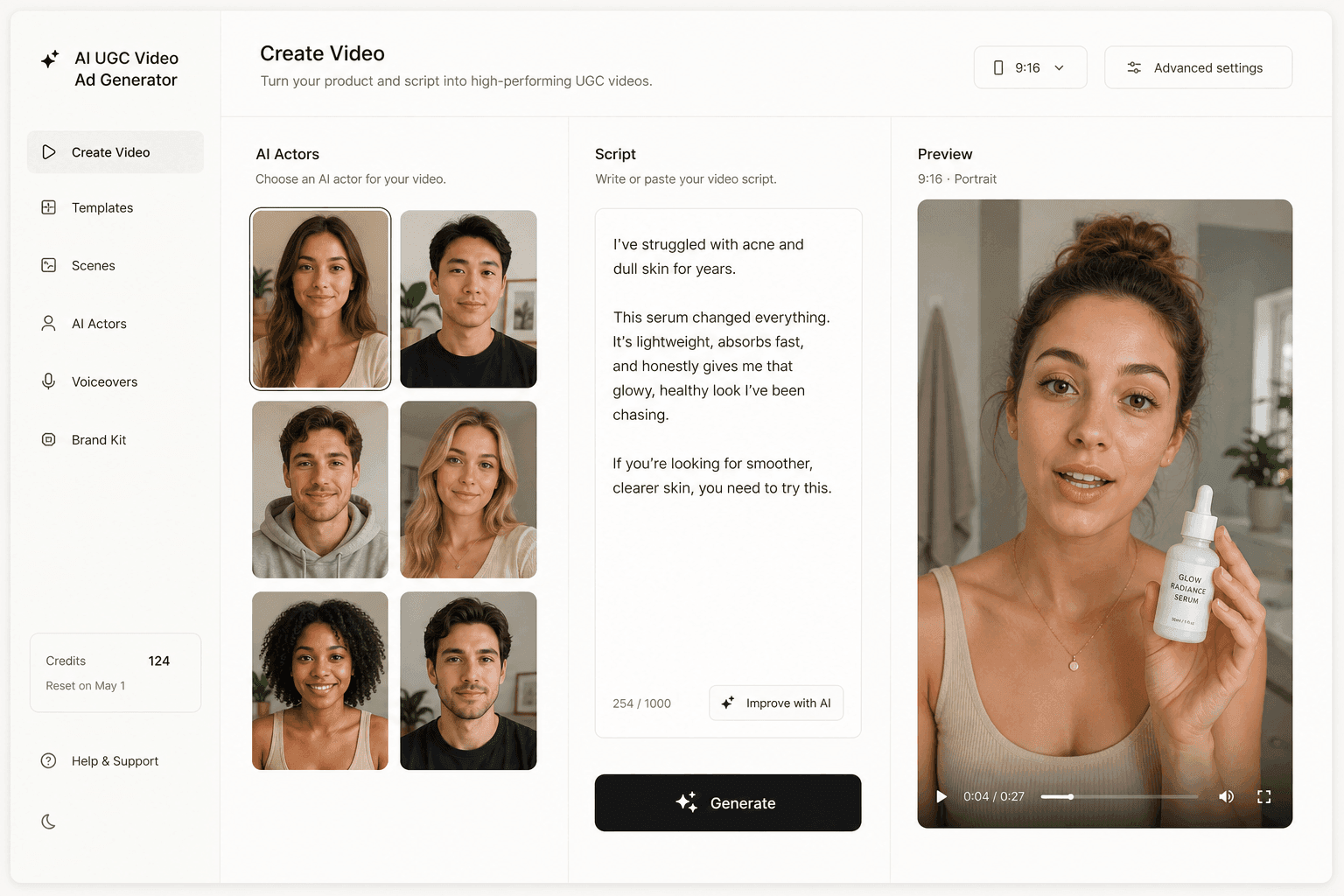
How Novoads solves the creative half of the nano split
Novoads generates the creative half. Upload a product image or write a script, pick from over 100 AI actors, and you get an ad-ready UGC-style video in vertical, square or horizontal format, with voice available across 31 languages, in about four minutes. A clip runs from about a dollar for a five-second Seedance 2.0 Mini clip to about $8 for an eight-second Seedance 2.5 clip, and about $26 for a full 30-second Seedance 2.5 take, with the cheapest routes sitting near the bottom of that band, which is what makes running fifteen variations of one angle a normal decision rather than a budget conversation.
What it does not do is put your product on someone else's account. Nothing does. If your goal this quarter is audience access, hire creators. If your goal is enough creative to find out which message works before you spend media behind it, that is the job this replaces. You can try it for $49 a month.
Buy the audience. Generate the creative.
The nano tier is not cheap influencer marketing. It is two different products sold under one name, and the reason so many nano programmes disappoint is that brands buy the expensive half, distribution, in order to obtain the cheap half, video files.
Split the invoice before you sign it. If you want reach inside a community that trusts a specific person, pay that person properly and accept the coordination cost, because there is no substitute and there is not going to be one. If you want thirty versions of a hook to find out what your market responds to, that stopped being a hiring problem some time ago.
Pay humans for what only humans have. Generate the rest.
Frequently Asked Questions
What is a nano influencer?
A nano influencer is a creator with a small but genuine following, most commonly defined as 1,000 to 10,000 followers. The label describes audience size, not job description: nano creators post on their own accounts to their own followers, which is what separates them from UGC creators, who are paid to produce footage the brand distributes itself. Definitions are not standardized, and some marketplaces cut the tier at 5,000 followers instead.
How much do nano influencers charge per post?
There is no reliable single number. One 2026 guide puts nano rates at $10 to $100 per Instagram post and $5 to $50 on TikTok; another puts the same tier at $50 to $500 per Instagram post and $20 to $200 per TikTok video. Survey data lands in between, with roughly 55% of reported nano payments sitting under $500. Product seeding, where the creator is paid in free product only, is also common at this tier.
Do nano influencers really have higher engagement rates?
Yes, consistently, but the figure depends heavily on the dataset. A platform-scale analysis of 76 million Instagram and 104 million TikTok accounts found nano-influencers hold the highest engagement rate of any tier at 2.19% on Instagram and 11.9% on TikTok. Rate-card guides quote higher Instagram figures, around 3% to 8%. Either way the rate is applied to a small base, so a high percentage still produces a small absolute number of interactions.
Are nano influencers worth it for a small brand?
They are worth it when you are buying audience access and community trust, not when you are buying video files. The economics work if you can run many small relationships cheaply, and they break when coordination overhead swallows the low fee. Before committing, price the whole programme: fees, marketplace commission of roughly 10% to 20%, product cost, shipping, briefing time and usage rights.
Can AI replace nano influencers?
No, and any tool claiming otherwise is selling you half an answer. A nano influencer sells two things in one invoice: the creative, and access to a real audience that trusts them. AI can produce the creative for a few dollars per clip. It cannot produce a person with 6,000 followers who genuinely uses your product. The honest use is to generate the variations you need for paid testing and keep human creators for organic reach.
Why do most nano creators never get found by brands?
Because the tier sits below the discovery infrastructure. TikTok's own brand-matching programme, TikTok One, requires a creator to have at least 10,000 followers, which is the ceiling of the nano band rather than its floor. The result is that the tier holding most creators on the platform is largely invisible to the platform's own matching tool, so brands find nano creators through manual search, hashtags and inbound pitches instead.
Key Takeaways
- Nano influencers are creators with roughly 1,000 to 10,000 followers, and they are now the majority tier on every major platform: 76% of Instagram influencers, 87% of TikTok influencers, and 69.4% of YouTube creators.
- There is no nano rate card. Two named 2026 pricing guides put the same tier and format at $10 to $100 and at $50 to $500, a 5x spread, so treat any single quoted nano rate as an anecdote.
- Every nano fee buys two different things at once: a piece of creative, which is reproducible, and a post on a real account with a real audience, which is not.
- The fee is rarely the real cost. Sourcing, negotiating, shipping product, briefing, chasing and licensing do not scale down with the invoice, and most nano programmes die on that overhead rather than on media cost.
- AI UGC substitutes for the creative half of a nano deal and for none of the audience half. Use it to produce the volume of variations testing needs, and keep paying real creators for reach you cannot manufacture.