Best Zeely Alternatives for AI Ads: 7 Tools Compared by Creative, Fit, and Price
Zeely builds, launches, and optimizes whole ad campaigns from one app. Our Zeely review covers its plans, fees, and ratings, then compares seven alternatives on the creative they make, who they fit, and what they cost to start.

Mauricio Valdivia
·Updated ·17 min

One app runs the whole campaign. The creative still has to sell.
A dropshipper with a new supplement opens Zeely to make her first ads, and finds more than an ad maker. The app will build the UGC video, generate the static creative, spin up an AI avatar, then launch the whole set on Facebook and Instagram and optimize the spend for her. One dashboard, the entire loop. For a solo operator wearing every hat, that is a genuinely good pitch.
Then the ads go live. And the numbers turn on one thing the dashboard cannot fake: whether the creative lands.
Zeely is an AI ad creative platform built to create UGC video and static ads, offer AI avatars, and then launch and optimize campaigns on Facebook and Instagram, pitched at small sellers who want to run ads like big brands. It is a real tool, and for someone who wants make-and-launch in one place, it is a fair choice. The reason people look past it is rarely the launcher. It is that the ad which carries the click, the product-in-hand UGC that reads as a genuine recommendation, is a specialist job, and an all-in-one is a generalist by design. For the closest head-to-head on the creative side, our Zeely vs Creatify breakdown goes deep. This piece is the wider field.
TL;DR: the 7 best Zeely alternatives in 2026
The lens that matters here is breadth versus the creative that carries the ad. Zeely bundles the whole loop, create, launch, and optimize, in one app. Every tool below unbundles it: you get a stronger or cheaper creative and run it wherever you already buy media. Which one wins depends on the kind of ad you need before it depends on price.
- Novoads is best for product-in-hand UGC across many languages, with custom actors made from a photo of someone holding your product. It starts at $15/month (Starter, 200 credits per month), level with Creatify's $15 Standard as the lowest published monthly price on this list.
- Creatify is best for paste-a-product-URL ecommerce volume, with a watermarked free plan.
- MakeUGC is best for a large AI-actor library you can start for $1.
- Captions is best for an all-in-one actor plus a built-in AI editor.
- HeyGen is best for spokesperson and avatar-style video.
- Synthesia is best for corporate training and reach across 140+ languages.
- HeyFish made AI UGC video ads, but its website has not loaded since at least September 19, 2026 (we checked again on October 22), so there is no current plan or price to compare.
The first question is not price. It is what kind of ad you actually need. If the creator should hold your product, look at Novoads (through a custom actor made from a photo of someone holding it), MakeUGC, or Creatify. If you need a polished spokesperson or a training video, HeyGen and Synthesia fit better. Then decide whether Zeely's built-in launch and optimization is worth more to you than the creative depth a specialist buys. If you came to judge Zeely itself, our Zeely review below covers its plans, fees and ratings.
| Tool | Best for | How to start |
|---|---|---|
| Novoads | Product-in-hand UGC via a custom actor, many languages | $15/month (Starter) |
| Creatify | Paste-a-URL ecommerce ads | Free plan |
| MakeUGC | Large AI-actor library (1,000+) | $1 trial |
| Captions | Actor plus built-in editor | Free tier |
| HeyGen | Spokesperson, avatar video | Free tier |
| Synthesia | Corporate training, 140+ languages | Free plan |
| HeyFish | AI UGC video ads (Feb 2026 archive) | Site not loading (Oct 22, 2026) |
What Zeely actually does
Before ranking alternatives, it helps to be precise about what you are replacing, because Zeely does more than a creative tool, and that breadth is both its pitch and its trade-off.
The whole loop in one app
Zeely does not stop at the ad. It bundles three jobs most stores otherwise buy from separate tools:
- Creative: UGC video ads, static ads, and AI avatars, generated in the app.
- Distribution: paid campaigns on Facebook and Instagram, launched from Zeely as a Meta Business Partner. Its About page says paid campaigns are "currently Meta Ads, with more channels coming soon", and its homepage says it connects with TikTok.
- Optimization: in its About page's words, Zeely "tells you which creatives are working and automatically scales the winners."
That is the real product. Zeely's help center shows how to download a finished video to use outside Zeely, but the app is built as a make-launch-optimize loop that lives in a single place. For a small store, the friction was never only producing one ad. It was the whole chain of making, publishing, and tuning, and Zeely is built to own all of it.
Who it is built for
Zeely names its audience plainly: it says it "helps small sellers run ads like big brands." That is a tell. It is designed for operators who want to scale ad output without stitching together a creative tool and a separate media buyer, and who are comfortable letting one platform run the spend. If you already have a media buyer and a preferred ad manager, the all-in-one design does more than you need.
The on-ramp
Zeely is paid from the first day. Its plan cards run from $29.95 to $79.95 a month, and its cheapest door is a paid Intro plan of $19.95 for two weeks, which its help center says then moves automatically to the Growth plan at $79.95 a month (all read October 23, 2026). The full plan table, the fee on ads it runs and its ratings are in our review below. That is a reasonable posture for a platform that runs your whole campaign. It is a harder starting point if what you actually want to test first is whether the creative converts.
Is Zeely legit? A Zeely review of its plans, fees and ratings
Our short answer is yes: Zeely is a real company selling a real product. Whether it is worth it turns on two things its own pages spell out: the fee it takes when it runs your Meta ads, and the price an account moves to after its first period.
How we reviewed it: we have not used Zeely hands-on. This review is built from Zeely's own pages (its pricing page, help center, blog, Terms of Service and subscription policy) and from its public ratings on Trustpilot, the US App Store and Google Play, all read on October 23, 2026. Where a page carries its own date, we give that date too.
Who is behind Zeely
- The company: Zeely, Inc., which prints a Wilmington, Delaware address on its pricing page. Its About page (updated October 12, 2026) says Zeely "started in Ukraine in 2022", has more than 200 specialists, and "now serves more than 2 million businesses and creators, with over 70% of paying customers based in the US".
- The pitch, in its own words: its press page (updated August 19, 2026) calls Zeely "the agentic AI platform for creating, launching, and scaling paid ads without design skills or an agency."
Zeely's plans and prices on October 23, 2026
Zeely's pricing page, which carries its own date of August 20, 2026, shows three monthly cards, each marked "Available only on the site". The cards print a bare "$", which we read as US dollars. We could not see what currency the checkout charges: Zeely's sign-up asks for an email before it shows a price.
| Plan | Price on the card | Struck price beside it | Credits |
|---|---|---|---|
| Starter | $29.95 a month | $49.95 | 2,500 |
| Plus | $49.95 a month | $89.95 | 5,000 |
| Growth ("Most popular") | $79.95 a month | $149.95 | 10,000 |
Zeely's other pages change what that table means:
- Not every feature on every card. All three cards list the same 12 features, but the page greys some out: Starter keeps four (Marketing video ads, Edit-ready templates, Paid campaigns and Viral campaigns), Plus adds Talking reels, Prompt to ad and Brand-inspired remix, and only Growth has all 12.
- The page's own FAQ. It says Zeely's plans start "at $19.99 per month", that plans run "monthly, bi-monthly, quarterly, and weekly", and that "The plans available in the app and on the website may vary."
- Paid Intro plans. Zeely's help center (updated October 13, 2026) calls them "paid, short-term plans": 2 weeks for $19.95, 4 weeks for $29.95 or 8 weeks for $49.95, after which "Your account will automatically move to the Growth plan at $79.95 per month."
- Growth's later price. A Zeely blog post, "Upgrade or downgrade your Zeely plan step-by-step" (published February 10, 2026), lists Growth at "$79.95 on a trial; $149.95 after trial period expires", the $149.95 the Growth card shows struck through. Zeely's help center (updated October 8, 2026) says a renewal higher than the first payment "usually means your initial purchase included a promo discount".
- The introductory unlimited period. Zeely's homepage says "Create without limits". Its Terms of Service (last updated October 20, 2026) say certain plans include an introductory "Unlimited Period" in which designated models use no credits, ending when the plan's time period expires or after 300 generations, with one active generation at a time.
- Charges and refunds. Zeely's subscription policy says payments "may be subject to mandatory additional charges (such as commissions, taxes, or duties) that are not included in the base Fees displayed on the Website", and its general rule is that payments are not refundable unless the policy or the law says otherwise.
To cancel, the pricing FAQ points to "the account settings in our app", and the help center also gives steps on the web (updated September 21, 2026) and asks you to cancel "at least 24 hours before your next billing date" (updated October 7, 2026). The subscription policy adds that uninstalling Zeely does not cancel the subscription.
Our reading: Zeely's own pages give two figures for what Growth costs after the first period, so the number that counts is the one on the checkout screen. Read it before you pay.
What running ads through Zeely adds
Zeely's pricing FAQ says running Facebook and Instagram ads through it "involves additional charges, with Zeely potentially charging up to 12%". Its help center (updated July 17, 2026) is exact: the service fee applies "only to paid campaigns launched through Meta", and "The fee is 12% of your ad spend." A Booster add-on cuts it: with one, "the fee drops to 6%". Booster costs $39.95, "billed annually in one payment" (help center, updated October 7, 2026).
The fee math: on $1,000 of Meta ad spend in a month, 12% is $120. With Booster it is $60, plus the $39.95 Booster once a year. That comes on top of the plan price and the ad spend itself, which our guide to what Facebook and Instagram ads cost breaks down.
Zeely's Terms (last updated October 20, 2026) add a detail for anyone who reads their own analytics: when you launch a campaign, "we generate a pre-landing page based on Your submitted creative materials and product information", and "the campaign measurement data will only show visits to this page only and not the store page of Your advertised product".
Zeely's ratings, with their counts
| Where | Rating | Count | Read |
|---|---|---|---|
| Trustpilot | 4.4 | 4,438 reviews | Oct 23, 2026 |
| App Store (US) | 4.6 | 23K ratings | Oct 23, 2026 |
| Google Play (US) | 4.3 | 9.22K reviews | Oct 23, 2026 |
Zeely's Trustpilot profile, read October 23, 2026, showed:
- 65% of reviews at five stars, 16% at four, 5% at three, 2% at two and 12% at one, with 4,139 of the 4,438 posted in the previous 12 months.
- The labels "Claimed profile • Oct 2025", "Paid Trustpilot subscription", "This company invites their customers to review, whether positive or negative" and "Replied to 100% of negative reviews".
Google Play's score belongs to a storefront: the same 9.22K reviews showed 4.1 when we opened the listing from Spain without a country.
What reviewers praise, and what they complain about
These are reviewers' own words on Zeely's Trustpilot profile, with the date each was posted; we leave out their names. The three five-star reviews below carry Trustpilot's "Invited" label, and the four one-star reviews carry "Unprompted review".
Five-star:
- "I like the ease of which i can plug in an image and make it into a video." (October 23, 2026)
- "My clothing looks the same in the ai images and videos as they do in real life." (October 22, 2026)
- "The ease of use makes this site amazing." (October 22, 2026)
One-star:
- "I paid $19.95 for a two-week trial to test Zeely." The same reviewer adds: "Despite my cancellation request, Zeely later attempted to charge my card $79.95 for the next subscription period." (October 13, 2026)
- "Be aware that they will increase you to the 79.95 plan without you knowing it and charge away until you notice it." (October 15, 2026)
- "I thought I paid €24.95 for a month, which was already more than I was willing to pay. On my account I was charged €59.99, and the monthly renewal said €79.95." (October 22, 2026)
- "Great app, but only for businesses in English." (October 18, 2026)
Zeely replied to the second of these on October 16, 2026: "We do not independently switch customers to a different subscription plan, and the applicable pricing and renewal terms are presented during signup." Its reply to the third, on October 22, 2026: "Our subscription pricing and renewal terms are presented during registration, but we're sorry if the information wasn't clear enough in your experience."
Who Zeely suits, and who should look elsewhere
Zeely suits you when:
- You want ads made and launched on Facebook and Instagram from one app, without a designer, an agency or a media buyer.
- You will run your paid campaigns through Zeely and accept a fee on that spend (12%, or 6% with Booster) for the tools, automation and support Zeely says it covers.
- You want every feature on the cards, which only Growth has.
Look elsewhere when:
- You already run Meta ads yourself or through a media buyer, and only need the creative.
- You need paid campaigns beyond Meta today; Zeely's About page says they are "currently Meta Ads".
- Your reporting has to count store visits from each ad, given the pre-landing page in Zeely's Terms.
- You want to judge the creative before any plan renews at Growth's price. Several tools below start lower, some on a free plan.
Zeely vs Novoads, honestly
They do different jobs. Zeely makes the ad, launches it on Meta and charges a fee on the spend it runs. Novoads makes the ad and stops at the file: it runs no campaigns and takes no cut of ad spend, so you launch the winners in your own ad manager, or in Zeely. Novoads starts at $15/month (Starter, 200 credits per month), and every plan is on our pricing page. If one app running the campaign is what you want, Zeely does something Novoads does not. If the ad itself is what needs to get better, that is what the tools below are for.
Breadth or the creative that carries the ad
Most tool comparisons rank features. For an all-in-one, that misses the real decision, which is not which platform has more boxes ticked. It is where you want to go deep.
What the all-in-one buys you
A make-launch-optimize platform buys you fewer moving parts. One login, one export-free path from idea to live spend, one place to read results. For a solo operator, removing the handoffs between a creative tool, an ad manager, and a spreadsheet is a real saving of time and attention. That is Zeely's honest strength, and no specialist below replaces it on its own.
What a specialist buys you
A specialist buys you depth on the one step that decides performance. In paid social, the creative is the variable that moves the result, and product-in-hand UGC, an actor holding and using your actual product in a voice your market trusts, is the hardest version of it to fake. A tool that does only that tends to do it better than a tool that also has to launch and optimize. The best AI ad platforms roundup, our best AI video ad platforms guide, maps how the field splits on exactly this axis.
The practical rule
Decide where the ad lives or dies, then go deep there and keep the rest simple:
- If your bottleneck is the whole loop, an all-in-one like Zeely earns its keep.
- If your bottleneck is the creative, a scroll-stopping, product-in-hand ad that sounds local, the launcher was never the problem, and unbundling to a specialist is the smarter move.
For the human-creator baseline this whole category replaces, how much UGC creators charge runs the numbers.
Match the tool to the ad you need
The first filter is not price. It is output. The alternatives split cleanly into a few jobs, and picking the wrong category is the most expensive mistake, because no plan tier fixes a tool that makes the wrong kind of video.
Reach for a UGC-actor tool (Novoads, MakeUGC, Creatify) when:
- The ad should feel handheld and native, like a real customer filmed it.
- The creator should hold, wear, or demonstrate your product on camera (in Novoads, through a custom actor made from a photo of someone holding it).
- You are running paid social and need many angles cheaply.
Reach for an avatar or corporate tool (HeyGen, Synthesia) when:
- You want a polished spokesperson or presenter, not a phone-shot vibe.
- You are making training, explainer, or internal-comms video.
- Studio-clean delivery matters more than looking unscripted.
And keep Zeely itself in the running when the launch-and-optimize loop, not the creative, is your real bottleneck. If you are still deciding whether AI can replace a hired creator at all, what a UGC creator actually is covers the format, and what UGC-style ads are covers the ad shape itself.
The 7 best Zeely alternatives in 2026
1. Novoads, best for product-led UGC in many languages
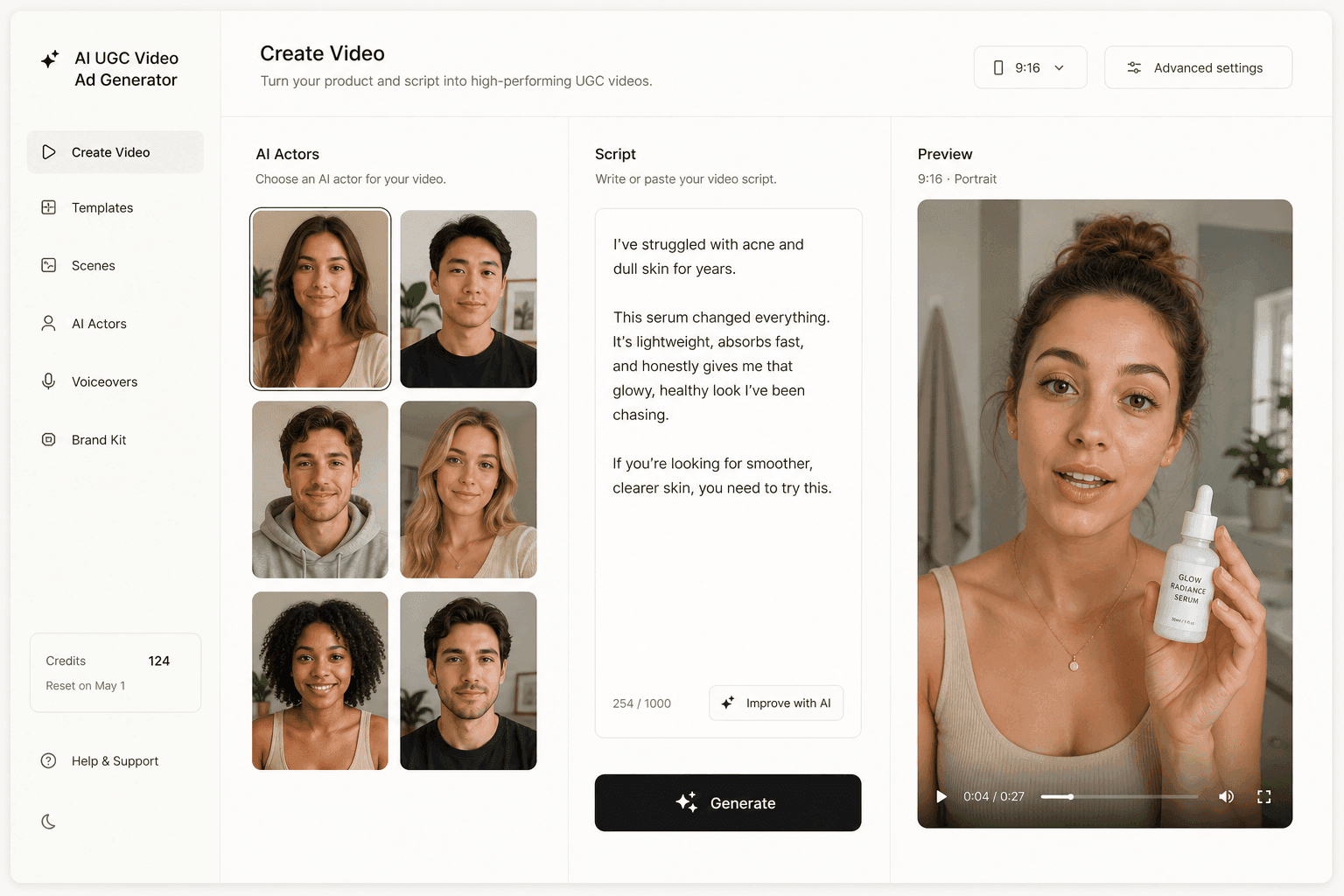
Novoads is a global AI UGC video-ad generator built around the part of the job ecommerce cares about: the actor presents your actual product. You upload a photo of someone holding your product to create a custom actor, write or auto-generate a script, and get a vertical ad where that creator holds the item; a stock actor from the library has empty hands. It runs multiple frontier models (Seedance, Kling, and Veo), and it ships ads in 30+ languages with real regional accents, not just translated captions. Where Zeely spreads across the whole campaign, Novoads goes deep on the single creative that carries it.
- Best for: product-in-hand UGC where the voice sounds local.
- Start at: $15/month (Starter, 200 credits per month).
2. Creatify, best for paste-a-URL ecommerce volume
Creatify is the closest shape to Zeely on the creative side, which is why they get compared so often. Its signature workflow is URL to Video: paste a product URL and it generates video ads, and its Batch Mode generates multiple ad variations at once when you want to test angles in bulk. It opens with a watermarked free plan (10 monthly credits), then Standard at 15 dollars a month and Pro at 55 dollars a month on monthly billing (read October 21, 2026). It leans more avatar-and-template than native handheld, but for paste-and-go catalog volume it is hard to beat. Our best Creatify alternatives guide covers its own field.
- Best for: URL-to-ad batch volume.
- Start at: a watermarked free plan.
3. MakeUGC, best for a large actor library
MakeUGC is the closest direct comparison to Novoads: a script-first generator with a very large AI-actor library (its homepage advertises 1,000+ realistic AI actors, read October 22, 2026), and actors that can present your product. It starts on a low-friction $1 trial of its own. If your priority is sheer variety of faces and accents to test, its library depth is the draw.
- Best for: maximum actor variety on a cheap trial.
- Start at: a $1 trial.
4. Captions, best for an all-in-one actor plus editor
Captions (by Mirage) pairs AI creators with a built-in, chat-based AI video editor in one app, so the clip and the edit live in the same place instead of bouncing to CapCut. Its entry web tier is $24.99/mo, with higher tiers above it and a free tier to start. If you want generation and editing without a second subscription, it is the most complete single creative workflow, though it stops at the file rather than launching it the way Zeely does.
- Best for: one app for actor and edit.
- Start at: a free tier.
5. HeyGen, best for spokesperson and avatar video
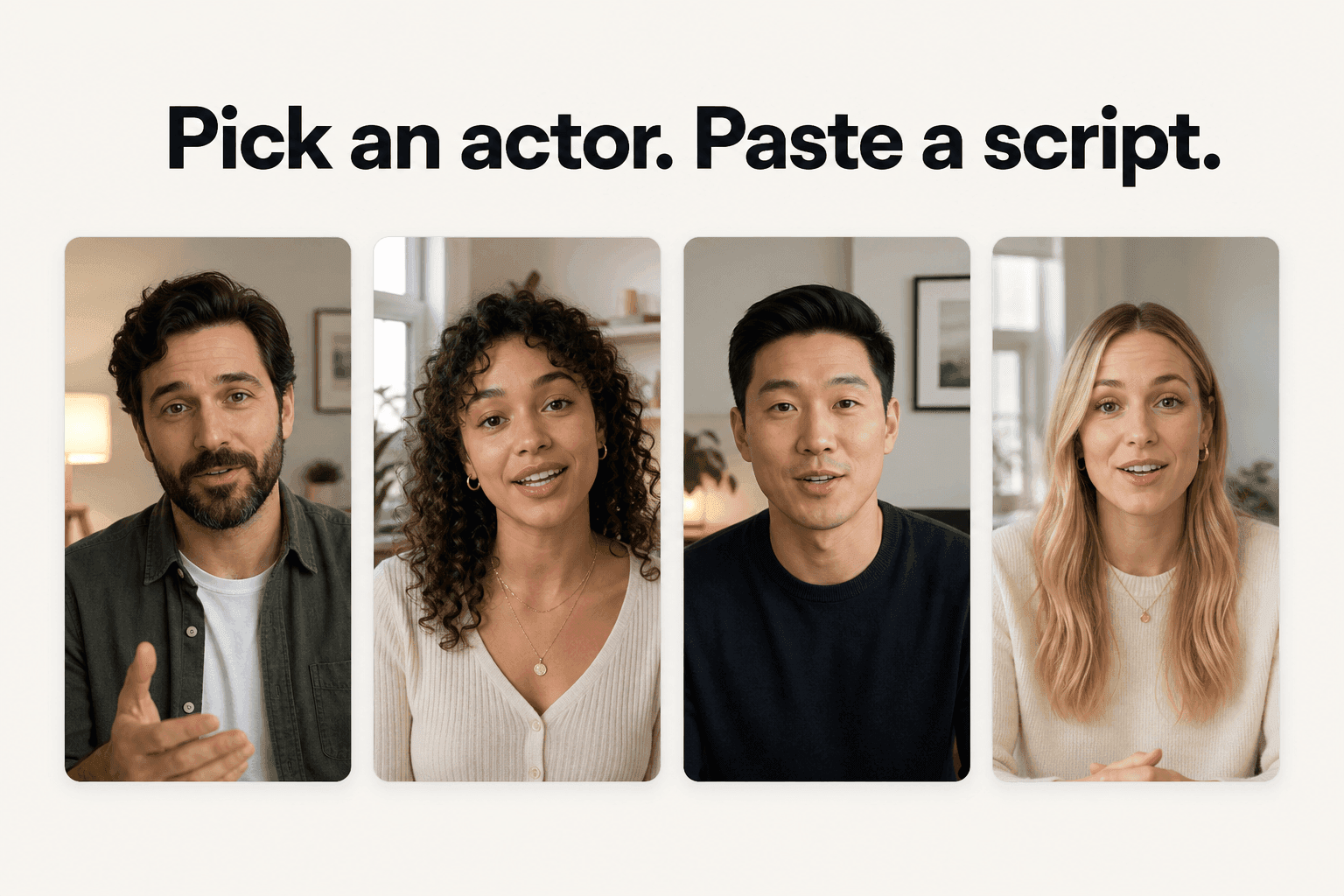
HeyGen is built around AI avatars and spokesperson-style delivery rather than handheld, phone-shot UGC. It is excellent for a clean presenter reading a script, explainer videos, and personalized video at scale, with a free entry tier to try it. For an ad that should look like a real customer in a kitchen, it is the wrong category. For a polished talking head representing the brand, it is a strong pick, and it overlaps with the AI-avatar slice of what Zeely offers.
- Best for: polished spokesperson and avatar video.
- Start at: a free tier.
6. Synthesia, best for corporate training and reach
Synthesia is the enterprise end of AI video: studio-clean avatars, deep localization across 140+ languages (its pricing page, read October 22, 2026), and a feature set aimed at training, onboarding, and internal communications. Its Starter plan was $19 a month on monthly billing for US visitors and $29 for other visitors shown dollar prices, as the page read on October 21, 2026, with a free Basic tier. It is not built to look unscripted, so it is a poor fit for native social UGC, but for polished, multilingual corporate video it is a category leader.
- Best for: training and 140+ language reach.
- Start at: a free Basic plan.
7. HeyFish, an AI UGC ad generator whose site is not loading
HeyFish's website has not loaded since at least September 19, 2026 (we checked again on October 22); the description below is from its homepage as archived on February 11, 2026. It called itself an AI UGC Video Ad Generator, with AI actors that can hold and showcase your real product through image-to-avatar technology. Until the site loads again there is no current plan or price to compare, so treat it as a name to re-check rather than a tool to start on.
- Best for: product-holding UGC ads, if its site comes back.
- Start at: site not loading (Oct 22, 2026).
The seven at a glance
The same field, laid out on the dimensions that actually decide it: the core job, the input the tool wants, and what it costs to begin.
| Tool | Core job | Signature input | Entry price |
|---|---|---|---|
| Novoads | Product-in-hand UGC | Photo of someone holding it, plus script | $15/mo (Starter) |
| Creatify | URL-to-video volume | Paste a product URL | Free plan, then paid |
| MakeUGC | Big actor library | Script plus product | $1 trial |
| Captions | Actor plus editor | Script in the app | Free tier |
| HeyGen | Spokesperson video | Script plus avatar | Free tier |
| Synthesia | Corporate training | Script plus template | Free Basic plan |
| HeyFish | AI UGC video ads (Feb 2026 archive) | Actor plus product | Site not loading (Oct 22, 2026) |
A worked example: a dropshipper testing one product
One supplement, one first real test: you want five angles, because the winner is rarely the one you would have guessed:
- A problem-solution hook.
- A testimonial to camera.
- A morning-routine clip.
- An ingredient explainer.
- An unboxing.
With an all-in-one, the temptation is to let the platform generate all five, launch them, and optimize automatically. That is convenient, and for the launch step it is genuinely useful. The catch is that if the five creatives are template-flat, no amount of automated optimization turns a weak hook into a winner. Optimization allocates budget between the ads you gave it. It does not make a better ad.
So run the creative step where it goes deepest, then launch wherever you buy media:
- On a published paid entry (MakeUGC's $1 trial, Novoads at $15/month, tied with Creatify's $15 Standard as the cheapest paid plan here), you get unwatermarked output with the product on camera (in Novoads, held by a custom actor made from a photo of someone holding it), in the accent your market speaks.
- On a watermarked free plan (Creatify), the first rough cuts cost nothing, enough to judge whether the actor and hooks land.
In Novoads specifically, the loop is short: upload a photo of someone holding the product once to create a custom actor, write or auto-generate the script, then generate each angle with a different accent (another photo makes another actor). Each returns as an ad-ready vertical with voice, lip-sync, and captions in about four minutes. A talking-actor take bills a full started minute, 200 credits at 720p, so Starter's 200 monthly credits cover one take and five takes use the 1,000 a month that Plus includes. A plain video clip with no talking actor runs from about 25 cents for a five-second Seedance 2.0 Mini clip to about $4 for an eight-second Google Veo 3.1 clip, and about $10 for a full 30-second Seedance 2.5 take. Even as five talking takes, five locally-voiced, product-in-hand variations land well under the cost of a single hired creator. You take the winners to your ad manager, or to Zeely if you want it to run the spend. The point is that the creative, the part that actually decides the result, got the depth it needed. Our best Arcads alternatives guide runs the same test against the realism benchmark.
How Novoads solves product-led UGC
Novoads is built for the exact job an all-in-one tends to under-serve: an ad where the creator holds your actual product, in the language your audience actually speaks. You upload a photo of someone holding your product to create a custom actor, write or auto-generate a script, and get a vertical UGC ad with voice, lip-sync, and captions, formatted for TikTok, Reels, and Meta. It runs multiple frontier models so you are not betting on one engine, and it produces ads in 30+ languages with real regional accents rather than a flat translation. The headline time is about four minutes. A talking-actor take bills a full started minute, 200 credits at 720p, and a plain video clip starts at about 25 cents, against the few hundred dollars a hired creator charges.
The difference from Zeely is not that one is good and the other is not. It is division of labor. Zeely wants to run your whole campaign from one app, and for a solo operator that loop is a fair reason to pick it. Novoads centers the one thing a launcher cannot fix for you: the product-in-hand, native-accent creative that paid social rewards, built on a custom actor made from a photo of someone holding your product. Many teams run both, a full-stack tool for launch and a specialist for the hero ad. For the closer one-on-one, our Zeely vs Creatify piece covers the creative side in detail.
The creative is the part you cannot automate around
The best Zeely alternative is not the one with the most features on the dashboard. It is the one that makes the ad your product needs, at a price that lets you test whether it converts. Zeely's all-in-one loop is a fair reason to stay if the launch and optimization are your real bottleneck. But an optimizer only moves budget between the ads you feed it, so the creative is the one step no platform can automate around. If the ad lives or dies on the product being seen and the voice sounding local, start where that creative goes deepest. You can produce your first product-in-hand AI UGC ad with Novoads, starting from a photo of someone holding your product, from $15/month at novoads.ai. Cancel anytime.
Frequently Asked Questions
What is the best Zeely alternative?
It depends on which part of Zeely you are replacing, not on a single winner. If you want the strongest product-in-hand UGC creative, where the actor holds and presents your actual product (in Novoads, a custom actor made from a photo of someone holding it) and sounds local across many languages, Novoads is the closest fit. For paste-a-product-URL ecommerce volume with a watermarked free plan, Creatify. For a large AI-actor library you can start for $1, MakeUGC. For spokesperson video, HeyGen; for corporate training, Synthesia; for an actor plus a built-in editor, Captions. Zeely's own edge, running launch and optimization in the same app, is the thing to weigh against all of them.
Is Zeely legit?
In our reading, yes: it is a real company selling a real product. Zeely, Inc. prints a Wilmington, Delaware address on its pricing page, and its About page says Zeely started in Ukraine in 2022 and now serves more than 2 million businesses and creators. Read on October 23, 2026, Zeely held 4.4 on Trustpilot from 4,438 reviews, 4.6 from 23K ratings on the US App Store and 4.3 from 9.22K reviews on Google Play's US storefront. Read the renewal terms before you pay: Zeely's help center says its paid Intro plans move automatically to Growth at $79.95 a month, while a Zeely blog post published February 10, 2026 lists Growth at '$79.95 on a trial; $149.95 after trial period expires'. We have not used Zeely hands-on; this answer comes from its public pages and public ratings.
How much does Zeely cost?
Read on October 23, 2026, Zeely's pricing page shows Starter at $29.95 a month (2,500 credits), Plus at $49.95 (5,000 credits) and Growth at $79.95 (10,000 credits), each beside a higher struck price, while the FAQ on the same page says plans start at $19.99 a month and that the plans in the app and on the website may vary. Zeely's help center also describes paid Intro plans, 2 weeks for $19.95, 4 weeks for $29.95 or 8 weeks for $49.95, which move automatically to Growth at $79.95 a month; a Zeely blog post published February 10, 2026 lists Growth at $149.95 'after trial period expires'. Running Meta ads through Zeely adds a service fee of 12% of ad spend, or 6% with its Booster add-on at $39.95 a year. So Zeely is paid from the first day, and the price that counts is the one on the checkout screen.
Does Zeely make the ads or just launch them?
Both, and that is the point of the product. Zeely creates UGC video ads, static ads, and AI avatars, then launches them on Facebook and Instagram and optimizes the spend, all from one app, and it connects with TikTok. The trade is breadth over depth: an all-in-one that does the whole loop tends not to go as deep on any single step as a specialist. For ecommerce, where the demo often is the ad, the creative step is usually the one worth going deep on.
Which Zeely alternatives have a free plan or trial?
Several. Creatify has a watermarked free plan with 10 monthly credits, Captions, HeyGen, and Synthesia offer a free entry tier, and MakeUGC uses a low-cost $1 trial. Novoads has no free tier and no trial, but it shares the cheapest paid door on this list with Creatify: Starter is $15/month (200 credits per month), the same as Creatify's Standard on monthly billing (read October 21, 2026), and below Captions' $24.99, Synthesia's Starter ($19 a month for US visitors and $29 for other visitors shown dollar prices, on monthly billing, read October 21, 2026) and Zeely's lowest monthly card, $29.95 (Zeely's paid Intro plans start at $19.95 for two weeks, read October 23, 2026). So finding out whether AI UGC works for your product costs nothing on a free plan, a dollar on MakeUGC's trial, or $15 for a month of the specialist.
Zeely vs Creatify: which is better?
They solve different halves of the job. Zeely is an all-in-one platform that creates, launches, and optimizes campaigns from one app. Creatify is an ad generator whose signature move is turning a pasted product URL into video ads, with batch generation and a watermarked free plan. If you want create-plus-launch in one place, Zeely leans that way; if you want to pump out creative variations fast and start free, Creatify does. Our Zeely vs Creatify breakdown runs the full head-to-head.
Do AI UGC ads actually perform?
User-generated content is the format shoppers trust, because a real-seeming person reads as more credible than a brand talking about itself. AI UGC reproduces that trust signal from a script in minutes for a few dollars, which is what makes testing many ad angles affordable. The tool you pick decides how close the output gets to a real creator and whether the product can be shown convincingly on camera, which is the part a launcher cannot fix for you.
Key Takeaways
- Zeely is an all-in-one AI ad platform: it creates UGC video and static ads, offers AI avatars, then launches and optimizes campaigns on Facebook and Instagram as a Meta Business Partner and connects with TikTok, pitched at small sellers who want to run ads like big brands.
- The reason teams look past Zeely is rarely the launcher. It is that the ad which actually carries the click, product-in-hand UGC that reads as a real recommendation, is a specialist job, and an all-in-one is a generalist by design.
- Most alternatives let you test the creative for less before committing: a watermarked free plan or a specialist at $15 a month, versus Zeely's plan cards, read on October 23, 2026 at $29.95 a month (Starter) up to $79.95 (Growth), or its paid Intro plans from $19.95 for two weeks, which its help center says move to Growth automatically.
- Match the tool to the ad. Novoads, MakeUGC, and Creatify make native handheld UGC; HeyGen is built for spokesperson video; Synthesia for corporate training; Captions bundles an actor and an editor.
- Novoads fits product-led UGC best: a custom actor made from a photo of someone holding your product keeps it on camera, it runs multiple frontier models, it ships ads in 30+ languages with real regional accents, and it starts at $15/month (Starter, 200 credits per month).
- Read on October 23, 2026, Zeely held 4.4 on Trustpilot from 4,438 reviews, 4.6 from 23K ratings on the US App Store and 4.3 from 9.22K reviews on Google Play's US storefront. Running Meta ads through Zeely adds a service fee of 12% of ad spend, or 6% with its Booster add-on.
Sources
- •Zeely
- •Zeely pricing
- •Zeely Help Center: what's included in the Intro plan
- •Zeely Help Center: what is Zeely's service fee
- •Zeely Help Center: what is Booster
- •Zeely blog: upgrade or downgrade your Zeely plan step-by-step
- •Zeely: About us
- •Zeely Terms of Service
- •Zeely subscription and refund policy
- •Zeely on the App Store (US)
- •Zeely on Google Play (US)
- •Creatify pricing
- •Novoads