
What MakeUGC Costs in 2026 and 7 Alternatives to Its $59 Plan
MakeUGC's entry plan is $59 a month for 500 credits, opened by its own $1 trial. What that buys, what its Unlimited layer really covers, and seven alternatives priced with their billing basis.

Mauricio Valdivia
·Updated ·12 min

MakeUGC's sticker is $59. Its meter is the real number.
MakeUGC is a script-first AI UGC video generator: you write the script, pick one of its AI creators, and it renders a talking clip you can run as an ad. Its entry plan is called Start up, and on MakeUGC's own pricing page, read on 2026-09-19, it lists at $59 a month, billed monthly, for a fixed 500 credits. Growth is $79 for 1,000 credits. Pro is $149 for 2,000. The button on every one of those cards reads Start for $1, so the door is MakeUGC's own paid trial rather than the full price.
That is the whole price.
The harder question is what the money buys, because MakeUGC meters output in credits rather than in videos, and a credit balance is not a number you can convert into finished ads before you have signed up. So this guide answers the pricing question first, then reads the Unlimited layer MakeUGC has since bolted onto the same ladder, and only then compares seven alternatives, with the billing basis printed next to every price. An entry price means nothing until you know whether it is monthly, annual-equivalent, iOS-only or a trial.
What MakeUGC actually is
The library and the languages
The catalog is the headline, and it is a real one. MakeUGC's pricing page repeats the claim on its cheapest card: 1000+ realistic AI creators and 50+ languages available. That means you can cast a plausible on-camera person for most markets and most demographics without booking a shoot, which is exactly the bottleneck this category exists to remove.
If your problem is variety of faces, few tools match it on breadth alone. What the number does not tell you is how many of those creators you will get through in a month, which is the credit question the rest of this page is about.
Script in, talking clip out
MakeUGC is script-first. You bring the words, it produces the clip. What changes as you climb the ladder is the shape of the product, not only the volume: the $79 Growth card is the first one that says Access to all AI models, where the entry card says Access to Selected models, and the $149 Pro card is where Product in hand videos and Video Agent and PDF to Video appear. So the feature you came for may sit two tiers above the price you were quoted.
What MakeUGC costs in 2026
The credit ladder
Read on 2026-09-19, MakeUGC's public pricing page carries one platform ladder and one API ladder. These are the list prices, on monthly billing:
| Plan | Per month | Credits per month | Model access |
|---|---|---|---|
| Start up | $59 | 500 | Selected models |
| Growth | $79 | 1,000 | All AI models |
| Pro | $149 | 2,000 | All AI models |
| Enterprise | Custom | Custom | Everything in Pro |
The API ladder sits on the same public page: API Starter is $99 a month for 2,000 credits, API Pro is $299 a month for 6,000 credits with higher concurrency and a priority queue. Those are developer tiers, not a cheaper way into the app.
The $1 door belongs to MakeUGC
Every self-serve card on MakeUGC's pricing page carries MakeUGC's own call to action, Start for $1, and its Pro card renders that door inside the price itself: $149 struck through, $1 live, Renews at $149. MakeUGC's own FAQ treats that trial as a given when it explains what Unlimited does not cover. Two things follow:
- It is a paid trial, not a sample. The card on file converts to the plan's real monthly price unless you cancel first.
- The low door is no longer the entry tier's signature. It opens Growth and Pro too, so the cheapest way in and the cheapest plan are now two separate decisions.
The promo layer on the page
When we read the page on 2026-09-19 it carried a banner reading Special 24h offer at 30% off, and every platform card wore a 50% OFF badge. Treat the ladder above as the published list, not as what a checkout will total on the day you read this, and expect a different promo next week. One detail is worth knowing before you do the mental arithmetic: on the Start up card the struck price and the live price are both $59, so that badge is not a discount off some higher list price. On Pro the two numbers do differ, $149 struck against $1 live, and that difference is the trial rather than a sale.

What MakeUGC's Unlimited actually covers
Since the last time we priced this page, MakeUGC has added an Unlimited layer on top of the same credit ladder. It is the biggest change to the pitch, and it argues directly against the complaint this post has always made, so it deserves reading closely rather than repeating.
Three conditions, all from MakeUGC's own FAQ
- Only the models your plan names. The FAQ says Unlimited lets you generate without spending credits on supported models in your plan. The entry Start up card spells out the other side of that sentence: it lists a block of unlimited model windows under the heading Unlimited unavailable.
- The slower queue. The same FAQ says Unlimited runs in the standard queue while credits always use the priority queue. Unlimited generations and credit generations are not the same service level.
- Not during the trial. Asked point blank whether Unlimited starts on the $1 trial, MakeUGC answers no: it activates only after that trial ends and your first full billing cycle begins.
What it changes about the credit math
Those three conditions add up to something real and something narrower than the word. On the tiers that get it, for the models it names, Unlimited genuinely takes the meter off the work that eats the most credits, and for a team testing one format at volume that is a meaningful change. What it does not do is rewrite the arithmetic on the entry plan, which still buys a fixed 500 credits a month, on selected models, with no rollover: MakeUGC's FAQ states that each generation costs a set number of credits depending on the model, duration and resolution, and that credits refresh each billing cycle and do not roll over.
So the honest summary is not that MakeUGC is unlimited now. It is that MakeUGC is unlimited on named models, in the slower queue, starting after your first full month. That is a genuine improvement and a much smaller claim, and the gap between the two is where most of the disappointment in this category lives.
Who MakeUGC fits, and where it stops
Pick MakeUGC when:
- Breadth of faces and languages is the reason you are shopping, and the catalog is the product.
- You will live on Growth or Pro, where all models are unlocked and the Unlimited windows actually apply.
- Your ads are talking-head or spokesperson clips where the person on camera could be holding anything.
Look at an alternative when:
- Your real packaging has to be recognizable on camera, which is a product-workflow question, not an actor-count question.
- You want the full monthly cost before a card is on file, with no trial step in the middle.
- You would rather pay less for one strong market than for a 50-language catalog you will never use.
None of these are knocks on MakeUGC's output. They are mismatches between a broad, credit-metered library and a narrow, product-first need, and they are exactly where the tools below pull ahead.
The 7 MakeUGC alternatives at a glance
Seven tools do a version of the same job, and they are not interchangeable:
- Novoads for product-led UGC, where your real product has to stay accurate on camera.
- Arcads for the most realistic AI actors.
- Captions for one tool that both generates the actor and edits the clip.
- Creatify for paste-a-URL ecommerce volume.
- HeyGen for spokesperson and avatar video.
- Synthesia for corporate and training video at scale.
- Vidnoz for the largest avatar catalog on the smallest budget.
Every entry price below carries its billing basis and the date it was read, because a headline number without either is not comparable:
| Tool | Entry price and basis | Read on | Best for |
|---|---|---|---|
| Novoads | $15/month (Starter), billed monthly | 2026-09-21 | product-led UGC |
| Arcads | no public price, account-gated | 2026-09-18 | most realistic actors |
| Captions | $24.99/month, iOS plans only | 2026-09-19 | actor plus editor |
| Creatify | $39/month, 100 credits | 2026-09-19 | paste-a-URL volume |
| HeyGen | $29/month, Creator tier | 2026-09-17 | spokesperson video |
| Synthesia | $29/month, Starter tier | 2026-09-17 | corporate and training |
| Vidnoz | $0 tier, paid prices JS-rendered | 2026-09-17 | biggest avatar catalog |
| MakeUGC | $59/month, 500 credits | 2026-09-19 | biggest actor library |
The seven alternatives in detail
1. Novoads, for product-led UGC
Novoads is built around the case an actor catalog does not directly solve: an ad where a specific, real product has to appear accurately in someone's hands. It gets there by two named routes rather than by hoping a stock actor happens to hold the right thing:
- Discover's product templates take your uploaded product image, swap the real item into the template creator's hand and animate it as a short clip.
- A custom actor, built from a photo of a person holding your product, delivers UGC-style talking clips for the cases where somebody has to speak.
It rents the same frontier video engines the rest of this list rents, so realism is a tie and the argument moves to what it costs to reach an ad you can actually run: $15 a month on Starter, billed monthly from the first charge, 200 credits included, with every plan published on the pricing page.

2. Arcads, for the most realistic AI actors
Arcads is the realism benchmark in this category. Its homepage offers a library of 1,000+ Captivating AI Actors or the option to create your own AI Avatar, and promises accurate translation in more than 30 languages. What you should know before shortlisting it is that the price is behind an account: on 2026-09-18 its pricing page returned a 404 and the site navigation offered only Features, Industries and Login or Sign up, with plan changes happening on an in-app paywall. That is a real difference in how you shop, not a judgment about the output, and we go deeper on the field in our Arcads alternatives comparison.
3. Captions, for one tool that generates and edits
Captions pairs synthetic AI creators with a built-in editor, so generating the clip and cutting it happen in one place. Its Max plan lists $24.99/mo with 500 credits a month, read on 2026-09-19. Carry the footnote along with the figure: the same pricing page states that features and prices reflect iOS plans only, so that number describes the App Store product rather than a web subscription, and it is the kind of detail that changes a procurement conversation. If you want the fewest tools in your stack and your team works on iOS, the all-in-one shape is genuinely appealing.
4. Creatify, for paste-a-URL ecommerce volume
Creatify is the volume play. Its Starter plan is $39 a month for 100 credits and Pro is $99 a month for 300 credits, both read on 2026-09-19, and its signature workflow is URL to Video: paste a product link and it generates ad variations from it. It also publishes a free plan with 10 monthly credits and a watermark, which is Creatify's offer and not a norm in this category. If your job is many product-ad variations, fast, this is the natural pick, and the credit counts are small enough that you should price the videos rather than the plan.
5. HeyGen, for spokesperson and avatar video
HeyGen is the polished presenter tool. Its pricing page, read on 2026-09-17 and not re-fetched for this update, puts the Creator plan at $29/month, or $24/month if you pay annually, with Pro at $49/mo for advanced individuals creating premium content at scale. It also runs a UGC surface stocked with creator-style presenters rather than corporate spokespeople. The centre of gravity is still a clean presenter talking to camera, which is right for explainers, onboarding and brand clips, and less right for scrappy handheld ads.
6. Synthesia, for corporate and training video
Synthesia is the enterprise-grade presenter tool. Read on 2026-09-17 and not re-fetched for this update, its Starter plan is $29 per month, and it publishes a Basic tier at $0/mo with no credit card required. It is built for polished corporate, training and internal video at scale rather than performance-ad UGC, with avatars, dubbing and SCORM export aimed squarely at learning teams. If your real need is professional talking-head content across a big organization, it fits better than any UGC-ad tool on this list.
7. Vidnoz, for the largest avatar catalog on the smallest budget
Vidnoz goes wide and cheap. Its homepage marketed 1900+ realistic AI avatars when we read it on 2026-09-17, and its pricing page publishes a Free tier at $0/mo. One caveat about the price, stated rather than guessed: the paid monthly figures on that page are rendered by JavaScript and are not visible to a plain fetch, so we do not print one here. Judge Vidnoz on catalog size and on the $0 tier, and read the paid ladder in your own browser before you commit to it.
A worked example: ten angles for one skincare serum
What ten angles costs when the unit is a credit
Say you have one skincare serum and ten ad angles to test this month. On MakeUGC you would probably want Growth at $79, because that is the first tier with all models unlocked, and then you are spending an allowance whose exchange rate you cannot compute in advance: the FAQ says each generation costs a set number of credits depending on the model, duration and resolution. Ten angles is rarely ten renders, either. Counted honestly it is closer to twenty or thirty once you add the reshoots, the language variants and the near-misses you scrap, and on a metered plan that is the difference between finding a winner and running out three days before the renewal.
Where the other plans land
Run the same ten angles past the rest of the list and the shape of the bill changes, not just its size:
- Captions Max buys 500 credits a month, on iOS plans.
- Creatify Starter buys 100 credits at $39 a month, which optimizes for variation count rather than for product fidelity.
- Arcads would give you the most convincing actor and an unknown monthly number until you have an account.
Underneath all of it sits the question none of the stickers answer, which is cost per winning ad: a cheap plan that yields few usable videos costs more per winner than a slightly pricier plan you can test freely on. We work that math through in how much UGC creators charge, and the logic transfers straight to AI tools.
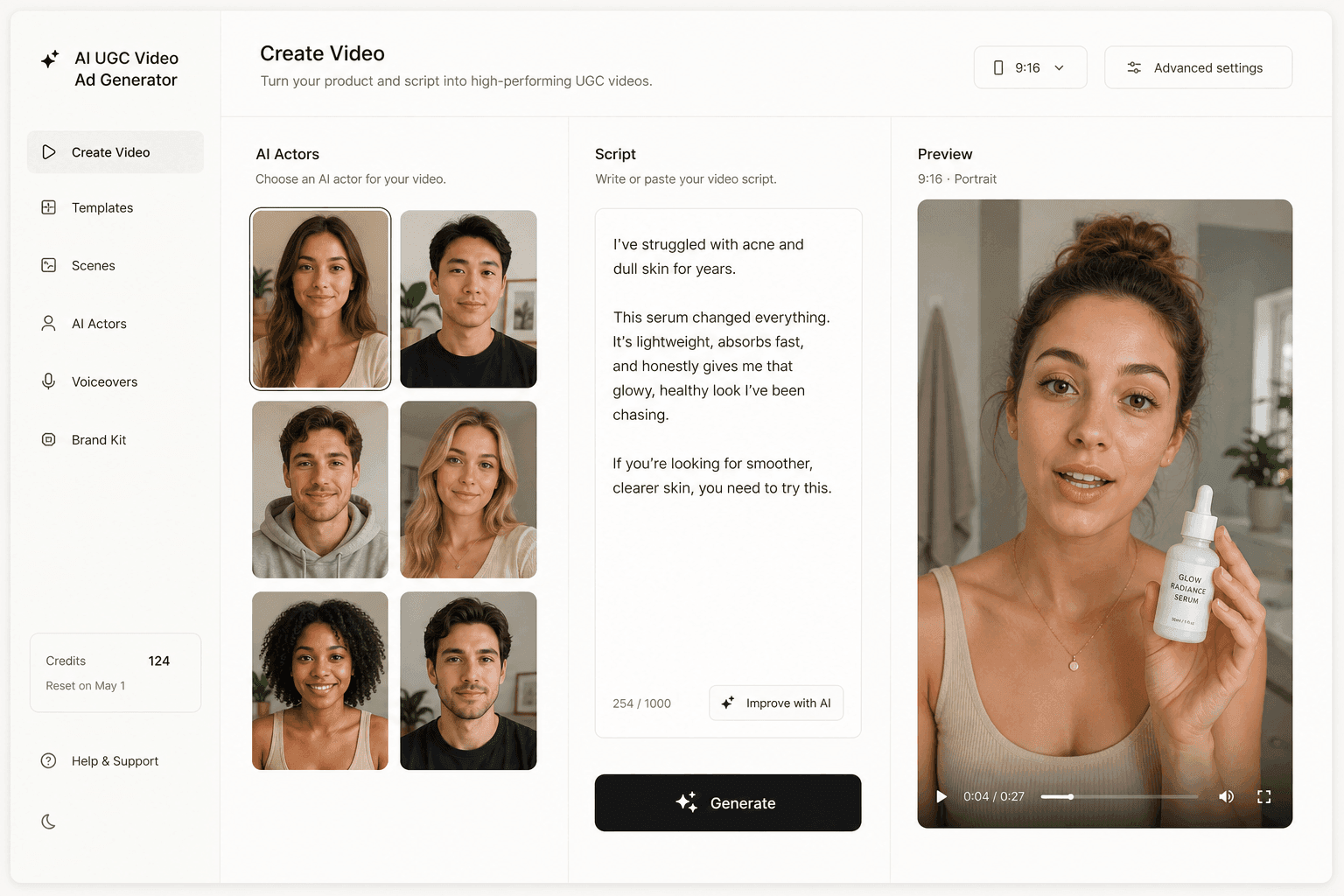
How Novoads solves product-led UGC
Most of these tools start from a person and add a product. Novoads starts from the product. Upload a product image and Discover's product templates swap the real item into the template creator's hand and animate it as a UGC-style clip, or turn a photo of someone holding it into a custom actor and get a talking clip in the language your market speaks. The failure mode this removes is specific: with a pure avatar tool the actor is convincing and the thing in their hand is an approximation, so the ads where packaging is the whole point quietly miss.
The commercial shape is deliberately boring. Novoads starts at $15 a month (Starter), billed monthly, 200 credits every month, cancel whenever you want. Every plan is paid from the first charge and there is no trial step in the middle, which means the number you compared is the number you pay. If you have read Novoads and MakeUGC side by side or weighed Creatify alternatives, the pattern is the one this whole page argues: pick by the ad you need, not by the size of the catalog. You can start at $15 a month.
Fit beats library size
Strip this guide down and the decision is one question asked in the right order. Does your real product have to be recognizable on camera? If it does, actor count is close to irrelevant and you are shopping for a product workflow. If it does not, you are shopping for actors and for cost per usable video, and that is where a straight Arcads vs Creatify read earns its keep, because those two are close enough that the details decide it.
MakeUGC's catalog is real, and its Unlimited layer is a genuine improvement on the models it names, in the queue it runs in, after the month it starts. Breadth still is not fit. The tool that wins is not the one with the most actors or the lowest sticker; it is the one that lets you test the most real ideas for the least friction and then gets out of the way, which is the same lesson behind the rise of AI UGC and why an authentic, real-feeling UGC ad keeps outperforming the glossy one. Count what you will actually ship this month, not how many actors you could theoretically cast.
Frequently Asked Questions
What is MakeUGC and what does it cost?
MakeUGC is a script-first AI UGC video generator: you write a script, pick one of its AI creators and it renders a talking clip for ads. Its pricing page, read on 2026-09-19, lists Start up at $59 a month for a fixed 500 credits, Growth at $79 for 1,000 credits and Pro at $149 for 2,000, all billed monthly, plus API tiers at $99 and $299. Every self-serve card opens with a Start for $1 button, so the entry is MakeUGC's own paid trial rather than the full price. A promotional banner was live when we read the page, so those numbers are the list ladder.
What does MakeUGC's Unlimited actually include?
Less than the word suggests, and MakeUGC's own FAQ is where the limits are written. Unlimited lets you generate without spending credits on the supported models named in your plan, so it is per-model rather than blanket. It runs in the standard queue while credits always use the priority queue. And it does not start during the $1 trial: the FAQ says it activates only after the trial ends and the first full billing cycle begins. On the entry Start up card several of the unlimited model windows are listed as unavailable.
What is the cheapest MakeUGC alternative?
On sticker price, Captions' Max plan at $24.99 a month is the lowest here, with the page's own footnote that features and prices reflect iOS plans only. HeyGen's Creator plan and Synthesia's Starter plan were both $29 a month when read on 2026-09-17, and Creatify's Starter is $39 a month for 100 credits. The cheapest plan and the cheapest usable ad are different questions, though: what decides the bill is how many renders it takes you to find a winner.
Which MakeUGC alternative is best for product ads?
For ads where a real physical product has to appear accurately, the deciding feature is how the tool handles the product, not how many actors it has. Tools built around a product-image workflow keep the item faithful: Novoads through its Discover product templates or a custom actor made from a photo of someone holding the product, Arcads through its product-video features, and MakeUGC's own Pro tier, which is where Product in hand videos are listed. Pure avatar libraries are stronger for talking-head and spokesperson formats.
Is MakeUGC or Arcads better?
They solve slightly different shopping problems. Both carry large actor libraries, and Arcads is the realism benchmark with 1,000+ AI actors, a custom-avatar builder and translation in more than 30 languages. MakeUGC's advantage is that you can price it before you sign up: its ladder is public, while arcads.ai's pricing page returned a 404 on 2026-09-18 and plan changes happen on an in-app paywall.
Do MakeUGC credits roll over?
No. MakeUGC's pricing FAQ states that each generation costs a set number of credits depending on the model, duration and resolution, and that credits refresh each billing cycle and do not roll over. That is why the plan you can afford matters less than the number of renders it takes you to find a winning ad: an unused balance is gone at the end of the month.
Key Takeaways
- MakeUGC's published ladder, read on 2026-09-19: Start up $59/month for 500 credits, Growth $79 for 1,000, Pro $149 for 2,000, each billed monthly and each opened by MakeUGC's own $1 trial.
- A promotional banner and 50% OFF badges were live on the page when we read it, so treat those figures as the list ladder rather than a checkout total. On the entry card the struck price and the live price are both $59.
- MakeUGC's Unlimited layer is bounded three ways by MakeUGC's own FAQ: only the models your plan names, the standard queue while credits keep the priority queue, and only after the trial and the first full billing cycle.
- Every alternative's entry price carries a basis: Captions Max $24.99/month on iOS plans and Creatify Starter $39/month for 100 credits (both 2026-09-19), HeyGen Creator $29/month and Synthesia Starter $29/month (both 2026-09-17), and Arcads publishes no self-serve price at all.
- If your real product has to be recognizable on camera, shop for a product workflow, not an actor count. That single question decides most of this list.