Best Creatify Alternatives for Ecommerce: 7 AI Ad Tools, Priced
Creatify's pricing page served three cards on 2026-09-19: Starter at $39 a month for 100 credits, Pro at $99, Enterprise on request. Here are seven alternatives, every entry price dated and every billing basis named.

Mauricio Valdivia
·11 min

Creatify costs $39 a month. Price the alternatives against it.
An ecommerce marketer opens Creatify's pricing page, reads Starter at $39 a month for 100 credits, and does the division against the meter Creatify publishes in its own help centre: 5 credits per 15 seconds of video, rounded up. That is about twenty fifteen-second ads a month. Then she watches the first clip and asks the question a price tag cannot answer: does this read like a real customer holding the product, in the accent her buyers actually speak?
Both questions decide the purchase, and most comparison posts answer neither: they rank features and skip the bill. This one starts with Creatify's live ladder, then gives all seven alternatives an entry price with the date we read it and the basis it is quoted on, because $24.99 charged through an iOS in-app plan and $59 charged month-to-month on the web are not the same number.
Creatify earned its place in the category. It turns a product link into a UGC-style ad in minutes, batches a dozen variations at once, and now ships a video model of its own. The question was never whether Creatify works. It is which of the seven below makes the ad your product needs, for the least it costs to find out.
What Creatify costs, read off the page on 2026-09-19
The three cards the pricing page serves
Fetched live on 2026-09-19, creatify.ai/pricing returned three plan cards and no fourth:
- Starter, $39 a month, 100 credits a month. 300 AI actors, 200+ ad templates, 50+ premium models, one generation at a time, videos up to 2 minutes.
- Pro, $99 a month, 300 credits a month, with a selector on the card stepping through 300, 500, 1,000, 2,000 and 5,000. 1,500 AI actors plus 3 custom avatars, 500+ templates, up to five parallel generations, videos up to 10 minutes.
- Enterprise, "Let's talk!", sold through Contact Sales. Custom brand, seat and credit limits, white-label support, a dedicated account manager.
Both paid cards list Watermark Removal, and the Compare Plans table underneath carries the same three columns and no others. A banner across the top reads SAVE UP TO 50% ON ANNUAL PLAN, but the page prints no annual dollar amount anywhere in its served text, so those are the month-to-month rates and the annual equivalent is not a number anyone can honestly quote yet. On languages the two surfaces disagree: the pricing card says 75+, the help centre says 29. Name the surface you are citing rather than splitting the difference.
What a credit actually buys
Creatify prices its meter in plain text in the help centre: "Video Ad, Avatar Video & AI Shorts: 5 credits per 15 seconds of video (rounded up)." Do the arithmetic and the entry allowance is about twenty fifteen-second ads a month, the Pro base about sixty. Divide the card price by that and one fifteen-second ad lands at roughly $1.95 on the cheaper card and roughly $1.65 on Pro.
Neither per-ad figure is printed anywhere by the vendor. Both are ours, derived by dividing a published price by a published meter, and they hold only for the plain Video Ad and Avatar Video paths. Agent, Ad Flow and Ad Clone are variable and not priced upfront. One detail in the buyer's favour: monthly-plan credits stay valid for two months rather than expiring at the cycle.
Where the free plan went
On 2026-09-19 the watermarked free plan is not a card on the ladder and not a column in the Compare Plans table. It survives in exactly one place, an answer in the page's own FAQ: 10 monthly credits, up to 2 video ads or 20 image ads, 300 AI actors, 10 premium models, 40 ad templates, and exports that carry a watermark.
That demotion is worth a sentence to anyone who arrived expecting a no-cost first test, because it is a footnote now rather than a headline offer. One honest caveat: creatify.ai/pricing is a client-rendered page with Platform, Studio and API tabs, and the cards above are what the Platform tab served our fetcher. Read that as what the page shows a buyer, not as a claim that the plan was withdrawn. Either way, the cheapest number a buyer can plan around on that page is the entry card.
The seven alternatives, priced side by side
Entry price and billing basis
Every figure below carries the date we read it and the basis it is quoted on. A price without its basis is what makes most of these comparisons useless, and it is the single thing the ranking pages get wrong.
| Tool | Entry price | Billing basis | Credits included | Read |
|---|---|---|---|---|
| Novoads | $15/mo | Monthly, no trial | 200/mo | 2026-09-21 |
| Arcads | Not published | Pricing page 404s | Not published | 2026-09-19 |
| MakeUGC | $59/mo | Monthly, $1 trial first | 500/mo | 2026-09-19 |
| HeyFish | $24.99/mo | Last verified 2026-06-26 | Not published | Site down |
| Captions | $24.99/mo | iOS in-app plans only | 500/mo | 2026-09-19 |
| HeyGen | $29/mo | Monthly, $24/mo annual | 600/mo | 2026-09-19 |
| Synthesia | $29/mo | Monthly, $18/mo yearly | 1,200/mo | 2026-09-19 |
| Creatify | $39/mo | Monthly, no annual figure | 100/mo | 2026-09-19 |
Why the credits column does not compare
Read that column as a shape, not as a price. A credit is a private unit: Creatify spends 5 of its own per 15 seconds of video, MakeUGC and Captions meter theirs differently, and Synthesia's 1,200 buy dubbing minutes and avatar builds as well as video. Only one vendor on this page publishes a meter clean enough to convert an allowance into ads without guessing, which is why there is exactly one per-ad figure in this post.
Three of the seven need their basis read carefully:
- Captions, $24.99. The footnote under the cards reads "All prices displayed in USD. Features and prices reflect iOS plans only", so this is an in-app price, not a web entry tier.
- MakeUGC, $59. Genuinely month-to-month, but the checkout entry is a $1 trial that renews at the plan price.
- HeyFish, $24.99. The one figure we could not refresh. heyfish.ai/pricing returned a Cloudflare 522 and www.heyfish.ai did not connect at all on 2026-09-19, across two separate attempts, so the price is dated to our last successful read.
An outage is an outage, and nothing further should be read into it in either direction. The same caution applies to any roundup quoting a HeyFish price as current today.
Three jobs, not seven tools
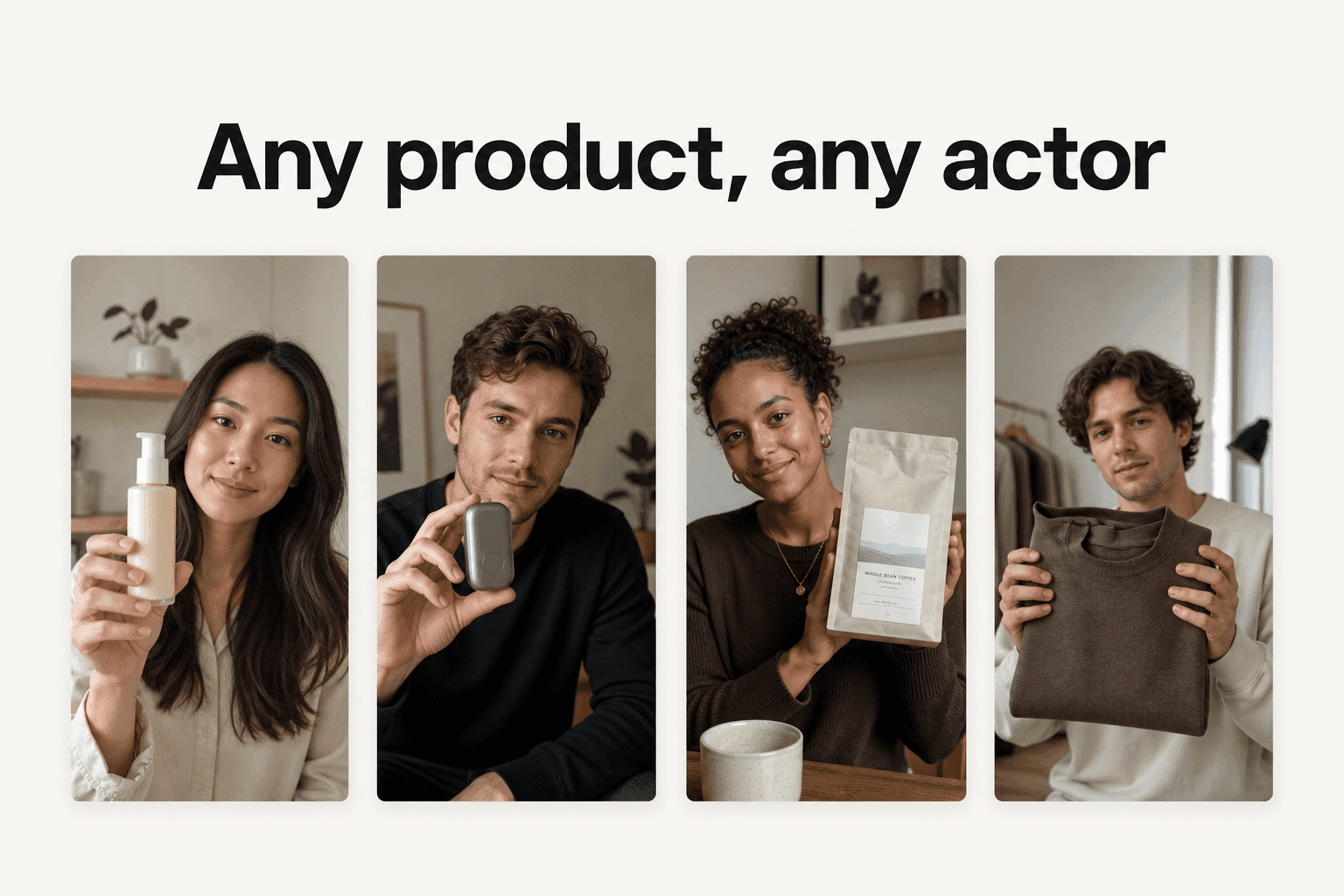
The first filter is not price. It is what the finished video has to look like, because no plan tier fixes a tool that makes the wrong kind of ad. The seven split into three jobs, and picking the wrong job is the expensive mistake.
Native handheld UGC
Looks customer-filmed: one person, a phone, your product in frame, the format paid social rewards precisely because it does not read as an ad. Novoads, MakeUGC and HeyFish sit here, with Arcads as the realism benchmark alongside them. If the demo is the ad, this is the row you are buying, and where that realism actually comes from predicts results better than any feature list.
An actor and an editor in one app
Generation and editing in the same place, so a clip and its cut do not bounce between two subscriptions. Captions is the only tool here built around that job, and it is the reason its price keeps getting miscompared against web-billed rivals.
Polished avatar and corporate
A studio-clean presenter reading a script: spokesperson clips, explainers, onboarding, internal comms. HeyGen and Synthesia own this end, and it is a different purchase from an ad, with a different unit of value underneath it.
Creatify straddles the first job's volume problem and the third job's finish, which is what paste-a-link-and-batch is for. So the shortlist narrows before any price is read:
- The ad should look customer-filmed, with your product on camera. Novoads, MakeUGC, HeyFish, or Arcads when raw talking-head realism is the priority.
- The clip and its edit should live in one subscription. Captions.
- You want a polished presenter, a training module or an explainer. HeyGen or Synthesia.
The native-UGC picks
1. Novoads, best for product-led UGC in many languages
Novoads is a global AI UGC video-ad generator built around the part ecommerce cares about: the actor presents your actual product. You write or auto-generate a script and pick an AI actor; for a vertical ad where the creator holds the item, you create a custom actor from a photo of someone holding it (Create Actor > Upload), because a stock library actor's hands are empty. Discover's product templates are the other route, swapping your uploaded product image into a template creator's hand. It runs Seedance 2.5, Seedance 2.0, Seedance 2.0 Mini, Kling v3 Pro, Google Veo 3.1 and Omni Flash, and it carries voices in 31 languages with real regional accents rather than translated captions.
- Best for: native-accent UGC with the product on camera.
- Entry price: $15/month (Starter, 200 credits per month), billed monthly from the first charge, no trial.
2. Arcads, best for the most realistic talking-head
Arcads is the realism benchmark for AI talking-head ads. Its homepage markets a library of 1,000+ AI actors plus the option to build your own AI avatar, it localizes into more than 30 languages, and its actors can hold and present a physical product through its custom-actor workflow. It publishes no pricing page: arcads.ai/pricing returned 404 to our fetch on 2026-09-19 while the homepage returned 200, so any dollar figure you see quoted for Arcads came from somewhere other than Arcads. Its help centre does document a 3-day trial that charges the saved card when it ends, and prices its talking-actor models at 800 credits per minute, per actor. Our Arcads alternatives post goes deeper on where it wins.
- Best for: the most realistic talking-head performance.
- Entry price: not published on its own site.
3. MakeUGC, best for the biggest actor library
MakeUGC is the closest direct comparison on this list: a script-first generator advertising 1,000+ realistic AI creators and 50+ languages. Its public ladder, read live on 2026-09-19:
- Start up, $59 a month, 500 credits, selected models only.
- Growth, $79 a month, 1,000 credits, the first tier with access to all models.
- Pro, $149 a month, 2,000 credits, badged best value.
Every self-serve tier opens on MakeUGC's $1 trial that renews at the plan price. Note where the feature you came for actually sits: "Product in hand videos" is listed on the Pro tier, not on the entry card. The full head-to-head is in our MakeUGC alternatives post.
- Best for: maximum actor and accent variety.
- Entry price: $59/month month-to-month, entered through a trial.
4. HeyFish, best for the lowest list price, when it is reachable
HeyFish is a direct AI UGC video-ad generator with price-aggressive positioning built around cheap per-video output. The last figure we verified from its own site, on 2026-06-26, was an entry paid plan at $24.99 a month, and we could not refresh it today for the reason given above. A 522 is an origin timeout, not a verdict on a business, so treat the price as dated rather than current and check the site yourself before planning around it.
- Best for: high volume at a low list price.
- Entry price: $24.99/month as of 2026-06-26, unverified since.

The editor, avatar and corporate picks
5. Captions, best for an all-in-one actor plus editor
Captions (by Mirage) pairs AI creators with a built-in chat-based AI video editor in one app, so the clip and the edit live in the same place. Read live on 2026-09-19:
- Max, $24.99 a month, 500 credits, the plan badged most popular.
- Scale, $69.99 / $139.99 / $279.99 a month, for 1,400, 2,800 and 5,600 credits.
- Enterprise, custom pricing with bulk credit discounts.
The line to read carefully sits under the cards: "All prices displayed in USD. Features and prices reflect iOS plans only." That makes the headline number an in-app price rather than a web entry tier, which is exactly how it ends up miscompared in most roundups. Its FAQ also confirms a free version with a limited feature set. More on the trade in our Captions alternatives post.
- Best for: one app for the actor and the edit.
- Entry price: $24.99/month, iOS in-app plans per the page's own footnote.
6. HeyGen, best for spokesperson and avatar video
HeyGen is built around AI avatars and spokesperson delivery: a clean presenter reading a script, explainer video, personalized video at scale. Read live on 2026-09-19:
- Free, $0 a month, capped at 3 videos of up to one minute.
- Creator, $29 a month billed monthly, or $24 a month paid annually, 600 credits, 1080p export.
- Pro, from $49 a month, 1,000 credits and 4K export, with tiers above it.
- Business, $149 a month plus $20 a seat, 1,500 credits.
Monthly credits roll over for one additional billing cycle, which softens the sting of a light month.
- Best for: polished spokesperson and avatar video.
- Entry price: $29/month billed monthly, $24/month billed annually.
7. Synthesia, best for corporate training and reach
Synthesia is the enterprise end of AI video: studio-clean avatars, deep localization, and a feature set aimed at training, onboarding and internal communications rather than paid social. Read live on 2026-09-19:
- Basic, $0 a month, 1,200 credits, no card required.
- Starter, $29 a month billed monthly, or $18 a month billed yearly.
- Creator, $89 a month billed monthly, or $64 a month billed yearly.
Its own FAQ puts the Starter annual plan at $264 a year. That is exactly the kind of number Creatify's up-to-50%-off banner does not give you, and it is why the annual column is missing from the table above.
- Best for: training and multilingual corporate video.
- Entry price: $29/month billed monthly, $18/month billed yearly.
Creatify now ships its own ad model
The framing most 2026 roundups still lean on, that Creatify is an avatar-and-template layer renting somebody else's engine, stopped being accurate in September. This is the one fact on this page that the eight listicles ranking above it do not carry.
What Boreal is
Creatify Labs publicly launched Boreal on 15 September 2026: a text-to-video and image-to-video model that generates synchronized native audio with the picture instead of dubbing it on afterwards. Creatify says it is available through the Creatify Labs API, inside Creatify's own Model Playground and AdFlow, and on fal. Creatify also publishes a comparison of its own, reporting that blind reviewers preferred Boreal to its untouched open base in 81% of decisive comparisons, 25 to 6 with 9 ties across 40 production cases. That is the vendor's own test rather than an independent benchmark, and it should be read as such.
What it costs on fal
When we read fal's Boreal page on 2026-09-16, the list price was per second and per resolution:
- 720p, $0.01 per second. fal's own example: a ten-second video costs $0.10.
- 1080p, $0.03 per second, or $0.30 for ten seconds.
- 2K, $0.12 per second, or $1.20 for ten seconds.
That basis is a different shape from every credit bundle in the table above, and it is the most interesting number on this page for anyone comparing costs at volume. We took the launch apart in more detail in our Boreal post.
For this comparison the consequence is narrow but real: the tool you are shopping away from is now also a model vendor, so "it is only templates" has stopped being a reason to leave.
A worked example: five angles for one supplement
The five angles
Say you just launched a single supplement and you want the winning angle, so you test five: a before-and-after story, a "why I switched" testimonial to camera, a morning-routine clip, a how-it-works benefit explainer and an unboxing. The format rewards running all five, because the winner is rarely the one you would have guessed. The only real question is what each route costs to find that out.
What each route costs
On the native side, in Novoads, the unit is the clip rather than the plan: an ad lands in about four minutes and runs from about 25 cents for a five-second Seedance 2.0 Mini clip to about $4 for an eight-second Google Veo 3.1 clip, and about $10 for a full 30-second Seedance 2.5 take, so five native variations cost five times that, on whichever model you pick. On Creatify's entry card, five fifteen-second ads is 25 credits out of a 100-credit allowance, about a quarter of the month. On MakeUGC the same test fits inside a 500-credit Start up allowance entered through MakeUGC's $1 trial.
Against a hired creator, who charges $50 to $500 and up per video, every one of those routes is a rounding error. The expensive mistake is never the subscription. It is buying the tool that makes the wrong kind of video and paying for a month of it before anyone notices.

How Novoads solves product-led UGC
Novoads is built for the job ecommerce teams reach for when a template ad stops converting: a video where the creator holds your actual product, in a language your audience actually speaks. Three things make that concrete:
- The product reaches the creator's hands by a named route. A custom actor built from a photo of someone holding it, or a Discover product template that swaps your uploaded image in.
- Several frontier engines, not one bet. Seedance 2.5, Seedance 2.0, Seedance 2.0 Mini, Kling v3 Pro, Google Veo 3.1 and Omni Flash.
- Voices in 31 languages with real regional accents, rather than a flat translation layered over English delivery.
You write or auto-generate a script, pick an actor, and get a vertical ad with voice, lip-sync and captions, formatted for TikTok, Reels and Meta. The headline time to a finished clip is about four minutes.
The difference is input and output, not quality: one product starts from a link and leans avatar-and-template for catalog speed, with its own model underneath it now, while Novoads centres the native-accent ad with the product in hand through that custom actor, and publishes one entry number, $15/month, Starter, 200 credits a month, billed from the first charge, no trial. The closer head-to-head is Novoads versus Creatify, and the wider field is in our UGC platforms for brands roundup.
The output is the whole game
The best Creatify alternative is not the cheapest tool or the fastest one. It is the one that makes the ad your product needs, for the least it costs to find out, and nobody can answer that until every price on the page carries its date and its billing basis. Creatify is genuinely good at link-to-ad volume on its entry card, and for a catalog that needs many avatar ads fast it stays a fair default to keep. For teams that want the creator to hold the product in the buyer's accent, name the output first, price the test honestly, and let the data pick the tool. You can make your first product-in-hand AI UGC ad, using a custom actor built from a photo of someone holding your product, from $15/month at novoads.ai. Cancel anytime.
Frequently Asked Questions
How much does Creatify cost?
Read live on 2026-09-19, Creatify's pricing page served three plan cards: Starter at $39 a month for 100 credits, Pro at $99 a month for 300 credits with a selector stepping to 5,000, and Enterprise on request with a Contact Sales button. A banner across the page offers up to 50% off an annual plan without printing an annual amount, so those two figures are the month-to-month rates as served. Creatify's help centre prices the meter at 5 credits per 15 seconds of video, rounded up, which puts the cheaper card's allowance at about twenty fifteen-second ads a month. That last number is our division of a published price by a published meter, not a figure Creatify prints.
Does Creatify still have a free plan?
On 2026-09-19 the watermarked free plan is not one of the three cards on creatify.ai/pricing and not a column in the Compare Plans table. It appears in one place, an answer in the page's FAQ: 10 monthly credits, enough for up to 2 video ads or 20 image ads, access to 300 AI actors, 10 premium models and 40 ad templates, with a watermark on exports. One caveat on the reading: that pricing page is client-rendered with Platform, Studio and API tabs, and the three cards are what the Platform tab served our fetcher, so this describes what the page shows a buyer rather than a claim that Creatify withdrew the plan.
What is the best Creatify alternative?
It depends on the output you need and on which bills are actually comparable. For product-led ecommerce UGC where the creator holds and presents your product, through a custom actor made from a photo of someone holding it, Novoads fits closest at $15/month. For the largest AI-creator library, MakeUGC, whose Start up tier is $59 a month month-to-month and enters through a $1 trial. For an actor plus a built-in editor, Captions at $24.99 a month, iOS-priced by its own page footnote. For spokesperson video, HeyGen, whose Creator plan is $29 a month billed monthly. For corporate training, Synthesia at $29 a month billed monthly. Arcads is the realism benchmark and publishes no pricing page: arcads.ai/pricing returned 404 to our fetch on 2026-09-19.
Can a Creatify alternative show the product in the creator's hands?
Yes, and so can Creatify: its own AI avatar page says a described custom spokesperson can hold your product. In Novoads the route matters, because a stock library actor's hands are empty. The product is in hand through a custom actor made from a photo of someone holding it (Create Actor > Upload), or through a Discover product template, which swaps your uploaded product image into the template creator's hand. MakeUGC lists Product in hand videos on its $149 Pro tier rather than its entry card, and Arcads markets actors that can hold and present a physical product through its custom-actor workflow. For ecommerce, where the demo often is the ad, that capability matters as much as raw realism.
Which Creatify alternatives have a free plan or trial?
Several, each dated to the day we read it. HeyGen lists a Free plan at $0 a month capped at 3 videos, and Synthesia a Basic plan at $0 a month with 1,200 credits, both read live on 2026-09-19. Captions' FAQ confirms a free version with a more limited feature set than its paid plans. MakeUGC opens every self-serve tier with a $1 trial that renews at the plan price, and its own FAQ says the Unlimited allowance does not activate during it. Arcads documents a 3-day trial in its help centre that charges the saved card when it ends. Novoads has no free tier and no trial: it starts at $15/month, 200 credits a month, billed from the first charge.
Creatify vs Novoads: which is better?
They solve different jobs, and the pricing pages say so. Creatify is built for paste-a-link workflows and high-volume batch generation, leans avatar and template, and as of September 2026 also ships its own video model, Boreal. Novoads centres native, product-in-hand UGC through a custom actor made from a photo of someone holding your product, runs several frontier engines, and carries voices in 31 languages with regional accents, starting at $15/month (Starter, 200 credits per month) with no trial. If you want link-to-ad catalog speed, Creatify. If you want the creator to hold your product in the buyer's accent, Novoads.
Key Takeaways
- Creatify's public pricing page served exactly three plan cards on 2026-09-19: Starter at $39 a month for 100 credits, Pro at $99 a month for 300 credits with a selector running to 5,000, and Enterprise on request. A banner offers up to 50% off an annual plan, but the page prints no annual dollar amount.
- Creatify's help centre prices its meter at 5 credits per 15 seconds of video, rounded up. Divide and the Starter allowance is about twenty fifteen-second ads a month, or roughly $1.95 an ad. That division is ours, not a figure Creatify publishes.
- The watermarked free plan is no longer a card on the ladder or a column in the Compare Plans table. On 2026-09-19 it survives only as an answer in the page's FAQ: 10 monthly credits, up to 2 video ads, watermarked exports.
- Compare entry prices only with the billing basis attached. Captions' $24.99 is an iOS in-app price by the page's own footnote, MakeUGC's $59 is month-to-month behind a $1 trial, Synthesia's $29 is billed monthly against $18 billed yearly, and Arcads publishes no pricing page at all.
- Match the tool to the output before the bill. For native product-in-hand UGC across many languages, Novoads starts at $15/month (Starter, 200 credits per month), billed from the first charge, with the product in hand through a custom actor made from a photo of someone holding it.