Creatify Boreal on fal: Video With Native Audio at $0.01 a Second in 720p
Creatify Labs publicly launched Boreal on September 15, 2026, a video model that generates synchronized sound with the picture. fal lists it at $0.01 per second at 720p, $0.03 at 1080p and $0.12 at 2K.

Mauricio Valdivia
·11 min

Five cents for a five-second clip, if 720p is enough
A growth marketer sits down on a Monday with one skincare serum, twelve hook ideas and a render budget that covers four of them. The other eight never run. Not because they are weak, but because every clip costs money and a wait. That is the math Creatify Labs is aiming at.
On September 15, 2026, Creatify Labs publicly launched Boreal as a general video model. It turns a text prompt, with an optional reference image or audio track, into a clip with synchronized sound. fal lists it at $0.01 per second at 720p, $0.03 per second at 1080p and $0.12 per second at 2K, list prices fetched on September 16, 2026. A five-second 720p clip comes to five cents.
One disclosure before anything else. Creatify is a direct competitor of Novoads: both companies sell AI-generated video ads to marketers, and we have compared the two products head to head in Novoads vs Creatify. Boreal is not in Novoads, we do not run it, and this post is not a pitch for it. It is a rival's launch, read by a rival, with every number traced back to the page that published it.
That matters because most of the striking numbers in this launch come from Creatify itself. The sections below separate what the listing pins down, what Creatify reports about its own model, and what a team that tests many ad variants should check before moving any budget.
What Creatify actually put on sale
The launch is easy to misread from the headline alone. Boreal is one model reached through three doors, it does sound as well as picture, and its name was already inside Creatify's product before September.
Video and sound from a single prompt
fal describes the model as one that creates "product, UGC, and presenter videos with synchronized native audio from text, with optional image and audio inputs." The audio is not a separate text-to-speech pass you stitch on afterwards. Dialogue, footsteps and background sound are written into the same brief as the camera direction.
fal's schema asks for that brief in four labeled parts:
- [VISUAL] for the subject, action, camera and look of the shot.
- [SPEECH] for the spoken line and how it is delivered.
- [SOUNDS] for effects and ambience.
- [TEXT] for any on-screen text, or "None."
The two optional inputs change what the model does. An image is an "optional reference image to animate," which guides identity, composition and appearance, and by default the output follows that image's aspect ratio. An audio file is "optional driving audio," such as narration, dialogue or a soundtrack, and it is kept in the output in place of generated speech. On fal, image-to-video works through that optional image input on the endpoint fal titles Boreal (Text to Video).
Three ways to reach it
Creatify's release lists the doors in one sentence, and two of them can be checked on pages outside the release:
- fal, as the endpoint
creatify/boreal, with the per-second price on the model page. - Creatify's own API, which now has a Boreal section in its documentation describing "Creatify's video generation model, built for video ads."
- Creatify's apps, where the release says Boreal runs inside Model Playground and AdFlow.
The first two are what a developer or an agency with its own pipeline would use. The third is what a Creatify subscriber would see inside the product they already pay for.
A name Creatify had used before
Boreal is not a name that first appeared this week. A Creatify help article dated May 10, 2026 tells Avatar Video users: "You can choose either an Aurora Model or Boreal Model which is a latest rendering model." So the September 15 event is the public launch of Boreal as a general text-to-video and image-to-video model on the API and on fal, not the first time the word showed up in Creatify's product. The pages we read do not say whether the May rendering option and the September model share the same weights.
The spec sheet, surface by surface
fal and Creatify publish different slices of the same model. Read side by side, they give a fuller picture than either page alone.
| Spec | On fal | On Creatify's API |
|---|---|---|
| Inputs | Prompt, optional image, audio | Prompt, optional image, audio |
| Resolutions | 720p (default), 1080p, 2k | 720p (default), 1080p, 2k |
| Aspect ratios | auto, 16:9, 9:16, 1:1, 4:3, 3:4 | Same six options |
| Length | Default 10 s, frame-rounded | Up to 60, 30, 15 s |
| Price | 720p $0.01, 1080p $0.03, 2K $0.12 per s | 720p 1, 1080p 3, 2k 12 credits per 10 s |
What the fal listing pins down
fal's schema carries three details that matter more for ads than the headline price:
- Language. The schema states that "English is the validated language." A Spanish, Portuguese or German script may still work, but English is the only language the listing vouches for.
- Length. Video is generated at 24 frames per second and rounded to the nearest legal frame count (fal's examples: 5 seconds to 121 frames, 10 to 241, 15 to 361). The default is 10 seconds, so a request that never sets a duration renders twice the length of a five-second test clip.
- Disclosure. A visible AI-generated label is optional, but "invisible C2PA metadata and watermarking are always applied." Every Boreal clip from fal carries a provenance marker whether or not you add the label.
What Creatify's own API adds
Creatify's documentation adds per-resolution limits and a different billing unit:
- Maximum length: 60 seconds at 720p, 30 seconds at 1080p and 15 seconds at 2k. A 30-second spot at 2K is not a request this API takes in one piece.
- Billing unit: "per started 10 seconds of video," at 1 credit for 720p, 3 for 1080p and 12 for 2k.
- Rounding in practice: Creatify's own example is that a 15-second 720p video costs 2 credits.
- Failures: credits are charged when rendering starts and refunded if the video fails.
What the cent actually buys
The cent a second is fal's 720p list price and nothing more. At 1080p the rate is three times higher, and at 2K it is twelve times higher. fal's own illustration is a 10-second video at ten cents, thirty cents or a dollar and twenty depending on resolution.
There is also a caveat Creatify prints on its own pages. On September 16, 2026, the Boreal model page still read "Pricing shown for the fal API. Figures pending final confirmation before launch." The fal page carries a live price, but the vendor has not yet called its figures final, so a budget built on them should be checked again before it is committed.
How Creatify says it made video cheap and fast
Creatify's explanation has three parts: an open base, one training recipe aimed at ads, and serving speed. All three are the company's description of its own work.
An open base model, tuned on ad footage
According to the release, Boreal "is built on top of an open-source video generation model that generates audio and video jointly." Creatify describes the base only in those terms in the release text. On top of it, the company says it ran a single post-training recipe on advertising footage, meant to turn a general base into what it calls an ad-grade generator.
That approach is a plausible part of the price story, though Creatify does not break its costs down. By its own account it did not train a frontier model from scratch; it specialized an existing open one. Post-training an open model is a cheaper path than pre-training, and a vendor that chooses it can pass the difference on in the per-second rate. The trade is that the ceiling of the base still bounds the result, a point Creatify concedes when it says the same recipe will move to newer open bases as they mature.
Realtime serving
Creatify says Boreal turns out "a five-second clip in about five seconds," generating "a second of finished video for every second of GPU time." For an ad team, generation time is the quieter half of the pitch. A model that returns a clip while you are still reading the prompt changes how people work: you stop batching ideas overnight and start trying them one after another in a single sitting.
The consistency pitch
The release spends a whole section on fidelity rather than price, and it targets the two failures a viewer notices instantly in a product ad:
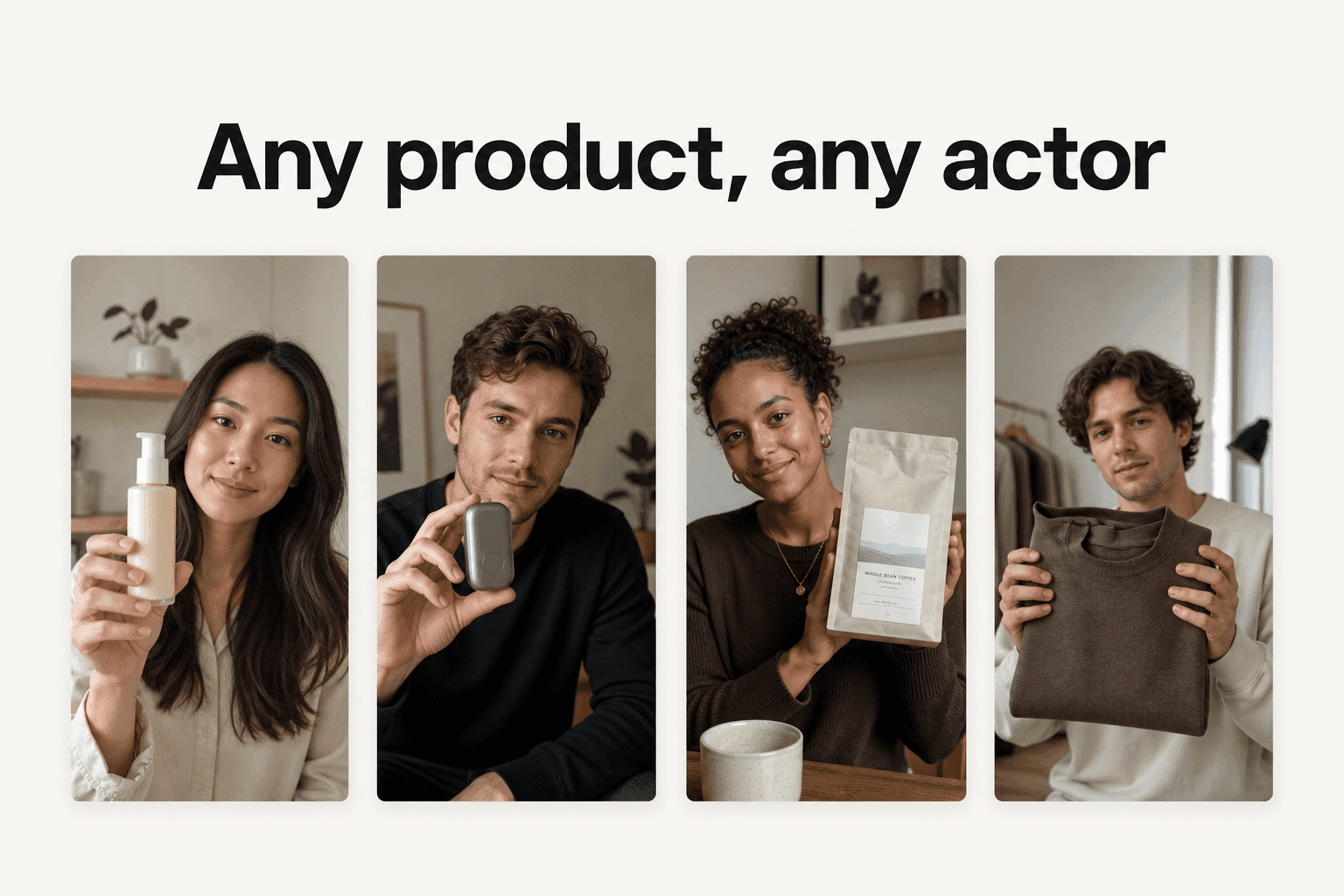
- The product: Creatify says the model "holds a personalized product label and on-screen name legible for a full clip," instead of melting the label into invented text.
- The person: it says the model "keeps a creator as one continuous person" rather than letting the presenter's face drift or swap halfway through.
Take the claim as the right test rather than a settled result. Generate your own product, with its real label, and look at the last second of the clip as hard as the first.
What Creatify's own benchmark shows, and who ran it
Every number in this section was measured and published by Creatify, in its September 15, 2026 release and on its Boreal model page as read on September 16, 2026. Treat all of it as the vendor's report until an outside evaluator repeats it.
Creatify's 81% against its own base model
Creatify's Boreal page says that "people preferred Boreal to its untouched base in 81% of decisive comparisons (n=40, p<0.001)." The release fills in the design:
- Result: 25 wins to 6 losses, with 9 ties.
- Sample: 40 production cases, reviewed blind and side by side.
- Controls: the same prompt, image, resolution and seed in both arms, so only the trained weights changed.
That design is careful, and it answers a narrow question. It shows that Creatify's ad-footage training improved on the model it started from. It does not show how Boreal compares with the video models ad teams already use. Nine ties out of forty also means almost a quarter of the pairs could not be separated at all.
Creatify's 40 times faster than a closed model it does not name
The comparison that reaches past the base model is against "a leading closed model run on identical inputs." Creatify reports Boreal at roughly 40 times the speed and 12 times cheaper at the benchmarked price. It also concedes that on raw fidelity "the quality figures land within a few percent in both directions, on inputs where the closed model renders at higher resolution."
The release puts the gap in production terms, for a storyboard of twenty five-second shots:
- On Boreal: about a quarter of a dollar, finished in under two minutes.
- On the closed model: roughly $12 and over an hour of queue time.
Because the closed model is not named, neither the 12x nor the $12 can be checked against a public price list.
Where Creatify says it is weakest
Creatify is unusually direct about the limits. Its model page says: "Short clips and simple scenes are where it's strongest." And: "Single-person talking clips are where the gap to the base narrows most, at 60%."
That second line matters for anyone making UGC ads, because one person talking to the camera is the core format of the genre, as we cover in what makes UGC-style ads work. Creatify Labs also sells a separate model for exactly that shot, Aurora, which its site describes as turning "a single photo and one audio clip into a lifelike talking video." That lineup suggests the company itself treats the talking-head clip as a separate job.
What cheaper renders change for teams that test variants
Cheap generation matters most to the people who render the most. For a brand that makes one polished ad a quarter, a lower per-second price barely registers. For a team that tests dozens of hooks a week, it changes which ideas get tried at all.
A worked example: forty five-second hooks
The cost of a test batch: number of clips times seconds per clip times the per-second rate.
Say you want to test 40 opening hooks for one product, five seconds each. That is 200 seconds of video. On fal's list prices from September 16, 2026:
- At 720p: 200 seconds at $0.01 is $2.00 for all 40 clips.
- At 1080p: 200 seconds at $0.03 is $6.00.
- At 2K: 200 seconds at $0.12 is $24.00.
Run the same 40 clips at 720p through Creatify's own API and the unit changes. Each five-second clip is one started 10-second block, so the batch is 40 credits. Creatify's billing page sells API Starter at $99 a month for 500 credits and API Pro at $299 a month for 2,000 credits. If every credit gets used, 40 credits work out to about $7.92 on Starter or about $5.98 on Pro. The two doors to the same model can differ several times over for short clips, because a five-second clip pays for a full 10-second block. We worked through the same billing-increment effect for another model in Mirage Avatar X's two prices.
All of this is list-price arithmetic. It ignores frame-count rounding, taxes and any change once Creatify confirms its figures.
Where the savings actually land
Rendering is one line in a creative test. The other line is media spend, the budget it takes to give each variant enough impressions to read a result, and a cheaper render does not shrink that. A team that renders 40 hooks still has to decide which handful earns real spend, and the discipline of that decision is what our guide to ad creative testing is about.
Our view is that the bigger change is upstream of the ad account. When a five-second 720p draft costs five cents, the right move is to stop pre-judging ideas in a document and let rough clips do the arguing. The filter moves from "is this worth rendering" to "is this worth spending on."
Speed changes the loop more than price
If Creatify's realtime claim holds, the practical workflow becomes a two-pass one:
- Draft every idea at 720p, where the rate is lowest and the clip is fast.
- Cut the list to the few that survive a hard look.
- Re-render only the finalists at the resolution the placement needs.
One caution on step three. A 1080p re-render is a new generation, so it may not match the 720p draft frame for frame. Review the finalist again before it goes anywhere near a campaign.
What to check before you move a test budget
A cheap listing is an invitation to test, not a reason to switch. These are the checks worth running first.
Commercial terms and disclosure
Two things to settle before a Boreal clip runs as a paid ad:
- License: fal's Boreal page carries a "Commercial use" label. Read fal's terms and Creatify's own terms for the way you plan to use the clips, because a label on a listing is not a license summary.
- Provenance: fal applies invisible C2PA metadata and watermarking to every clip and offers a visible AI-generated label as an option. If your market or platform expects disclosure on synthetic ads, our overview of AI ad labeling rules in 2026 is the place to start.
The talking-clip gap
Test the format you actually run. If your ads are mostly one creator talking to the camera, that is the shot where Creatify says Boreal's edge over its own base is smallest. Render ten talking clips with your real script before you judge the model on ten product close-ups.
What your price really covers
Before a budget is set, confirm each of these on your own requests:
- Resolution: the headline rate is 720p. A 1080p feed placement costs three times as much per second.
- Length: the default duration is 10 seconds, and Creatify's API caps 2k clips at 15 seconds.
- Language: English is the validated prompt language, so test pronunciation in every market you sell to.
- Billing door: fal bills per second, while Creatify's API bills per started 10 seconds in credits.
- Price status: Creatify's own page still marked its figures pending final confirmation on September 16.
Where Novoads fits while Boreal lives elsewhere
This is our product section, so it is short and it stays honest about what we do not have.
Boreal is not in Novoads
Boreal is not available in Novoads, and we have not priced it, benchmarked it or run it on our side. If you want to try it, the doors are fal and Creatify's own products. For how Creatify compares with other ad tools more broadly, see our roundup of the best Creatify alternatives.
What Novoads does instead
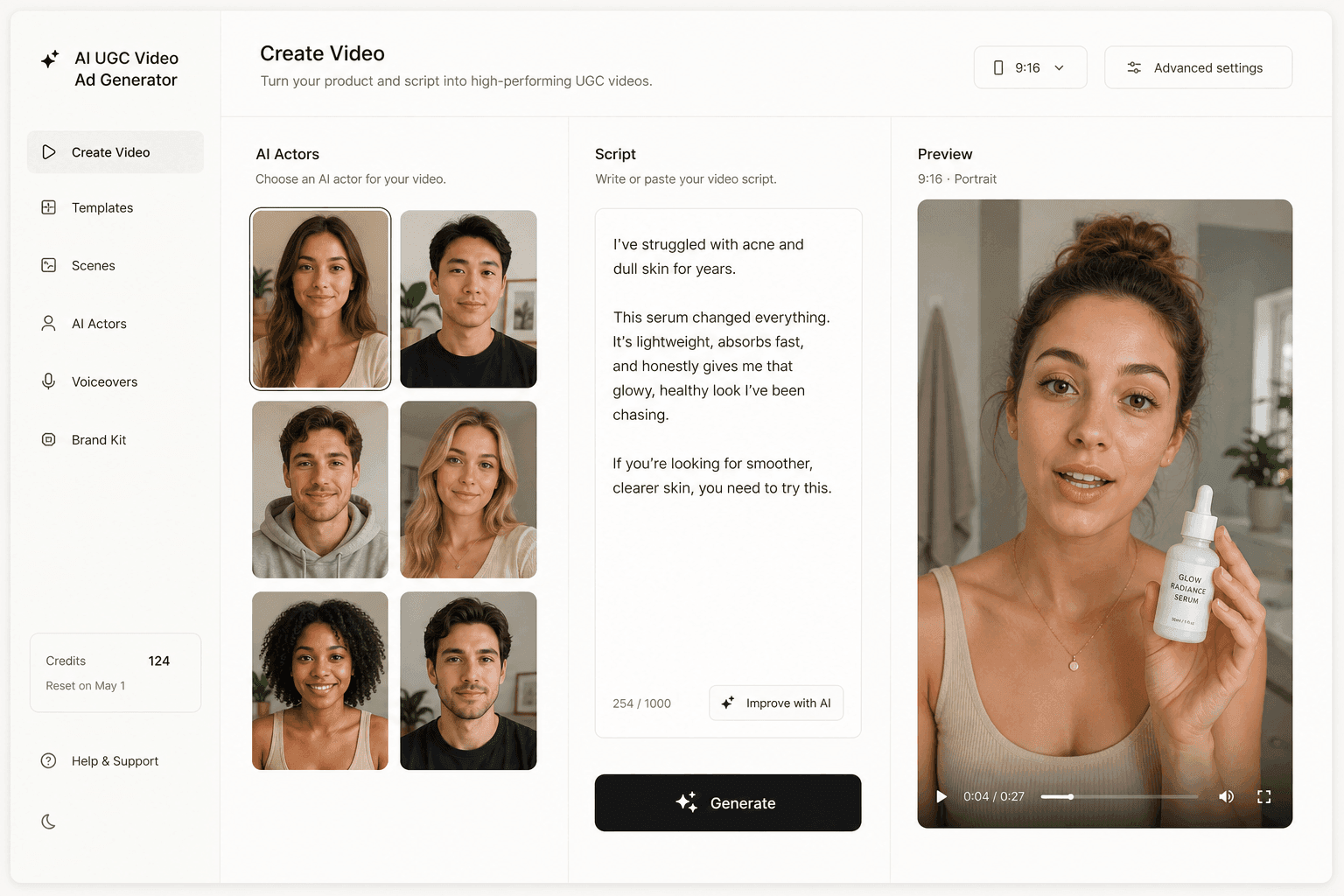
Novoads is a finished ad workflow rather than a raw model endpoint. You upload a product image or write a script, pick an AI actor, and get a video in 9:16, 1:1 or 16:9 that is ready to upload to any ad platform. In Novoads, the video picker runs Seedance 2.0, Seedance 2.0 Mini, Seedance 2.5, Kling v3 Pro, Google Veo 3.1 and Omni Flash, and each has its own credit price, explained in how AI video credits work. If your test plan is the two-pass loop above, you can build that first batch of hooks in Novoads with the product photo you already have.
The cheap render is the easy part
Boreal makes the render the cheapest decision in an ad test, at least at 720p and at least on fal's list price. The expensive decisions are still yours: which idea deserves a clip, which clip deserves media spend, and whether the person and the product on screen stay the same from the first frame to the last.
Frequently Asked Questions
What is Creatify Boreal?
Boreal is a video generation model from Creatify Labs, the research arm of the AI ad company Creatify. It turns a text prompt into a video with synchronized sound, and it accepts an optional reference image to animate and an optional audio track to drive the clip. Creatify publicly launched it as a general video model on September 15, 2026, on fal, on its own API and inside its Model Playground and AdFlow features.
How much does Boreal cost?
It depends on the door and the resolution. On fal, the list price fetched on September 16, 2026 is $0.01 per second at 720p, $0.03 per second at 1080p and $0.12 per second at 2K, so a five-second 720p clip is five cents. Creatify's own API bills credits per started 10 seconds: 1 credit at 720p, 3 at 1080p and 12 at 2k. Creatify's model page still noted on September 16 that pricing figures were pending final confirmation, so treat these as list prices that can move.
Did the Boreal name exist before September 2026?
Yes. A Creatify help article dated May 10, 2026 already offered a Boreal Model as a rendering option for Avatar Video. What happened on September 15, 2026 is the public launch of Boreal as a general text-to-video and image-to-video model on Creatify's API and on fal.
How good is Boreal compared with other video models?
The only numbers so far come from Creatify. Its September 15, 2026 release and its Boreal model page say blind reviewers preferred Boreal to its untouched base model in 81% of decisive comparisons (25 to 6, with 9 ties, across 40 cases), and that against a leading closed model it runs roughly 40 times faster and 12 times cheaper at the benchmarked price, with raw fidelity within a few percent either way. The release does not name that closed model, so treat the comparison as the vendor's claim until an independent test repeats it.
Can I use Boreal inside Novoads?
No. Boreal is not in Novoads, and we do not quote a Novoads price for it. Novoads generates ads with the models in its own picker, which today are Seedance 2.0, Seedance 2.0 Mini, Seedance 2.5, Kling v3 Pro, Google Veo 3.1 and Omni Flash.
What is Boreal weakest at?
By Creatify's own account, Boreal is strongest on short clips and simple scenes, and its advantage over its base model narrows most on single-person talking clips, where Creatify puts the preference at 60%. fal's schema also names English as the validated prompt language, so scripts in other languages deserve their own test.
Key Takeaways
- Creatify Labs publicly launched Boreal as a general video model on September 15, 2026. It generates synchronized audio with the picture from a text prompt, with an optional reference image or driving audio track.
- fal's list price, fetched September 16, 2026, is $0.01 per second at 720p, $0.03 at 1080p and $0.12 at 2K. Creatify's own API bills credits per started 10 seconds instead: 1 at 720p, 3 at 1080p, 12 at 2k.
- The quality figures are Creatify's own, from its September 15, 2026 release and Boreal model page: 81% blind preference over its untouched base model (25 to 6, 9 ties, 40 cases), and roughly 40 times the speed and 12 times cheaper than a closed model the release does not name.
- Creatify says Boreal is strongest on short clips and simple scenes, and that its margin narrows most on single-person talking clips, the format most UGC ads use.
- Boreal is not available in Novoads, and nothing in this post comes from running the model inside our product.