AI Ad Disclosure Rules for Meta, TikTok, and Google: 3 Rulebooks Compared for 2026
There is no single AI ad label rule in 2026. Meta, TikTok, and Google each define what counts as AI, who applies the label, and what happens if you skip it differently. Here is the cross-platform comparison and a per-platform checklist.

Mauricio Valdivia
·11 min

Three platforms, three definitions of AI
A skincare brand records one AI UGC ad, an AI actor reading a testimonial script, and ships the same 9:16 file to Meta, TikTok, and Google in the same afternoon. On TikTok it arrives with an "AI-generated" label already stamped on it, applied automatically. On Meta it runs unlabeled. On Google it depends on whether the ad mentions an election. One video, three outcomes, zero changes to the file.
That is the reality of AI ad disclosure in 2026. There is no shared rulebook. Each platform decides on its own what counts as AI-generated, who has to attach the label, and what happens when nobody does. A creative that is fully compliant on one surface can trip a policy on the next, not because the ad changed but because the definition did.
This is the cross-platform comparison the per-platform guides do not give you: what Meta, TikTok, and Google each require, side by side, plus a short checklist for what an AI UGC advertiser actually has to do on each one.
Why there is no single AI ad label rule in 2026
Before the platform-by-platform detail, it helps to understand why the rules diverge in the first place. The short answer: nobody with authority over all three has written a single standard, so each platform wrote its own.
The regulatory patchwork advertisers inherited
Governments have moved on AI disclosure, but unevenly and mostly at the edges. State-level rules target narrow cases. AdExchanger notes that "California, New Jersey and Utah all require customer service chatbots or similar communication tools fueled by generative artificial intelligence to clearly disclose to users that they are communicating with a bot rather than a real human, especially when a purchase or voting is involved." That is a real obligation, but it covers chatbots, not a UGC video ad for moisturizer.
The result is a fragmented map. An advertiser has to satisfy whatever disclosure law applies to the audience or the claim, and then, separately, the policy of the platform where the ad runs. The two layers rarely line up cleanly, and neither one waits for the other.
Platforms wrote the rules governments have not
Into that gap stepped the platforms. As AdExchanger puts it, "While state and federal governments slowly move towards proposing and advancing more comprehensive AI labeling and disclosure requirements, social media platforms are filling the gaps with their own rules." Meta, TikTok, and Google each built a disclosure regime on their own timeline, for their own risk tolerance, without coordinating scope or wording.
That is why the same ad behaves differently on each surface. The platforms are not implementing one law. They are each managing their own liability, and the definitions reflect three different judgment calls about where the risk lives.
Each platform defines "AI-generated" differently
The deepest divergence is the definition itself. TikTok defines AI-generated content broadly, as images, video, or audio generated or modified by AI, and it explicitly includes real footage that has been modified beyond minor corrections. Google and Meta frame their mandatory rules more narrowly, around synthetic or digitally created or altered content, and they concentrate the hard requirement on depictions of real or realistic-looking people and events in political contexts.
So the trigger differs by design. An AI voice reading a script over otherwise real product footage might count as "significantly edited" on one platform and as unremarkable commercial content on another. If you author for the strictest definition, you are covered on the looser ones. That single habit is the throughline of this whole comparison, and it is the logic our overview of labeling AI-generated ads builds on.

What Google Ads requires
Google's mandatory AI disclosure is scoped tightly to political advertising, but the requirement inside that scope is explicit and non-optional.
The synthetic-content disclosure that is mandatory
Google's political content policy is direct: "Advertisers must disclose all election ads that contain synthetic or digitally altered content," specifically content that inauthentically depicts real or realistic-looking people or events. The trigger is a synthetic or altered depiction of a real person or event in an election ad. If your creative shows a plausible-looking politician doing or saying something generated by AI, disclosure is not a courtesy, it is required to run.
For ordinary commercial ads, Google does not impose the same blanket AI label. But note the interaction with provenance: Google states that its own image and video models tag their output with SynthID watermarking, which means the origin signal travels with the file whether or not you disclose.
Clear, conspicuous, and where users notice it
Google also specifies how the disclosure has to appear, not just that it must. The policy requires that "the disclosure must be clear and conspicuous, and must be placed in a location where it is likely to be noticed by users." A grey line of small print buried under a fold does not satisfy it. Google even gives example wording, such as a note that the video content was synthetically generated.
The practical read: if you are disclosing to satisfy Google, the label has to be legible at a glance, not technically present. Our deeper look at Google's AI-generated images policy covers how this extends to static creative.
Provenance as the backstop
The theme underneath Google's rules is provenance. SynthID watermarking on Google-made assets, plus the "clear and conspicuous" standard, means Google is building toward a world where the origin of an ad is machine-detectable and the disclosure is human-legible. An AI UGC advertiser should assume the file carries signals about how it was made, and write the disclosure accordingly rather than hoping the origin stays invisible.
What Meta requires
Meta's approach mirrors Google's in shape, a hard rule for political and social-issue ads, plus automatic labeling of content made with its own tools, but the details differ enough to matter.
The political and social-issue disclosure
Meta's rule for the sensitive category is a manual advertiser obligation. In its policy, "advertisers have to disclose when they digitally create or alter a political or social issue ad." The label is the advertiser's job to declare, up front, when the ad touches politics or a social issue and uses AI to create or alter what is shown.
Meta pairs that with hard enforcement on falsehoods: it states that "we reject an ad if it contains debunked content." So for the political category, the exposure is twofold: fail to disclose an AI alteration and you have a policy violation, and cross into debunked claims and the ad is rejected outright.
Auto-labels for its own generative tools
Beyond politics, Meta labels AI creative it can see you made with its own features. The company states that "we began labeling ads that were created or significantly edited using our generative AI creative features." If you build an ad inside Meta's generative creative tools, expect Meta to attach a label based on that, independent of any manual disclosure you add.
This is the pattern to internalize: the platform labels what it can detect, and you are responsible for what it cannot. If you generate the ad elsewhere and upload it, the manual disclosure is more on you; if you use Meta's own tools, the label may be applied for you.
Where Meta enforces hardest
Meta's strictest enforcement lives in the political and social-issue lane, the same lane where non-disclosure of AI alteration and debunked content both cause rejection. For a standard commercial AI UGC ad with no political content, you are largely outside the mandatory-disclosure zone on Meta today. The honest caveat: "today" is doing real work in that sentence, because this is the category platforms expand first.
What TikTok requires
TikTok runs the broadest AI disclosure regime of the three. It is not scoped to politics. It reaches ordinary commercial content, which makes it the platform an AI UGC advertiser has to think about most.
Label all realistic AI-generated content
TikTok has been explicit and early. Its newsroom states that it has "required creators to label realistic AIGC for over a year," where AIGC means AI-generated content across realistic images, audio, and video. That scope is the key difference: a realistic AI UGC ad, an AI actor delivering a script, sits squarely inside TikTok's labeling expectation even with no political angle at all.
TikTok gives creators several ways to declare it, and the mechanics are covered in our guide to TikTok's AI ad disclosure rules. The point for this comparison is scope: TikTok wants the label on realistic synthetic media generally, not only on the sensitive categories Google and Meta gate.
Auto-labeling through Content Credentials
TikTok also does the labeling for you when it can. Its newsroom announced that "TikTok is starting to automatically label AI-generated content (AIGC) when it's uploaded from certain other platforms," reading the C2PA Content Credentials attached to a file and applying the label on ingest. If your generation tool writes Content Credentials into the export, TikTok can recognize and label it the moment you upload.
The scale here is not trivial. TikTok says its AI-labeling tool is one that "over 37 million creators have used since last fall." This is not an experiment on the margins; it is infrastructure the platform is standardizing on.
The label you cannot take off
The consequence of automatic labeling is worth stating plainly, because it changes the calculus. When TikTok applies a label on its own, you lose control of it. That auto-applied label becomes a fixed property of the post. So the choice is not really "label or not." It is "write your own disclosure, or accept the one the platform writes for you." Given that, authoring a clean, intentional label is the only move that keeps you in control of the wording.
The three rulebooks side by side
Here is the comparison in one view. Read the anchor column as the platform, then how each one answers the same three questions.
| Platform | What must be labeled | Who applies the label | If you skip it |
|---|---|---|---|
| Google Ads | Synthetic or altered real people in election ads | Advertiser (clear, conspicuous) | Policy violation; disapproval |
| Meta | Digitally created or altered political and social-issue ads | Advertiser; Meta auto-labels its own AI tools | Rejection; debunked content removed |
| TikTok | All realistic AI images, audio, and video | Creator toggle; TikTok auto-labels via Content Credentials | Auto-label applied; possible removal |
What must be labeled on each
Scope is where the platforms diverge most. Google and Meta gate the hard requirement to political and election content with synthetic depictions of real people. TikTok reaches all realistic AI-generated media, commercial ads included. If you only remember one row, remember that TikTok's definition is the widest, so a creative built to satisfy TikTok will usually satisfy the other two.
Who applies the label
Two hands do the labeling: yours and the platform's. Google leans on the advertiser to place a clear, conspicuous disclosure. Meta splits it, you disclose for political ads, Meta auto-labels ads built with its own generative features. TikTok splits it too, but its automatic side is the most aggressive, reading Content Credentials on upload and applying labels itself.
What happens if you skip it
Enforcement scales with the sensitivity of the content. In the political and election lane, non-disclosure is a genuine policy violation on Google and grounds for rejection on Meta. In general content, the more common outcome is an automatic label you did not author, plus removal if the content also breaks a community guideline. The quiet penalty, on every platform, is a label in wording you did not choose on an ad you paid to run.
A worked example: one AI UGC ad, three platforms
Abstract rules get concrete fast when you run one asset through all three. Take a common case and walk it across the platforms.
The ad we are running
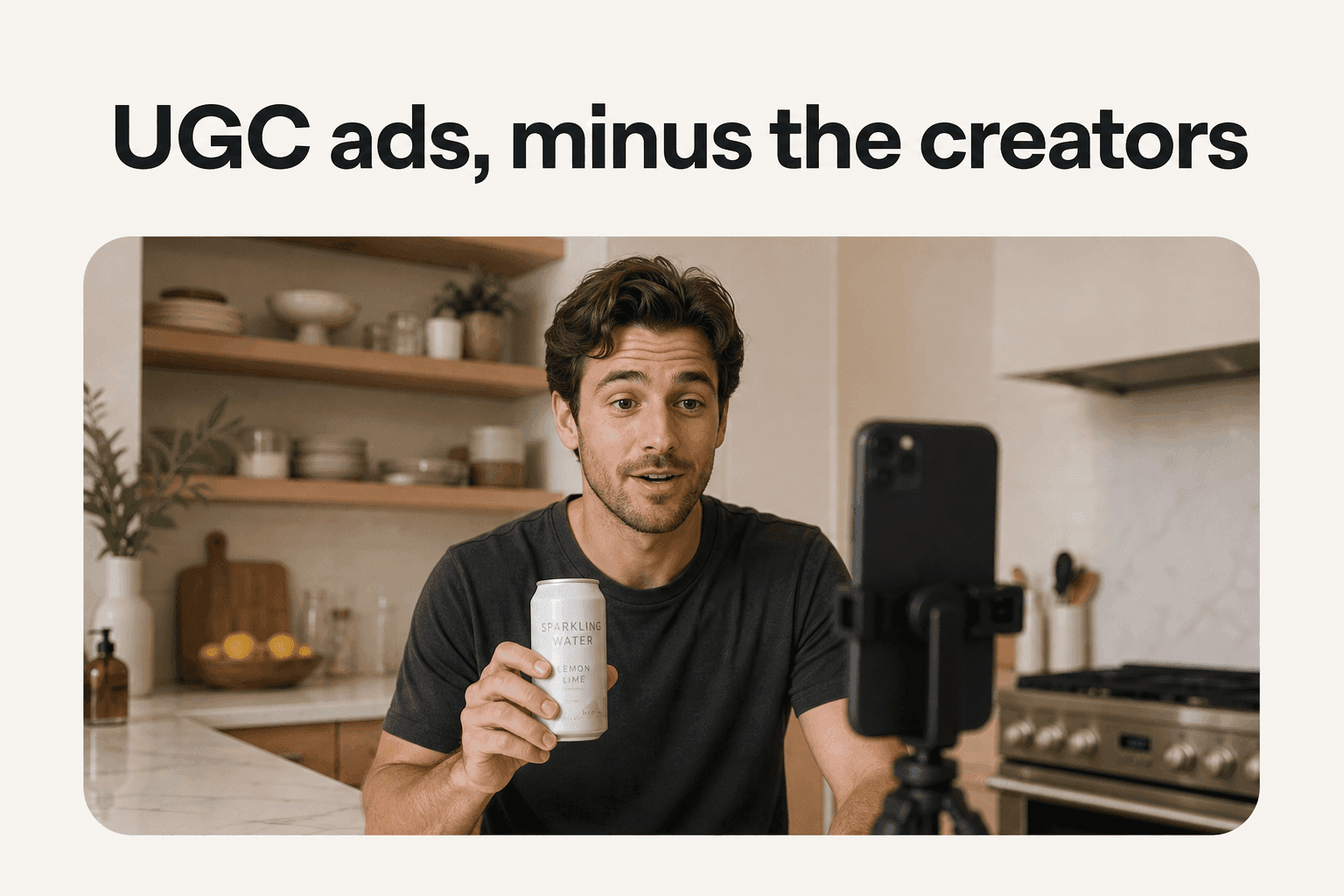
A supplement brand generates a UGC-style ad: an AI actor, clearly synthetic but realistic, reads a 20-second testimonial to camera over real product B-roll. No politics, no real public figure, a standard commercial creative in 9:16. This is exactly the kind of ad AI UGC tools like Novoads produce, and it is the case most advertisers actually face.
Walk it through and the divergence is obvious. On Google, with no election content and no depiction of a real person, the mandatory synthetic-disclosure rule is not triggered, though any Google-made assets in it may carry SynthID. On Meta, with no political or social-issue angle, the manual disclosure requirement does not fire, though a label appears if you built it with Meta's own generative tools. On TikTok, the same ad is realistic AI-generated video, so it falls inside TikTok's labeling expectation, and if your export carries Content Credentials, TikTok may label it for you on upload.
The per-platform checklist
Here is the short version of what to actually do, in order of strictness:
- TikTok: Turn on the AI-generated content label yourself before you post. TikTok states this does not hurt distribution, and doing it manually means you control the wording rather than accepting an auto-applied label you cannot remove.
- Meta: For commercial ads, no mandatory label today, but disclose voluntarily and never cross into political or social-issue content without declaring AI alteration. Assume Meta labels anything you make with its own AI features.
- Google: For commercial ads, no mandatory AI label, but if the creative ever depicts a real or realistic-looking person in an election context, add a clear, conspicuous disclosure. Assume Google-made assets carry SynthID provenance.
- Everywhere: Keep the Content Credentials your generation tool writes, because provenance metadata is increasingly what triggers the automatic label anyway. Fighting it is harder than disclosing.
The pattern that falls out is simple. Author every ad to TikTok's broad standard, disclose proactively, and preserve provenance, and you are compliant across all three without maintaining three separate versions of the truth.
Disclosure is table stakes, not a tax
The instinct is to treat an AI label as friction, a cost that dampens performance. The evidence points the other way. TikTok is explicit that turning on its AI-generated content setting does not affect a video's distribution as long as the content follows its guidelines. A disclosed ad is not a penalized ad. An undisclosed one that gets auto-labeled in someone else's words is the real risk.
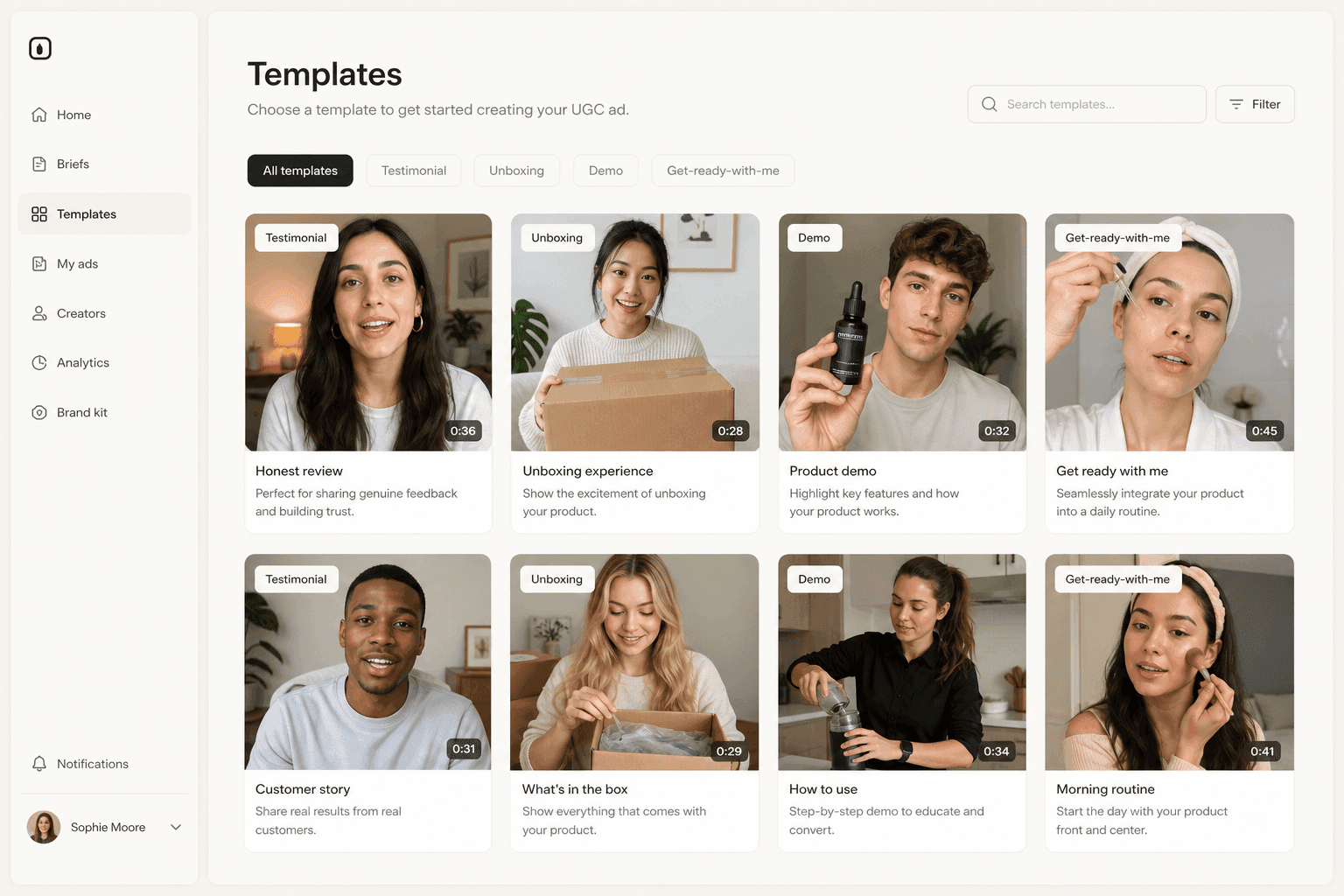
For a brand running AI UGC at volume, the compliance work is not the hard part. The hard part is producing enough native, on-format variations to test, in a way that is honest about how they were made. That is where the production tool matters. In Novoads you write or auto-generate a script, pick an AI actor, and get a UGC-style vertical ad in about four minutes, formatted 9:16 for exactly these platforms, so the disclosure step is the last small box to tick, not a separate project. A clip runs from a few dollars rather than the $200 to $500 a human creator charges, which is what makes testing many angles, each properly labeled, affordable in the first place. If you want the format basics first, our primer on what a UGC creator is sets the ground.
The rules will keep moving, and the safe posture is not to chase each platform's exact wording. It is to disclose more than the minimum, everywhere, and let honesty be the default the file carries with it. You can produce your first labeled AI UGC ad with Novoads from $49/month at novoads.ai. Cancel anytime.
Frequently Asked Questions
Do I have to label every AI-generated ad in 2026?
It depends on the platform and the content. TikTok asks creators to label all realistic AI-generated images, audio, and video. Google and Meta make disclosure mandatory specifically for election and political or social-issue ads that use synthetic or altered depictions of real people or events. For ordinary commercial AI UGC, the rules are lighter, but the practical safe move is to disclose proactively everywhere, because the platforms auto-detect provenance metadata anyway.
What exactly counts as AI-generated content on these platforms?
Each platform draws the line differently, which is the core problem. TikTok defines AI-generated content as images, video, or audio generated or modified by AI, and includes real footage modified beyond minor corrections. Google and Meta frame it around synthetic or digitally created or altered content, especially depictions of real or realistic-looking people and events. An AI voice reading a script over real product footage can trigger a label on one platform and not another.
Who applies the AI label, me or the platform?
Both. You apply it manually through a disclosure toggle or an on-screen line, and the platform applies it automatically when it detects provenance signals. TikTok auto-labels content that arrives carrying C2PA Content Credentials or that it identifies as AI-made. Google notes its own models tag output with SynthID watermarking. So even if you forget, an automatic label may appear, and on TikTok an auto-applied label cannot be removed.
What happens if I do not disclose an AI ad?
The consequence scales with the content. For election and political ads, non-disclosure of synthetic content is a policy violation that leads to disapproval or account-level action on Google and rejection on Meta. For general content, the platform may still auto-apply a label, remove content that breaks its guidelines, or, in TikTok's case, treat misleadingly mislabeled content as a Terms of Service issue. The reputational cost of an ad that reads as deceptive is often larger than the policy penalty.
Is disclosing that my ad is AI-made bad for performance?
Not necessarily. TikTok states that turning on its AI-generated content setting does not affect a video's distribution as long as it does not violate Community Guidelines. A clear label can also read as honesty rather than a red flag, especially as viewers grow used to synthetic media. The bigger risk to performance is an undisclosed ad that gets an automatic label you did not choose, in wording you did not write.
Do platform rules replace government AI-disclosure laws?
No. They sit on top of a growing patchwork of state and federal rules. As AdExchanger notes, while governments slowly advance broader AI labeling requirements, social platforms are filling the gaps with their own rules. An advertiser has to satisfy both layers: the platform's policy where the ad runs, and any disclosure law that applies to the audience or the claim.
Key Takeaways
- There is no single AI ad label rule in 2026: Meta, TikTok, and Google each run their own disclosure regime, and a compliant ad on one platform is not automatically compliant on the next.
- The strictest scope is TikTok's: it asks creators to label all realistic AI-generated images, audio, and video, not only political content, and it auto-labels uploads that carry Content Credentials.
- Google and Meta focus their mandatory disclosure on election and political or social-issue ads, where synthetic or altered depictions of real people or events must be clearly disclosed.
- Two forces do the labeling: you (a manual disclosure toggle or on-screen line) and the platform (automatic labels from provenance metadata like C2PA Content Credentials or Google's SynthID).
- For an AI UGC advertiser the safe default is to disclose proactively on every platform, because platform rules are filling the gap that state and federal law has not yet closed.
Sources
- •Google Ads: Political content policy (synthetic content disclosure)
- •Meta: Generative AI transparency in Meta's ads products
- •Meta: Labeling AI-generated content and manipulated media
- •TikTok Newsroom: Advancing AI transparency and literacy
- •TikTok: AI-generated content labeling (support)
- •AdExchanger: AI disclosure requirements, state laws and platform rules