How to Disclose AI-Generated UGC Ads on TikTok: A 5-Step Compliance Checklist
TikTok asks you to label realistic AI content, and for a UGC ad that means a synthetic actor or voice. Here is what counts, how to add the label in a few taps, and a 5-step checklist to stay compliant.

Mauricio Valdivia
·11 min
The one label that keeps your TikTok ad compliant
You just rendered your first AI UGC ad for TikTok. An AI actor holds your product, reads a 20-second script, and sounds like a real customer in your buyer's language. Then the worry lands. Do you have to tell TikTok the video is AI, and will the app bury it if you forget?
Here is the short version, before the details. TikTok wants realistic AI content labeled, the label takes a few taps, and it does not throttle your reach. TikTok says more than 37 million creators had already used its AI-labeling tool by the time it expanded auto-labeling, so you are joining a well-worn path rather than flagging your account as suspicious.
That reframes the whole question. For a normal commercial product ad, this is not the tense compliance minefield the headlines suggest. It is a toggle you flip on publish. This guide walks what TikTok counts as AI content, the rule that actually applies to your ad, how to disclose it, what TikTok labels on its own, the hard lines you cannot cross, and a five-step checklist you can run in under a minute. If you want the cross-platform picture first, the companion guide to labeling AI-generated ads covers how Meta and Google differ.
What TikTok counts as AI-generated content
Before any rule makes sense, you need TikTok's own definition of the thing being labeled. It is broader than "a fully fake video," and narrower than "anything an algorithm touched."
The definition, in TikTok's own words
TikTok defines the category plainly. Its help center says "AI-generated content (AIGC) includes images, video and/or audio that is generated or modified by artificial intelligence." Note the word modified. The definition is not limited to clips conjured from a text prompt. It reaches real footage that AI has reworked, which is where a lot of advertisers assume they are safe and are not.
TikTok's own examples span three shapes, and most ad creative falls into the last one:
- A real person whose image, voice, or words are altered by AI.
- A real scene or event that has been modified by AI.
- An entirely AI-generated video or image of real or fictional people, places, and events.
If your creative pipeline used a model to build the presenter, the voice, or the scene, you are inside this category, and the last bullet is where a synthetic UGC actor lives.
"Significantly edited" versus a routine touch-up
The line that matters for an ad is what TikTok calls significantly edited. TikTok describes it as content that "uses real images/video as source material, but has been modified by AI beyond minor corrections or enhancements." The split is practical:
- Does not count: cropping a product shot, resizing it, or fixing the color. These are minor corrections.
- Does count: swapping a face, generating speech, or making a subject say something they never said.
TikTok spells out one of those triggers directly: an example is when "The primary subjects are portrayed saying something they didn't say, for example, AI-generated speech." That is the exact mechanism behind a synthetic voiceover, so it is worth internalizing.
Where a synthetic actor and voice land
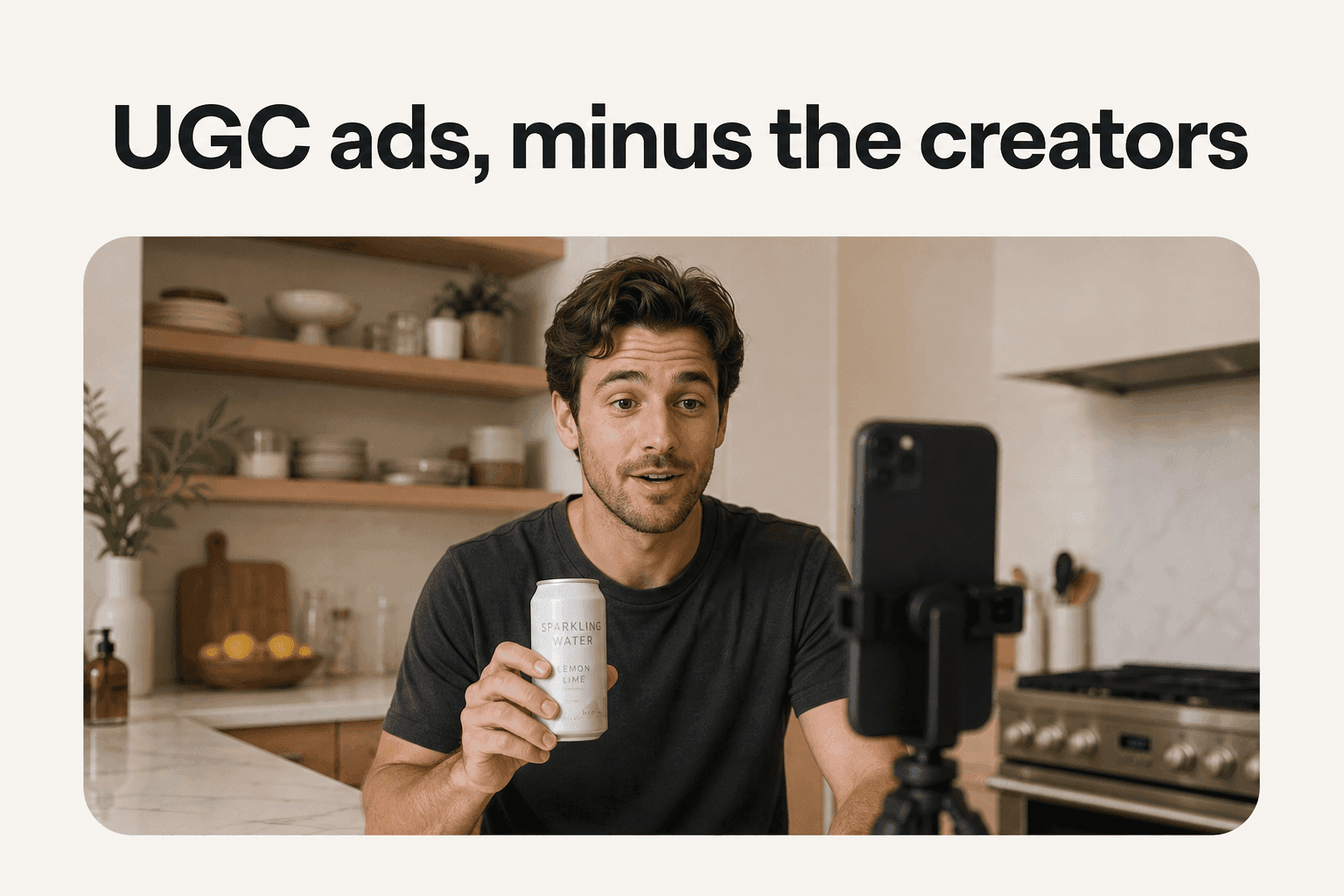
Put the definition next to a typical AI UGC ad and the answer is not ambiguous. An AI actor is an entirely generated person. A synthetic voiceover is AI-generated speech. Both sit squarely inside TikTok's AIGC category, and both are realistic in the sense that the video reads like a real video. This is different from the way a hired UGC creator performs on camera, where nothing is synthesized, and it is worth knowing which side of the line your creative falls on before you publish it.
The rule that actually applies to your ad
TikTok's labeling requirement is the one most relevant to a UGC advertiser, and the good news is that it is simple to satisfy. The trap is misreading its scope.
Broader than the Meta and Google rules
On Meta and Google, the hard self-disclosure rules are reserved for political, election, and social-issue advertising, so a commercial product ad usually slips past them. TikTok is the exception. Its policy states that it also requires "creators to label all AI-generated content that contains realistic images, audio, and video." There is no politics carve-out. The scope is realistic AI of any kind, commercial included. TikTok has held this line for a while, too: in its 2024 transparency update the company noted it has "required creators to label realistic AIGC for over a year." So this is not a new experiment you can wait out. It is a settled expectation.
What "realistic" means for a brand spokesperson
The load-bearing word is realistic, and advertisers read it more anxiously than TikTok intends. An AI actor who is visibly a brand's spokesperson, presenting your real product, is realistic in the plain sense that the footage looks like footage. It is not realistic in the dangerous sense the policy is chasing, which is media that could be mistaken for a documentary recording of a specific real person or event. Both still get labeled on TikTok, because the video contains realistic synthetic media. The distinction matters more for the prohibitions further down than for whether you label at all. On TikTok, if it is a realistic AI actor or voice, you label it, full stop.
The two-question habit that keeps you clean
The cleanest way to never get caught out is to answer two independent questions for every TikTok post:
- Is this realistic AI? If a synthetic actor or voice is involved, the answer is yes and the AI label applies.
- Was this a paid partnership? If money changed hands for a creator to post it, the branded-content disclosure applies on top, as a separate switch.
The two are independent. A fully human creator video can owe the partnership label and nothing else. A synthetic ad you run yourself owes the AI label and nothing else. A paid partnership on a synthetic clip owes both. Ask both questions every time and you will not miss a case. For the campaign mechanics around all of this, the TikTok ads guide covers targeting and budget.
How to add the AI label in the app
The requirement sounds heavier than the action. Disclosing is a few taps, and TikTok gives you more than one way to do it.
The AI-generated content toggle, step by step
The primary method is the built-in setting. For a video, the flow is short:
- Tap the add-post button, then record or upload your clip.
- Tap Next to reach the post screen.
- Open More options.
- Turn on the AI-generated content setting.
TikTok then applies the label for you, and it reads "creator labeled as AI-generated" on the published post. That is the whole flow. It lives one menu deep, and once you have done it once it becomes muscle memory for every AI ad you ship.
Manual options: caption text, hashtag sticker, description
The toggle is not your only option. TikTok also accepts self-declared disclosure in the post itself. As the help center puts it, "Creators can disclose content as AI-generated directly on the post by adding text, a hashtag sticker, or context in the post's description." That is three accepted signals beyond the toggle:
- A line of on-screen or caption text that says the content is AI-generated.
- A hashtag sticker placed on the post.
- A note in the post's description.
For a UGC ad, a short on-screen line reads as candid rather than clinical, and it pairs naturally with a strong hook. Many advertisers use both the toggle and a caption line, which costs nothing and leaves no ambiguity.
Why it will not cost you reach
The fear underneath all of this is that the label quietly tanks distribution. TikTok addresses it head on: "Turning on the AI-generated content setting won't affect the distribution of your video as long as it doesn't violate our Community Guidelines." Read that literally. The label is metadata for viewers, not a demotion signal against your account. What suppresses a video is breaking the guidelines, which is a content problem, not a disclosure problem. Honest disclosure and healthy reach are not in tension.
What TikTok labels for you automatically
Self-disclosure is only half the system. TikTok runs a detection layer in parallel, and understanding it changes how you think about provenance.
Creator label versus auto label
There are two labels doing two jobs:
- Creator label. The one you apply yourself with the toggle. It reads "creator labeled as AI-generated."
- Auto label. One TikTok applies on its own. Per the policy, "TikTok may automatically apply the 'AI-generated' label to content we identify as completely generated or significantly edited with AI."
The two can land on the same video. The practical takeaway is that even when you forget to disclose, the platform may still mark the content, so the honest move and the default move are converging.
Content Credentials travel inside the file
The detection layer leans on provenance metadata. TikTok reads C2PA Content Credentials, the cross-industry standard from the Coalition for Content Provenance and Authenticity. In TikTok's words, "Content Credentials attach metadata to content that we can use to recognize and label AIGC instantly." A tool that stamps Content Credentials into the exported file effectively pre-announces the AI to every platform that reads them. TikTok has said it auto-labels AIGC "when it's uploaded from certain other platforms" precisely because it can read that metadata. Provenance is becoming ambient, which is an argument for making ads you are happy to have labeled, not for hiding the AI.
The auto label is permanent
One detail catches advertisers off guard. An auto label is not reversible. TikTok is explicit: "Once your content is labeled as AI-generated with an auto label, you won't be able to remove the label from your post." So you do not want to publish first and negotiate later. Decide up front that a realistic AI ad gets the label, because the platform may make that decision for you and then lock it in.
The lines you cannot cross, even with a label
Labeling solves the disclosure question. It does not grant permission to make any AI content you want. A separate set of rules bans certain content outright, whether or not you tag it. Three of them matter most for advertisers:
- A faked endorsement by a public figure.
- A real private person's likeness, or anyone under 18, without permission.
- Mislabeling genuine footage as AI when it is not.
Fake endorsements and public figures
The clearest red line for advertisers is the fake endorsement. TikTok does not allow AI that "falsely shows public figures in certain contexts. This includes being bullied, making an endorsement, or being endorsed." A synthetic clip of a named celebrity praising your product is not a labeling problem you can toggle away. It is prohibited content. This is the exact scenario likeness laws and platform bans exist to stop, and a disclosure sticker does not change the answer.
Real people's likeness and minors
The second hard line protects real people who did not agree to appear. TikTok prohibits AI use of "The likeness of young people under the age of 18, or the likeness of adult private figures used without their permission." An AI actor who is a fully invented person is fine. A synthetic version of a real, identifiable private individual, or anyone under 18, is not, regardless of the label. Keep your presenters genuinely synthetic and you stay clear of this entirely.
Mislabeling honest content is its own violation
The rule cuts both ways. You are not supposed to slap the AI tag on footage that is not AI, either. TikTok warns that "misleadingly labeling unaltered content with this label is a violation of our Terms of Service and may result in the removal of content." So the label is a truth claim in both directions. Tag realistic AI, do not tag genuine footage, and let each post carry the label that is actually accurate.
Your 5-step TikTok AI-ad disclosure checklist
Here is the whole policy compressed into something you can run before you publish. The table sorts the common cases, and the five steps turn it into a routine.
| Your TikTok post | Label it? | Why |
|---|---|---|
| AI actor and AI voice read your script | Yes | Realistic synthetic presenter |
| Product photo cropped or color-corrected | No | Minor edit, not AIGC |
| Built-in TikTok AI effect only | Auto | Effect labels it for you |
| AI clip of a named celebrity endorsing | Never | Prohibited, even labeled |
| Boosting an already-labeled AI post | Keep it | Label carries to the paid version |
| Fully human creator video, no AI | No | Nothing synthetic to disclose |
The five checks before you hit publish
Run these in order and you will not miss a disclosure:
- Decide if it is realistic AI. If a synthetic actor or voice reads your script, it is, and the label applies.
- Flip the toggle. Turn on the AI-generated content setting when you publish, or under More options for an upload.
- Back it up in the open. Add a line of on-screen text, a hashtag sticker, or a note in the description.
- Check the hard lines. No real person's likeness without permission, no faked endorsement from a public figure.
- Keep the label honest. Do not tag genuine footage, and remember an auto label cannot be removed later.
A worked example: one skincare ad, one toggle
Picture a skincare brand running a single AI UGC ad. An AI actor holds the serum, reads a 20-second script, and sounds like a real customer. Walk the five steps:
- The actor and voice are synthetic, so this is realistic AI.
- On publish, open More options and turn on the AI-generated content setting.
- Add one caption line, "Made with an AI creator," so it is candid in the feed.
- The actor is invented and there is no celebrity endorsement, so the hard lines are clear.
- Nothing here is mislabeled, since the content genuinely is AI.
Total compliance cost: about three taps and one caption. That is the real shape of TikTok disclosure for a commercial ad, and it is why volume-first testing with tools like AI for advertising stays practical rather than paperwork-heavy.
How Novoads helps you ship label-ready TikTok ads
Most disclosure stress comes from ambiguous, could-be-deceptive creative. The durable fix is upstream: make ads that are honest by construction, in a format TikTok already accepts, so the label is a formality rather than a judgment call.
Honest by construction
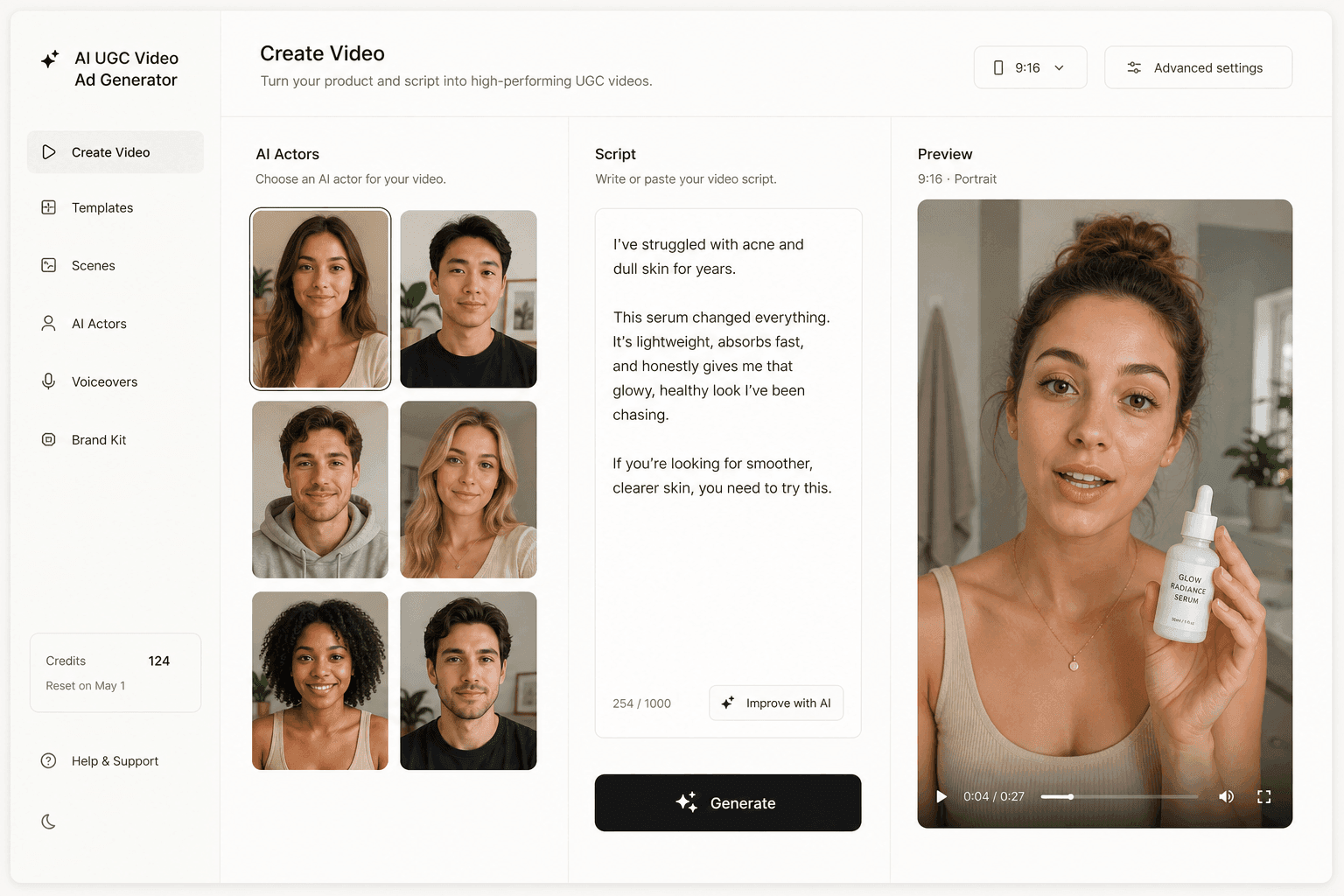
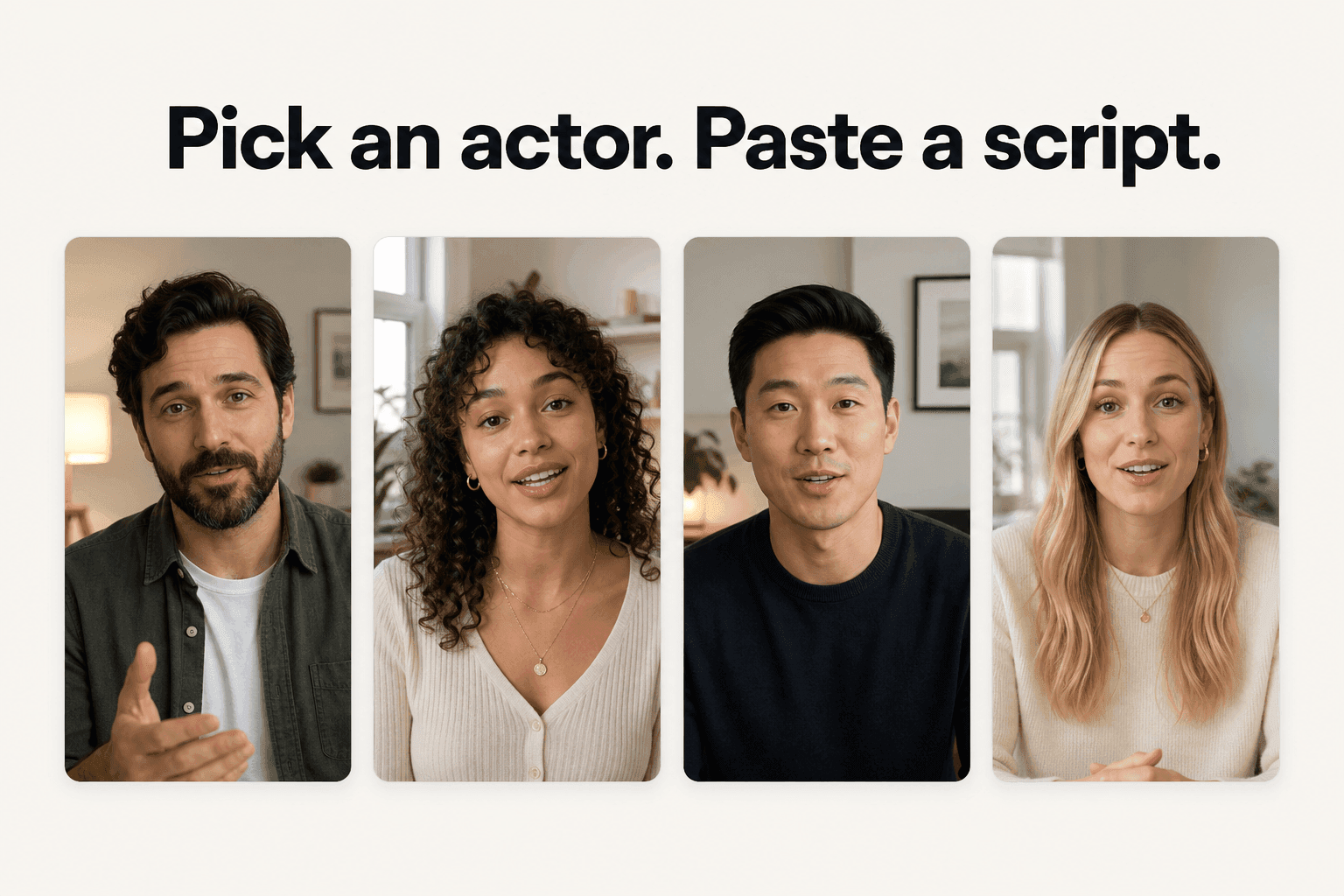
Novoads is a global AI UGC video-ad generator that makes native-local ads in more than 30 languages with real regional accents. You pick an AI actor, write or auto-generate a script, and the presenter is plainly a brand spokesperson, not a real named person. That is exactly the commercial, non-impersonating zone TikTok's rules are built around. You are not faking a documentary recording of a real individual, so the only thing left to do is the honest label itself, and the prohibitions on fake endorsements and real-person likenesses simply never come into play.
One clean file, one toggle
The output is a normal downloadable video, vertical or horizontal (9:16, 1:1, or 16:9) in HD, that you upload to TikTok like any other creative. When TikTok wants the AI-generated toggle, you flip it, and nothing about the file fights you. Because the whole point of AI UGC is testing many angles cheaply, a clean and clearly commercial file means compliance is a non-event per ad rather than a review. If you are still choosing tools, the roundup of the best AI video ad platforms puts the options side by side, and you can spin up your first label-ready batch with Novoads for $49 a month, cancel anytime.
Disclosure is context, not a confession
The advertisers who lose sleep over TikTok's AI rules are usually picturing a rejection that is not coming. For an honest commercial ad, the obligation is small and pointed at the same thing good marketing already wants: creative that does not pretend to be something it is not. Flip the toggle, keep the presenter genuinely synthetic, and stay away from real people's likenesses, and the label stops being a warning sticker and becomes what it actually is, a small signal of honesty that travels well next to a strong hook. If you can master a hook, you can master a toggle, and the how-to on making TikTok ads covers the rest.
Frequently Asked Questions
Do you have to label AI-generated ads on TikTok?
For realistic AI, yes. TikTok asks creators to label all AI-generated content that contains realistic images, audio, and video, which squarely includes a synthetic AI actor and a synthetic voice reading your script. A cleanly commercial spokesperson ad is exactly the kind of content the label is meant for.
How do you add the AI label on TikTok?
Turn on the AI-generated content setting when you publish. For a video upload it lives under More options. You can also disclose it yourself with a line of on-screen text, a hashtag sticker, or a note in the post's description, and TikTok treats those as valid disclosure too.
Will the AI label hurt my reach on TikTok?
No. TikTok states that turning on the AI-generated content setting does not affect the distribution of your video, as long as the content still follows its Community Guidelines. The label is context for viewers, not a penalty on your account.
Does TikTok detect AI content automatically?
Increasingly, yes. TikTok may automatically apply the AI-generated label to content it identifies as completely generated or significantly edited with AI, including content made with its AI effects or uploaded with C2PA Content Credentials attached. Once an auto label is applied, you cannot remove it.
What AI content is banned on TikTok even if it is labeled?
A label does not rescue harmful AI. TikTok prohibits AI content that falsely shows public figures making or receiving an endorsement, and AI that uses a minor's likeness or an adult private figure's likeness without permission. Those are off limits whether or not you disclose them.
Do I need to label a normal AI UGC product ad?
If it uses a realistic AI actor or voice and you are publishing on TikTok, label it. It takes a few taps. Keep the ad clearly commercial, do not impersonate a real named person, and the labeling question mostly answers itself.
Key Takeaways
- On TikTok, realistic AI content should be labeled, and the rule covers a synthetic UGC actor or voice, not just political media.
- Turning on the AI-generated content setting takes a few taps, and TikTok states it does not affect your video's distribution.
- TikTok also auto-labels AI made with its effects or carrying C2PA Content Credentials, and an auto label cannot be removed once applied.
- Some AI content is banned even with a label, including faked endorsements by public figures and unauthorized real-person likenesses.
- For an honest AI UGC product ad, disclosure is a one-toggle habit, not a reason to avoid AI.