AI Ads: How to Make Video and Image Ads With AI in 5 Steps
AI ads are paid ads whose script, image, voice or video is generated by AI; here are the five steps to make one and what a finished ad costs in credits.

Mauricio Valdivia
·Updated ·11 min
Ads Made by a Model Instead of a Film Crew
AI ads are paid ads whose script, image, voice or video is generated by an AI model instead of being shot, cast and edited by people. On TikTok, Reels and Facebook, an AI video ad is usually an AI actor reading your script to camera, or a product photo turned into a moving scene, uploaded like any other creative.
Production got cheap. Judgment did not.
That split runs through this whole guide: what counts as an AI ad, how Meta describes AI inside its own ads business, five steps to make a video or image ad, and what one finished ad costs in Novoads credits.
What Counts as an AI Ad Now
Three different jobs AI can do in an ad
"AI ads" covers three things that solve different problems:
- AI copy. A model writes headlines, primary text and opening lines. It is the cheapest way to get variations, and on its own it rarely moves a campaign, because on social feeds the creative carries most of the weight.
- AI images. A model makes product shots, backgrounds or a finished static ad. In Novoads, one uploaded product photo becomes an ad image.
- AI video. A model produces the moving ad: an AI actor reading a script in a UGC style, a product video built from a photo, or a TV-style spot like the ones in our guide to the AI commercial generator.
Video is the hardest of the three to make the old way, so most of this guide is about it.
How Meta describes AI in its own ads business
Meta says the combined revenue run-rate of its video generation tools hit $10 billion in Q4 2025. The figure comes from Meta's January 2026 newsroom post on AI and ads, and it is Meta's own number about Meta's own tools.
The same post covers the other end of the ad. Meta says it doubled the GPUs used to train its ads ranking model, GEM, in Q4 2025, and that the model helps its systems determine which ads to show people on Facebook and Instagram.
Our reading: on Facebook and Instagram, AI already helps decide who sees an ad, and generated video is part of how those ads get made. What stays with you is the idea, the script and the call on what to scale.
Where the UGC-style video ad fits
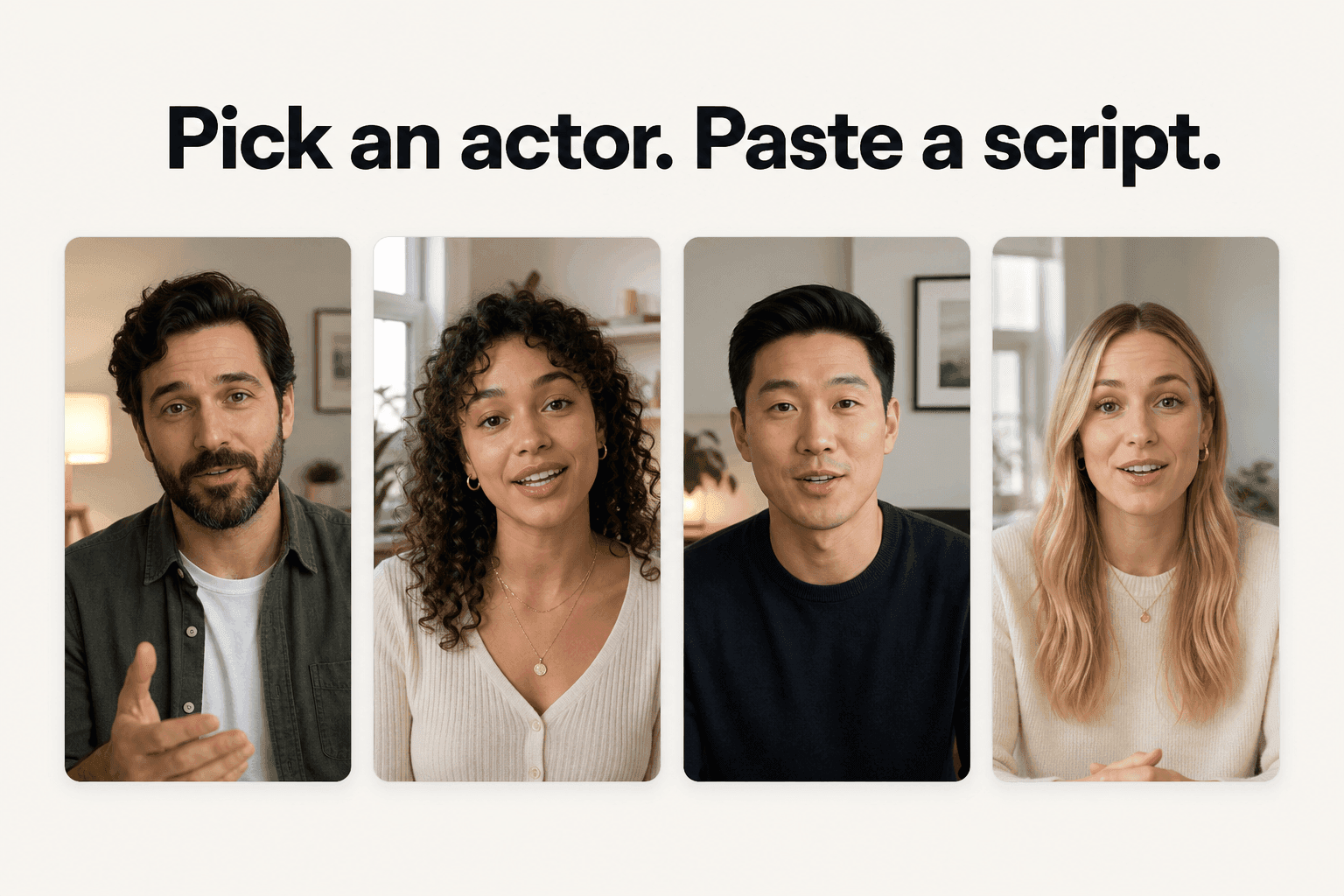
If you only learn one AI ad format, make it the UGC-style video: one person talking to the camera about a product, the way a customer would post it. That is a UGC ad, and an AI actor can deliver it without a creator, a shoot or a wait for delivery. It is the shape the steps below build.
AI Ad Agents That Make the Ad and Ones That Run It
Amazon Ads defines agentic AI as software that "can act independently to achieve predetermined goals," and says marketing agents plan and complete multi-step tasks for marketers, with their approval, such as analyzing ad performance and generating creative. So an AI ad agent takes the goal you describe in plain words and does several steps of the work for you.
Today's agents differ in which half of that work they take on. Some make the ad, writing the script and generating the video or image. Others launch the campaign, shift budget and adjust targeting. A few claim to do both. We based each agent's description below on its maker's own pages, which we read on October 30, 2026.
The platforms' own agents, and who can use them today
- Amazon. At unBoxed on September 29, 2026, Amazon named its unified ad platform Amazon Ads Agent (the ads console and Amazon DSP in one buying surface). In its chat, which Amazon calls the conversational experience, enrolled advertisers can plan, create, manage, optimize, measure and troubleshoot, and they approve a summary of the proposed changes before they're applied. Amazon's product page says access to that chat "is expanding to eligible advertisers through a rolling closed beta," depending on eligibility, marketplace, language, campaign type and capacity. The page sends advertisers to their Amazon Ads account executive and lists 25 countries for the chat, among them the US, the UK, Spain, India and Japan. All US advertisers can use Full-Funnel Campaigns, where Amazon's AI plans and optimizes the campaign and built-in tools let you make video and display images from your existing product pages.
- Meta. On October 6, 2026, Meta said it's beginning to test new capabilities in its Meta AI business assistant that will let you plan and create a campaign, generate creative imagery and text, update targeting or change a budget by conversation. Meta added that you'd get previews, approvals and controls to decide what you hand off. The same post says video made from your existing static assets is generally available in Advantage+ creative. Muse, a separate personal AI agent in the US and Canada, can connect a business's Meta ad accounts. Meta's September 29 post about it says nothing gets published, sent or spent without your approval.
- Google. Google introduced Ask Advisor on May 20, 2026, as its "new cross-product AI agent." It's in beta for English-language accounts and isn't available in manager (MCC) accounts. In Google Ads, it suggests new text and image creatives and applies the changes it proposes once you approve them.
Agents that make the ad
- Creatify Ad Agent. In a help article updated October 4, 2026, Creatify says Ad Agent writes the concept and script, generates the video and keeps editing it based on your feedback. The article calls Ad Agent the main way to make ads in Creatify now, and Creatify's pricing page lists it on every paid plan as of November 10, 2026, with Ad Agent bots and automations from the Pro plan up.
- TopView. TopView says it plans the scenes, picks the models and generates the assets from your idea, script, reference video or product URL, and it makes UGC-style ads with what it calls "lifelike AI presenters."
- HeyGen Video Agent. HeyGen says Video Agent goes "from idea to finished video with just a prompt."
Agents that run the campaign, or claim both
- Synter. Synter calls itself "the AI Agent media buyer" and says you can run ads on 43 platforms from Claude, Cursor or ChatGPT.
- AdStellar. AdStellar says that its agent creates image and video ads, that the winners go live on Meta in one click, and that the agent then pauses waste, scales winners and adjusts budgets.
- Creatify AI Media Buyer and Performance Agent. On June 18, 2026, Creatify launched AI Media Buyer, an agent "that connects to your ad accounts and runs them." Creatify's feature page for Performance Agent says "Creatify Agent audits the spend, says what to scale, fix or cut, and makes the change once you approve," and that when a winner fatigues, the same chat writes the new hooks and renders fresh video and image ads to test.
- Madgicx. Madgicx calls itself "the AI Ads Manager for Meta" and says advertisers use it to audit accounts, launch ads and shift budget.
If you're short on ads, we'd start with an agent that makes them, and if you're short on time, with an agent that runs your campaigns.
Where your own agent plugs in, and where Novoads fits
On April 29, 2026, Meta put its ads AI connectors in open beta, its ads MCP server among them. They let the AI tools you already use create and edit ads, ad sets and campaigns. Meta's October 6 post adds campaign workflows for large advertisers and agencies, in which an agent's work lands in Ads Manager as a draft and every action waits for explicit approval. Google's own Ads MCP server gained its first write tools on November 2, 2026: it can now create assets and manage labels, each after the user approves. It still can't pause a campaign or change a bid, and Google's guide, last updated October 30, 2026, still calls it read-only.
Novoads makes the ad and doesn't run, buy or place it. Our MCP connector works with any client that speaks MCP over Streamable HTTP with OAuth, so an agent you already use can ask Novoads for the ad. In Claude Code, you add it with one command, claude mcp add --transport http novoads https://novoads.ai/api/mcp. We tried it on October 20, 2026. A Claude Code session made a 6-second vertical Seedance 2.0 Mini clip through the connector for 6 credits, and you can see each call in our Claude ads skill post. The five steps below cover the making half of the work, whether you do it yourself or hand it to an agent.
How to Make an AI Ad in Five Steps
The steps are the same in most tools. They are written here for a video ad, with the image route noted where it differs.
Step 1: Set the goal, the audience and the placement
Decide four things before you generate anything:
- Who sees it. Age, location and the problem they already feel.
- What they should do. Buy, sign up or visit a page. One action per ad.
- What kind of ad it is. A UGC-style review, a product demo or a time-limited offer, because each wants a different script.
- Where it runs. This sets the shape: vertical 9:16 for TikTok, Reels and Stories, square 1:1 as a feed alternative. Novoads renders vertical, square and horizontal formats.
Step 2: Write a script that earns the first three seconds
The script decides more than the model does. A structure that holds up for a 15 to 30 second ad:
- Hook (0 to 3 seconds): a specific line about the viewer's problem, not a greeting.
- Problem (3 to 10 seconds): the pain, in the words a customer would use.
- Solution (10 to 20 seconds): the product as the answer, shown or named.
- Proof (20 to 25 seconds): one concrete detail, result or demonstration.
- Call to action (last 5 seconds): exactly what to do next.
"Hi, are you looking for the best solution for your business?" fails at the first beat. "I was paying a creator for every video, then I started testing ten hooks a week" gives the viewer a reason to stay. Our 12 hook formulas go deeper on the opening, and the guide to ads that convert covers the rest of the structure.
A note for other languages: write the script in the viewer's language from the start instead of translating it word for word. A literal translation reads stiff even when every word is correct.
Step 3: Choose the AI actor, or start from a product photo
For a talking ad, pick an actor who looks like someone your buyer would trust: casual clothes for UGC, a cleaner look for B2B. Match the voice to the market as well; Novoads' voice catalog covers 31 languages.
Two details trip up first-timers:
- Product in hand. A stock AI actor's hands are empty. To show your product held up to the camera in Novoads, create a custom actor from a photo of someone holding it, or start from one of the product templates in Discover, which place your product in the creator's hand.
- Image ads. For a static ad, skip the actor: upload a product photo and generate the ad image from it. Our walkthrough of product videos from one photo shows the same input turned into motion.
Step 4: Generate the video or the image
Paste the script, pick the engine and render. A render takes minutes. The engine sets both the look and the price, from a five-second Seedance 2.0 Mini clip at the cheap end to a full 30-second Seedance 2.5 take, and the cost section below prices each one.
Step 5: Review, vary and export
Before anything goes live:
- Watch the first three seconds with the sound off. If the opening does not land as captions, rewrite it and render again.
- Make variants that differ in the idea. Change the hook, the angle or the actor, not only the background, because look-alike variants teach a campaign very little.
- Check the realism tells. Our checklist on making AI video look real covers light, skin and sound.
- Export the right shape for each placement and upload the file to Ads Manager like any other video.
Test Hooks Cheap, Then Pay for the Long Take
Start with the opening, not the full ad
The most useful first test is not a finished 30-second spot. It is five openings on the same offer, kept short, so the first three seconds compete on their own. Our guide to testing ten openings on one video ad shows the setup. Render the full-length version only for the hook that wins.
Mistakes that waste the test
- One ad, one bet. A single render cannot tell you why it worked or failed.
- A slow open. Saving the best line for second ten means many viewers never hear it.
- A script that runs long. Past about 45 seconds an ad usually carries two messages; split it into two ads.
- No call to action. Without one, the video is content, not an ad.
- Changing the engine instead of the message. A new model changes the look. A new hook changes the result.
What One Finished AI Ad Costs in Novoads
On Novoads, a clip runs from about 25 cents for a five-second Seedance 2.0 Mini clip to about $4 for an eight-second Google Veo 3.1 clip, and about $10 for a full 30-second Seedance 2.5 take. Those dollar figures use the Plus plan's rate per credit. A plan grants credits, so here is one finished ad of each kind in credits, and how many a month of each plan buys:
| Finished ad | Credits | Starter (200 a month) | Plus (1,000 a month) |
|---|---|---|---|
| 30-second Seedance 2.5 take, 720p | 210 | 0 | 4 |
| Talking-actor ad up to 60 s, 720p | 200 | 1 | 5 |
| Eight-second Veo 3.1 clip | 72 | 2 | 13 |
| Five-second Seedance 2.0 Mini clip | 5 | 40 | 200 |
| Ad image from a product photo | 1 | 200 | 1,000 |
Starter cannot pay for one 30-second take
Read the first row twice. A 30-second Seedance 2.5 take at its default 720p costs more credits than Starter grants in a month, so a Starter month cannot pay for even one. The same month does cover one talking-actor ad of up to a minute, or a test round of short clips and product-photo images. Plus covers four of those 30-second takes.
Spend the credits where the test is
Put the first credits into short openings and product-photo images, then spend the long take on the angle that already won. Plan prices, and what each plan's credits buy model by model, are on the pricing page.
When a Creator Still Beats an AI Ad
AI ads win most production races, not all of them.
Use AI when:
- you need many variations of one offer to find the angle that works;
- the ad is a person talking to camera or a product shown in motion;
- speed and volume matter more than a famous face.
Hire a creator when:
- the creator's own audience and name are part of what you are buying;
- the ad depends on real use the viewer has to believe, such as a before-and-after on skin;
- it is one flagship piece you will run for months.
What creators charge per video, by tier, is in our UGC creator rates breakdown.
A Cheaper Question, Asked More Often
The old limit on paid social was how many ads you could afford to make. AI moved that limit to how many distinct ideas you can write and how quickly you read the results. An AI ad is not a cheaper video. It is a cheaper question, asked as often as your budget allows.
To see the format end to end, start with AI UGC video ads in Novoads.
Frequently Asked Questions
How is AI used in ads?
AI shows up in two places. It makes the creative, writing the copy and script and generating the image or video, and it helps decide who sees the ad. On the creative side, Meta says the combined revenue run-rate of its video generation tools hit $10 billion in Q4 2025. In a tool like Novoads you write or generate a script, pick an AI actor or upload a product photo, and get a finished ad file to upload to Meta or TikTok.
What are some examples of AI in advertising?
Four common ones. Generated ad video and images, made with tools such as Meta's own video generation tools or a dedicated ad generator. Ads ranking models such as Meta's GEM, which Meta says helps its systems determine which ads to show people on Facebook and Instagram. Assistants, such as the Meta AI business assistant that Meta began testing with advertisers in Q4 2025. And AI actor ads, where an AI presenter reads a script to camera in a UGC style.
What is an AI ad agent?
An AI ad agent is software that takes an advertising goal you describe in plain words and carries out several steps of the work for you. Some agents make the ad, writing the script and generating the video or image. Others launch the campaign, shift budget and adjust targeting. A few claim to do both. The ad platforms are building their own. As of October 30, 2026, the conversational experience in Amazon Ads Agent is in a rolling closed beta for eligible advertisers, and Google's Ask Advisor is in beta for English-language accounts. Both apply changes after you approve them. Meta said on October 6 that it's beginning to test new agentic capabilities in its Meta AI business assistant.
How much does an AI ad cost to make?
On Novoads a clip runs from about 25 cents for a five-second Seedance 2.0 Mini clip to about $4 for an eight-second Google Veo 3.1 clip, and about $10 for a full 30-second Seedance 2.5 take, at the Plus rate per credit. Novoads starts at $15/month (Starter, 200 credits per month). Plus is $49/month (1,000 credits), and Ultra starts at $129/month (3,000 credits) for more volume.
Do you need a camera or actors to make an AI ad?
No. You write a script or have one drafted, pick an AI actor, and the tool renders the voice, lip-sync and video. For an image ad you upload a product photo instead, and Novoads turns it into an ad image for 1 credit. A stock AI actor's hands are empty, so to show your product in hand, create a custom actor from a photo of someone holding it, or start from a Discover product template.
Key Takeaways
- AI ads are paid ads whose script, image, voice or video is generated by AI. For social feeds, the form worth learning first is the AI video ad: an AI actor reading a script to camera.
- Platforms already run AI at both ends of an ad: Meta describes video generation tools for ad creative and an ads ranking model that helps decide which ads people see.
- AI ad agents differ in which half of the work they take on. Some make the ad, some run the campaign and a few claim to do both. As of October 30, 2026, the conversational experience in Amazon Ads Agent is in a rolling closed beta, and Google's Ask Advisor is in beta for English-language accounts. Meta said on October 6 that it's beginning to test agentic capabilities in its Meta AI business assistant.
- Making one takes five steps: set the goal and placement, write a script that earns the first three seconds, pick the AI actor or product photo, generate, then review and vary.
- A 30-second Seedance 2.5 take costs 210 credits, more than Starter's 200 a month, so test hooks on short, cheap clips and render the long take only for the winner.
- The tool does the production. Which hook to test, which angle to scale and what to kill stays your call.
Sources
- •Meta Newsroom: 2026: AI Drives Performance (January 28, 2026)
- •Meta: Q4 2025 earnings call transcript (January 28, 2026)
- •Amazon Ads: Ads Agent, an AI marketing assistant from Amazon Ads (read October 30, 2026)
- •Amazon Ads: Introducing Amazon Ads Agent, your AI-powered ad platform (September 29, 2026)
- •Meta for Business: AWNY 2026: New AI Capabilities to Guide Campaigns and Reach Customers (October 6, 2026)
- •Meta for Business: Introducing Meta Ads AI Connectors (April 29, 2026)
- •Meta Newsroom: The Future Is for Everyone: Muse for Small Business (September 29, 2026)
- •Google Ads & Commerce Blog: Meet Ask Advisor, your new AI-powered collaborator (May 20, 2026)
- •Google Ads Help: Ask Advisor in Google Ads (beta) (read October 30, 2026)
- •Google Ads API: Google Ads MCP server, developer integration guide (last updated October 30, 2026)
- •GitHub: googleads/google-ads-mcp release v0.0.6 (November 2, 2026)
- •Creatify Help Center: Ad Agent (updated October 4, 2026)
- •Creatify: AI Ads Agent for Meta, Google and TikTok, the Performance Agent page (read November 10, 2026)
- •Creatify: Introducing AI Media Buyer, AI That Runs Your Ads (June 18, 2026)
- •Creatify: Pricing (read November 10, 2026)
- •TopView: AI Video Agent (read October 30, 2026)
- •HeyGen: Video Agent (read October 30, 2026)
- •Synter (read October 30, 2026)
- •AdStellar: AI Ad Campaign Builder for Meta Ads (read October 30, 2026)
- •Madgicx (read October 30, 2026)