AI Commercial Generator: How to Make a TV-Style Commercial in Minutes, Not Weeks
An AI commercial generator turns a product brief into a polished, TV-style commercial, generating the script, video, voice, and sound in one flow. Here is how to make a commercial with AI, the models that do it, and when a commercial beats UGC.

Mauricio Valdivia
·Updated ·11 min
The shoot day is now a text box
An AI commercial generator turns a written brief into a finished, TV-style commercial: it drafts the script, generates the video, adds a voice, and lays in the sound, all from a prompt. If you have ever wondered how to make a commercial without a crew, a studio, or a five-figure budget, this is the shortcut that got real in the last year.
The change is not that video got cheaper. It is that the whole production line, the part that used to mean a location, a shoot day, and weeks of editing, now runs inside a text box. You describe the spot; the models render it. What you keep is the part that always mattered: the idea, the script, and the taste to pick the take that lands.
This guide walks the full loop. What an AI commercial generator actually does, how to make a commercial with AI step by step, the models doing the heavy lifting, when a commercial beats a UGC-style ad, and a worked example that turns one product brief into a 30-second spot with a real cost and time.
What an AI commercial generator actually does
From brief to broadcast: the four stages
A traditional commercial is a relay race across four teams: writers draft the script, a production crew shoots the footage, a voice booth records the narration, and an edit suite scores and cuts it. An AI commercial generator collapses those four handoffs into one flow. You give it a brief; it moves through script, video, voice, and sound without anyone booking a studio.
The important word is finished. This is not a stock-footage slideshow. The current video models render original, cinematic shots with sound baked in, which is what separates a commercial from a clip. The output is a real deliverable: an HD file, vertical or horizontal, ready for a feed or a broadcast slot.
Why it reads as a commercial, not a clip
A commercial has a grammar. An establishing shot, a hero product beat, a benefit or transformation, and an end card with the logo and line. What makes the new tools usable for advertising is that they can hold that grammar across shots instead of producing one pretty five-second loop.
That grammar is also why generation quality alone is not enough. The models supply the footage; the sequence is the craft. A good AI commercial generator gives you shot-by-shot control so the beats land in order, the way an editor would assemble them.
What you still bring
The machine does not have the brief. You still decide the angle, the promise, and the one thing the viewer should remember. You choose whether the spot is a moody brand film or a fast direct-response cut. You pick the winning take from the variations it generates.
Put plainly: AI removes the production bottleneck, not the thinking. The brands that get the most out of these tools treat them like a very fast, very cheap production house, and spend the saved time on more ideas. The same logic drives every good run of AI ads: the constraint stops being budget and becomes how many angles you can dream up.
How to make a commercial with AI, step by step
Write the brief and the script
Start with one sentence: who it is for, what it sells, and the single feeling it should leave. From there, a 30-second script is roughly 60 to 75 spoken words. Keep sentences short. Lead with the hook in the first three seconds, because that is where a viewer decides to stay.
If you are staring at a blank page, this is where the tool earns its keep. Paste a product page or a brand URL and let it draft a script and a set of angles, then edit. You are a faster editor than writer, and a rough first draft spares you the tyranny of the empty document.
Storyboard it into shots
A commercial is not one prompt; it is a shot list. Break the script into three to five beats and write a visual line for each: the setting, the subject, the camera move, the mood. This is the step most people skip, and it is the difference between a coherent spot and four unrelated clips.
- Shot 1, establish. The world of the product. A kitchen, a gym, a bathroom shelf.
- Shot 2, hero. The product itself, lit and framed like it costs something.
- Shot 3, benefit. The transformation, the result, the moment of relief.
- Shot 4, end card. Product plus logo plus one line, held for a beat.
Generate, assemble, and finish the sound
Now you generate each shot, pick the best take, and lay them in order. Add a voiceover if the spot needs narration, drop in a music bed, and burn captions so it plays silently in a feed. The better generators keep this inside one project so you are not exporting clips into a separate editor.
The finishing touches are what sell the polish: a consistent color grade across shots, audio that ducks under the voice, and a clean cut on the beat. None of that requires an edit suite anymore, but all of it still requires you to notice when a shot is off and regenerate it.
The models doing the heavy lifting
Cinematic video with sound in one pass
The reason this works now is a jump in video models that render footage and audio together. Google Veo 3.1 generates video with native audio and outputs in 1080p and 4K, the resolution ceiling you want for a beauty or detail shot. Kling v3 Pro brings its own native audio and multi-shot storyboarding, so a storyboarded beat arrives with its sound out of one pass instead of an edit.
Both are available in Novoads, alongside Seedance 2.0 for the supporting beats, so the hero of your spot does not have to be the weakest link.
Multi-shot direction and camera moves
A commercial lives or dies on movement and sequence, and two models are built for that. Kling v3 Pro outputs up to 1080p with clip durations from 3 to 15 seconds, and unifies multi-shot storyboarding with native audio generation in one model, so a longer, multi-beat sequence holds together. Seedance 2.0 renders cinematic output with native audio, multi-shot editing, and director-level camera control, which means you author the push-in or the orbit rather than hoping for it.
Both are available in Novoads too. If you want the head-to-head on the two most common commercial workhorses, our breakdown of Seedance 2.0 versus Google Veo 3.1 compares them shot for shot.
Voice, music, and the final mix
The video models carry the ambient sound and effects; the spoken lines and the mix are their own layer. AI voice (TTS) reads your script in the tone you pick, lip-sync aligns a talking presenter, and captions render the whole thing legible on mute. The audio bed is where a lot of amateur AI spots fall down, so treat it as a real stage, not an afterthought.
Choosing a stack matters here, and the field is crowded. If you are weighing options, our roundups of the best AI video ad generators and the best Arcads alternatives map the tools that pair generation with the assembly and sound work an actual commercial needs.
Commercial or UGC? When each format wins
When a polished commercial is the right call
A commercial is a signal. High production value tells a viewer, before a word is spoken, that a real company stands behind the product. That signal is worth the most when you are launching, when you are premium, or when you are buying attention on surfaces that reward polish: connected TV, YouTube pre-roll, a homepage hero.
Use a polished commercial when the goal is brand, trust, or a launch moment; when the media is TV, CTV, or pre-roll; when the product is premium and the look has to match; and when you want one flagship asset that represents the brand.
When UGC-style outperforms the commercial
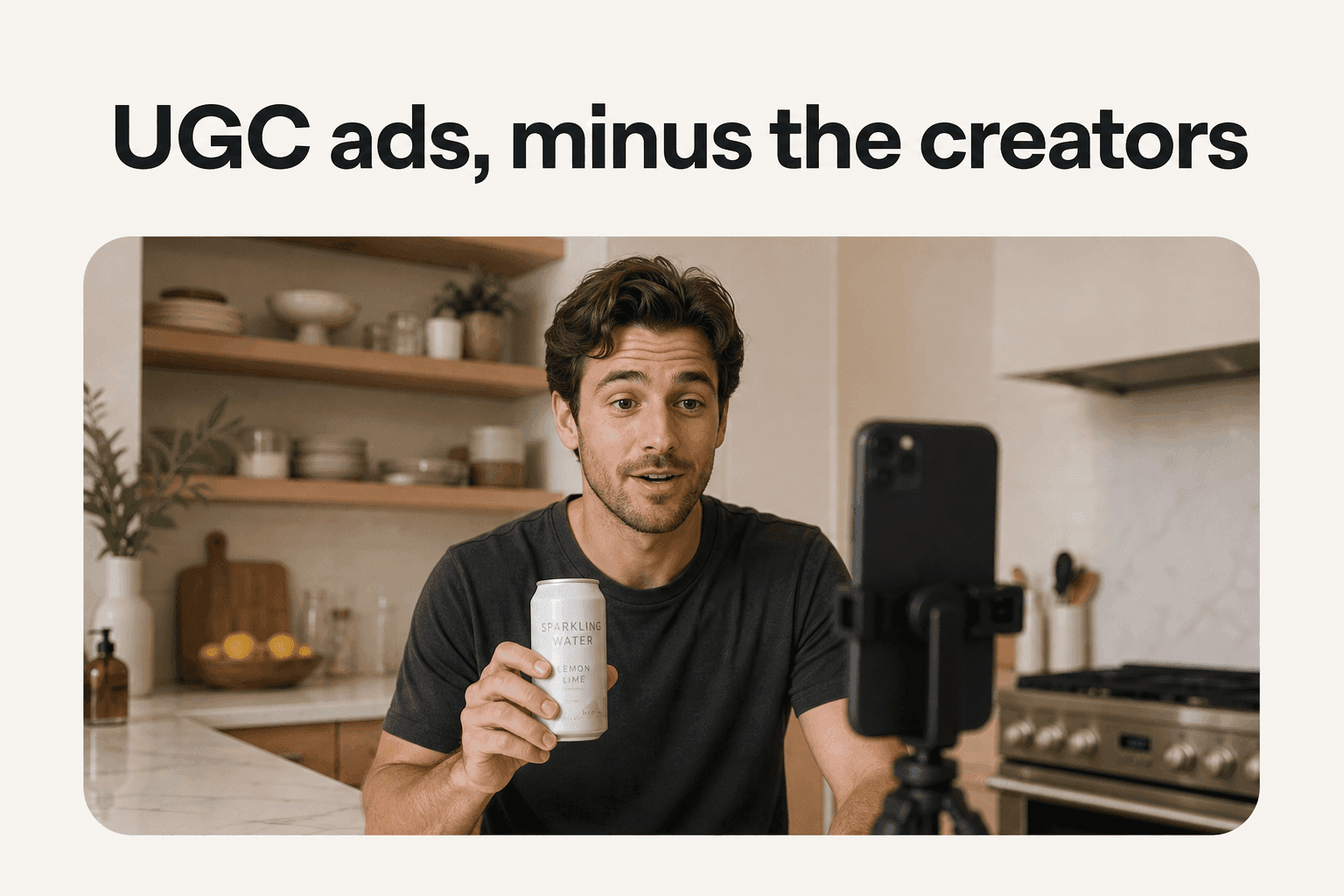
On a native social feed, polish can work against you. A phone-shot clip of a real-seeming person reads as more honest than a glossy spot, and it converts because it does not look like an ad. That is the entire logic of UGC-style ads, and it is why user-generated content has become the default creative for performance on TikTok and Reels.
Use a UGC-style ad when the goal is direct response and cost per acquisition; when the placement is TikTok, Reels, or Stories; when you need volume to test angles; and when authenticity beats production value. Many of these run as faceless video ads or the fast, native cuts our guide to making TikTok ads walks through.
The hybrid most brands actually run
The honest answer is that it is not a choice. The strongest accounts run a small number of polished hero commercials to build the brand and a large stack of UGC-style variations to find what performs. The commercial earns the trust; the UGC volume finds the winner. An AI generator is what makes running both affordable, because the same tool produces the cinematic spot and the scrappy testimonial for a few dollars each.
A worked example: one supplement brief, one 30-second spot
The brief and the shot list
Take a real case. A supplement brand sells a magnesium sleep drink and wants a 30-second commercial for YouTube pre-roll. The brief is one line: for stressed professionals who cannot switch off, a calming nightly ritual that helps them fall asleep faster. The script is 65 words, hook first: "Still awake at 2am? Your brain will not stop."
That becomes a four-shot storyboard:
- Establish. A dark bedroom, a phone glowing at 2am, restless. Mood: tense.
- Hero. The drink poured into a glass on a nightstand, warm lamp light. Mood: calm turning.
- Benefit. The same person asleep, peaceful, morning light arriving.
- End card. The product with the logo and the line "Sleep on schedule."
The generation pass: rough cost and time
Now you generate. The hero shot wants the most fidelity, so it goes to a premium tier; the supporting beats can run on a faster model. Here is the rough bill, using Novoads' per-clip costs:
| Step | Tool | Rough cost |
|---|---|---|
| Product still | GPT Image 2 | ~$0.21 |
| Hero shot, 1080p | Google Veo 3.1 | ~$6.90 |
| 3 supporting shots | Seedance 2.0 | ~$2 each |
| Voiceover line | AI voice | part of a minute |
That is roughly $13 to $15 in total generation cost, and the first full assembly lands in well under an hour, with each individual clip returning in about four minutes. Compare that to a produced spot: a crew, a location, talent, and an edit that runs weeks and easily reaches five figures. Our full video ad production cost breakdown runs the traditional math in detail.
The point is not that the AI version replaces a flagship brand film with a real director. It is that you can now produce a broadcast-shaped spot for the price of lunch, which means you can make five and test them instead of betting the quarter on one.
How to tell it landed
Quality control on an AI commercial is specific. Watch the first three seconds on mute: does the hook read without sound? Check the hero shot for the uncanny tell, a warped hand, a floating label, text that turns to soup. Confirm the audio ducks under the voice and the cut hits on the beat. If any shot fails, regenerate just that shot; you are never re-shooting the whole spot, only swapping one clip.
Where AI commercials still go wrong
The uncanny hero shot
The most common failure is the shot you care about most. Faces, hands, and small text are where generators still stumble, and the hero product beat is exactly where a viewer looks hardest. The fix is volume: generate three to five takes of the hero shot and pick the clean one, rather than accepting the first render because it mostly works.
Muddy audio and off-brand voice
Native model audio is good for ambience and effects, but a muddy mix or a voice that does not match the brand undoes the polish above it. Treat voice as a deliberate choice: pick a tone that fits the product, keep the music bed low under the narration, and do not let the model's ambient bed fight your voiceover. The audio is half the commercial.
Continuity drift across shots
Because each shot is generated independently, the product, the lighting, or the color can drift from beat to beat, and continuity errors read as cheap. The defense is the storyboard: describe the product and the palette the same way in every prompt, generate a consistent product still first and reference it, and grade all shots to match in the assembly. Continuity is the discipline that turns four clips into one spot.
How Novoads turns a brief into a finished commercial
Novoads is built for this exact loop. You can paste a brand or website URL into the Ad Generator wizard and it proposes ad ideas and exports the prompts, or upload a product image and turn it into an ad creative. From there the video runs on the models a commercial needs, Google Veo 3.1, Kling v3 Pro, and Seedance 2.0, with AI voice, captions, and lip-sync in the same place, exported as vertical or horizontal HD. You can produce your first spot with Novoads and keep the parts that matter, the idea and the taste, in your hands.
Because a clip runs from a few dollars and a first result returns in about four minutes, the tool does the thing a production house cannot: it lets you make the commercial five times and run the one that wins.
Distribution used to gate the idea. Now the idea leads.
For a century, the bottleneck on a commercial was never the concept. It was the crew, the calendar, and the invoice standing between the idea and the screen. That gate is what an AI commercial generator removes. The script-to-sound pipeline that took weeks and a budget now runs in an afternoon for the cost of lunch, which changes not just how you make one spot but how many you dare to try. The best commercial was always going to be the one you tested your way into, and now you finally can.
Frequently Asked Questions
What is an AI commercial generator?
An AI commercial generator is software that produces a short, TV-style commercial from a written brief. Instead of a crew and a shoot, it drafts or takes a script, generates the video shots, adds a voiceover and sound, and assembles them into a finished ad. The output is a downloadable video you can run on YouTube, connected TV, or social feeds.
How do you make a commercial with AI?
Write a one-line brief and a short script, break it into a shot list of three to five beats, then generate each shot with an AI video model, add a voiceover, and assemble the clips with music and captions. Modern tools do the generation and assembly for you, so the whole loop takes minutes rather than the weeks a location shoot requires.
How much does it cost to make an AI commercial?
On Novoads, individual clips run from about a dollar for a five-second Seedance 2.0 Mini clip to about $8 for an eight-second Seedance 2.5 clip (a full 30-second Seedance 2.5 take is about $26), and a product still is a fraction of a dollar. A full 30-second spot built from a handful of shots typically lands around $13 to $15 in generation cost, versus the five and six figures a produced commercial can cost. The entry plan is $49 per month, cancel anytime.
Is an AI commercial better than a UGC ad?
They do different jobs. A polished commercial signals brand, trust, and production value, which suits launches, connected TV, and pre-roll. A UGC-style ad looks like a real person filmed it, which wins on native social feeds where authenticity outperforms polish. Most brands run a hero commercial for brand-building and many UGC-style variations for performance testing.
Can AI make a real 30-second TV commercial?
Yes. The video models generate cinematic footage with native audio, so a 30-second spot is a matter of storyboarding three to five shots, generating them, and assembling with voice and sound. The ceiling today is up to 4K on some models. The honest limits are continuity across shots and the occasional uncanny frame, both of which you fix by generating variations and picking the clean take.
Key Takeaways
- An AI commercial generator turns a written brief into a finished, TV-style commercial by handling the script, the video, the voice, and the sound in one flow, instead of a crew and a shoot day.
- The workflow is brief, script, shot list, generate, assemble: you still make the creative decisions, but the production step drops from weeks to minutes.
- The heavy lifting is done by video models that generate footage with native sound: Google Veo 3.1, Kling v3 Pro, and Seedance 2.0 are all available in Novoads.
- A polished commercial signals brand and quality; a UGC-style ad trades on native-feed authenticity. Most brands run a hero commercial for brand and a stack of UGC-style variations for performance.
- A worked 30-second spot came in around $18 to $20 of generation cost and well under an hour, versus the crew, studio, and multi-week timeline a traditional commercial demands.