Faceless Video Ads: How to Make Them With AI (No Camera, No Actor)
A faceless video ad sells a product without a presenter: product b-roll, screen recordings, or AI-generated scenes carried by a voiceover and captions. Here are the three builds, when each one wins, and how to produce one with AI for about 10 credits.

Mauricio Valdivia
·11 min
No Face, No Studio, and It Still Converts
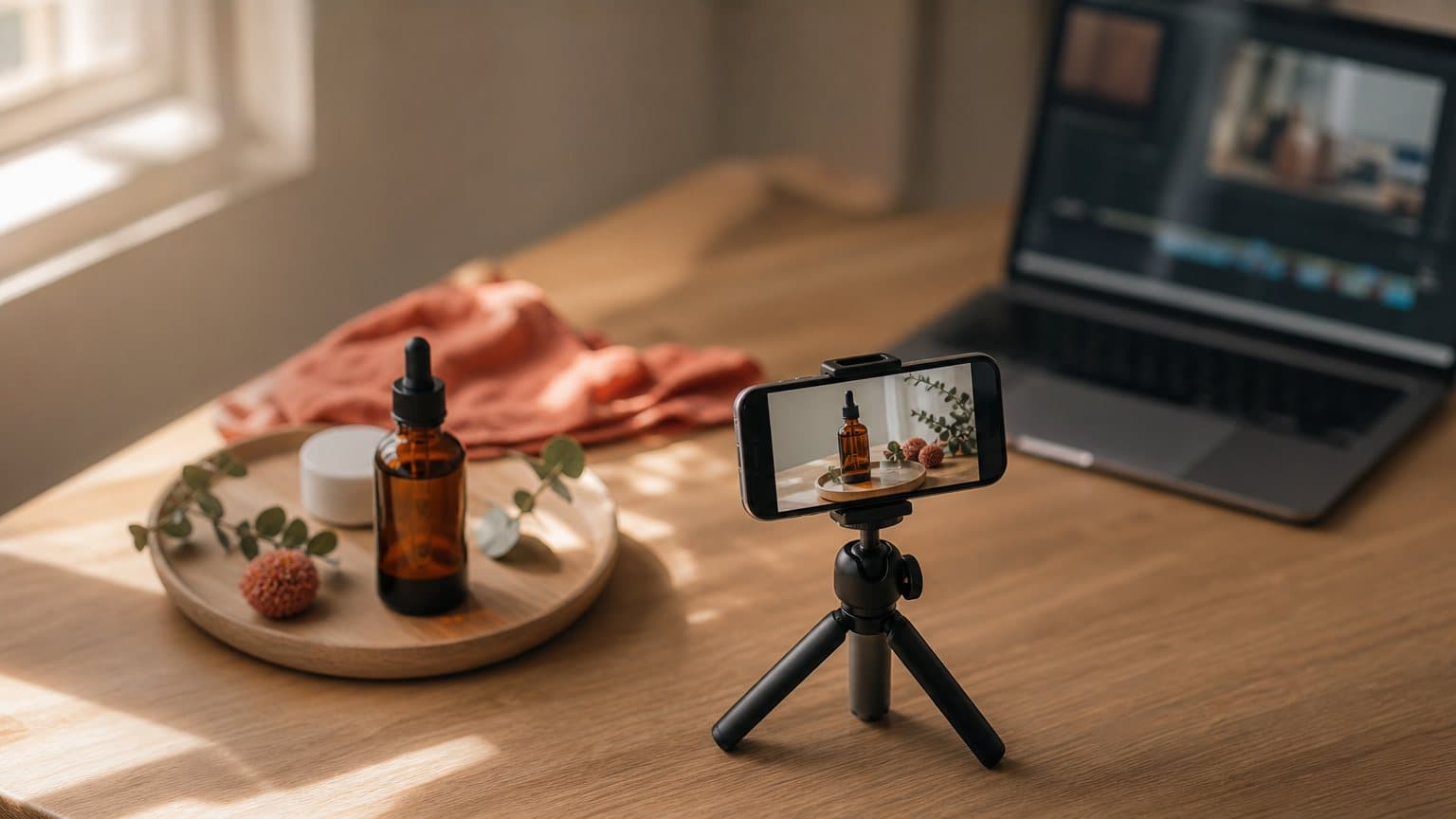
Open TikTok and watch the ads in any product niche for ten minutes. A kitchen gadget slices onions in close-up while a calm voice lists three reasons it beats a knife. An app installs itself on screen, captions doing the talking. A candle burns on a wooden table at golden hour. Nobody appears in any of them. Nobody was filmed.
That is a faceless video ad: a paid video with no on-camera presenter, where the product, the screen, or a generated scene does the showing and a voiceover plus captions do the telling. The format used to demand a b-roll shoot or a stock-footage subscription. With AI video tools it now takes a product photo, a script, and a few minutes, which is why faceless ads have quietly become the default for thousands of small advertisers who will never book a set. This guide covers what the format actually is, the three builds that work, and the exact step-by-step (with real credit math) to produce one without a camera or an actor.
What a faceless ad is, and why the format refuses to die
Marketers keep predicting that authenticity trends will kill faceless content. The spend keeps going the other way. Understanding why starts with what the format really trades away, and what it keeps.
What counts as faceless
The test is simple: if the ad removed its presenter and lost nothing, it was already faceless in spirit. A faceless ad commits to that. Hands are allowed. Voices are essential. Faces never appear. That leaves three raw materials to build from:
- footage of the product itself
- recordings of a screen
- scenes generated by AI
Everything else (music, captions, the voiceover, the edit) is shared with every other ad format.
What faceless ads give up is the borrowed credibility of a human presenter, the thing that makes UGC-style ads work so well. What they keep is everything else that makes short video convert: a hook, a demonstration, and a reason to act.
Why advertisers keep choosing it
Four practical reasons, none of them aesthetic:
- No talent bottleneck. No casting, no scheduling, no reshoots when the script changes, no usage-rights renegotiation when a winning ad runs past 90 days.
- Volume is cheap. Swapping a voiceover and reordering scenes produces a new variant in minutes, so testing ten angles does not mean briefing ten creators.
- The product gets every second. In a 15-second ad, a presenter's intro can eat a third of the runtime. Faceless ads spend that third demonstrating.
- Privacy. Plenty of founders and marketers simply do not want to be the face of their store, and the format removes the choice entirely.
What platforms actually police
The persistent fear is that platforms punish faceless content. What they punish is effort-less content. On July 15, 2025, YouTube updated its channel monetization policies to rename its "repetitious content" policy to "inauthentic content", clarifying that it covers content that is repetitive or mass-produced. The same policy text notes that this type of content was always ineligible, because creators are rewarded for original and authentic content. Nothing in it mentions faces. A faceless ad with an original script, a real point of view, and a deliberate edit sits comfortably on the right side of that line; a hundred near-identical clips generated from one template does not.
The three builds that actually work
Every faceless ad you have ever scrolled past is one of three builds, or a hybrid. Each has a distinct job, a distinct cost profile, and a distinct failure mode.
Build 1: product b-roll plus voiceover
The classic. Close-up footage of the product in use (pouring, slicing, folding, glowing) sequenced under a voiceover that sells the outcome. This build wins for physical products whose value is visible: cookware, cleaning gear, candles, pet toys, anything with a satisfying texture or transformation. Historically it required a tabletop shoot; today an image-to-video model animates a single product photo into usable motion, which is the core trick behind AI image-to-video generators. The failure mode is generic gloss: b-roll with no argument underneath reads as a screensaver, not an ad.
Build 2: screen recording plus captions
The default for apps, SaaS, info products, and services. You record the actual interface doing the actual thing (a booking made in four taps, a dashboard filling with data) and let captions narrate. Nothing builds product credibility faster than the product itself working in real time. It is also the cheapest build on this list: the recording costs nothing but time. The failure mode is pacing. Raw screen captures run slow, so the edit has to cut every dead second and the first two seconds must show the payoff state, not the login page.
Build 3: AI-generated scenes
The newest build, and the one that erased the format's last production barrier. Text-to-video and image-to-video models generate scenes that would be unshootable on a small budget: the product on a beach at sunrise, a slow orbit around a bottle in falling water, a miniature kitchen world. This build wins when you need scroll-stopping novelty or when the product photo is genuinely all you have. The failure mode is drift: models can invent labels, warp packaging, or produce a product that is almost yours. Starting from a real product image instead of a text prompt is the practical fix.
| Build | Best for | You need | Weak spot |
|---|---|---|---|
| Product b-roll + VO | Physical products that demo | Product photos or footage | Generic without a script |
| Screen record + captions | Apps, SaaS, services | The product itself | Slow pacing |
| AI-generated scenes | Novelty, unshootable shots | One product image | Product drift |
Matching the build to your product
The wrong build wastes the format's main advantage, so choose before you script.
Use product b-roll when:
- the product's value is visible in under three seconds
- you sell a physical good with texture, motion, or a before-and-after
- your catalog changes often and reshoots would never keep up
Use a screen recording when:
- the product is software and the "aha" is a state change on screen
- your buyers distrust polish and want proof it works
- you can show a real result (a booking, a report, a saved hour) end to end
Use AI scenes when:
- the shot you need does not exist and cannot be filmed on your budget
- you are testing a new angle and need variants faster than any shoot allows
- one clean product photo is your entire asset library
Hybrids outperform purists here. A screen-record ad with one generated establishing scene, or product b-roll with an AI close-up you could never film, usually beats either build alone.
The anatomy that decides whether it converts
Removing the face removes a crutch. The remaining elements have to work harder, and three of them do almost all of the lifting.
The hook does the presenter's job
A talking head earns a half-second of attention just by being a person. A faceless ad gets no such gift, so the first shot has to carry the entire stopping job: the mess before the cleanup, the number on screen, the product mid-transformation. Write the hook before the script, not after. Our guide to ad hooks breaks down the patterns, but the faceless-specific rule is that the hook must be visual first; a great spoken line over a static shot still scrolls past.
The voiceover carries the trust
In a faceless ad, the voice is the presenter. A flat robotic read undoes everything, because viewers assign the voice's credibility to the product. This is where AI voiceover quality quietly became the format's enabling technology: current AI voices handle pacing, emphasis, and regional accents well enough that the voice reads as a person with an opinion. Three script rules keep it that way:
- one idea per sentence, written for the ear rather than the eye
- contractions and plain verbs; nothing you would not say to a friend
- read it aloud once before generating, because anything you stumble on, the voice will too
Captions are the second soundtrack
A large share of feed viewing happens with sound off, and a faceless ad without captions is, for those viewers, a silent slideshow. Captions are not an accessibility checkbox here; they are the primary script surface for the muted majority. Keep them short, synced, and high-contrast, and make sure the hook line appears as text in the first two seconds, not only in audio.
The failure-mode catalog. Four ways faceless ads die, why each happens, and the recovery:
- The screensaver. Beautiful b-roll, no argument underneath. It happens when the visuals get made before the script. Recover by writing the voiceover first, then generating scenes to match each line.
- The essay. A voiceover that explains instead of sells, usually because the script was written to be read silently. Recover by cutting every clause you would not say out loud to a friend.
- The mute slideshow. No captions, so the sound-off majority sees nothing happen. Recover by captioning every ad and putting the hook line on screen as text.
- The stranger's product. An AI scene that warped your packaging or invented a label. It happens when generation starts from a text prompt. Recover by always starting from a real product image.

Step by step: a faceless ad in Novoads for about 10 credits
Here is the full build, end to end, with the real credit math. Novoads runs every step in one project: write or auto-generate a script, generate the visuals, add the voice, caption, and export a vertical 9:16 file ready for any ad platform. No step involves a camera.
Step 1: turn one product photo into three scenes
Upload a product image (JPEG or PNG) and Product-to-Ad generates an ad-styled product still with GPT Image 2 for 0.3 credits. Then animate: each 5-second image-to-video scene with Seedance 2.0 or Kling v3 Pro costs 3 credits, so three scenes (hook shot, demo, closing shot) cost 9 credits. Starting from your real photo instead of a text prompt is what keeps the label, the colors, and the packaging yours.
Step 2: add the voiceover
Paste your script and pick an AI voice. Voice generation costs 0.9 credits per minute of narration, so the 15-second read for this ad comes to 0.3 credits. Pick an accent that matches the audience you are buying: a Mexico City voice for a Mexican audience, a US voice for a US one. The accent match is a conversion detail most faceless ads skip.
Step 3: caption, assemble, export
Layer captions over the assembled scenes. Karaoke-style captions render without spending credits; the Classic preset costs 0.4 credits and Animated costs 0.8. Order the scenes hook-demo-close and export. Before you do, run the 20-second check:
- the hook appears as on-screen text within the first two seconds
- the product looks exactly like your product in every scene
- the ad still makes its full argument with the sound off
- the captions are readable on a phone held at arm's length
- the last frame tells the viewer what to do next
The full build: 0.3 (product still) + 9 (three 5-second scenes) + 0.3 (voiceover) + 0.4 (captions) = 10 credits, comfortably inside the 50 credits the $49/month plan grants each month. One complete faceless ad, no camera anywhere in the chain. You know it worked when the exported file plays as a coherent 15-second argument with the sound off. Prefer one continuous shot instead of three cuts? A single 15-second scene costs 7 credits and the rest of the math holds.
The label question: when a faceless ad needs a disclosure
Going faceless does not exempt an ad from AI-content rules, because the rules key on realism, not on faces.
TikTok's rule for realistic AI content
TikTok requires creators to label all AI-generated content that contains realistic images, audio, and video, and it had already required realistic AIGC labels for over a year before its May 2024 industry announcement on automatic labeling. Applied to the three builds, the line falls in a predictable place:
- Screen recordings: no label; nothing in the frame is synthetic.
- Obvious motion graphics and animation: no label; nobody could mistake them for filmed footage.
- Photoreal AI scenes: label them; a generated clip that could pass for a real recording is exactly what the rule describes.
- Synthetic voiceover: fine as narration; label it when the voice is presented as a specific real person's.
The cross-platform picture (Meta, Google, TikTok) is mapped in our guide to labeling AI-generated ads.
What tips an ad into misleading
Labeling is the easy half. The harder line is deception: an AI voiceover reading a fabricated customer testimonial, or a generated scene showing results the product cannot produce, breaks ad policy on every major platform regardless of any label. The working rule for faceless ads is that the voice may narrate, praise, and argue, but the moment it claims to be a customer who used the product, you have left advertising and entered fabrication. TikTok's specific disclosure mechanics are covered in our breakdown of its AI ad disclosure rules.
When a face still wins
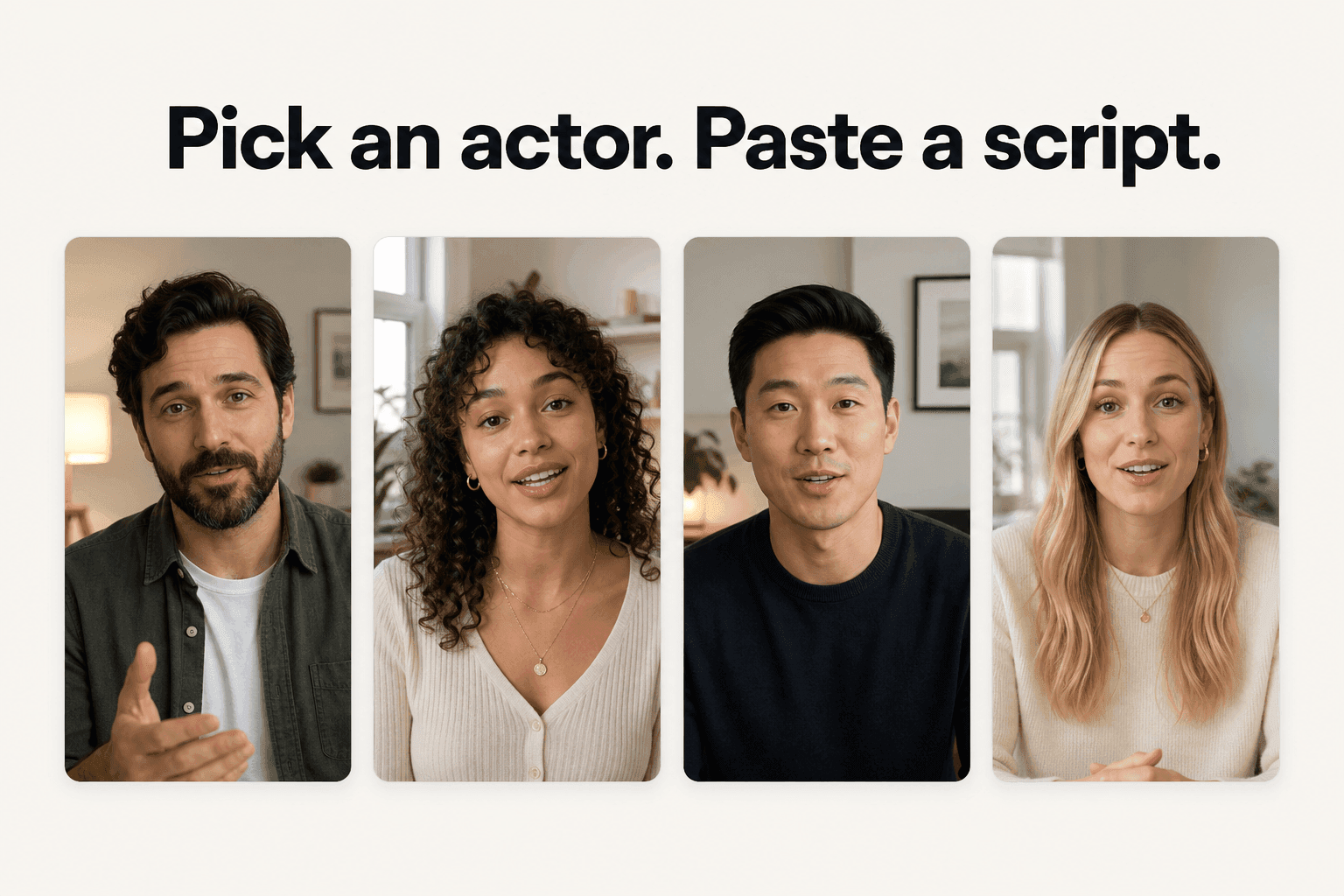
An honest guide has to draw this boundary: faceless is a tool, not a religion. Shoppers lean heavily on people when the purchase feels personal; 86% of shoppers engage with creator content before buying, and categories like skincare, supplements, apparel, and coaching sell on skin-in-the-game credibility that a product close-up cannot fake. If your buyer's first question is "did this work for someone like me?", the answer needs a someone, which is the territory of UGC creators and the trust mechanics behind them.
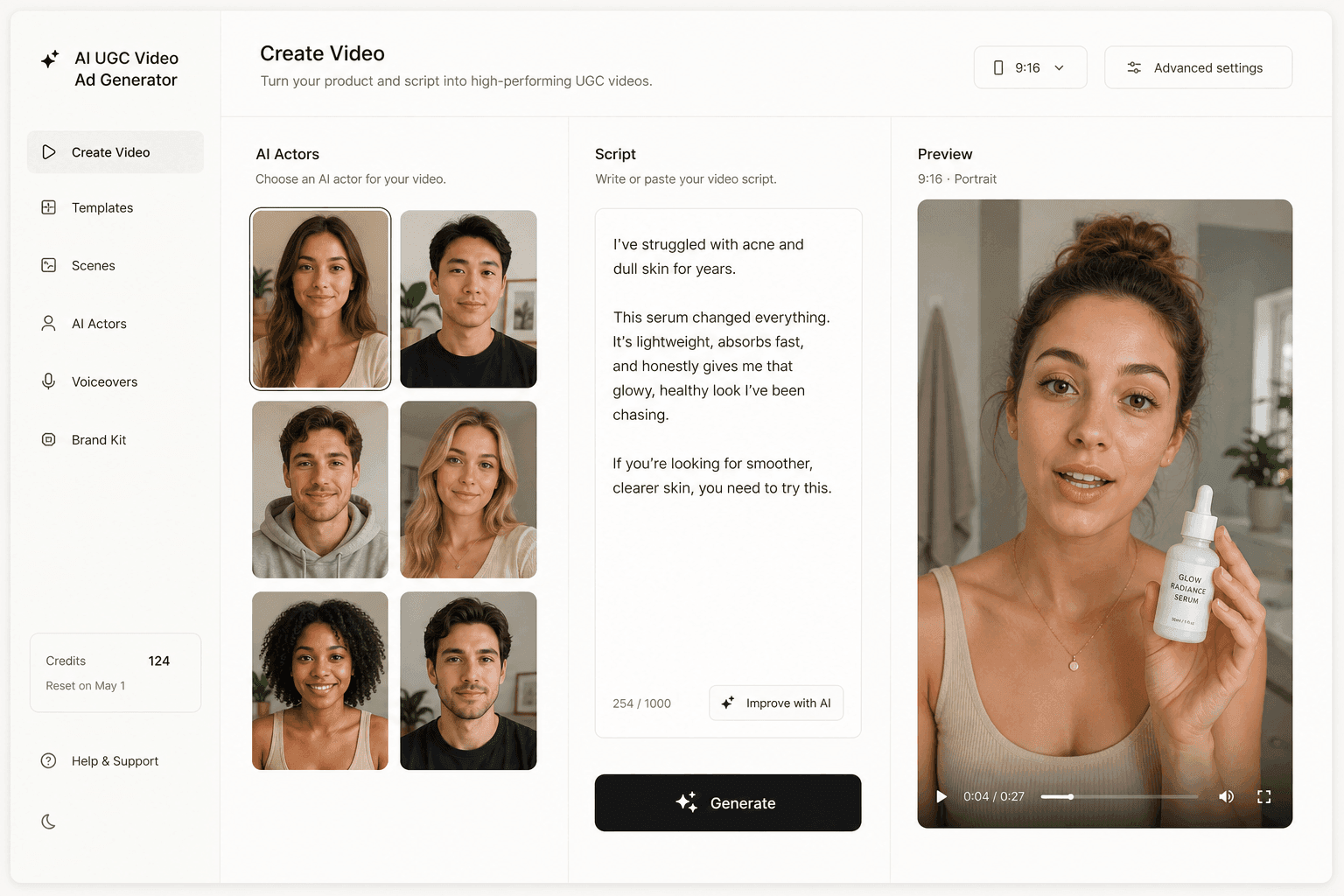
The modern move is that this is no longer a camera decision either. AI talking actors produce a presenter-led ad from the same script for 10 credits per minute of video, so the real workflow is to test both: run the faceless build and the talking-actor build against the same audience and let the numbers pick. How that synthetic-presenter side works is covered in our guide to UGC AI, and the broader no-camera toolkit in how to create video ads without a camera.
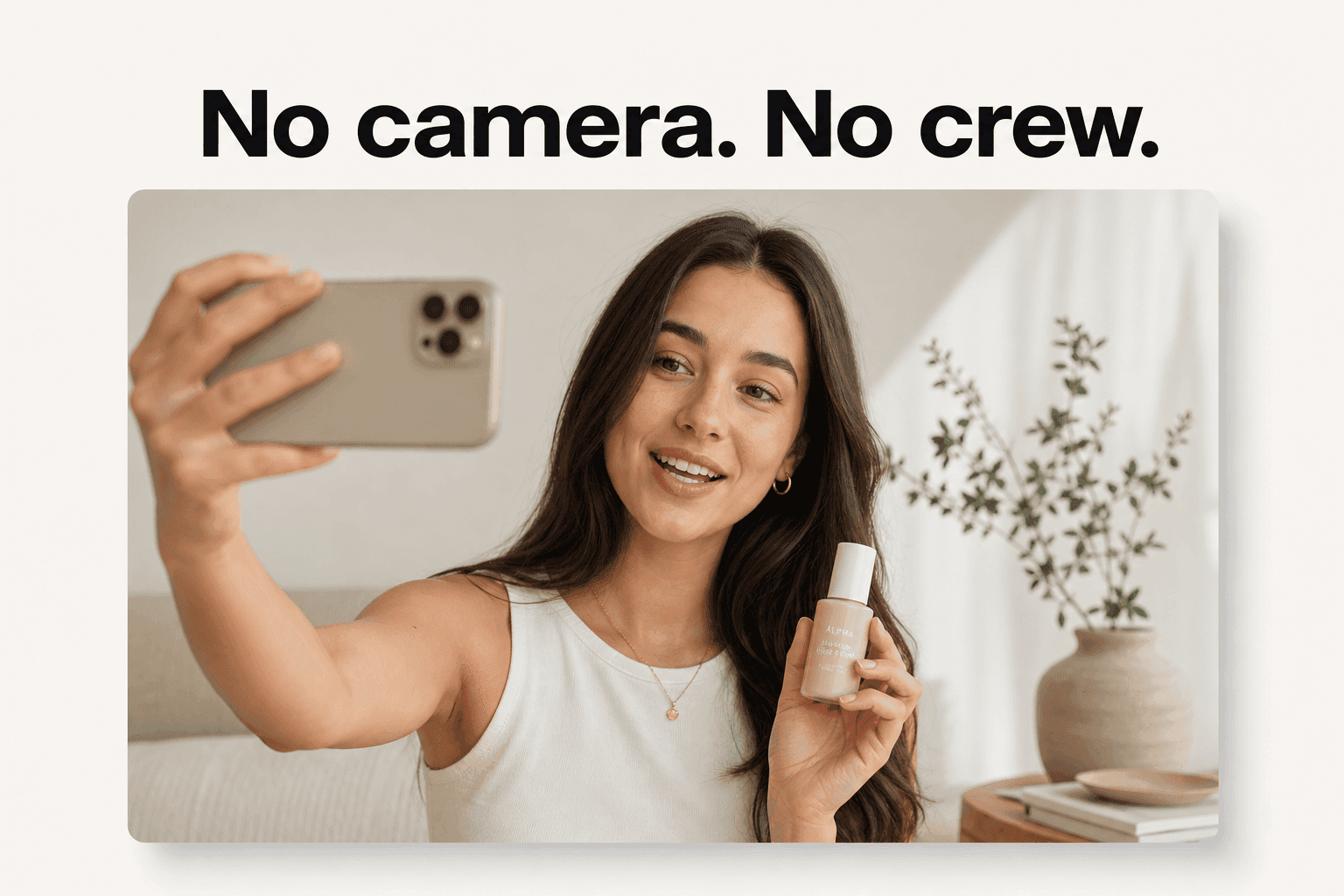
The camera was never the asset
The faceless format looks like a style choice from the outside. From the inside it is an economics choice: it decouples ad production from the two scarcest resources a small advertiser has, a willing face and a filming day. AI finished the job by decoupling it from footage itself. What is left is the part that was always the actual asset: a product worth showing and an argument worth hearing.
Novoads solves the production half of that sentence. Upload a product photo, write or auto-generate the script, and it produces the scenes, the voiceover, and the captions as one vertical ad in about four minutes, in more than 29 languages with real regional accents when your market needs them. The argument half is still yours, which is exactly how it should be. Start for $49/month: 50 credits every month, about 10 credits per complete faceless ad. Cancel anytime.
Frequently Asked Questions
What is a faceless video ad?
A faceless video ad is a paid video that never shows a presenter's face. Instead of a person talking to camera, the ad is built from product b-roll, screen recordings, or AI-generated scenes, and the persuasion is carried by a voiceover, on-screen captions, and the edit itself. The format dominates niches like apps, gadgets, home products, and services where the product can demonstrate itself.
Do faceless ads perform worse than ads with people?
Not as a rule. Performance follows the match between format and product. Products that demo well (apps, kitchen tools, cleaning products, software) often convert better faceless because every second goes to the product. Trust-heavy categories like skincare, supplements, and coaching usually benefit from a human face, since shoppers lean on creator content before buying. The honest answer is to test both against your own audience.
What is the easiest way to make a faceless video ad with AI?
Start from a single product photo. Upload it to an AI ad tool, generate an ad-styled product still, animate it into short scenes with an image-to-video model, add an AI voiceover reading your script, and layer captions. In Novoads that whole flow runs inside one project and takes minutes, not days, with no filming at any step.
How much does a faceless video ad cost to make with AI?
In Novoads the worked math is: one GPT Image 2 product still at 0.3 credits, three 5-second Seedance 2.0 scenes at 3 credits each, a 15-second AI voiceover at about 0.3 credits, and a Classic caption pass at 0.4 credits. That is about 10 credits for a finished three-scene ad, comfortably inside the 50 credits a month the $49/month Starter plan includes.
Do I have to label a faceless ad as AI-generated?
It depends on the content, not on the missing face. TikTok requires creators to label AI-generated content that contains realistic images, audio, and video. A faceless ad made of obvious motion graphics or screen recordings usually needs no label, but photoreal AI scenes and synthetic voices presented as real ones fall inside the labeling rules. When an AI scene could be mistaken for a real recording, label it.
Can faceless content still be monetized on YouTube?
Yes. YouTube's channel monetization policies were updated on July 15, 2025 to rename 'repetitious content' to 'inauthentic content', clarifying that repetitive or mass-produced content is ineligible. The target is low-effort sameness, not the absence of a face. Faceless channels and ads that add original scripting, editing, and a real point of view remain eligible.
Key Takeaways
- A faceless video ad is a paid video with no on-camera presenter: the product, the screen, or an AI-generated scene does the showing while a voiceover and captions do the telling.
- There are three reliable builds: product b-roll plus voiceover, screen recording plus captions, and fully AI-generated scenes. Match the build to what your product needs to prove.
- Platforms police effort, not faces. YouTube's monetization policy update in July 2025 renamed 'repetitious content' to 'inauthentic content', targeting mass-produced sameness rather than the faceless format itself.
- In Novoads, a complete three-scene faceless ad (product still, three 5-second AI clips, voiceover, and captions) adds up to about 10 credits, which is well inside what the $49/month Starter plan includes each month.
- Faceless wins when the product demos well; a face still wins in trust-heavy categories, and AI talking actors let you test both without ever booking a camera.