Do You Have to Label AI-Generated Ads? The Meta, Google, and TikTok Rules
Whether you must label an AI-generated ad depends on the platform and the ad. Here is what Meta, Google, and TikTok actually require in 2026, and how to ship compliant AI ads.

Mauricio Valdivia
·9 min

The label most AI ads don't actually need
You just finished your first AI ad. An AI actor reads your script, holds your product, and sounds like a real person in your buyer's language. Then the doubt arrives. Do you have to stamp an "AI-generated" label on it before you run it, and will the platform reject the ad if you forget?
Here is the answer most guides bury. For an ordinary commercial ad, the strict disclosure rules you are picturing mostly do not apply to you. Meta and Google reserve their hard self-disclosure requirements for political, election, and social-issue advertising. TikTok is the broad exception, and it is the one worth getting right. This guide walks each platform's 2026 rules, what actually triggers a label, and how to ship AI ads that comply without slowing your testing to a crawl.
What labeling AI content actually means
Before any platform rule makes sense, separate two things that share one confusing name.
Two different jobs wearing the same word
"Labeling AI content" describes two systems that work very differently:
- Self-disclosure: you, the advertiser, tell the platform (or your audience) that the ad uses AI. This is the part that carries obligations and can get an ad rejected.
- Platform detection: the platform decides on its own that content looks AI-made and attaches a label whether or not you said anything. This is metadata, not a rejection.
Most of the anxiety around AI ads comes from blurring the two. The rules that can get your ad rejected are almost always self-disclosure rules, and those are narrower than the headlines suggest.
Self-disclosure: the checkbox and the on-screen note
Self-disclosure is an action you take. On Google it is a checkbox in campaign settings. On TikTok it is a toggle when you publish, or a line of on-screen text. On Meta it is a prompt inside the ad-creation flow for the ad categories that require it. The obligation is yours, and skipping it where it is required is what carries a penalty.
Automatic detection: what platforms add without asking
Detection is something done to your content. Platforms increasingly scan media for signs of generative AI and apply their own label, often using provenance signals like the cross-industry Content Credentials standard. This matters for one practical reason: even when you are not required to disclose, a platform may still mark an ad as AI-assisted. That is not a rejection. It is metadata, and for a UGC-style ad it is usually harmless.
Meta: the disclosure rule is built for political ads
Meta's headline AI requirement lives inside its rules for ads about social issues, elections, and politics. If you are selling a product, read this section mostly to confirm it is not about you.
What you are required to disclose
Meta's own description of the rule is plain. As the company puts it, "advertisers have to disclose when they digitally create or alter a political or social issue ad" in certain cases. The trigger is narrow and deliberate: it is about realistic depictions inside political and social-issue messaging, the place where a synthetic video of a real person can do real damage. A skincare testimonial or a software demo is simply not in that category.
How Meta enforces it
For ads that do fall under the rule, Meta polices them hard. The same policy notes that "we reject an ad if it contains debunked content," and Meta wraps an entire review apparatus around political and social-issue advertising. So for political advertisers the cost of guessing wrong is real. For a commercial advertiser, the rule you would be skipping does not apply in the first place.
Detection and AI labels run in the background
Self-disclosure is only half of Meta's plan. Meta says "we began labeling ads that were created or significantly edited using our generative AI creative features," and it adds AI-info labels when it detects industry-standard signals of AI media. Read that as a detection layer: it runs in the background, it is not a rejection, and it does not turn every AI product ad into a flagged ad. It means provenance is becoming the default, which is an argument for making honest ads, not for avoiding AI.
Google: one checkbox, scoped to election ads
Google's synthetic-content rule is even more contained than Meta's. It is a single setting, and it lives entirely inside political advertising.
The "Altered or synthetic content" checkbox
Google's political content policy is direct: "Advertisers must disclose all election ads that contain synthetic or digitally altered content by selecting the checkbox in the 'Altered or synthetic content' section in their campaign settings." If you run election ads with AI-altered media, you tick a box and Google can generate the on-ad disclosure for you in many formats. If you do not run election ads, the entire requirement passes you by.
What counts, and what is too minor to matter
Google scopes the rule to media "that inauthentically depict real or realistic-looking people or events," and it explicitly carves out the routine editing every marketer does. The policy notes the exemption "includes editing techniques such as image resizing, cropping, color or brightening corrections, defect correction (for example, 'red eye' removal), or background edits that do not create realistic depictions of actual events." Color grading your product shot or cleaning a background is not synthetic content. Fabricating a realistic event that never happened is.
Why your product ad is almost certainly out of scope
Put the two pieces together. The rule applies to election ads, and only to media that inauthentically depicts real people or events. A UGC ad where an AI actor genuinely is not a real person, presenting a product that genuinely is your product, depicts nothing inauthentic about a real person or event. That is the gap most advertisers worry themselves into and then walk straight through. If you want the bigger picture on where AI sits in the ad stack, the overview of AI for advertising covers it.

TikTok: the platform that wants realistic AI labeled
TikTok is where the answer flips. Its rule is not scoped to politics, and it is the one most relevant to a UGC advertiser. The good news: complying is trivial.
A wider rule than Meta or Google
TikTok's policy states plainly that "we also require creators to label all AI-generated content that contains realistic images, audio, and video, as explained in our Community Guidelines." Note the scope. It is not limited to elections or social issues. It applies to realistic AI content of any kind, which squarely includes a synthetic AI presenter and a synthetic voice reading your script. If your UGC ad uses an AI actor on TikTok, this is you, and the right move is to label it.
How to disclose in a few taps
Labeling on TikTok is not a burden. When you publish, you turn on the AI-generated content setting, and TikTok adds the label for you. You can also state it yourself with on-screen text, a sticker, or a line in the caption. None of this hurts performance the way advertisers fear, because the whole format already reads as casual and self-aware. A clear AI tag on a genuinely useful ad is not a confession. It is context, and it travels well next to a strong hook. If you are still mapping the channel, the TikTok ads guide covers the campaign side.
Auto-labels and Content Credentials
TikTok also backstops disclosure with detection. The policy explains that "TikTok may automatically apply the 'AI-generated' label to content we identify as completely generated or significantly edited with AI. This may happen when a creator uses TikTok AI effects or uploads AI-generated content that has Content Credentials attached, a technology from the Coalition for Content Provenance and Authenticity (C2PA)." Content Credentials are a provenance signal baked into the file. The lesson is the same as Meta's detection plan: provenance is becoming ambient, so the durable strategy is to make ads you are happy to have labeled.
So do you actually have to label your AI ad?
Here is the part you came for, turned into a decision you can make in ten seconds. The three platforms line up like this:
| Platform | Must you self-disclose? | Applies to | Platform detection |
|---|---|---|---|
| Meta | Only political or social-issue ads | Realistic AI media in those ads | AI-info labels on detected AI |
| Only election ads | Synthetic or altered media | In-ad disclosure auto-generated | |
| TikTok | Yes, for realistic AI | All realistic AI content | Auto-label via Content Credentials |
A worked example: one ad, three platforms
Picture a skincare brand running a single AI UGC ad: an AI actor holds the serum, reads a 20-second script, and sounds like a real customer. On Meta, the ad is commercial, not political, so the self-disclosure rule does not apply, though Meta's detection may quietly note the AI media. On Google, it is not an election ad, so the synthetic-content checkbox is irrelevant. On TikTok, the actor and voice are realistic AI, so you flip the AI-generated toggle on publish. One ad, three platforms, and the only place you actively label is TikTok. That is the real shape of the rules in 2026.
When you do not need a special label
You generally do not owe a self-disclosure label when all of the following hold:
- The ad is commercial, not political, electoral, or about a social issue.
- It does not depict a real, identifiable person saying or doing something they did not.
- It does not stage a realistic version of an event that never happened.
- You are running it on Meta or Google rather than relying on TikTok's broader rule.
When you absolutely should
Reach for the label, every time, when any of these are true:
- You are publishing on TikTok with a realistic AI actor or voice.
- The ad touches an election, a candidate, or a social or political issue.
- You used a real person's likeness or voice, even a celebrity sound-alike.
- You depicted a realistic event, endorsement, or result that did not actually occur.
The honest test is simple. If a viewer could mistake your AI media for a real recording of a real person or event, label it. If they would just see a clearly commercial pitch with a presenter who is obviously a brand's spokesperson, you are on safe ground. When in doubt, the platforms reward over-disclosure, and you can create your ads with AI and still keep every one of them squarely on the right side of that line.
What "realistic" actually means
The word doing the heavy lifting in every one of these policies is "realistic," and advertisers read it more broadly than the platforms intend. An AI actor who is visibly a brand spokesperson, presenting a real product, is realistic in the sense that the video looks like a real video. It is not realistic in the dangerous sense the rules target, which is media that could be mistaken for documentary footage of a specific real person or a real event. That distinction is the whole game. A synthetic presenter saying "I tried this serum" is a commercial performance, the same job a hired UGC creator does on camera. A synthetic clip of a named celebrity or a public figure endorsing that serum is a deepfake, and it is exactly what disclosure rules, likeness laws, and platform bans exist to stop. Keep your AI ads on the first side of that line and the labeling question mostly answers itself: a light touch on TikTok, nothing unusual elsewhere.
What about boosting a post or running branded content?
Two adjacent cases trip people up, and both have a clean answer. The first is boosting an organic post. When you put paid spend behind a video you already posted, the AI question does not change: if the clip is realistic AI and you are on TikTok, it should already carry the AI-generated label from when you published it, and boosting it does not remove that obligation. Label it at upload and the paid version inherits the label.
The second is branded content and creator partnerships. If a real human creator posts your AI-assisted video as a paid partnership, two separate switches apply: the paid-partnership / branded-content toggle (because money changed hands) and, if the media is realistic AI, the AI-generated toggle. They are independent. A creator can owe the partnership disclosure on a fully human video, owe the AI label on a synthetic one, or owe both. The safe habit is to treat the two questions separately every time: was this paid? and is this realistic AI? Answer each on its own and you will not get caught out by a case that needs one label, the other, or both.
How Novoads helps you ship platform-ready AI ads
Most disclosure headaches come from ambiguous, deceptive creative. The fix is upstream: make ads that are honest by construction, in a format every platform already accepts.
A standard file you control, for any platform
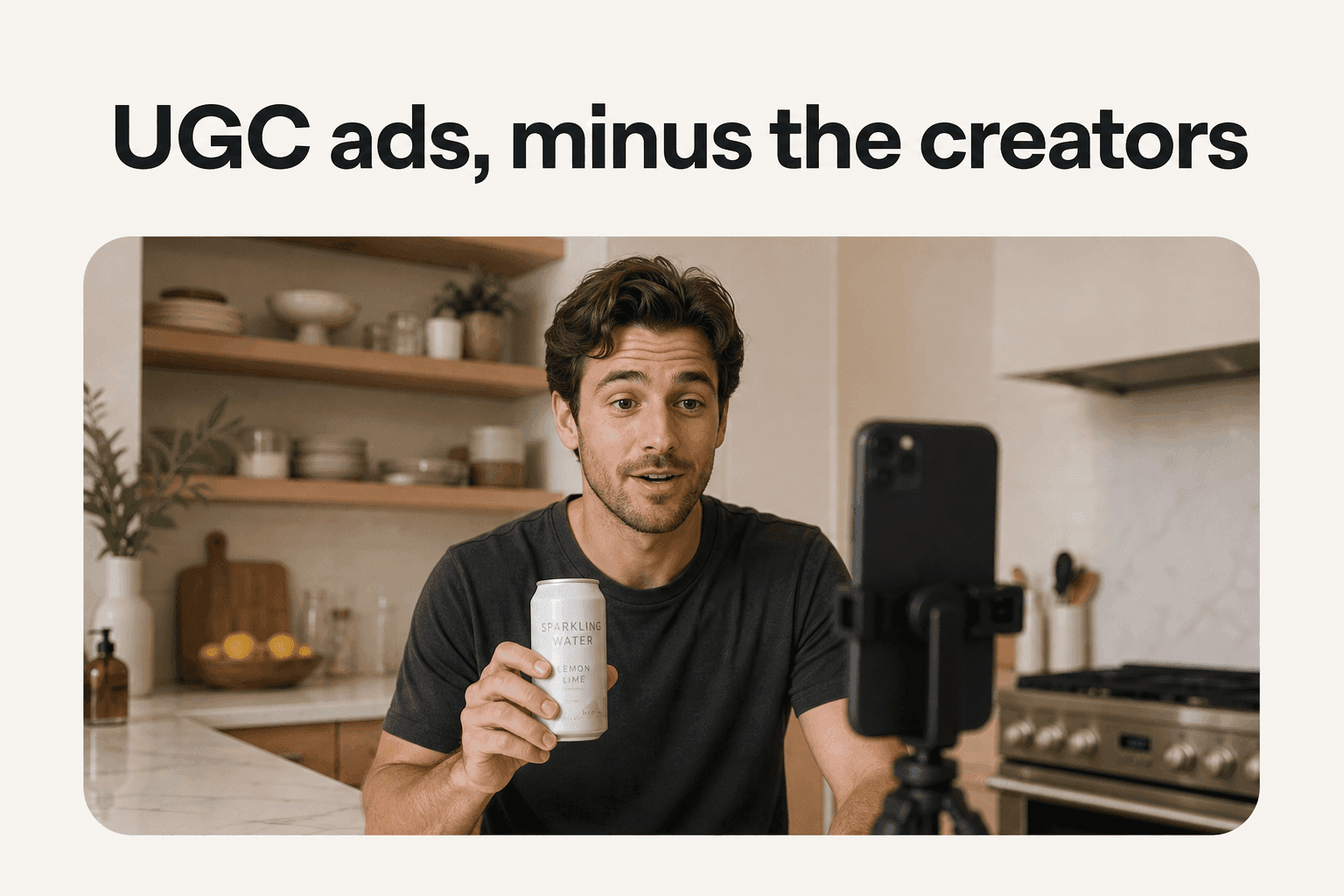
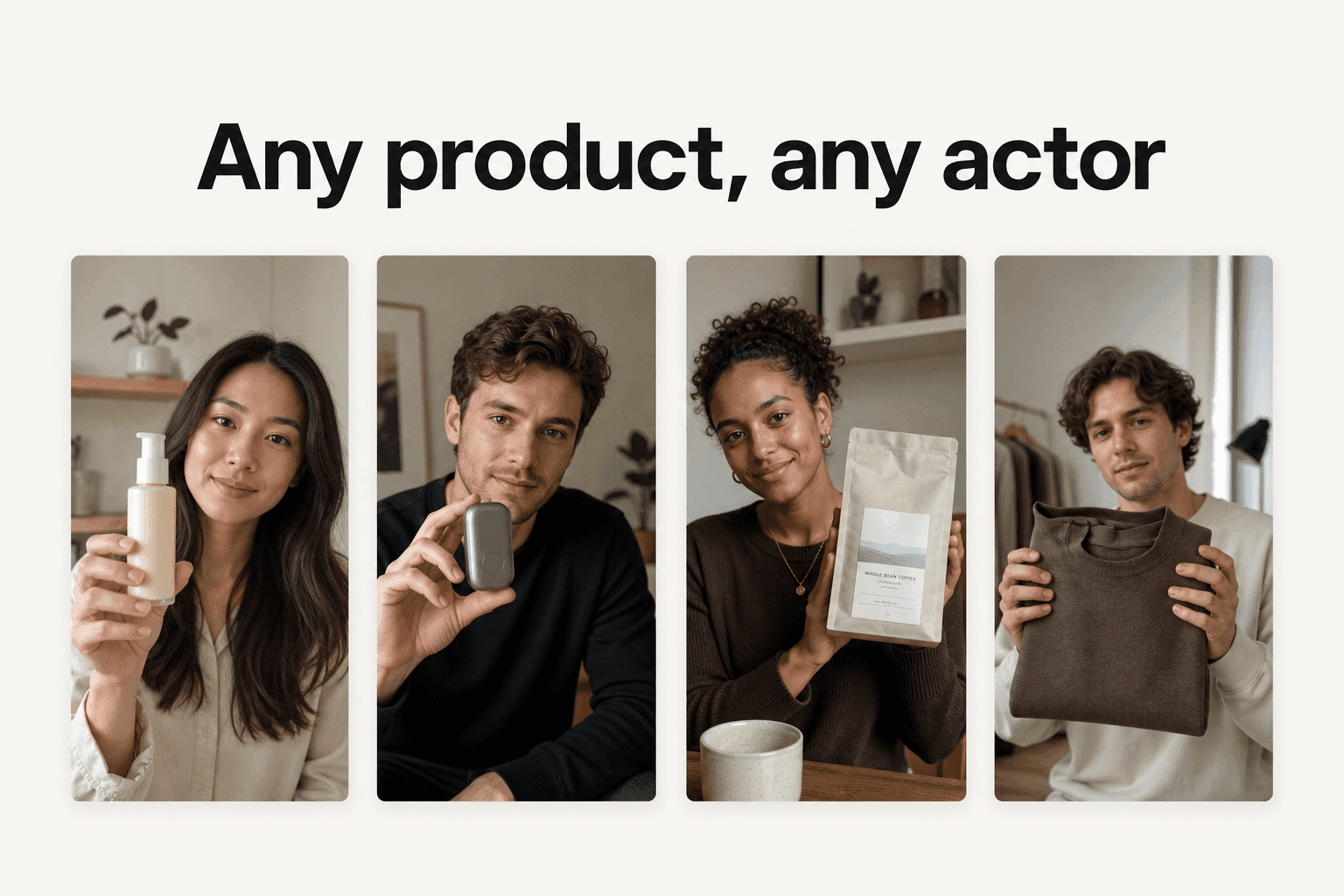
Novoads is a global AI UGC video-ad generator. You pick an AI actor, write or auto-generate a script, and get a vertical or horizontal video as a normal downloadable file (9:16, 1:1, or 16:9, in HD) that you upload to Meta, Google, or TikTok like any other creative. Because you control the script and the actor is plainly a brand spokesperson rather than a real named person, the output lands in the commercial, non-deceptive zone the disclosure rules are built around. When TikTok wants the AI-generated toggle, you flip it; nothing about the file fights you. If you are weighing tools, the roundup of the best AI video ad platforms puts the options side by side.
Honest by design, fast enough to test
The reason any of this matters is volume. The point of AI UGC is to test many angles cheaply, the same logic behind learning to create ads with AI in the first place. A workflow that produces clean, clearly commercial creative means compliance is a non-event rather than a per-ad review. You spend your attention on hooks and offers, not on whether the platform will flag you.
Disclosure is a trust signal, not a warning label
The advertisers who lose sleep over AI labels are usually picturing the wrong rulebook. The hard mandates are for political speech. For commercial UGC, the obligation is small, mostly limited to a TikTok toggle, and pointed at the same thing good marketing already wants: ads that do not pretend to be something they are not. Treat the label as a trust signal rather than a warning sticker, and AI stops being a compliance risk and goes back to being what it is, the cheapest way to test a lot of honest creative. Start your first batch from $49/month, and cancel anytime.
Frequently Asked Questions
Do you have to label AI-generated ads on Facebook and Instagram?
Only in specific cases. Meta requires advertisers to disclose when they digitally create or alter a political or social-issue ad. For ordinary commercial ads, there is no self-disclosure requirement, though Meta also adds 'AI info' labels to ads it detects were created or significantly edited with AI.
Does Google require you to disclose AI in ads?
For election ads, yes. Google requires advertisers to disclose election ads that contain synthetic or digitally altered content by selecting the 'Altered or synthetic content' checkbox in campaign settings. Minor edits such as cropping, resizing, or color correction are out of scope, and non-election commercial ads are not covered by this rule.
Does TikTok require labeling AI-generated ads?
TikTok asks creators to label all AI-generated content that contains realistic images, audio, and video, which includes synthetic presenters and voices. You can label it with the in-app AI-generated content toggle, and TikTok also auto-applies an AI-generated label using C2PA Content Credentials.
What happens if you do not follow Meta's AI rules in a political ad?
Meta polices political and social-issue ads tightly. Advertisers have to disclose when they digitally create or alter a political or social-issue ad, and Meta rejects ads that break its rules, for example ads containing debunked content. The safest path for political advertisers is to disclose AI-created or AI-altered media every time.
Do I need to label a normal AI UGC product ad?
On Meta and Google, a standard commercial product ad is generally not subject to the political and election disclosure rules, so no special label is required from you. On TikTok, a UGC ad with a realistic AI actor or voice should be labeled, which takes a few taps. In all cases, keep the ad clearly commercial and avoid depicting real people doing things they never did.
Will platforms detect AI ads automatically?
Increasingly, yes. Meta adds 'AI info' labels to ads it detects were created or significantly edited with AI, and TikTok auto-applies an AI-generated label to content it identifies as AI-made or significantly AI-edited, including content that carries C2PA Content Credentials. Self-disclosure and platform detection are separate systems that increasingly run side by side.
Key Takeaways
- The mandatory self-disclosure rules on Meta and Google apply to political, election, and social-issue ads, not to ordinary commercial ads.
- Meta requires advertisers to disclose when they digitally create or alter a political or social-issue ad, and it labels ads it detects were created or significantly edited with AI.
- Google requires a single 'Altered or synthetic content' checkbox for election ads with synthetic or digitally altered media, and exempts minor edits like cropping or color correction.
- TikTok is the broadest: it asks creators to label all AI-generated content that contains realistic images, audio, and video, and auto-labels using C2PA Content Credentials.
- A normal AI UGC product ad usually needs no special label on Meta or Google, but you should label it on TikTok and keep the ad honest and clearly commercial.