
Google Expands Ask Advisor Across Ads and Analytics: What Actually Ships Today
On August 10, 2026 Google wrapped four AI reporting capabilities around Ask Advisor, the agent it launched back in May. Here is the ship status of each one, and why none of it produces the ad you still have to run.

Mauricio Valdivia
·11 min

Google is automating the reporting, not the ad
Monday morning, before the first coffee, someone opens Google Analytics and finds a short paragraph already waiting at the top of the homepage telling them what moved since Friday. No date-range fiddling. No pivot table. The read is just done.
That is the small, concrete change in Google's August 10, 2026 post by Josh Moser, Senior Director of Product Management. Google announced four reporting capabilities wrapped around Ask Advisor: AI Overviews at the top of the Google Analytics homepage, a revamped set of AI-powered insight cards on the Google Ads homepage, Dashboards you build by typing a prompt, and a benchmark that compares your campaigns against anonymized averages from similar businesses. Ask Advisor itself is not the news. Google shipped that in May, and the post says so in the past tense.
What follows is what each piece actually is, where each one really ships, and the part no announcement will spell out for you: all four of them read numbers. Not one of them makes an ad.
What Google actually published on August 10
The post is short, and it does something most product announcements do not: it dates itself honestly if you read the verbs.
The four capabilities, in Google's own words
Google Analytics gets "new AI Overviews at the top of the homepage that give you an instant summary of important updates since you last logged in." Clicking a card carries that context into Ask Advisor. On the ads side, Google writes that "We've also revamped the Google Ads homepage to surface timely AI-powered insights cards personalized to your business," with a prompt box above the cards for custom questions.
Reporting gets the biggest change. "With the new Dashboards in Google Ads (coming soon in Google Analytics), you can transform raw data into clear visualizations with simple text prompts," and each report generates a running summary of the why behind the numbers. Then the newest item: "a new benchmarking feature that compares your campaign performance against anonymized averages from similar businesses."
| Capability | Where it lives | Status in Google's words |
|---|---|---|
| AI Overviews | Google Analytics homepage | Present tense, "now" |
| Insight cards | Google Ads homepage | "Revamped", an existing surface |
| Dashboards | Google Ads | Live, "coming soon" in Analytics |
| Benchmarking | Ask Advisor in Analytics | Announced, no date given |
The verb that dates the whole announcement
One sentence sets the frame: "That's why we introduced Ask Advisor," followed by "Today, we're announcing new agentic capabilities." Introduced, past tense, for the agent. Announcing, present tense, for the surfaces around it. The post never claims to be launching Ask Advisor, and the footnote that carries its beta status is lifted straight from May.
That distinction matters more than it sounds, because it is the first thing a summary drops. Strip the tense out of those two sentences and an expansion reads as a launch. If your read of the day was that Google put AI agents into Ads and Analytics on August 10, the calendar disagrees.
Ask Advisor is 82 days old, and the beta came with it
The agent has a launch date, a launch post, and a set of limits that have not moved since.
What Google published in May
On May 20, 2026, Google published "Meet Ask Advisor, your new AI-powered collaborator," introducing it as "our new cross-product AI agent that unites your marketing tools into one expert experience." That post already carried the sentence people are quoting today: Ask Advisor is currently available in beta for English language accounts.
So the beta label is not fresh news attached to a fresh product. It is the same status, restated on the same terms, eighty-two days later.
What "beta for English language accounts" actually gates
The August footnote reads "Currently available in beta for English language accounts," and the marker sits on three items in the post: Ask Advisor, the revamped Ads insight cards, and Dashboards. Google's Analytics help page is blunter still. It is titled "Ask Advisor in Google Analytics (Beta)" and states that "Ask Advisor is currently available in properties with English as the selected language, with plans to expand support to other languages."
If you run accounts in Spanish, Portuguese, French or German, this is a preview of your roadmap and not a change to your Monday. Worth filing next to the target-based bidding change landing on August 17, which is not optional and does not wait for a language rollout.
Why an expansion post reads like a launch post
Announcement posts recap. They restate the product, then add the delta, and a reader skimming for the delta absorbs the recap as news. The tell is always the verb. Introduced, revamped and coming soon are the three words in this post that carry the real timeline, and all three are easy to read past.
Read the ship status per surface, not per press release
The single most useful thing you can do with this announcement is refuse to treat it as one bundle.
Dashboards: live in Google Ads, coming soon in Analytics
Google's parenthetical is doing heavy lifting: "in Google Ads (coming soon in Google Analytics)". One product, one place, today. It is also the easiest phrase in the whole post to skim past, and skimming past it is exactly how a reporting plan ends up assuming you can type a prompt into Analytics this week and get a chart back. If that plan is yours, rebuild it.
Benchmarking: announced with no date attached
This is the genuinely new item, and it is the one you can act on least. Google introduces the feature, describes the comparison against anonymized averages from similar businesses, and stops. No availability window, no eligibility criteria, no note about which verticals get peer groups first. Search Engine Journal, reading the same post the same day, landed on the same silence and wrote that Google did not say when the benchmark reaches accounts.
Treat it as a signal about where Ask Advisor is heading, not as a capability to build a Q4 reporting process on.
AI Overviews and the revamped insight cards
These two are the quiet ones. AI Overviews summarize what changed since your last login and can push to phone or email at a cadence you choose. The Ads insight cards are explicitly a revamp of a homepage surface that already existed, with a prompt box added above them. Google's Analytics help center describes the overview as "a concise, AI-generated overview of the most critical changes to your data since your last visit."
Google's verb for these is present tense. Whether they are in your property this morning is still a question only your property answers, which makes logging in and looking the whole of the task.
Useful, genuinely. Also the kind of feature that stops being a differentiator the moment every account in your category has it.
What that means for this week
Four capabilities, four different answers to "can I use this now":
- Log in and look. AI Overviews and the revamped Ads insight cards are the two Google writes about in the present tense. Check whether they are in your account.
- Build reports in Ads only. Prompt-built Dashboards exist in Google Ads. Do not design an Analytics reporting workflow around them yet.
- Park the benchmark. No date means no plan. Note it and move on.
- Check your account language first. If the property is not set to English, none of this is a Monday change for you.
Four announcements, one job description
Line the capabilities up and something obvious appears. They do the same job.
Everything here operates on data you already have
A homepage summary reads your data. Insight cards read your data. A dashboard built from a prompt visualizes your data. A benchmark compares your data to other people's. Not one of these capabilities creates anything. They are all, precisely, faster ways to find out what happened, which is the half of the job that creative analytics has been chipping away at for years and that Google has now taken most of the way to done.
The agent's field of view is one property
There is a limit here that the announcement does not mention and the help center does. Google states that "Ask Advisor processes data solely at the property level, which means the information used to generate responses is from within that specific Google Analytics property only." So it is an extremely fast reader of one property. It is not a view across your business, your other channels, or the creative that actually produced the numbers it is describing.
That gap is where most bad conclusions live. Roughly:
- It can answer: what changed, when it changed, how this campaign compares to the last one, which segment moved.
- It cannot answer: why the creative stopped working, which hook carried the winning variant, what to film next.
A dashboard can tell you click-through fell in week three. It cannot tell you the hook went stale, which is the question that reading a CTR movement correctly actually depends on, and the one nobody has automated because the answer is not in the numbers. It is in the footage.

Google does generate creative, just not in this post
To be precise rather than convenient: Google Ads absolutely ships generative creative tools. Its own help center states that "Google Ads offers generative AI tools to help you create new image assets in seconds," alongside a set of rules for labeling AI-edited or AI-created assets. None of that is what changed on August 10. This announcement is measurement, end to end, and the creative side of your account is exactly where you left it.
What happens when the measurement half gets commoditised
Here is the unhedged version. Analysis is becoming a commodity, and commodities do not win auctions.
A read everyone can get is not an edge
For most of the last decade, the marketer who could interrogate the data faster had a real advantage. That advantage came from skill, and skill is scarce. An AI Overview at the top of a homepage is not scarce. When your competitor's homepage summarizes their weekend as competently as yours summarizes your own, and the benchmark hands you both the same peer median, the read stops separating you.
Google is explicit about the ambition. The post closes with "Built with Gemini, these new solutions will help marketers move from insight to action even faster." Faster insight is the promise. Notice that the action is still yours.
The bottleneck moves to how many ads you can put in front of it
Once everyone can see the gap, the question becomes who can close it. Closing a creative gap means shipping creative: more hooks, more angles, more variants tested against a real audience. That is a production problem, not an analysis problem, and no dashboard has ever solved a production problem. It is the same conclusion that creative operations teams reached before any of this shipped, arrived at from the opposite direction.
Production has its own clock, and it is slower than the dashboards suggest: measured across 1,045 production renders, the median wait for a finished video ran from two minutes to seven depending on the model. The same squeeze is showing up on the newest ad surfaces too, where running ChatGPT ads means living with a keywordless auction in which the creative is close to the only dial you control.
A worked example: what a benchmark actually asks of you
Imagine the benchmark lands and tells you your video ads sit below the category median on click-through. Good. Now what? The instruction implicit in that sentence is: make better ads, and make enough of them to find out which one is better. If your working assumption is that finding one winner takes roughly ten tries, the benchmark just handed you a ten-video invoice.
On the $79 Pro plan you get 100 credits a month, which puts a credit at $0.79. A five-second clip on Seedance 2.0 Mini costs 1.5 credits, about $1.19. Ten of those, ten different hooks against the same product, is 15 credits, about $11.85 of rendering. A full one-minute talking-actor ad costs 10 credits, about $7.90. Those are the numbers that decide whether a benchmark is useful information or just a well-formatted complaint.
The three things a benchmark will not tell you
A peer median is a scoreboard, and scoreboards are famously quiet about method. What a comparison against anonymized averages leaves out:
- Which creative earned the number. The peer group's median click-through came from ads you will never see, in formats the benchmark does not name.
- How far behind is worth chasing. Below median is a fact. Whether closing it pays for the production it requires is a margin question the dashboard has no inputs for.
- What to change first. Hook, offer, format, actor, length. The benchmark ranks you. It does not diagnose you.
None of this makes benchmarking useless. It makes it a starting gun rather than an instruction, and what happens after the gun is production.
How Novoads solves the creative-volume half
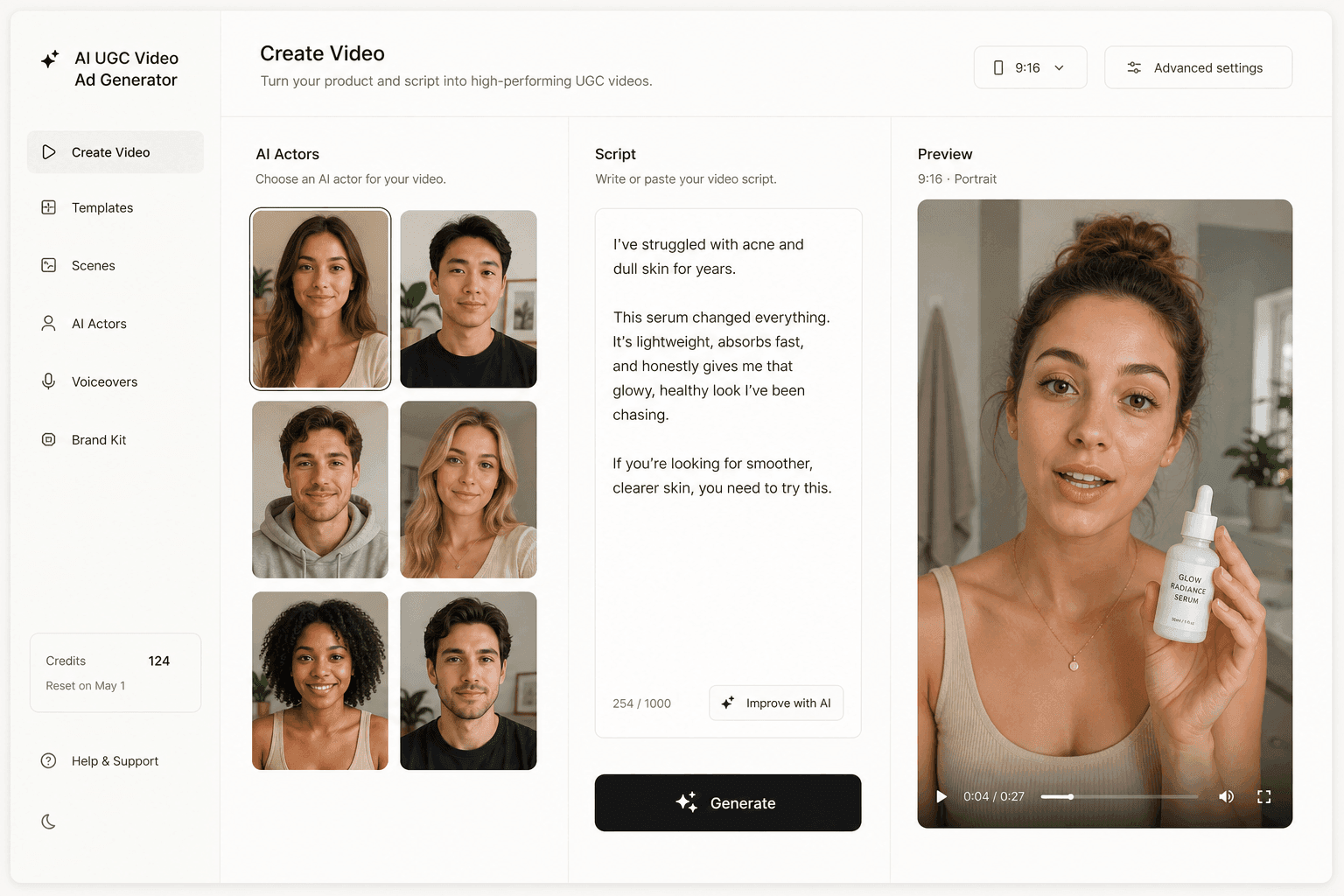
Google closed the gap between you and your data. The gap between you and ten shootable variants is still open, and that is the one Novoads is built for.
From a product photo to a running ad
The input is a product image and a script, and the loop is short enough to run inside one afternoon:
- Upload the product photo. No plugin, no store connection, no product URL.
- Write the script, or have it drafted, then rewrite the first three seconds yourself.
- Pick an AI actor and render. Output is vertical or horizontal, ready to upload to Google Ads, Meta or TikTok.
- Change one variable and render again. Same product, different hook.
In Novoads that runs on the same frontier engines everyone rents, including Google Veo 3.1, Seedance and Kling, so the render quality is a tie and the argument moves to what it costs to get an ad you can actually run. You know step four worked when the variants disagree with each other in the results, which is the whole point of an ad creative testing loop: ten hooks in an afternoon, not one hero video in a fortnight.

What one more variant costs
The reason volume works here is that the marginal ad is cheap enough to be disposable. A product image turned into an ad still costs 0.3 credits. A five-second clip costs between 1.5 and 3 credits depending on the engine. Nothing about that math changes when a benchmark tells you to do better, which is the entire reason it holds up as a plan. If you want the fuller cost picture against commissioned creators, what UGC creators charge is the honest comparison.
Start for $49/month. Cancel anytime.
Creative is the half Google left you
Read the August 10 post as what it is: a measurement release, dated honestly by its own verbs, with one genuinely new item that has no ship date and one flagship item that only exists in one of the two products named in the headline. It is a good release. It will make your Mondays shorter.
It will also make every competitor's Mondays shorter, at the same time, with the same summaries and the same peer medians. When the analysis is handed to everyone for nothing, the only thing left to compete on is what the analysis is pointed at. Google is automating the half of advertising that describes the work. The half that does the work is still yours to produce, and now it is the only half that separates you.
Frequently Asked Questions
Is Ask Advisor new as of August 10, 2026?
No. Google announced Ask Advisor on May 20, 2026, in a post titled "Meet Ask Advisor, your new AI-powered collaborator," describing it as a new cross-product AI agent that unites your marketing tools into one expert experience. The August 10 post refers to it in the past tense, saying "That's why we introduced Ask Advisor," and then announces new agentic capabilities built around it. If a summary told you Google just launched AI agents in Ads and Analytics, that summary is eighty-two days behind.
Is Ask Advisor available in my language?
Only if your account or property language is English, as of this date. The footnote on Google's August 10 post reads "Currently available in beta for English language accounts." Google's own Analytics help page is titled "Ask Advisor in Google Analytics (Beta)" and states that Ask Advisor is currently available in properties with English as the selected language, with plans to expand support to other languages.
Can I build a dashboard from a text prompt in Google Analytics?
Not yet. Google's wording is precise and worth reading twice: the new Dashboards are in Google Ads, with Analytics marked coming soon, and inside that product you can transform raw data into clear visualizations with simple text prompts. A headline that names both products is describing the announcement, not the availability.
When does the peer benchmarking feature reach my account?
Google does not say. The post introduces a new benchmarking feature that compares your campaign performance against anonymized averages from similar businesses, and attaches no date, no rollout window and no eligibility detail. Search Engine Journal, reading the same post the same day, reached the same conclusion and wrote that Google did not say when the benchmark reaches accounts.
What data can Ask Advisor actually see?
Less than people assume. Google's Analytics help page states that Ask Advisor processes data solely at the property level, which means the information used to generate responses is from within that specific Google Analytics property only. It is a very fast reader of one property, not an oracle with a view across your whole business.
Does any of this generate ad creative for me?
Not in this announcement. The four capabilities all operate on performance data you already have: a homepage summary, personalized insight cards, prompt-built visual reports and a peer comparison. Google does ship creative generation elsewhere in Ads, and its help center says Google Ads offers generative AI tools to help you create new image assets in seconds. That is a different product surface, and it is not what changed on August 10.
Key Takeaways
- Ask Advisor is not new. Google launched it on May 20, 2026 and the August 10 post uses the past tense about it: "That's why we introduced Ask Advisor." The August news is the reporting surfaces Google wrapped around it.
- Ship status differs per surface. Dashboards built from a text prompt are described as live in Google Ads and explicitly coming soon in Google Analytics, so treat them as one product in one place, not two.
- The peer benchmarking feature is announced without a rollout date. Google's post introduces it and names no availability window, so it is a roadmap item you can plan around but not a switch you can flip.
- The beta label is still attached. Google's footnote reads "Currently available in beta for English language accounts," and the marker sits on Ask Advisor, the revamped Ads insight cards and Dashboards.
- Every capability in the announcement reads data you already have. None of it writes a script or renders a clip, so the measurement half of the job is getting cheaper while the creative half stays exactly as expensive as it was.