
Higgsfield MCP Explained: How It Connects, and Why Unlimited Stops at the Browser
Higgsfield reaches AI agents through a hosted MCP server and a CLI, with no API key anywhere in the setup. The rule that catches people out is the billing one: every generation an agent makes deducts credits, even on a plan with unlimited web access.

Mauricio Valdivia
·11 min

Same account, same models, a different meter
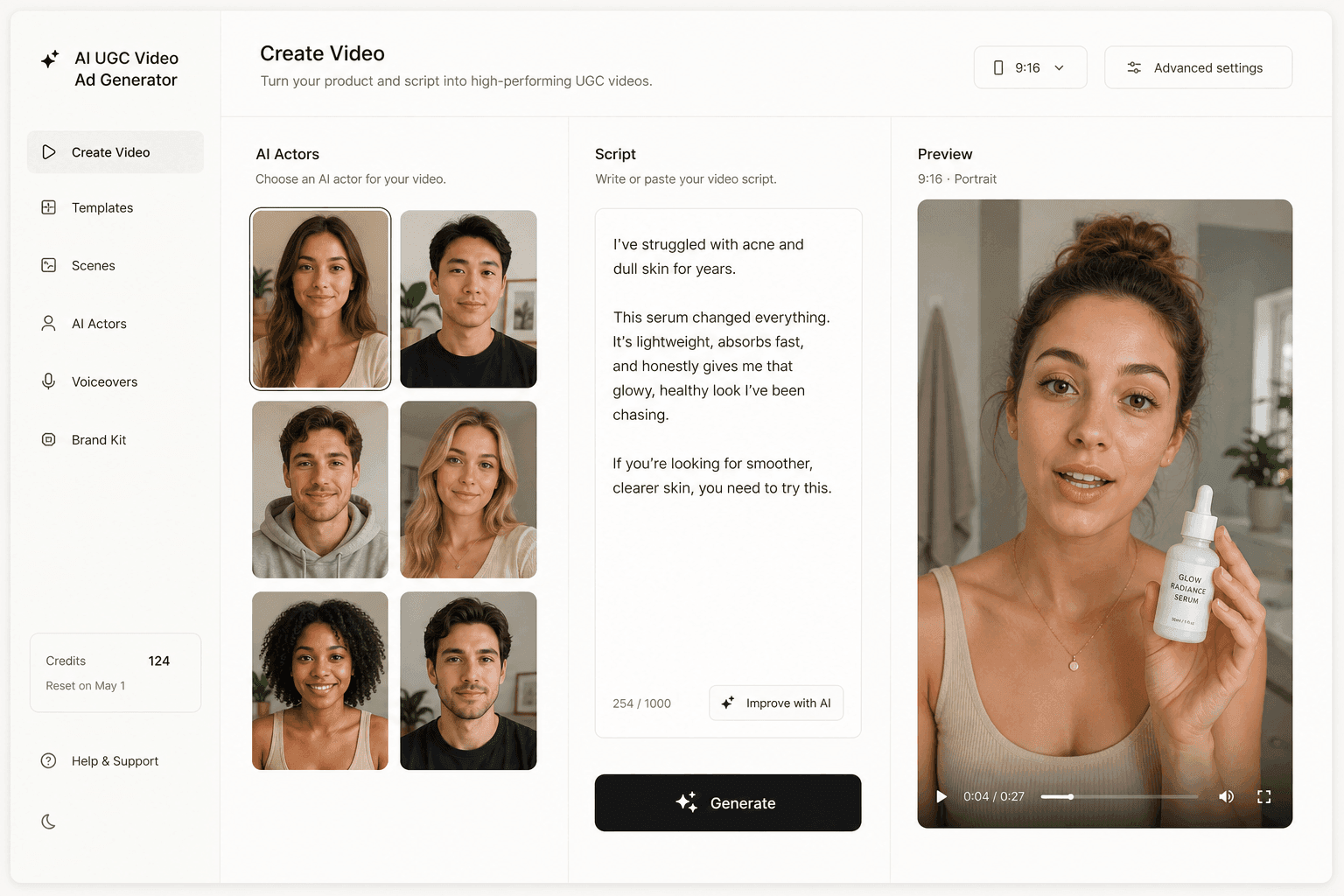
The request took eleven words. Fifteen seconds of vertical UGC, one product, a creator talking to camera. The agent expanded it into a production prompt, picked a model, ran the job, and dropped the finished clip back into the conversation. Then the balance moved. Higgsfield's own walkthrough puts the number on that exact run: 270 credits.
The account behind it may well have had unlimited model access on the web. It did not matter. Higgsfield MCP is the connector that lets an AI agent reach Higgsfield's models without opening the web app, and the help center is unusually direct about what changes when you use it: "Unlimited access and free generations apply only on higgsfield.ai", so "anything generated through MCP, CLI, Canvas, Supercomputer, or other automated tools deducts credits at standard rates."
That is the whole story, and most write-ups miss it because they stop at the setup steps. Connecting takes about a minute and never asks for an API key. What it actually does is move your generations from an unmetered surface to a metered one. Below: what the connector is, the two different doors Higgsfield ships and why they are not the same thing, what the metering costs in practice, and how to stop an agent from spending a month of credits in an afternoon.
What Higgsfield MCP actually is
A connector, not a separate product
MCP is the Model Context Protocol, described by Higgsfield's own help center as "an open protocol that lets AI agents connect to external services and call their tools." Higgsfield's implementation is a hosted server you point an agent at. The help center is explicit that it is not a new SKU: "It isn't a separate product or API: it connects to your existing account and uses your existing plan credits, with no API key required."
The address is published in plain text: "MCP server URL: https://mcp.higgsfield.ai/mcp". Where you put it depends on the client:
- In Claude, into a custom connector under settings
- In Cursor, you add Higgsfield from the marketplace rather than pasting a URL
- In anything else that speaks the protocol, wherever that client keeps server URLs
What the agent can call
Higgsfield summarises the surface as "Image and video generation, Soul character use, Higgsfield audio, and credit balance checks." The connection guide expands that into a longer table of what is available through MCP:
- Image and video generation, across all models
- Image and video upscaling
- Background removal, on images and on video
- Expand image (outpaint) and expand video (reframe)
- Kling 3.0 motion control
- Soul characters and reference elements
- Audio: voiceover, voice cloning, voice change, video dubbing
- Personal clipper, which turns YouTube videos into short clips
- Credit balance checks, plus listing your generations and uploads
The CLI page puts a number on the catalog, saying Higgsfield "gives your agent access to 30+ models." A connector that can spend is a different animal from one that can only look, which is the line we drew when Google shipped a read-only Ads MCP server. Vendors are also starting to expose realtime surfaces an agent can hold open, such as fal's H3 Max Director sessions.
One behavior worth knowing before your first prompt: "The agent selects a model automatically if you don't name one." That is convenient and it is also the most expensive default in the system, because model choice is what moves the credit cost.
Where the output lands
Nothing disappears into the chat. "All generations from connected agents land in your assets at higgsfield.ai", tagged with the MCP source so you can filter for them, and the guide says "results typically appear within 60 seconds of the job completing." Generation is asynchronous: the CLI page notes that "All generation runs asynchronously, so your agent polls for results and delivers them as soon as they're ready", which is the right design for video and the reason a render can outlive the message that started it. If you want the wider picture on how long these jobs really take, we timed renders across the main models.
Two doors, and only one of them is MCP
This is where almost every secondary write-up gets it wrong, and where Higgsfield's own MCP page invites the mistake by carrying two different FAQ sets on one screen, one scoped to the protocol and one scoped to the ChatGPT plugin. Both answer the API key question with no. They are not describing the same mechanism.
The MCP server, for Claude, Cursor and anything else that speaks the protocol
The first door is the hosted server. Higgsfield's connection guide gives Claude, on the web and in the desktop app, a "custom connector with the MCP server URL", and its CLI page states that "Higgsfield MCP works with Claude (web, Cowork, and Claude Code), OpenClaw, Hermes Agent, and NemoClaw." Any MCP-compatible client can use the same address.
The CLI, for terminal agents
The second door is a command line tool. In "Claude Code, OpenClaw, and Hermes, the agent installs the Higgsfield CLI", which is a nice piece of design: you paste a short instruction into the agent and it does the install itself, starting with "install the CLI: run npm i -g @higgsfield/cli". Higgsfield's MCP page steers terminal users this way outright: "If you are using Claude Code or Codex, it's better to use the CLI."
The ChatGPT plugin, which Higgsfield says is not MCP
The third path is not MCP at all, and Higgsfield says so twice in its own documentation. The connection guide instructs ChatGPT users to add the plugin from the plugins directory, and the protocol article states flatly: "In ChatGPT, use the official Higgsfield Plugin instead." Its ChatGPT walkthrough closes the loop from the other direction, noting that "in Claude, Higgsfield connects as an MCP connector, not a plugin."
The distinction is not pedantry, because the feature surface differs. Higgsfield notes that "Audio generation and the Website Building skill aren't available in ChatGPT", which matters if your ad workflow ends in a voiceover.
| Agent | How it connects |
|---|---|
| Claude, Claude Desktop | Custom connector, MCP server URL |
| Cursor | Marketplace entry, then sign in |
| Claude Code, OpenClaw, Hermes | Higgsfield CLI, installed by the agent |
| ChatGPT | Official plugin, not MCP |
| Any other MCP client | Server URL in the client's settings |
Use the MCP server when:
- Your agent is claude.ai, Claude Desktop or Cursor
- You want one address that any future MCP client can also point at
- You need audio, which the ChatGPT door does not carry
Use the CLI when:
- Your agent lives in a terminal: Claude Code, Codex, OpenClaw or Hermes
- You would rather the agent install and authenticate the tooling itself
The credit rule that changes the economics
Unlimited stops at higgsfield.ai
Here is the sentence to read twice, from Higgsfield's own help center: "Unlimited access and free generations apply only on higgsfield.ai", because they are meant for manual use rather than automated or programmatic generation. The consequence is stated in the same article: "everything generated through MCP deducts credits, regardless of your plan." The connection guide repeats it for the agent surface in general: "Every generation through a connected agent deducts credits, regardless of your plan."
So the plan you bought and the plan the agent uses are, economically, two different plans:
- On higgsfield.ai: a subscription with unlimited model access behaves like a flat fee, and free generations apply where the plan includes them.
- Through MCP, the CLI or any connected agent: the same subscription behaves like a prepaid balance that drains per render, at standard rates.
Nothing about the models, the quality or the account changes. Only the meter does.
What two of Higgsfield's own runs cost
Higgsfield publishes real figures from its own production runs rather than a rate card, which is more useful. Its ChatGPT walkthrough reports that "a 15-second UGC video with Seedance 2.5 at 1080p cost 270 credits, and a 30-second cinematic take cost 540 credits, plus 0.5 credits for the Soul 2.0 character sheet", and that the references were metered too, at "the creator with Soul 2.0 at 2K (0.5 credits) and the product shot with GPT Image 2 at 4K (48 credits)". Laid out:
- 15-second UGC video, Seedance 2.5 at 1080p: 270 credits
- 30-second cinematic take: 540 credits
- Character sheet, Soul 2.0 at 2K: 0.5 credits
- Product shot, GPT Image 2 at 4K: 48 credits
Those numbers are worth holding onto, because they are the ones that turn an agent workflow into a budget. We keep a broader explainer on how AI video credits are actually consumed if you want the general shape of this across tools.
It is a policy, not a bug
The clearest evidence that this catches people out is that Higgsfield wrote the support ticket into its own FAQ. The question reads: "I have unlimited access to a model, but MCP charged credits for it. Is that a bug?" The answer is no, and the article explains that unlimited is intended for manual use. If a vendor has pre-written the answer to a complaint, the complaint is common.
What "no API key" does and does not mean
OAuth instead of a key
The keyless setup is real and it is genuinely better than the alternative. Higgsfield's help center: "No. MCP connects through OAuth authorization, no API key is needed." Its CLI page phrases it operationally: add the server URL "and authenticate through your Higgsfield account. No API keys to manage or configure." For the ChatGPT plugin the answer is the same with different plumbing: "No. Add the plugin and sign in with your Higgsfield account. Your existing Higgsfield credits are used for generations in ChatGPT."
That removes a real class of problem, and it is worth being precise about which. Keyless takes away three chores:
- No secret to create, store, rotate or revoke
- No config file sitting on disk with a credential in it
- No separate developer account to reconcile against the subscription, since the connector runs on the account you already have
What it does not take away is the spending. OAuth moves the trust boundary to a sign-in you already understand, and that same sign-in is what hands an agent your balance.
A paid subscription is still the entry condition
Keyless is not the same as open. The connection guide is blunt: "An active paid subscription is required." There is no evaluation path through the connector that does not go through a plan first, which means the honest way to describe the agent surface is as a feature of a subscription rather than a way to sample one.
You are the developer now
The quieter consequence is legal and operational. Because MCP connects programmatically, Higgsfield says that "using Higgsfield through it falls under the developer terms in the terms of use", and it spells out what that implies: "In short: keep your connection secure, and you're responsible for anything an agent generates through your account."
Read that next to the credit rule and the picture sharpens. Three things move at once when you connect:
- The agent gets a spending instrument, because every call it makes deducts credits
- The account holder carries the output, whatever the agent decided to render
- The relationship is governed by developer terms rather than ordinary web usage
That is a fair arrangement. It is also a very different posture from clicking generate in a browser tab.
Where the agent surface actually helps an advertiser
The brief stops getting retyped
The real win is not speed of render, it is continuity. Higgsfield's own framing of the problem is accurate: you plan in one window and produce in another, explain the context again, and details get lost on the way. When the model call happens where the brief already lives, the hook you argued about in the chat is the hook that reaches the prompt. That is the same argument behind building ad creative through an agent workflow rather than a series of copy-pastes.
References move differently than they do on the web
This is the practical gotcha nobody warns you about, and the two doors behave differently:
- Through the MCP server: "reference files reach Higgsfield through a separate upload step that the agent opens for you", so attaching a product photo to the chat is not enough on its own. You describe what you want to use and the agent opens a Higgsfield upload window inside the conversation.
- Through the ChatGPT plugin: "In ChatGPT, you attach the image straight to the chat. ChatGPT uploads it to your Higgsfield account", and every later generation in that conversation can reuse it.
If your ads depend on a real product being visible and correct, that difference decides which door you use. It also decides how often you re-upload, which is the kind of friction that quietly kills a workflow after week two.
The failure mode is an unattended chain
An agent that can generate is an agent that can generate repeatedly, and there are three ordinary ways that becomes expensive:
- It retries a render that failed, and the retry is a new charge
- It decides on its own that three variants would be better than one
- It reaches for a heavier model, because nothing told it which one to use
None of those needs a second confirmation. The workflows that spend hardest are the ones designed to produce volume, like rebuilding a competitor's ad into your own variants, where many outputs is the entire point. Higgsfield's suggested control is a sentence you type at the start of the session: "before generating anything, tell me the credit cost and wait for my confirmation."
That advice is sound and it is also the weakest link in the design, because it is a convention rather than a control. A model that forgets an instruction from forty turns ago has spent your credits, and the balance check the vendor recommends is something you have to remember to ask for.
How to stop an agent from eating a month of credits
Quote the render before you run it
Make pricing an explicit step, not a hope. Higgsfield documents a balance query you can send the agent directly, and the habit worth building around it is three lines long:
- Open the session with the cost instruction rather than the brief, in the words Higgsfield itself suggests above.
- Ask "what is my current Higgsfield credit balance?" before the batch, so you have a number to compare against.
- Ask again after it, because the difference is the only audit trail you get.
Name the model and the format
Because "The agent selects a model automatically if you don't name one", the cheapest habit in agent-driven video is naming one yourself. State the model, the duration, the resolution and the aspect ratio in the request. Every one of those is a multiplier on the credit cost, and letting a language model pick them is letting it pick your budget. The same discipline applies to prompts: our Seedance prompting guide covers what actually changes a render versus what just makes the prompt longer.
A worked example
Run the arithmetic before the session, not after. Say a skincare brand wants four hook variations of a 15-second vertical UGC ad, using Higgsfield's own published figures for a comparable run:
- Four videos at 270 credits each: 1,080 credits
- One creator reference with Soul 2.0 at 2K: 0.5 credits
- One product shot with GPT Image 2 at 4K: 48 credits
- Total for one round of four variants: 1,128.5 credits
Then the uncomfortable part. Generate the same four variants by hand in a browser tab on a plan that includes unlimited access to that model, and the metered cost of the round is zero. The agent did not make the work cheaper. It made it faster and moved it onto the meter, which is a trade worth making deliberately rather than discovering on a balance screen. If you are weighing the platform as a whole rather than just its agent door, we compared it directly in Novoads versus Higgsfield and ranked the wider field in the best Higgsfield alternatives.
How Novoads solves the metered-agent problem
Novoads publishes its own connector, and the answer we landed on to the spend problem is a tool rather than a sentence you have to remember to type. The connector URL is https://novoads.ai/api/mcp, added in Claude as a custom connector and authorised with OAuth, so that path issues no API key either. Setup and the alternative terminal path are documented on our MCP page.
The connector exposes nine tools, and four of them spend credits: analyze_ad, generate_video, generate_image and generate_captions. The other five read, price and report, and none of them costs anything to call:
upload_assetreturns a presigned URL plus the asset id every later call refers tolist_caption_presetslists the subtitle styles and the price tier of eachestimate_costreturns what a generation would cost, your balance, and whether it covers it, and creates no jobget_generationreturns status, progress and, once finished, a time-limited output URLlist_generationsreturns your recent jobs, newest first
That third one is the answer to the problem this post is about. Pricing is a call the agent can make rather than an instruction it has to remember, so the quote arrives before the spend instead of depending on a sentence typed forty turns earlier. Every plan runs on the same frontier engines the rest of the category rents, and Novoads starts at $49 per month on the Starter plan with 50 credits per month, cancel anytime. There is one meter, and it is the same one whether the request comes from a browser or from a chat.
An agent is a client, not a plan
The useful way to think about Higgsfield MCP, and about every agent connector arriving in this category, is that it is a new client for an account you already have. It does not extend your plan. In Higgsfield's case it explicitly narrows it, converting unmetered web usage into metered credit burn, which is a defensible business decision stated openly in the vendor's own documentation and a genuinely useful capability for anyone whose creative work already lives in a chat window.
Just price it as what it is. The connector is not a cheaper way to make ads. It is a faster way to make them, billed differently, and the difference shows up on the balance rather than in the render.
Frequently Asked Questions
What is Higgsfield MCP?
It is Higgsfield's connector for AI agents. Its help center describes MCP as an open protocol that lets AI agents connect to external services and call their tools, and says Higgsfield MCP lets you generate images, videos, characters and audio from Higgsfield directly inside Claude or another MCP-compatible agent. It is not a separate product or an API: it connects to your existing account and uses your existing plan credits. The server URL Higgsfield publishes is https://mcp.higgsfield.ai/mcp.
Do I need an API key for Higgsfield MCP?
No. Higgsfield's help center answers the question directly: MCP connects through OAuth authorization, no API key is needed. Its CLI page says the same thing in different words, telling you to add the server URL in your agent's settings and authenticate through your Higgsfield account, with no API keys to manage or configure. What you do need is an account with an active paid subscription, which the connection guide lists as a requirement.
Does a Higgsfield unlimited plan work through MCP?
No, and this is the single most important thing to understand before connecting. Higgsfield's help center states that unlimited access and free generations apply only on higgsfield.ai, so anything generated through MCP, CLI, Canvas, Supercomputer, or other automated tools deducts credits at standard rates. Its FAQ even pre-answers the support ticket this generates, confirming that a charged generation on an unlimited model is expected behavior rather than a bug.
How much does a generation through Higgsfield MCP cost?
It depends on the model, duration and resolution, and Higgsfield publishes figures from its own runs. In its ChatGPT walkthrough, a 15-second UGC video with Seedance 2.5 at 1080p cost 270 credits and a 30-second cinematic take cost 540 credits, plus 0.5 credits for the Soul 2.0 character sheet. The same article lists 0.5 credits for a creator reference at 2K and 48 credits for a product shot with GPT Image 2 at 4K. Higgsfield's pricing page does not render plan prices to a plain fetch, so credit figures are the groundable ones.
Is the Higgsfield ChatGPT plugin the same as Higgsfield MCP?
No. Higgsfield draws the line itself. Its help center says that in ChatGPT you use the official Higgsfield Plugin instead of the server URL, and its own ChatGPT guide states that in Claude, Higgsfield connects as an MCP connector, not a plugin. The connection guide also notes that audio generation and the Website Building skill are not available in ChatGPT. Same account, same credits, different mechanism and a different feature surface.
Which agents can connect to Higgsfield?
Higgsfield's connection guide lists Claude through a custom connector with the MCP server URL, ChatGPT through the official plugin, Cursor from its marketplace, and Claude Code, OpenClaw and Hermes through the Higgsfield CLI, which the agent installs itself. Its CLI page adds NemoClaw and states that Higgsfield MCP works with Claude on web, in Cowork and in Claude Code. Any client that speaks MCP can point at the same server URL.
Key Takeaways
- Higgsfield MCP is a hosted connector at https://mcp.higgsfield.ai/mcp that any MCP-compatible agent can add. Authentication is OAuth, and Higgsfield states plainly that no API key is needed.
- The ChatGPT integration is a separate mechanism. Higgsfield's own help center tells ChatGPT users to add the official plugin instead of the server URL, which is why the two FAQ sets on its MCP page read as if they contradict each other.
- Unlimited access and free generations apply only on higgsfield.ai. Anything an agent generates deducts credits at standard rates, and Higgsfield's FAQ answers the resulting support ticket with a flat no, that is expected.
- Higgsfield publishes real credit costs from its own runs: 270 credits for a 15-second UGC video and 540 credits for a 30-second cinematic take, plus 0.5 credits for the character sheet.
- The safeguard Higgsfield recommends is a sentence you type at the start of the session asking the agent to state the credit cost and wait. That is a convention, not a control, which is the gap worth designing around.