
What Is UGC? A Complete Guide to User-Generated Content [2026]
UGC (user-generated content) is content that looks like a real customer made it, used by the brand to sell. Here is what it is, why it converts, and how AI now produces the same trust signal at volume.

Mauricio Valdivia
·11 min
![What Is UGC? A Complete Guide to User-Generated Content [2026]](/_next/image?url=%2Fblog%2Fque-es-ugc.jpg&w=3840&q=75)
Shoppers Believe Strangers, Not Brands
Ask a shopper whose opinion actually moves them on a product, and it is rarely the company selling it. 79% of consumers say user-generated content influences their purchasing decisions. That single number is the whole reason this format exists.
UGC stands for user-generated content. It is any photo, video, review, testimonial, or social post that looks like it came from a real customer rather than a marketing department. The content can be organic, created spontaneously by a real user, or paid, when a brand commissions someone to produce that same authentic look on purpose. Either way, the brand then puts it to work on its own channels and ads.
This guide is written for the brand side. What UGC is, why it converts, the formats that carry the signal, and how AI now produces the same effect at a fraction of the price and time. If you want the human behind the camera, our companion piece on what a UGC creator is covers that role in depth.
What UGC Really Means (and What It Doesn't)
The term gets stretched until it means almost nothing, so it is worth pinning down before the strategy makes sense. At its simplest, a piece qualifies as UGC when it carries three traits at once:
- It looks like a real person made it, not a studio.
- It centers a genuine experience with the product, not a feature list.
- The brand can use it on its own channels, in ads, or on a product page.
Organic UGC vs paid UGC-style content
Real, organic UGC is unpaid. A customer films themselves using a product and posts it because they genuinely want to. Paid UGC-style content manufactures that same casual, handheld, talking-to-camera feel on demand. The output looks identical. The difference is who set it in motion and who owns the file at the end:
- Organic: the customer initiates it, the customer owns it, and the brand asks permission to reuse it.
- Paid: the brand briefs it, pays for it, and owns full rights from day one.
That distinction matters because the entire value of the format rests on looking unpolished. The craft is making content that was paid for read as if it was not. When a piece tips over into looking produced, it stops being UGC-style content and starts reading like the ad people scroll past.
Why "user" is doing slippery work
The word "user" implies a real customer. In practice, a great deal of what brands run as UGC is made by hired creators who may never have bought the product. This is not dishonest. It is the same way a testimonial actor has always worked. The point is the look and the trust it carries, not a literal purchase history. Once you see that, the question shifts from "is this a real user?" to "does this read as believable?" Believability, not authorship, is the asset you are paying for.
UGC is not influencer marketing
The two get confused constantly, and the difference is the whole point. An influencer's product is distribution: you pay for access to their audience. UGC's product is the asset: you pay for footage you own and post yourself.
| UGC | Influencer marketing | |
|---|---|---|
| What you pay for | A content asset you own | Access to an audience |
| Who posts it | You, on your channels | They, on theirs |
| Where the value sits | The footage | The following |
| Typical use | Ads, product pages, organic | A sponsored post or story |
| Run it as a paid ad | Yes, freely | Only with extra rights |
A creator with a large following can be both. But when a brand says "we need UGC," they almost always mean the asset, not the audience. The mistake that wastes budget is paying influencer rates for what you actually need to be a reusable content asset.
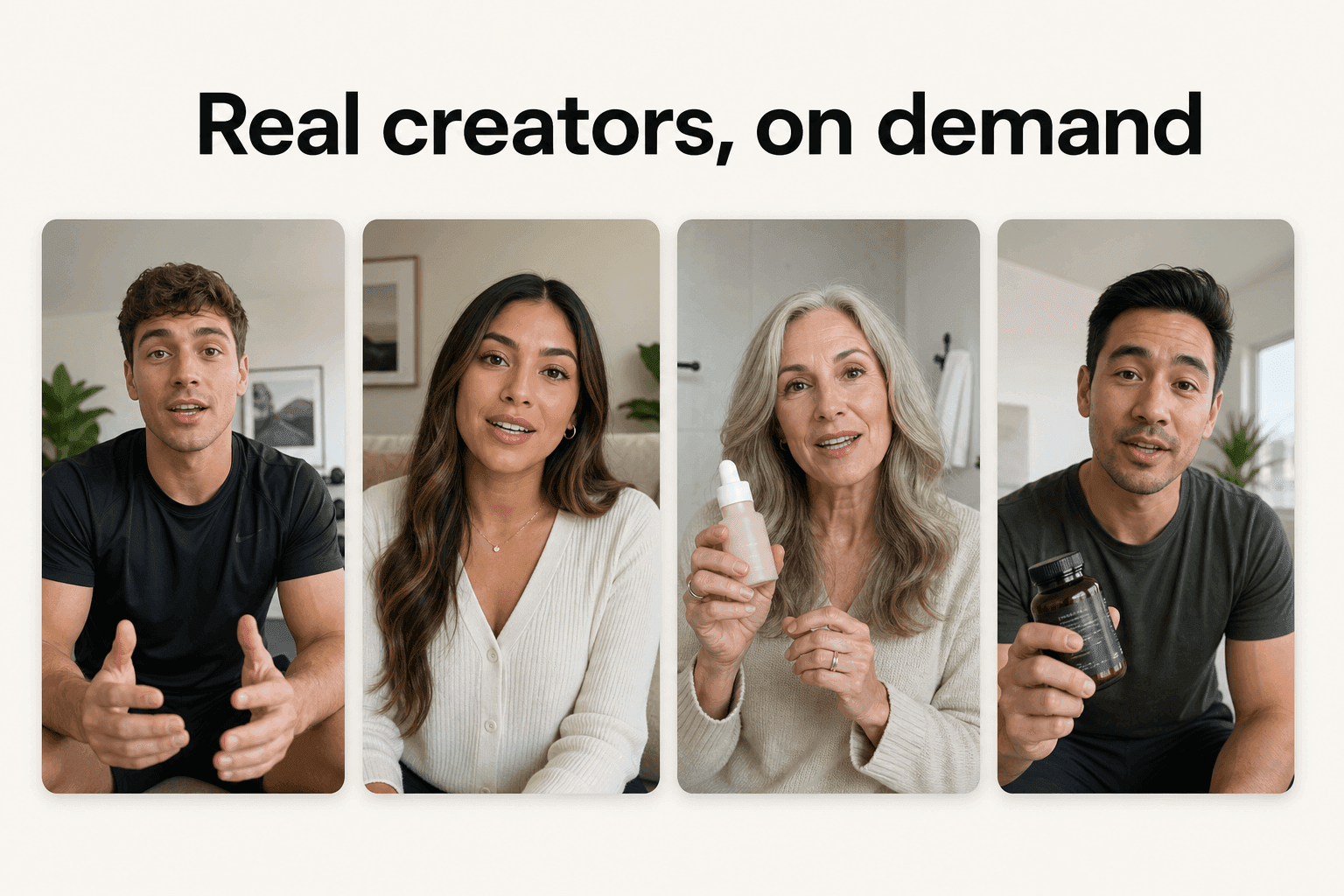
The Trust Transfer: Why UGC Converts
Here is the idea worth naming, because it explains every number in this article. When a brand uses UGC, it is not really buying a video. It is buying a Trust Transfer: the credibility of a real-seeming person, moved onto a product.
Credibility moves from person to product
A brand talking about itself is discounted on arrival. Everyone knows it is selling. A person who looks like a peer is not discounted the same way, so their endorsement carries weight the brand could never claim for itself. UGC is a way to buy that credibility on a schedule instead of waiting for it to happen organically. Every tactic that follows, the unboxing, the testimonial, the demo, is just a vehicle for the Trust Transfer.
The numbers behind the signal
The trust is measurable, and the figures stack in the same direction:
- 79% of consumers say UGC influences their purchasing decisions.
- 82% say they are more likely to buy from a brand that uses it.
- Roughly 6 in 10 consumers say UGC is the most authentic form of marketing content there is.
None of these are reach numbers. They are belief numbers, which is the harder thing to earn. A brand can buy impressions all day; it cannot buy the assumption of honesty. UGC is the closest thing to renting it.
Word of mouth, manufactured on demand
This is not new behavior dressed up with a hashtag. Decades of advertising research show consumers' reliance on word-of-mouth in the decision-making process keeps rising, whether the recommendation comes from someone they know or a stranger online. UGC is word of mouth a brand can actually commission. That is its real innovation: it turns the most trusted form of persuasion into something you can schedule, brief, and run as media. The Trust Transfer is the bridge between an inherently unscalable thing, genuine endorsement, and a marketing channel you can plan around.
The Formats That Carry the Signal
UGC is a small, repeatable set of formats, because the audience rewards familiarity. The job of each one is the same Trust Transfer, just dressed differently.
Video and short-form
Short vertical video is the highest-leverage format for paid social and the one most people mean when they say UGC. It lives on TikTok, Reels, and Shorts, and it covers most of the recognizable styles:
- Testimonials: a person to camera explaining what changed for them.
- Unboxings and first impressions: the package, the reveal, the reaction.
- Demos and how-tos: the product solving the exact problem it is sold against.
- Get-ready-with-me and day-in-the-life: the product woven into a routine.
- Problem-solution skits: a frustration in the first three seconds, the product as the turn.
None of these are hard to film. The skill lives in the hook and the angle, not the production values.
Photos, reviews, and testimonials
The signal is not only video. On product pages, customer photos and written reviews do the heavy lifting. In one large survey, 95% of shoppers said they regularly read product reviews, and 60% of US consumers said they always search for customer images and videos before committing to a purchase. The non-video formats each answer a different silent question:
- Written reviews answer "did it work for someone like me?"
- Customer photos answer "what does it actually look like outside the studio shot?"
- Video testimonials answer "is a real person willing to put their face on this?"
Together they cover the doubts a polished hero image never will.
Unboxings, GRWM, and demos
The recurring formats persist because the variables are few and the winners are unpredictable. A handful of levers decide whether a clip lands:
- The hook in the first three seconds.
- The angle, meaning which problem or desire the clip leads with.
- The face, meaning whether the person reads as someone the viewer trusts.
That is also what makes UGC the easiest content to test: change one lever, hold the rest, and let performance decide. Hold that thought, because it becomes the central tension later in this guide.
Where UGC Earns Its Keep
The trust signal is nice in theory. What matters is where it shows up in the funnel and turns into revenue.
On the product page
UGC is not just a top-of-funnel toy. 57% of shoppers say customer ratings, reviews, and user-generated content are the most important product page element for completing a purchase. A page that shows real people using the product removes the last hesitation before checkout. UGC on the page does three jobs at once:
- It proves the product exists and works outside the marketing photos.
- It answers objections in the buyer's own words, before support has to.
- It keeps a hesitant shopper on the page instead of leaving to search reviews elsewhere.
That is exactly where conversion is won or lost. If you are mapping the journey, our guide to improving ROAS with UGC connects these touchpoints to the math.
In paid social feeds
In the ad auction, the native look wins attention that polished brand films do not. 93% of marketers who use UGC say it performs better than traditional branded content. The reason is mechanical as much as emotional: TikTok, Reels, and Meta surface content that matches the feed, and UGC matches the feed by design. For the platform-level breakdown, see our comparison of AI video ad platforms.
The platforms that reward it
Each platform rewards a slightly different shape, so the same product usually needs more than one cut:
- TikTok and Reels: short, punchy, sound-on testimonials and skits that hook in the first seconds.
- YouTube and Shorts: longer demos and detailed reviews, for viewers who arrive with more intent.
- Meta feeds: native-looking testimonials and problem-solution clips that blend into the scroll.
The constant across all of them is that the algorithm favors content that does not look like an ad, which is the one thing UGC is built to deliver. The brand that ships one variant per platform almost always loses to the one that ships several and lets the feed pick.
The Volume Bottleneck
Now the trap that quietly stalls most UGC strategies. The format's advantage is testing, but the human way of producing it makes testing the most expensive thing you can do.
Why the winning ad is unpredictable
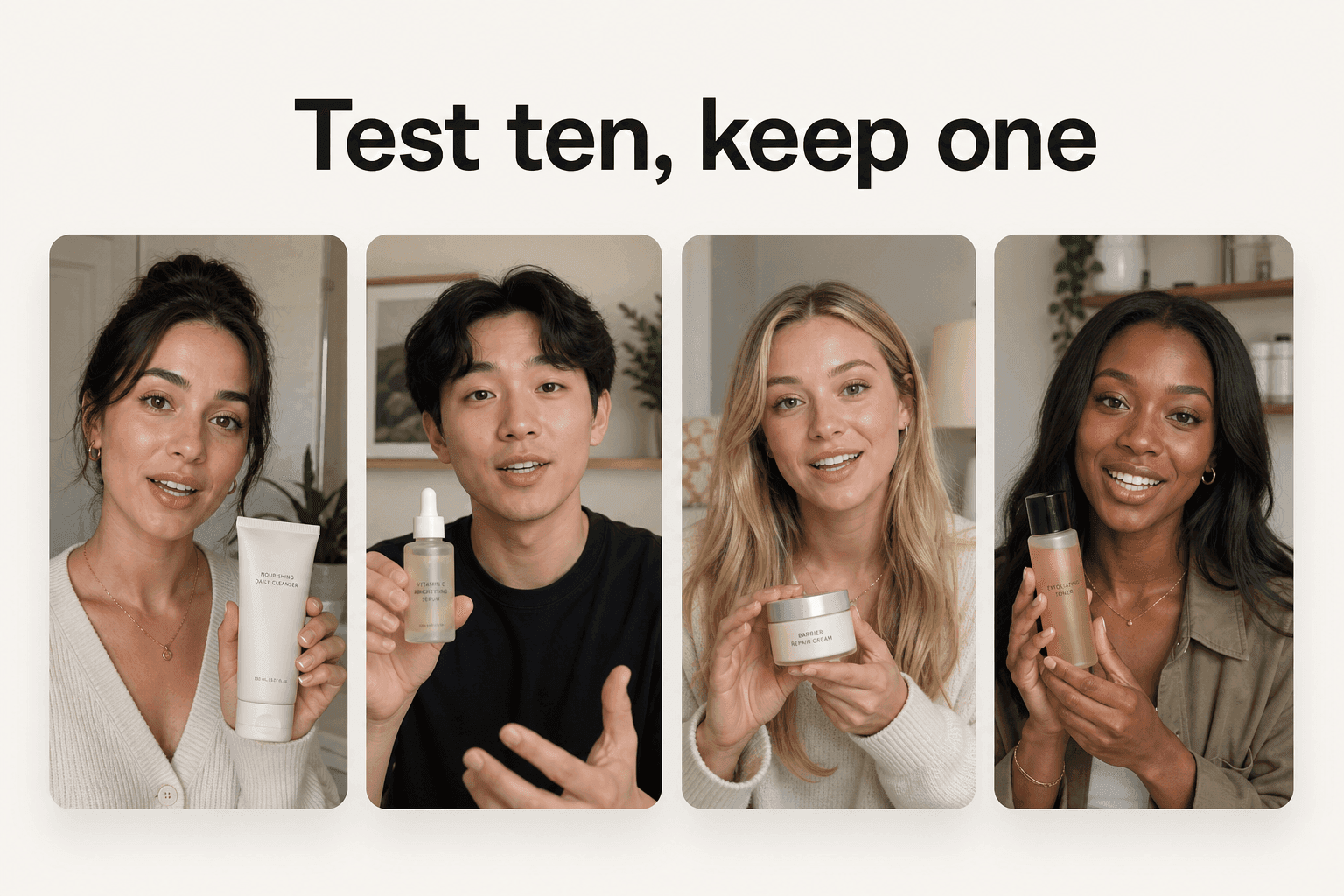
The ad that wins is rarely the one you would have bet on. The hook that lands, the face that converts, the angle that clicks, these are discovered, not designed. The same product can swing wildly on small changes:
- A different opening line can double or halve the watch-through rate.
- A creator who matches the audience can beat a polished read from one who does not.
- An angle you dismissed in the brief can quietly become the best performer.
That is why you have to run many variations to find the one that beats your benchmark. UGC is a testing medium, not a single-shot medium, and treating it like a single shot is the most common way brands waste the format.
A worked example: testing ten angles
Say you want to test ten angles for one skincare serum. With AI UGC, ten variations at about a dollar to $8 each (a five-second Seedance 2.0 Mini clip at one end, an eight-second Seedance 2.5 clip at the other; a full 30-second Seedance 2.5 take is about $26) comes to about $10 to $80, produced in a single afternoon, since each clip renders in about four minutes. Hiring creators for the same ten clips runs into the hundreds or low thousands of dollars and one to two weeks of briefs, drafts, and revisions before a single ad goes live. Our video ad production cost breakdown runs the full comparison, but the conclusion is blunt: at hand-made prices, testing ten angles is a luxury most brands simply skip.
When to hire a human
This is not an argument against people. The two approaches have different jobs, and the smart play is knowing which you are buying.
Hire a human creator when:
- You need a specific, recognizable real face for the brand.
- You want a long-term ambassador relationship, not a one-off asset.
- The piece is a flagship where the person genuinely is the message.
Generate with AI when:
- You need to run many variations to find the winner.
- You are testing hooks, angles, faces, or accents against each other.
- Speed and cost per variation matter more than a single named personality.
The honest stance: if your entire UGC budget goes to a handful of expensive clips a quarter, you are paying creator prices for a job that is mostly about volume. For the full head-to-head, see AI versus UGC creators.

How Novoads Solves the Volume Bottleneck
If what you are buying is a trust signal, a real-seeming person reading a script to camera, then for volume testing it does not have to come from one specific human. That is the gap AI UGC closes.
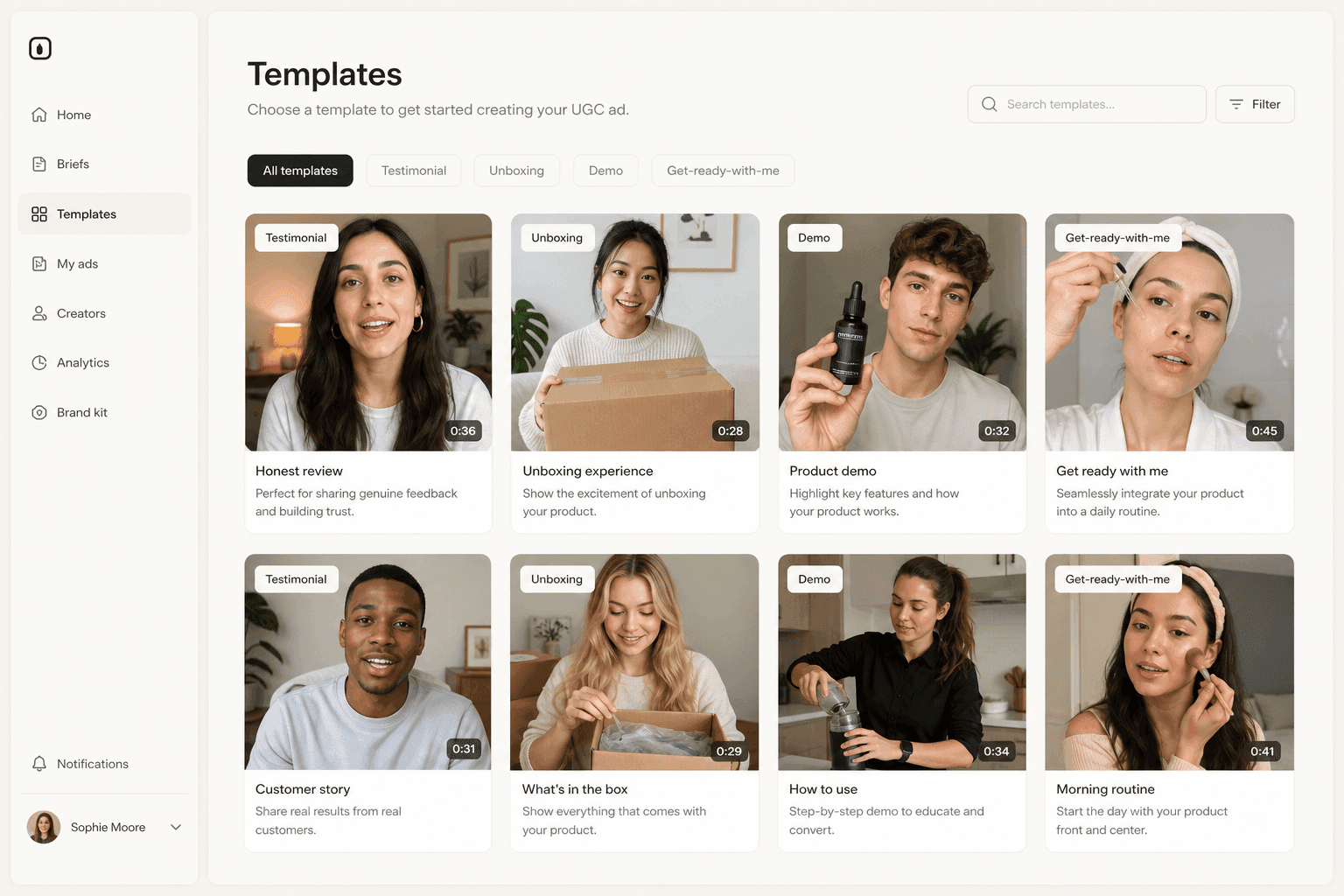
From script to UGC ad in minutes
In Novoads the flow is short enough to repeat dozens of times in a sitting:
- Upload a product image.
- Write a script, or let the tool auto-generate one.
- Pick from 100+ AI actors to match your audience.
- Download the finished ad, formatted for the platform you need.
The actor talks about your product on camera (library actors have empty hands, so to show it in hand you create a custom actor from a photo of someone holding it), and the tool ships a UGC-style video with voice, lip-sync, and captions, formatted 9:16, 1:1, or 16:9 for any ad platform. The headline time is about four minutes, and a clip runs from a few dollars rather than a few hundred. Our walkthrough on how to create UGC ads with AI covers the full flow.
Actors, accents, and formats
The trust signal is local. A viewer in Mexico City reads a Mexican accent as more credible than a neutral one, so Novoads renders ads in 30+ languages with real regional accents, drawing on models like Seedance, Kling, and Veo. That is what makes the Volume Bottleneck dissolve: when each variation costs a few dollars and minutes, you can finally test faces, hooks, and accents the way the format always demanded.
Trust at the speed of testing
UGC was never about the video. It was always about the Trust Transfer: a real person's credibility, moved onto a product, in a format people actually believe. That is why it converts, and it is why the role exists at all.
What changed is the price of running it. The trust signal used to be locked behind a creator's calendar and a per-clip invoice. Now it can be generated from a script in minutes, which means a brand can finally test the way the format was built to be tested. You can produce your first AI UGC ad with Novoads from $49/month at novoads.ai. Cancel anytime.
Frequently Asked Questions
What is UGC in simple terms?
UGC stands for user-generated content: any photo, video, review, testimonial, or social post that looks like it came from a real customer rather than a marketing department. Organic UGC is unpaid (a customer posts it because they want to). Paid UGC-style content is commissioned by a brand to get the same authentic look. Either way, the value is that it reads as real, not like an ad.
What is the difference between UGC and influencer marketing?
An influencer posts to their own audience, so you pay for distribution and their followers' trust. UGC is a content asset: you pay for footage you own and post yourself, usually as an ad, on a product page, or organically. Many creators do both, but the roles are different. UGC is the asset, influence is the reach.
Does UGC actually convert better?
The trust signals are strong. 79% of consumers say UGC influences their purchasing decisions, 82% say they are more likely to buy from a brand that uses it, and 93% of marketers say it performs better than traditional branded content. The mechanism is credibility: a real-seeming person clears a bar that a brand talking about itself cannot.
What types of content count as UGC?
The common formats are short videos (testimonials, unboxings, demos, get-ready-with-me), product photos in real use, written and video reviews, and organic social posts or mentions. Short vertical video for TikTok, Reels, and Shorts is the highest-leverage format for paid social, but reviews and photos do heavy lifting on product pages.
Can AI-generated UGC work as well as the real thing?
For volume testing, increasingly yes. AI UGC tools let you write or auto-generate a script, pick an AI actor that matches your audience, and produce a UGC-style vertical video with voice, lip-sync, and captions in minutes for a few dollars. Human creators still matter for a specific face or a flagship piece, but for running many ad variations cheaply, AI is the practical tool.
How do I start using UGC for my brand?
Pick one product, write three angles (a problem-solution, a testimonial, a demo), and write a strong hook for each. Then produce variations rather than one ad, launch them as a test, and put budget behind the winner. Hiring creators, that is several briefs and a week or two. With AI, it is several clips in one sitting.
Key Takeaways
- UGC (user-generated content) is any photo, video, review, or post that looks like a real customer made it; brands then use it on their own channels and ads.
- What you actually buy is the Trust Transfer: a real-seeming person's credibility moved onto your product. 79% of consumers say UGC influences their purchasing decisions.
- UGC is not influencer marketing. An influencer rents you their audience; UGC is an asset you own and run yourself.
- The format's superpower is testing, but producing it by hand makes volume the most expensive thing you can do. That is the Volume Bottleneck.
- AI UGC reproduces the same trust signal from a script in minutes for a few dollars, which is what makes testing at volume finally affordable.