Adobe Firefly Adds 3 AI Audio Tools for Ads: What Commercial Safety Actually Covers
On August 20, 2026 Adobe made Generate Music, Generate Speech and Generate Sound Effects generally available in Firefly, and sold the licence as the product. Here is what Adobe's own indemnification terms say in writing, and where the covered and uncovered outputs sit side by side in one interface.

Mauricio Valdivia
·11 min
The safety promise is real. It also has a footnote.
A voiceover gets recorded twice in one afternoon. Same script, same Firefly tab, same Generate Speech button. The first take uses Adobe's own speech model. The second uses the ElevenLabs option in the sidebar, because the accent lands better on the hook. Both files export to the same folder, go into the same edit, and ship in the same campaign. One was made with a capability Adobe's indemnification terms name as eligible. The other was made with a model Adobe did not train, and the terms have a specific sentence about those. Nothing in the interface flags the difference.
On August 20, 2026, Adobe moved three AI audio tools into general availability inside Firefly: Generate Music, Generate Speech and Generate Sound Effects. The announcement leads with the licence, not the fidelity. Adobe describes the release as "bringing commercially safe AI audio to your creative workflows," and Generate Music as producing "universally licensed original tracks tuned to your video's length and mood, so your music can go wherever your content does without worrying about takedowns." Those are Adobe's phrases. They are also, plainly, the reason anyone would switch.
So this piece is about the distance between the pitch and the paperwork, because for anyone shipping paid creative that distance is the entire question. What follows is what actually shipped, what Adobe's own published indemnification terms say in writing, where covered and uncovered outputs sit two clicks apart in one interface, and the questions worth taking to your own counsel. It is a reading of public documents, not legal advice, and nothing below tells you what is safe.
What Adobe actually shipped on August 20
Three tools, three Adobe models, one tab
Adobe's post is specific about which engine sits behind each tool, and the specificity turns out to matter later. Generate Music runs on the Firefly Music Model. Generate Speech runs on the Firefly Speech Model, "with the option to use ElevenLabs," and turns a script into voiceover with control over voice, pacing and emotion. Generate Sound Effects runs on the Firefly Audio Model and "creates custom sounds that match the action, timing and energy of your content."
Adobe's summary line is the sales pitch in one sentence: "This is audio built for real production: commercially safe and ready for finished work. No separate subscription or time spent hunting for a track you're allowed to use." Read that carefully. "No separate subscription" is a claim about not paying ElevenLabs or a stock library on top. It is not a claim that the generations are free of charge, and Adobe does not publish a credit cost per audio generation anywhere in the announcement.
A beta exit, not a debut
The most useful correction to the coverage is a date. Adobe launched Generate Sound Effects more than a year earlier, on July 17, 2025, and described it that same day in the same words: "Generate Sound Effects (beta) is commercially safe, so you can create with confidence." TechRadar's hands-on opens by noting the tools had been "sitting in beta for sometime."
Nothing new became technically possible on August 20. What changed is availability, and for anyone who reads terms, legal status, because beta and trial features are one of the two things Adobe's indemnity footnote carves out. That is not a small change. It is just a different change from the one the headlines describe.
What it is like to use, from someone who tried it
TechRadar's Steve Clark ran all three against real footage, and his verdict is more useful than a spec list. On music, he was "served four tracks to choose from, all different but with the same vibe. They were...ok. A bit generic, but they'd do in a pinch." More prompt detail improved them sharply. His overall call: "The real winner here is Generate Music."
On speech he "picked a speaker from a list of 45" and hit the ordinary frustrations of the category, including a word that came out mispronounced and a preview flow that needed a context menu instead of a play button. His conclusion is the honest one for any ad team: "I don't think they'll substitute professional sound designers, composers, and musicians any time soon." That tracks with what a good ad voiceover actually needs, where pronunciation control and language coverage decide usability long before raw voice quality does.
The indemnity is a list, and the list has a footnote
What eligible actually means
Adobe publishes its Firefly indemnification scope on a product description page, and the first sentence sets three conditions before any feature is named. "If you are a customer and your agreement with Adobe includes a link to this page's URL, then below is the list of Eligible Firefly Features, Eligible Firefly Surfaces, and Export Events that apply to the Firefly IP indemnity."
Unpack that. The indemnity runs through your specific agreement, not through the product. It applies to a named list of features, not to everything the app can make. And it attaches at an export event, which the same page defines as the moment "a User provisioned under a qualifying SKU or plan downloads the Firefly Output." Three gates, and a marketing phrase on the homepage clears none of them by itself.
The list is also dated, feature by feature, and the dates are the most quietly interesting thing on the page. Text to Sound Effects and Voice to Sound Effects were added "As of September 30, 2025." Generate Speech and Generate Music were added "As of July 13, 2026," which is five weeks before the general availability announcement. The legal paperwork moved first, then the product did.
Exclusion A: anything the interface calls a non-Adobe model
The eligible-features table carries a single footnote, and it does the heaviest lifting on the page. It excludes any "(A) capabilities that Adobe may develop that are denoted in the user interface as being powered or provided by non-Adobe trained models."
That is a clean, deliberate line, and it is the coherent one for Adobe to draw. Adobe can stand behind output from models it trained on its own licensed corpus. It cannot underwrite output from a model somebody else trained on a corpus Adobe never saw. The consequence for a buyer is that eligibility is not a property of Firefly. It is a property of which model produced the specific file, and that choice is made in a dropdown during a task nobody documents.
Exclusion B: anything designated beta or trial
The second half of the same footnote excludes "(B) any features designated as 'beta' or 'trial' or accessed within a surface labeled as 'beta' or 'trial.'"
Note the two halves of that clause. A beta feature is out, and so is anything "accessed within a surface labeled as beta." That second reading is broader than most people would guess: it is about where you were standing when you made the asset, not only about what you clicked. It is also the exclusion that gives the pre-August-20 audio betas their real story, and, as the next section shows, the one that lands on the newest thing Adobe announced.
Where covered and uncovered sit side by side
One tab, four surfaces, and the eligibility line runs between them rather than around them:
| Surface in Firefly | What it is | Where it sits against the indemnity |
|---|---|---|
| Generate Music, Generate Speech, Generate Sound Effects on Adobe's own models | Adobe-built, generally available since August 20 | The path Adobe's commercial-safety language is written for |
| ElevenLabs Multilingual V2, in the Generate Speech dropdown | A partner model, picked from the same sidebar as Adobe's own voice | Exclusion (A): the interface labels it a non-Adobe model |
| Gemini Omni Flash, Kling AI, Luma AI, OpenAI, Runway | The video partner roster, a different job from the speech path | Exclusion (A), same reason |
| Firefly AI Assistant, including the new free daily generations | Called "Firefly AI Assistant (beta)" in Adobe's own post | Exclusion (B): designated beta or trial |
Nothing in the interface draws that line for you. The rest of this section walks the three cases where it bites.
The speech dropdown is the clearest case
Adobe's own announcement says Generate Speech comes "with the option to use ElevenLabs." TechRadar found exactly that when testing: "at the time of writing, there's Adobe's commercially safe Firefly and the ElevenLabs Multilingual V2 partner model." Two entries in one sidebar, chosen the way you choose a voice, which is by ear.
Set that beside exclusion (A) and the question writes itself. It is not a question I am going to answer, because the answer depends on your agreement, your plan, and how Adobe's interface labels that entry on the day you clicked it. What I will say is that this is the highest-value question in the whole launch, it is answerable in writing by the vendor, and almost nobody is asking it. A creative director choosing a voice by accent is making a licensing decision without being told one is on the table.
The free tier is the assistant, and the assistant is a beta
Adobe also introduced a free tier, and it is narrower than the coverage suggests. The sentence is: "To help everyone experience the magic of Firefly AI Assistant, we're introducing a free experience with daily generations that lets you start creating immediately." It sits under a heading about the assistant. It is not free Firefly, and it is not free audio generation. Adobe puts no number on "daily."
Now stack it against exclusion (B). Adobe's own post refers to "Firefly AI Assistant (beta)" in the same article. So the newly free surface is a surface the indemnity footnote describes, and the thing most likely to be tried first by someone who read a headline about commercial safety is the thing furthest from it. That is not a trap Adobe set. It is the ordinary result of shipping a funnel and a legal document on the same day.
The new model joined the video roster, not the audio one
One more distinction the coverage flattens. Adobe wrote that it is "expanding that choice with the addition of Gemini Omni Flash which joins other models from Google, Kling AI, Luma AI, OpenAI and Runway." That is the video partner roster. ElevenLabs is not in that sentence, because ElevenLabs sits on the speech path instead. Two rosters, two jobs.
The model itself is also not news. Google introduced Gemini Omni Flash at I/O earlier this year, announcing that it was "rolling out now to all Google AI Plus, Pro and Ultra subscribers globally through the Gemini app and Google Flow," and we covered what a ten-second clip with sound costs when it reached developers. Its arrival in Firefly is the August story. Its existence is not.
The questions worth taking to your own counsel
Everything above is a reading of published pages. What follows is not advice, and it is deliberately shaped as questions rather than answers, because the answers are contract-specific and a blog post cannot know your contract. Send these three to whoever signs off your creative, and get the replies in writing.
Which agreement are you actually under
The indemnification page conditions itself on your agreement linking to that URL. So the first question is not about audio at all. It is whether the plan your team pays for is one of the "qualifying SKU or plan" tiers the export-event language names, and whether your agreement carries that link. A solo creator on a consumer Firefly plan and an enterprise team on a negotiated contract are reading the same marketing sentence and standing in two different places.
Which model produced this specific file
Exclusion (A) makes the model choice legally load-bearing, and model choice is currently invisible in the delivered asset. There is no metadata field on a .wav that says which entry in the sidebar was selected. If your process cannot answer "which engine made this voiceover" six months later, the honest state of your archive is that you do not know which of your files the terms cover. That is a records problem with a records fix, and it costs nothing to start today.
Where was it exported from, and by whom
The export event is the moment the indemnity attaches, and Adobe's page gives a worked example of its own: if user A generates an output and places it in an Adobe Express project, and user B exports that project, then user B performed the export event. In an agency workflow where a junior assembles and a senior exports, or where an asset is handed across companies mid-edit, that single sentence decides which account the coverage follows. Ask it out loud before it matters.
What this costs a team that does not track it
A worked example: twenty variants, two clauses
Take an ecommerce team running twenty live ad variants off one launch. Fourteen use the house voice from Adobe's own speech model. Six use the ElevenLabs option, because the accent tested better on a regional audience. Nobody wrote that down, because at the moment of the choice it was a taste decision that took four seconds.
Three months later a client's brand-safety questionnaire arrives asking, per asset, what generated the audio and under what licence. Reconstructing the answer means opening twenty projects, listening for a voice you have to recognise by memory, and guessing on the ones that are close. Twenty audits, on a deadline, for a distinction that would have been a column in a spreadsheet. This is the same fan-out that makes creative operations a real discipline: the expensive part is never the asset, it is the number of places the asset went. It is also the exact question the Munich judgment against Suno put at the centre of the field, where a court looked at a generated file and asked whose decisions were inside it.
Disclosure is a separate rule from licensing
One clean thing to keep separate. Whether output is licensed for commercial use and whether it must be disclosed as AI-generated are two different rules, enforced by different parties on different clocks. Nothing in Adobe's indemnity touches your ad platform's AI-labeling requirements, and a rejected ad on Tuesday costs more than a licensing question that stays theoretical for a year.
The practical soundtrack options have not changed either, and they are still the three in the AI music clearance rundown: a licensed library with the receipt filed next to the creative, your ad platform's own cleared commercial sound library, or a voice-forward cut with no bed at all. A better generator does not remove that decision, which is the argument in the ad soundtrack gap and is still true with Adobe's version of the tool.

How Novoads keeps the ad's audio layer accountable
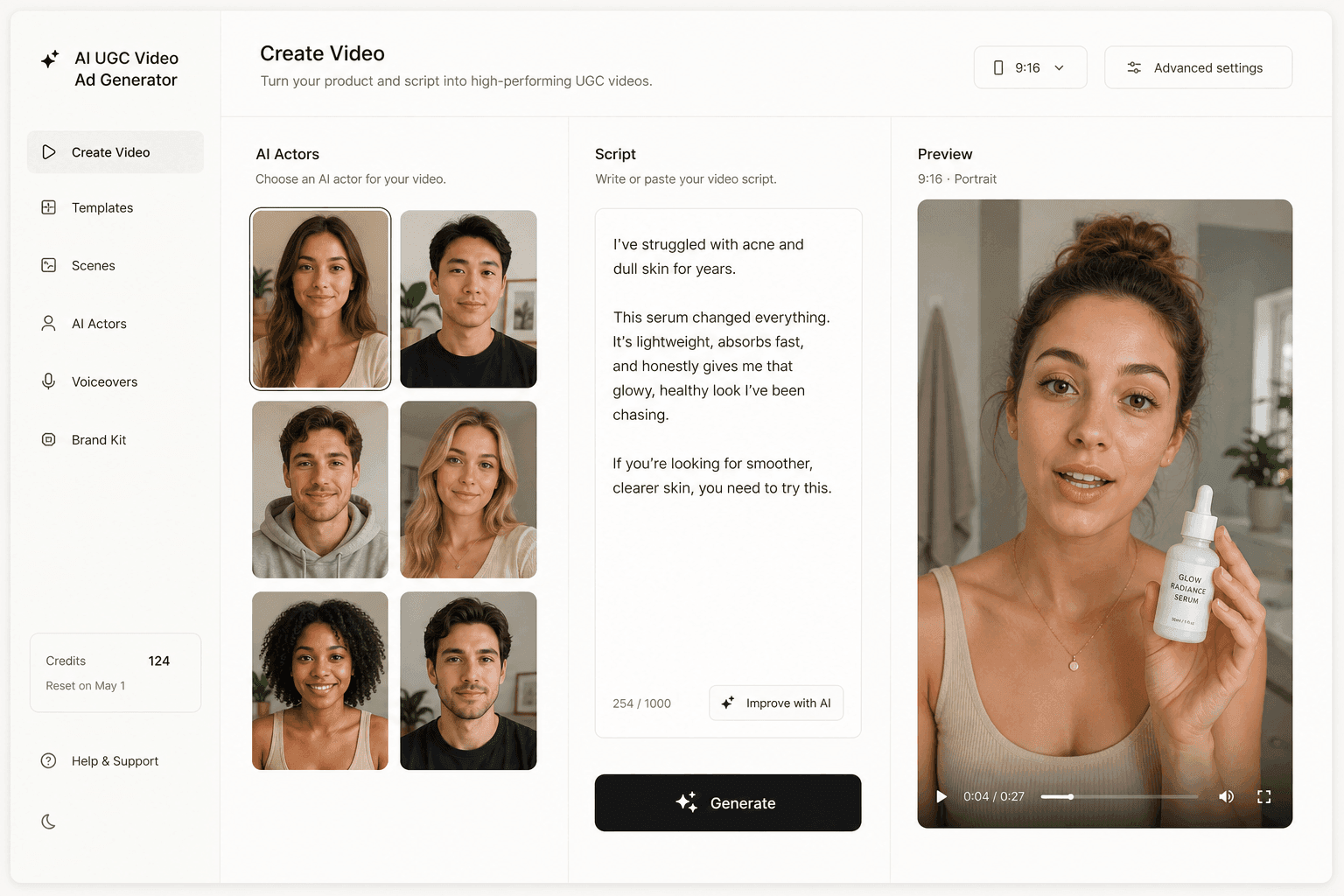
Novoads generates the layers a creator-style ad is actually made of: an AI actor delivering your script, the voiceover, the captions, and ad images built from a product photo you upload. Music is deliberately not one of them, so a bed never arrives fused into a render you cannot account for afterwards. It stays an explicit choice you make in the edit, from a source you can name.
The narrower surface is the point. Every generated layer in the ad maps to one engine you picked on purpose, which is a much shorter provenance answer than an all-in-one studio produces. It also matches how the strongest creator-style ads already sound, where a real voice and room tone read as a recommendation and a polished bed reads as a commercial. You can try the actor and script flow for $49/month: 50 credits every month, cancel anytime.
Commercial safety is a property of the path, not the platform
Adobe built something genuinely good and priced the legal comfort into it, which is a smarter read of this market than another point of realism would have been. Both creators Adobe put in the announcement talked about licensing and time, and neither said the music sounded better. That is the buying trigger, and Adobe found it.
The thing worth carrying out of the launch is smaller and more durable than the launch itself. Commercial safety is never a property of an app. It is a property of a specific file, made by a specific model, on a specific plan, exported by a specific person. Adobe's own terms say so in more careful language than its homepage does. The teams that come out of this era clean will not be the ones that picked the safest vendor. They will be the ones that could still name, a year later, which engine made the thirty seconds of audio under their best-performing ad.
Frequently Asked Questions
What did Adobe actually release in Firefly on August 20, 2026?
Adobe moved three existing audio tools out of limited release and into general availability: Generate Music, powered by the Firefly Music Model, Generate Speech, powered by the Firefly Speech Model with the option to use ElevenLabs, and Generate Sound Effects, powered by the Firefly Audio Model. Adobe's own post says Firefly's audio capabilities are now generally available for all. Adobe separately added Google's Gemini Omni Flash to its video partner roster and introduced a free experience with daily generations for the Firefly AI Assistant.
Is Adobe Firefly's AI audio generation free now?
No, and this is the most commonly garbled part of the announcement. The free experience Adobe introduced is scoped to the Firefly AI Assistant, in a paragraph that sits under a heading about the assistant. Adobe writes that to help everyone experience the magic of Firefly AI Assistant it is introducing a free experience with daily generations. The announcement gives no figure for how many daily generations that is, and it does not say audio generation is free. Adobe describes the audio as needing no separate subscription, which is a statement about not paying a second vendor, not a statement about price.
Does commercially safe mean Adobe indemnifies my ad?
Not automatically. Adobe's Firefly product description opens the indemnification section by saying that if you are a customer and your agreement with Adobe includes a link to that page's URL, then below is the list of eligible features, surfaces and export events that apply to the Firefly IP indemnity. So the indemnity runs through your specific agreement, applies to a named list of features, and attaches at an export event performed by a user provisioned under a qualifying SKU or plan. Whether your plan qualifies is a question for Adobe and for your own counsel, not something the phrase commercially safe answers on its own.
Is output from the ElevenLabs option covered the same way as Adobe's own speech model?
Adobe's terms carry an explicit carve-out that is worth reading before you assume either way. The eligible-features list is footnoted to exclude any capabilities that Adobe may develop that are denoted in the user interface as being powered or provided by non-Adobe trained models, and any features designated beta or trial. Adobe's announcement says Generate Speech comes with the option to use ElevenLabs, and TechRadar's hands-on found both Adobe's own model and the ElevenLabs partner model selectable in the same sidebar. What that combination means for a specific file on a specific plan is exactly the question to put to your own lawyer in writing.
Is Generate Music a new tool?
No. The August 20 event is a graduation out of limited release. Adobe launched Generate Sound Effects as a beta on July 17, 2025 and described it that day as commercially safe, and TechRadar's write-up opens by noting the tools had been sitting in beta for some time. What changed on August 20 is availability and, for anyone reading the terms, legal status, since beta and trial features are the second thing Adobe's indemnity footnote excludes.
Does Novoads generate music for ads?
No. Novoads generates the layers a creator-style ad is actually built from, which are the AI actor delivering your script, the voiceover, the captions, and ad images made from a product photo you upload. There is no music model in the catalog, so a bed never arrives bundled inside a render you cannot account for. It stays an explicit choice you make in the edit, from a source you can name later.
Key Takeaways
- On August 20, 2026 Adobe made three Firefly audio tools generally available: Generate Music, Generate Speech and Generate Sound Effects. Adobe's announcement calls the result commercially safe AI audio, and that licensing claim is the product rather than a side benefit.
- This is a beta exit, not a debut. Adobe launched Generate Sound Effects in beta on July 17, 2025 and already described it as commercially safe that day, so nothing new became technically possible on August 20.
- Adobe's Firefly IP indemnity is a named list with a footnote. The footnote excludes any capability denoted in the user interface as being powered or provided by non-Adobe trained models, and anything designated beta or trial.
- That matters because Generate Speech offers ElevenLabs as an option in the same dropdown as Adobe's own speech model, and the free experience Adobe introduced is scoped to the Firefly AI Assistant, which Adobe's own post still calls a beta.
- The eligible-features list is dated. Text to Sound Effects was added as of September 30, 2025 and Generate Speech and Generate Music as of July 13, 2026, which is five weeks before the public GA announcement.
Sources
- •Adobe Blog: Adobe Firefly expands its creative AI studio, generate music, speech, and sound effects in one place (20 August 2026)
- •Adobe Firefly Product Description, Firefly IP Indemnification (helpx.adobe.com, captured 24 August 2026)
- •TechRadar Pro: I tested Adobe Firefly's 3 new AI audio tools for creators
- •Adobe Blog: Firefly adds new video capabilities, industry leading AI models, and Generate Sound Effects feature (17 July 2025)