Arcads vs Creatify: The Actor Library Against URL-to-Video and Boreal
One sells casting depth behind a login; the other publishes three plan cards, a credit meter and now a per-second render price. Six factors compared for ecommerce.

Mauricio Valdivia
·Updated ·13 min

100 credits and a public price, or a login screen
A marketer with a new supplement line sits down to make video ads and narrows the field to two names that keep coming up: Arcads and Creatify. She opens the Creatify pricing page and reads three cards, fetched live on September 19, 2026: Starter at $39 a month with 100 credits, Pro at $99 with 300 credits that a selector scales to 5,000, Enterprise on request. She opens www.arcads.ai/pricing and gets an HTTP 404. Arcads has prices, they just live past the login, on an in-app paywall. Both are real tools. Both make believable ads. The output is not where they part ways.
They part ways at the very first screen, twice. Arcads is an actor-led generator: its gravity is the roster of AI actors and custom avatars you cast. Creatify is a URL-led generator: its gravity is speed from a product page you already have. One asks you to pick a face; the other asks you to paste a link. And one of them lets you do the arithmetic before you hand over a card. This is an honest head-to-head, not a takedown, and where a product-in-hand, multilingual angle changes the answer, we will name where Novoads fits and where it does not.
One thing moved under this comparison since it was written. On September 15, 2026, Creatify Labs launched Boreal, its own video model, with a per-second list price on fal and a credit table in its API docs. That does not change the plan cards, but it extends the thing Creatify already did and Arcads does not: publish numbers. We cover the model itself in Creatify Boreal on fal, so this post keeps it to what it changes for a buyer choosing between the two. For the wider category, the best Arcads alternatives and best Creatify alternatives guides map the field.
The quick answer
If you only read this far, here is the decision in three lines.
- Pick Arcads if you want actor range and custom avatars: 1,000+ AI actors, a custom actor from a single headshot, Seedance 2.5 and Kling among its models, and a Show Your Product feature that puts the item in an actor's hands.
- Pick Creatify if your bottleneck is creative volume from a catalog and you want to budget before you sign up. Paste a product URL, batch a dozen variations at once, and read the plan price and the credit meter on public pages first.
- Pick Novoads if the creator has to hold your actual product and sound local: a script plus an actor as the input (for product in hand, a custom actor made from a photo of someone holding your product), voices in 31 languages with real regional accents, and an ad-ready file with voice, lip-sync and captions.
The rest is the reasoning behind those three lines. For the format itself, what a UGC creator actually is is the primer.
What each tool is built for
Both agree on the basics an ad buyer cares about: a person on screen without a film crew, a steady stream of creative rather than one hero film a quarter, all of it in the browser. Where they diverge is what you hand the tool first, and how the product shows up in the ad.
Arcads: cast the actor, then generate
Arcads presents itself around its people. The homepage leads with a library of more than 1,000 AI actors and the option to create your own AI avatar, so the first decision you make is casting rather than pasting. Custom Actor builds that avatar from a single headshot and saves it for reuse; Actor Replacement swaps the performer in a finished video while preserving script, timing and background, which Arcads pitches for A/B testing faces; Show Your Product places the item in the generated video, held by an actor or set in a scene. It does not lock you to one engine either: its homepage names Seedance 2.5 as live and lists Kling, and it markets translation into more than 30 languages.
Creatify: paste a URL, then batch the variations
Creatify is built to get you from a product page to an ad with as little setup as possible. Its signature workflow is URL to Video: paste a product URL and it generates video ads, and Batch Mode runs multiple scripts and multiple avatars against one URL in a single step. Its Starter card lists 300 AI actors and 200+ AdFlow templates; Pro lists 1,500 actors plus 3 custom avatars, 500+ templates, a Competitor Ad Tracker over 10M+ Meta ads, and Ad Clone, which remakes an ad from a URL. For a high-SKU catalog where the description already lives on the page, volume is the point rather than a single crafted hero.
Where Novoads sits: product-in-hand, multilingual UGC
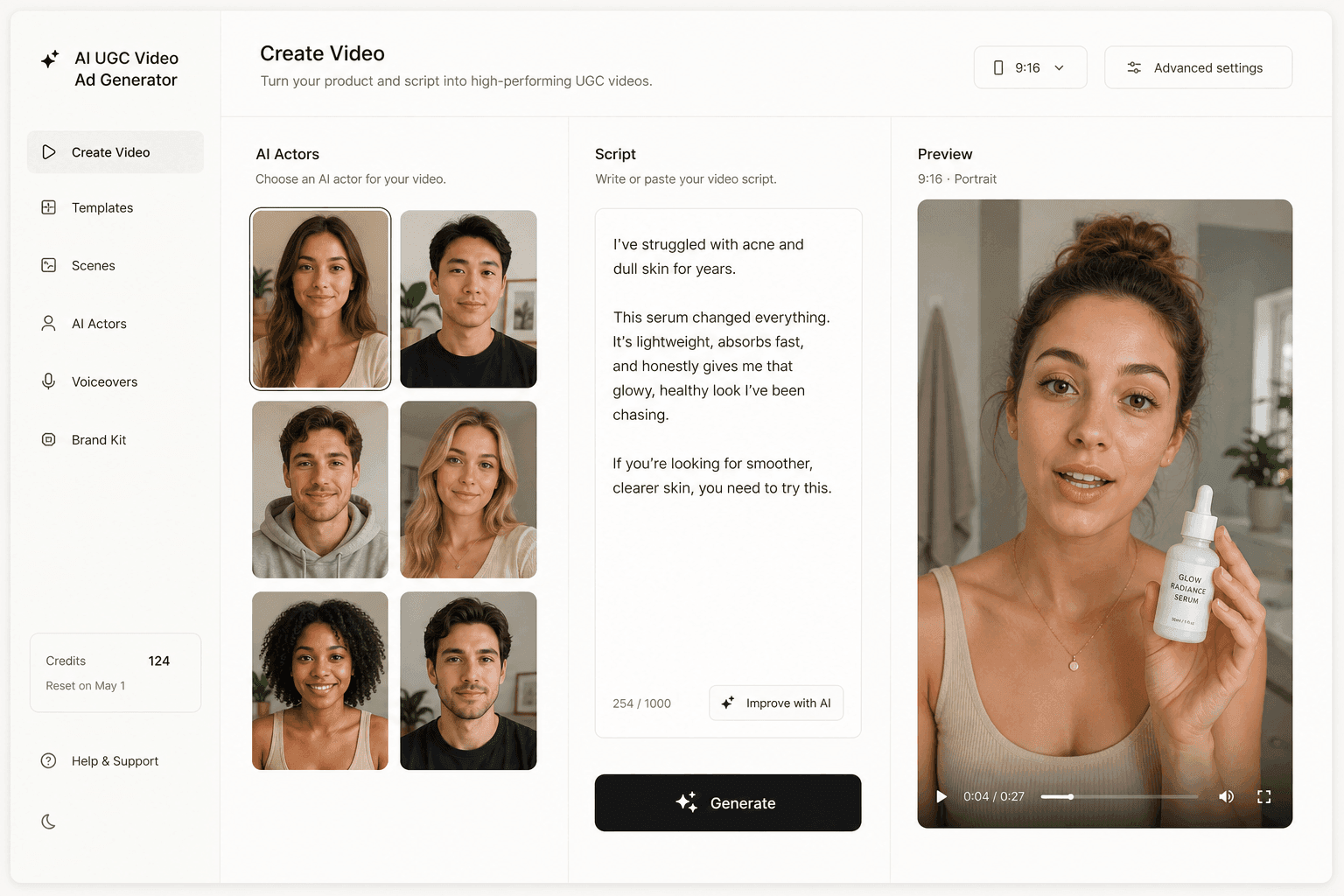
Novoads is narrower on purpose. It is a global AI UGC video-ad generator built around the last mile of an ecommerce ad: the product on camera, in the right language, ready to publish. You upload a product image and write or auto-generate a script, pick from 100+ AI actors, and get a vertical or horizontal ad with voice, lip-sync and captions. It runs multiple frontier models, Seedance 2.0, Seedance 2.5, Google Veo 3.1 and Kling v3 Pro among them, and its voice catalog covers 31 languages with real regional accents. It is the specialist for the hero ad where the item has to be held, through a custom actor made from a photo of someone holding it (a stock actor's hands are empty), and the voice has to sound native.

The head-to-head, factor by factor
Here is the snapshot across the six factors that decide it. Where a tool posts no number in public, the table says so plainly rather than borrowing one from elsewhere.
| Factor | Arcads | Creatify |
|---|---|---|
| Starting input | Cast an actor or avatar | Paste a product URL |
| Actor library | 1,000+ AI actors | 300 on Starter, 1,500 on Pro |
| Custom avatars | From a single headshot | 3 custom avatars on Pro |
| Product handling | Actor holds your product | Pulled from the URL |
| Languages | 30+ on its homepage | 75+ on its pricing page |
| Published plan price | None, /pricing 404s | $39 and $99 a month |
Actors, avatars and creative casting
This is where Arcads is strongest. It markets more than 1,000 AI actors and a Custom Actor built from a single headshot, so the range of faces you can cast is the headline feature rather than an afterthought. Creatify is not short on actors either: Starter lists 300 and Pro lists 1,500 plus 3 custom avatars. The framing differs. Arcads sells the roster as the product; Creatify treats actors as one ingredient in a fast, template-driven pipeline. If your concept starts with "I want this specific kind of person," Arcads gives you more room to cast, and Actor Replacement makes swapping the face a test rather than a rebuild.
Script-to-video and product handling
The input divide is the cleanest line in this comparison. In Creatify, the workflow starts at a product URL and ends at a set of video ads you take elsewhere to run, which is the quickest route when the page already carries the detail; its avatar page also says a described custom spokesperson can hold your product. In Arcads, you cast first, and Show Your Product places the item in the generated video. Neither default is wrong. A URL is fastest when the product page does the describing; an actor-first flow is better when the ad lives or dies on who is holding the thing and how they say it.
Languages, models and the surface you read them on
Language counts need their surface named, because these pages disagree with each other. Arcads markets translation into more than 30 languages on its homepage. Creatify's pricing page puts 75+ languages on both paid cards, while its help-centre FAQ dated May 11, 2026 names 29, so quote the page you actually read. On engines, Arcads is unusually open for a tool that hides its prices: its homepage names Seedance 2.5 as live and lists Kling, and Workflows runs one script across 10 actors in 2 languages in a single pass. Creatify's Pro card counts 100+ premium models in its Model Playground and, since September, its own Boreal.
What each one costs, and how openly
Cost rarely decides this on its own, but the shape of each on-ramp is genuinely different, and so is how much of it you can read before you pay. This is where the two diverge most.
Creatify: three cards, and a credit meter you can do arithmetic with
Fetched live on September 19, 2026, the Creatify pricing page serves exactly three plan cards.
- Starter, $39 a month: 100 credits, 300 AI actors, one generation at a time, videos up to two minutes.
- Pro, $99 a month: 300 credits at its base step, a selector scaling that to 500, 1,000, 2,000 or 5,000, 1,500 actors and 3 custom avatars.
- Enterprise: a conversation, not a number.
The page advertises an annual discount but renders no annual dollar figure at all, so anyone quoting a specific Creatify annual price is guessing. A watermarked plan with 10 monthly credits, good for about 2 video ads or 20 image ads, still lives in the FAQ further down that page, but it is no longer one of the cards.
The dollar figure is only half the answer. What makes a plan countable is the meter, and Creatify publishes that too. Its credit-usage help article, dated August 19, 2026, prices Video Ad, Avatar Video and AI Shorts at 5 credits per 15 seconds of video, rounded up, so a 20-second avatar video costs 10 credits and a 70-second one 25. Revisions are 3 credits per 15 seconds, waived on Pro and higher tiers when you do not change the script, avatar or voice. So 100 credits is roughly twenty fifteen-second avatar videos a month, and 300 is roughly sixty, before revisions.
Arcads: a meter without a rate
Arcads does not publish a public self-serve price. Fetched again on September 19, 2026, www.arcads.ai/pricing returns HTTP 404 with no redirect, the word Pricing does not appear anywhere in the homepage's rendered text, and its help centre routes plan changes through an in-app paywall reached past app.arcads.ai/login. We will not print a number we cannot read on a public page, and you should distrust any comparison post that does.
What Arcads does publish is the meter. Its help-centre article on credit counting, dated April 29, 2026, prices talking-actor models at 800 credits per minute, per actor, and says length is always rounded up and credits are counted per actor when a video uses more than one, so a 20-second clip bills a full minute and a two-actor script doubles before you change a word. Video models are priced per generation instead. That is a rate card with the rate removed: you can count the credits a campaign will burn, but not what they cost, until you are inside. Its refund article, last modified September 16, 2026, also describes a three-day trial whose saved card is charged automatically unless you cancel from Billing settings before the 72 hours are up. Whether that is a dealbreaker or simply a sales motion is a judgment call, but it is the single biggest contrast with Creatify's open page.
Novoads: a published monthly price
Novoads starts at $15/month (Starter, 200 credits per month), and all plans are published on our pricing page. There is no free tier and no trial: every subscription pays the plan price from the first charge. Under the hood, a single video runs from about 25 cents for a five-second Seedance 2.0 Mini clip to about $4 for an eight-second Google Veo 3.1 clip, and about $10 for a full 30-second Seedance 2.5 take, so the per-ad economics sit far below hiring a creator. For the human-creator baseline this replaces, how much UGC creators charge runs the numbers.
What Boreal changed, and what it did not
On September 15, 2026, Creatify Labs publicly launched Boreal as a general video model that generates synchronized audio with the picture. It is the newest thing on Creatify's side of this comparison, and the one most likely to be oversold, so it is worth separating what is documented from what is marketed.
The name is older than the launch
Boreal did not arrive in Creatify's product that week. A Creatify help article dated May 10, 2026 already offered a "Boreal Model" as a rendering option for Avatar Video, four months earlier. What the September launch added was reach and, more usefully for a buyer, a published price.
A render floor you can read
Two surfaces publish the number, and they bill differently. These are list prices fetched on September 16, 2026.
- 720p: $0.01 per second on fal, or 1 credit per started 10 seconds in Creatify's API.
- 1080p: $0.03 per second on fal, or 3 credits per started 10 seconds.
- 2K: $0.12 per second on fal, or 12 credits per started 10 seconds.
fal's own example puts a ten-second clip at ten cents, thirty cents or $1.20, and Creatify's API charges credits when rendering starts and refunds them if the render fails. One caveat travels with all of it: Creatify's model page still carried a note on September 16 that the pricing figures were pending final confirmation, so treat them as list prices that can move. The full breakdown, including what the model accepts and where it is weakest, is in Creatify Boreal on fal.
The quality numbers are the vendor's own
Every performance figure on Boreal so far comes from Creatify. It reports that blind reviewers preferred Boreal to its untouched base model in 81% of decisive comparisons, 25 to 6 with 9 ties across 40 production cases, and that against a leading closed model it does not name, Boreal runs roughly 40 times faster and about 12 times cheaper at the benchmarked price. Creatify also says the margin narrows most on single-person talking clips, to 60%, which happens to be the format most UGC ads use. Those are vendor-run benchmarks published by the vendor, and no independent test has repeated them, so weigh them as claims rather than results. Boreal is not available in Novoads, and nothing here comes from running it.
The practical effect on this two-way decision is narrow and real: Creatify moved from a workflow with opaque render costs to one whose floor a buyer can read in advance, on the same axis where Arcads still publishes nothing.

A worked example: one product, three markets
Picture the concrete job. You sell one supplement and you want a product-in-hand UGC ad running in three markets that do not sound alike: Mexico, Brazil and the United States. Same bottle, same hook, three audiences. The place this gets expensive is not the first ad. It is the second and third language, where a flat translation flattens the accent and the ad starts to sound like it was made somewhere else.
With Creatify, the fastest path is to paste the product URL and batch a set of variations; at 5 credits per 15 seconds, a Starter plan covers about twenty such clips a month. With Arcads, you would cast an actor or build one from a headshot, use Show Your Product to put the bottle on camera, and lean on its 30-plus-language translation and a Workflows pass to localize. With Novoads, the path is one loop, repeated three times.
- Upload a photo of someone holding the bottle once to create a custom actor, and write or auto-generate the script.
- Pick a Mexican Spanish accent and generate. Then a Brazilian Portuguese voice. Then a US English one.
- Each returns as an ad-ready vertical with voice, lip-sync and captions, in about four minutes per clip.
- Spot-check each before it goes live: does the accent match the market, does the lip-sync hold on the product name, does the hook land in the first second.
A custom actor renders at the talking-actor rate, 200 credits per started minute of video (the clip prices above are the separate route for generated video clips), so three locally-voiced, product-in-hand ads of up to a minute each come to 600 credits, which fits inside one Plus month (1,000 credits, $49/month). Make a second custom actor from another photo of someone holding the bottle, keep the same script, and you fork a fourth and fifth variation in minutes. That is the whole thesis in one task: the ad was never the hard part; the local, product-in-hand version of it was.
The honest trade-offs
No tool is without them, and pretending otherwise is how comparison posts lose your trust. Here is where each side asks you to give something up.
Where Arcads asks more of you
Arcads' strength, its actor-and-avatar depth, comes with a commit-first on-ramp: there is no public price to weigh, so evaluating it means entering the funnel, starting the three-day trial and remembering to cancel inside 72 hours if it is not for you. Its credit meter is useful once you know what a credit costs, and useless until then, and because talking actors bill per minute and per actor, a multi-actor concept multiplies rather than adds. That is a fit consideration, not a flaw. Our Novoads versus Arcads breakdown goes deeper.
Where Creatify asks more of you
Creatify's meter is public, which also means you can watch how fast it runs: 100 credits covers about twenty short avatar videos before revisions, and a revision costs 3 more credits per 15 seconds unless you are on Pro and changed nothing material. And because its center of gravity is URL-to-ad volume and template-driven creative, an ad that depends on a real pair of hands holding and demonstrating the product, in a voice native to each market, is not the job it optimizes for. Our Novoads versus Creatify comparison covers that one-on-one.
Where Novoads asks more of you
Novoads is purpose-built for ad UGC, not a general-purpose studio and not a URL batch tool, so if you want to paste a product page and walk away, it is the wrong shape. There is no free tier and no trial. And because the product in hand comes from the photo you upload to create a custom actor (a stock actor's hands are empty), that photo matters: a clean, well-lit shot with the product clearly visible in the hand produces a noticeably better ad than a busy, cluttered one, so the input deserves a minute of care.
When to choose each
The honest version is not a single winner. It is a fit test, and most of the decision falls out of three short lists.
Choose Arcads when:
- You want the widest choice of AI actors and a custom one built from a single headshot.
- Your ad concept starts with a specific kind of on-screen person, and you plan to A/B the face.
- You localize the same creative across many languages in one workflow pass.
- You are comfortable entering the funnel before you see a price.
Choose Creatify when:
- You want to paste a product URL and get video ads back with minimal setup.
- You are producing creative volume from a high-SKU catalog and batching matters.
- You want to read the plan price and the credit meter before you hand over a card.
- Your ads lean template-and-actor and the product does not need to be physically held.
Choose Novoads when:
- The creator should hold your actual product, from a custom actor made with a photo of someone holding it.
- You sell across markets and the voice has to sound local, with real regional accents.
- You want an ad that ships with voice, lip-sync and captions, not a clip to finish elsewhere.
- You want a published monthly price rather than a quote after signup.
If you are weighing the broader landscape, the best Creatify alternatives roundup and what UGC-style ads are cover the wider field and the format.
How Novoads fits between an actor library and a URL
Between an actor-led generator like Arcads and a URL-led generator like Creatify, Novoads is deliberately the third thing: the product-and-language specialist, built for the moment an ecommerce team needs the creator to hold the real product in the language the audience actually speaks. You upload a photo of someone holding your product to create a custom actor, write or auto-generate a script with Novoads, and get a vertical UGC ad with voice, lip-sync and captions, formatted for TikTok, Reels and Meta. It runs multiple frontier models so you are not betting on one engine, and its voices cover 31 languages with real regional accents. The headline time is about four minutes, and a clip runs from a few dollars instead of a few hundred.
The practical effect is that the file that lands in your downloads is the file you upload to the ad manager: no second tool, no captions to burn in afterward, no export settings to second-guess. None of that makes Arcads or Creatify worse; it makes the three a clean division of labor.
Where you start decides what you can ship
There is no winner of Arcads versus Creatify, because they are not running the same race. Arcads wants you to cast the ad around a person, with the deepest actor library and the fastest face swaps in this pair, and for a concept built on a specific face that is a fair reason to pick it, as long as you accept that the price arrives after the sign-up. Creatify wants to turn a product URL into ad volume fast, and it now publishes the whole ladder in the open: the plan, the credit meter and, since Boreal, the per-second render floor. Where the real bottleneck is a product-in-hand ad that sounds local in every market, that is the seam Novoads was built for. A tool you can do arithmetic about before you buy is not automatically the better tool, but it is the only one you can compare honestly. You can produce your first product-in-hand AI UGC ad with Novoads, starting from a photo of someone holding your product, from $15/month at novoads.ai. Cancel anytime.
Frequently Asked Questions
What is the main difference between Arcads and Creatify?
They start from opposite inputs. Arcads is built around its AI actors: it markets a library of more than 1,000 AI actors, creates a custom actor from a single headshot, names Seedance 2.5 and Kling among its models, and markets translation into more than 30 languages. Creatify is built around speed from a product page: its signature workflow is URL to Video, where you paste a product URL and it generates video ads, and you can batch create a dozen variations at once. If you want actor range and custom avatars, Arcads leans that way; if you want fast volume from URLs, Creatify does.
How much does Creatify cost?
Its pricing page, fetched on September 19, 2026, serves three cards: Starter at $39 a month with 100 credits a month, Pro at $99 a month with 300 credits at its base step (a selector scales it to 500, 1,000, 2,000 or 5,000), and Enterprise on request. A watermarked plan with 10 monthly credits is described in the FAQ further down that page rather than as a card. The page advertises an annual discount but renders no annual dollar figure, so there is no annual price to quote.
How many ads does a Creatify plan actually buy?
Read the credit meter, not the dollar figure. Creatify's credit-usage help article, dated August 19, 2026, prices Video Ad, Avatar Video and AI Shorts at 5 credits per 15 seconds of video, rounded up, so a 20-second avatar video costs 10 credits and a 70-second one 25. At that rate Starter's 100 monthly credits is roughly twenty fifteen-second avatar videos, and Pro's 300 is roughly sixty. Revisions are 3 credits per 15 seconds, waived on Pro and higher tiers when the script, avatar and voice are unchanged.
Does Arcads publish its prices?
Not on its website. Fetched on September 19, 2026, www.arcads.ai/pricing returns HTTP 404 with no redirect, and the word Pricing does not appear anywhere in the homepage's rendered text; plan changes happen on an in-app paywall reached through app.arcads.ai/login. So we do not print an Arcads dollar figure sourced to a public page. What Arcads does publish is the meter: a help-centre article dated April 29, 2026 prices talking actors at 800 credits per minute per actor, rounds length up, and counts credits separately for each actor in a video. Its refund article, last modified September 16, 2026, also describes a three-day trial whose saved card is charged automatically unless you cancel from Billing settings within 72 hours.
What does Creatify's Boreal model change for a buyer?
Mostly transparency, not availability. A Creatify help article dated May 10, 2026 already offered a Boreal Model as a rendering option for Avatar Video, so the September 15, 2026 launch did not put a new engine in the product. What it added was a published render price: on fal, list prices fetched September 16, 2026 were $0.01 per second at 720p, $0.03 at 1080p and $0.12 at 2K, and Creatify's own API bills per started ten seconds at 1, 3 and 12 credits. Creatify's model page still carried a note that the figures were pending final confirmation, so treat them as list prices that can move. Our full breakdown is in Creatify Boreal on fal.
How does Novoads compare to Arcads and Creatify?
Novoads is narrower and deeper on one thing: product-in-hand UGC that sounds local. You upload a photo of someone holding your product to create a custom actor (Create Actor > Upload), write or auto-generate a script, and get an ad-ready vertical or horizontal file with voice, lip-sync and captions; a stock actor from its 100+ library has empty hands. Its wedge is voices in 31 languages with real regional accents, so the same product ad can sound like a local creator in each market. It starts from a photo rather than a pasted URL like Creatify, and it publishes a clear on-ramp, $15/month (Starter), unlike Arcads' gated pricing. Boreal is not one of its models.
Key Takeaways
- Arcads and Creatify start from opposite ends. Arcads leads with a library of 1,000+ AI actors plus custom avatars built from a single headshot; Creatify leads with a paste-a-URL workflow that turns a product page into batches of video ads.
- Creatify's pricing page, fetched September 19, 2026, serves three cards: Starter at $39 a month with 100 credits, Pro at $99 with 300 credits scaling to 5,000, and Enterprise on request. A watermarked 10-credit plan now appears only in that page's FAQ, not as a card.
- The credit meter is what turns a price into a countable number of ads. Creatify's help centre prices Video Ad, Avatar Video and AI Shorts at 5 credits per 15 seconds rounded up, so Starter's 100 credits is about twenty fifteen-second avatar videos a month.
- Arcads publishes the meter but not the rate. Its help centre prices talking actors at 800 credits per minute per actor, while www.arcads.ai/pricing returned HTTP 404 on September 19, 2026, the word Pricing appears nowhere in its rendered homepage, and plan changes happen on an in-app paywall, so the cost of a credit is only visible after sign-up.
- Novoads is the product-in-hand, multilingual specialist: a script plus an actor as the input (for product in hand, a custom actor made from a photo of someone holding your product), voices in 31 languages with real regional accents, and an ad-ready file with voice, lip-sync and captions from $15/month.