
CreateUGC Pricing, Plans and the Best CreateUGC Alternatives
CreateUGC pricing: Launch $19.90/mo billed yearly or $26.90 monthly, Scale and Max, credits and the 3-day trial. Then the alternatives, priced today.

Mauricio Valdivia
·Updated ·12 min
$19.90 a month, charged a year at a time
CreateUGC sells three plans: Launch, Scale and Max. Its pricing page opens on the annual toggle, and that is where the $19.90 comes from. Billed yearly, Launch is $19.90 a month, and CreateUGC's FAQ says the full annual amount is charged upfront, which comes to $238.80. Billed monthly, the same plan is $26.90. Scale is $29.90 a month yearly or $39.90 monthly, and Max is $49.90 or $66.90. Every plan opens with a 3-day free trial capped at three videos.
That is the sticker. It is not the bill.
The number that matters is which plan your ad needs. Picture a dropshipper who wants an avatar holding his serum and speaking Spanish to his second market. CreateUGC's FAQ lists Product in Hand on Scale and Max only, and puts multi-language voiceovers on the same two plans. For his ad, then, the entry price is Scale: $29.90 a month paid a year ahead, or $39.90 month to month.
This guide lays out each plan and what it unlocks, how the trial converts into a charge, and six CreateUGC alternatives grouped by the reason a team leaves, each priced from its own site on September 21, 2026.
CreateUGC pricing: Launch, Scale and Max
CreateUGC publishes every figure below on two of its own pages, the pricing page and the FAQ. Nothing sits behind a sales call.
Annual and monthly prices side by side
| Plan | Billed yearly | Billed monthly | Credits a month | CreateUGC's video estimate |
|---|---|---|---|---|
| Launch | $19.90/mo ($238.80 a year) | $26.90/mo | 100 | about 10 |
| Scale | $29.90/mo ($358.80 a year) | $39.90/mo | 200 | about 20 |
| Max | $49.90/mo ($598.80 a year) | $66.90/mo | 450 | about 50 |
The toggle loads on "Annual (25% off)", and the Launch card prints the saving in dollars: Save $84, which is the gap between twelve monthly payments of $26.90 ($322.80) and one annual charge of $238.80. The video column is CreateUGC's own estimate, and the card itself adds that it "varies by AI model".
What each plan unlocks
The three plans do not differ only in credits. CreateUGC gates features by tier:
- Launch: 100 credits, 20 avatars with AI voices, three auto-generated scripts, and square, horizontal and vertical formats.
- Scale: 200 credits, a "Premium AI models" line naming Veo 3, Kling 3 and Seedance 2, Product in Hand, 120 avatars, AI voice in 30+ languages, and 15, 30 or 60-second durations.
- Max: 450 credits and 1,000+ avatars, plus 40 AI image generations a month according to the FAQ.
The FAQ spells the gate out: "Product in Hand, custom voices and AI image generation are available on Scale and Max only." It says the same of multi-language voiceovers. Read together, the $19.90 plan covers avatar ads without the product in hand and without a second voice language, and needing either one moves you to Scale.
How credits turn into finished videos
A credit is spent when a final video renders, not before. From CreateUGC's FAQ:
- Credits: consumed only when you generate a final video; editing a video costs one more credit, and previews use none.
- Length: Product in Hand with Veo 3 is a fixed 8-second clip, the Kling version offers 5 or 10 seconds, the Seedance 2.0 variants 8 or 15, and the standard types 15, 30 or 60.
- Speed: the homepage headline says "Generate Your Video In 60 seconds", while the FAQ says a final video typically takes 5 to 15 minutes and a preview about 3 to 7.
- Payment: credit card only.
The practical rule is mine, not CreateUGC's: budget in finished videos, not credits. The preview loop is where you iterate, and the credit only drops when you commit.
CreateUGC's 3-day free trial, and what it turns into
The trial is the easiest way into CreateUGC, and it is also the part of the pricing most likely to surprise a buyer, because it converts into whichever billing period was selected.
The rules, in CreateUGC's words
The FAQ sets four rules:
- Length: 3 days that also include up to 3 video creations, whichever limit you reach first.
- Conversion: "You're charged for your selected plan on your 4th video creation or when the trial period ends."
- Card hold: a pre-authorization hold for the plan amount is placed on your card at signup, which CreateUGC calls a verification step, not a charge.
- The exception: the AutoDS add-on, which bills Scale through an AutoDS account, does not include a free trial.
The first charge depends on the toggle
CreateUGC's FAQ answers two questions separately: the trial ends with a charge for the selected plan, and annual billing charges the full year upfront. Put those two answers together and a trial started on the annual toggle ends in one payment: $238.80 for Launch, $358.80 for Scale, $598.80 for Max. On the monthly toggle the same moment costs $26.90, $39.90 or $66.90.
To stop it, the FAQ says to click your profile icon, select My Plan, and choose Cancel subscription; the plan stays active until the end of the current billing period. Refunds are case by case, "with eligibility depending on your usage, the timing of your request and any applicable administrative fees".
How to spend three trial videos well
Three videos is enough for one honest test if you plan it:
- Start the trial on the plan you would actually buy. If the ad needs the product in hand or a second language, that is Scale, not Launch.
- Pick the monthly toggle unless you already know you will stay a year, so the conversion is one month, not twelve.
- Iterate in previews and spend the three final renders on the one angle you would actually run.
- Diary the deadline. The fourth video or the end of day three triggers the charge, whichever comes first.
Why teams look past CreateUGC
Most roundups rank features in the abstract. For a tool you already use, that is the wrong first cut, because you are switching for a reason, and the reason maps almost one to one onto a tool.
Where CreateUGC still fits
Name no reason below and CreateUGC is a fair place to stay. Its loop is link-first: you paste your product link and upload images, choose from hundreds of hyperrealistic and synthetic AI avatars, and either drop in your own script or let its AI write one. On Scale you also choose the engine, since the card lists Veo 3, Kling 3 and Seedance 2 and the FAQ names ElevenLabs for voices. For a store testing avatar ads in one market, the trial plus a monthly plan is a sensible default. For the wider economics of that choice, our breakdown of AI versus UGC creators runs the math against hiring a person.
Four reasons that do move a team
In practice, the switch comes down to one of these:
- The plan gate. CreateUGC's FAQ puts the product-in-hand video types and multi-language voiceovers on Scale and Max. For a product-led ad, that makes the entry $29.90 billed yearly or $39.90 monthly, not $19.90.
- The product shot. When the demo is the ad, you want control over how the product appears and which route puts it in a hand.
- The voice for a second market. Localization starts at Scale on CreateUGC, and a language count on any pricing page is not the same thing as a voice your market trusts.
- The face. Some teams want benchmark talking-head polish, or a far larger cast than Launch's 20 avatars.
Match the reason to the tool
Reach for Novoads or MakeUGC when:
- The product has to be on camera, held or demonstrated.
- You want to pick the engine per clip and pay monthly from the start.
Reach for Creatify or JoggAI when:
- You like pasting a product URL and want a different engine or price.
- You want batch variations from one product page.
Reach for Arcads when a polished talking head is the whole ad, and reach for Vidnoz when you want to see an AI presenter read your lines before paying anything.
If you are still deciding whether AI can stand in for a hired creator at all, our guide to what a UGC creator actually is is the better starting point, and the wider field is covered in our best Creatify alternatives roundup.
The 6 best CreateUGC alternatives, priced on September 21, 2026
Every price below was read from the vendor's own site on September 21, 2026. The table ranks fit and the price of a first real test, not speed.
| Tool | Best for | Starting price (sourced 2026-09-21) |
|---|---|---|
| Novoads | Product-led UGC, low entry | $15/month (Starter) |
| Arcads | Talking-head realism | No public price list; 3-day trial |
| Creatify | Paste-a-URL batch ads | Watermarked free plan; $39/month |
| JoggAI | Link-to-ad, big avatar library | 200 one-off credits; $29/month |
| MakeUGC | Biggest actor library | Starts for $1; $59/month |
| Vidnoz | Zero-cost first test | Watermarked $0 plan |
1. Novoads, best for product-led UGC on a low monthly entry
Novoads is a global AI UGC video-ad generator. Instead of pasting a URL, you upload a product image, write or auto-generate a script, pick one of 100+ AI actors, and get a vertical ad. A library actor has empty hands, so to put the item on camera you either create a custom actor from a photo of someone holding it (Create Actor > Upload) or drop your product image into one of Discover's product templates, which swaps it into the template creator's hand and renders a 15-second Seedance 2.0 clip.
It runs the same engine families CreateUGC's Scale card names, Seedance, Kling and Veo, and the Starter plan reaches every one of them: the plans differ in credits, not features. Voices come in 31 languages. What it lacks, stated plainly: Novoads has no trial, no product-link import, and a smaller actor catalog than CreateUGC Max's 1,000+. If the plan gate is your reason for leaving, you can start with Novoads on the entry plan.
- Best for: product-in-hand ads without a plan gate.
- Starts at: $15/month (Starter, 200 credits, monthly only).
2. Arcads, best for talking-head realism
Arcads is the pick when the performance is the ad. Its homepage offers a library of 1,000+ AI actors or the option to create your own AI avatar, says it can make them hold your product, and promises translation into more than 30 languages; on September 21, 2026 it led with "Seedance 2.5 is live". Arcads does not publish a price list: arcads.ai/pricing returned a 404 that day, and the site's navigation sends you to sign up. Its help centre does describe a 3-day trial that, if you do not cancel, charges the saved card for its Starter plan. For the rest of that end of the field, see the best Arcads alternatives.
- Best for: polished talking heads once the format is proven.
- Starts at: a 3-day trial, with plans shown after sign-up.
3. Creatify, best for a paste-a-URL workflow
Creatify is the closest workflow twin to CreateUGC. Its URL to Video tool turns any link into a ready-to-post video, its homepage says you can batch create a dozen variations at once, and its avatar page says a custom spokesperson can hold your product. The free plan includes 10 monthly credits, enough for up to 2 video ads, and its exports include a watermark; Starter is $39 a month for 100 credits.
- Best for: URL-to-ad batch volume.
- Starts at: a watermarked free plan, then Starter at $39/month.
4. JoggAI, best for link-to-ad with a big library
JoggAI also starts from a link: you paste a product URL from Amazon, Shopify, WooCommerce or Etsy and it builds the ad. Its stock library holds 450+ ready-made avatars, with presenters in over 50 languages. New accounts receive 200 promotional credits valid for 31 days, and the free plan does not renew them monthly; Starter is $29 a month with 12,000 credits.
One catch for product ads: JoggAI's pricing FAQ says Product Ad Tools, Product Avatar and Voice Clone require a paid plan. In practice, that makes the free credits a test of the avatars, not of the product demo.
- Best for: link-to-ad with library depth.
- Starts at: 200 one-off credits, then Starter at $29/month.
5. MakeUGC, best for the biggest actor library
MakeUGC is script-first: write your script, pick an avatar, generate the video. Its pricing page advertises 1000+ realistic AI creators and 50+ languages on the entry tier, and its homepage says any AI actor can naturally hold and present your product on camera. The Start up plan is $59 a month for 500 credits, and the card's button offers to start for $1. If your reason for leaving is that you want sheer variety of faces to test, the library is the draw; our best MakeUGC alternatives covers its own trade-offs, and our Arcads vs MakeUGC pricing and trial comparison sets it against the talking-head pick above.
- Best for: maximum actor variety.
- Starts at: $1 to start, then Start up at $59/month.
6. Vidnoz, best for a zero-cost first test
Vidnoz is a free-first avatar tool. Its homepage markets 1900+ realistic AI avatars, 140 languages and 60 free credits every day, and its pricing page lists a Free plan at $0/mo whose exports carry a Vidnoz watermark. It leans spokesperson-avatar rather than handheld UGC. If the only question right now is whether an AI presenter works for your product at all, it answers that at zero cost, and our Vidnoz alternatives guide covers where to go next.
- Best for: trying the format at zero cost.
- Starts at: a watermarked $0 plan.
A worked example: one serum, two markets, three budgets
Say you sell one skincare serum and already have an English CreateUGC clip that converts. The question is whether a Spanish, product-in-hand cut can match it in your second market, and guessing will not answer it. The ad needs the product in an avatar's hand and a second language, which settles the CreateUGC plan before you compare anything.
The CreateUGC path
On CreateUGC, that ad is a Scale ad. The trial gives you three days and three videos on Scale for nothing. After that the month costs $39.90 on monthly billing for 200 credits, about 20 videos by CreateUGC's own estimate, or $358.80 upfront if you chose the annual toggle.
The Novoads path
On Novoads, the same test runs on Starter at $15 a month for 200 credits, with the serum placed in a hand through a custom actor or a Discover product template. A clip runs from about 25 cents for a five-second Seedance 2.0 Mini clip to about $4 for an eight-second Google Veo 3.1 clip, and about $10 for a full 30-second Seedance 2.5 take, at the Plus plan's credit rate; Starter's credits cost more each ($15 for 200 against $49 for 1,000). There is no trial, so the first $15 is the price of finding out. Two hundred credits here and two hundred there are not the same unit, so compare finished ads, not credit counts.
The zero-cost baseline
Before either, you can re-cut your three best lines on Vidnoz's free daily credits to see whether an AI presenter reading your script works at all. It will carry a watermark, and it tests the presenter rather than the product demo, which is fine for a first read.
Then push the two product-in-hand cuts into a small paid test and let click-through and ROAS decide, not your ear. The first month costs $39.90 on CreateUGC's Scale billed monthly, after three videos at no charge, or $15 on Novoads' Starter from day one. Either way you know which cut wins before you commit to a year of anything. For the production side of those clips, our notes on how to create UGC ads walk through the steps.
How Novoads solves the plan gate on product-led ads
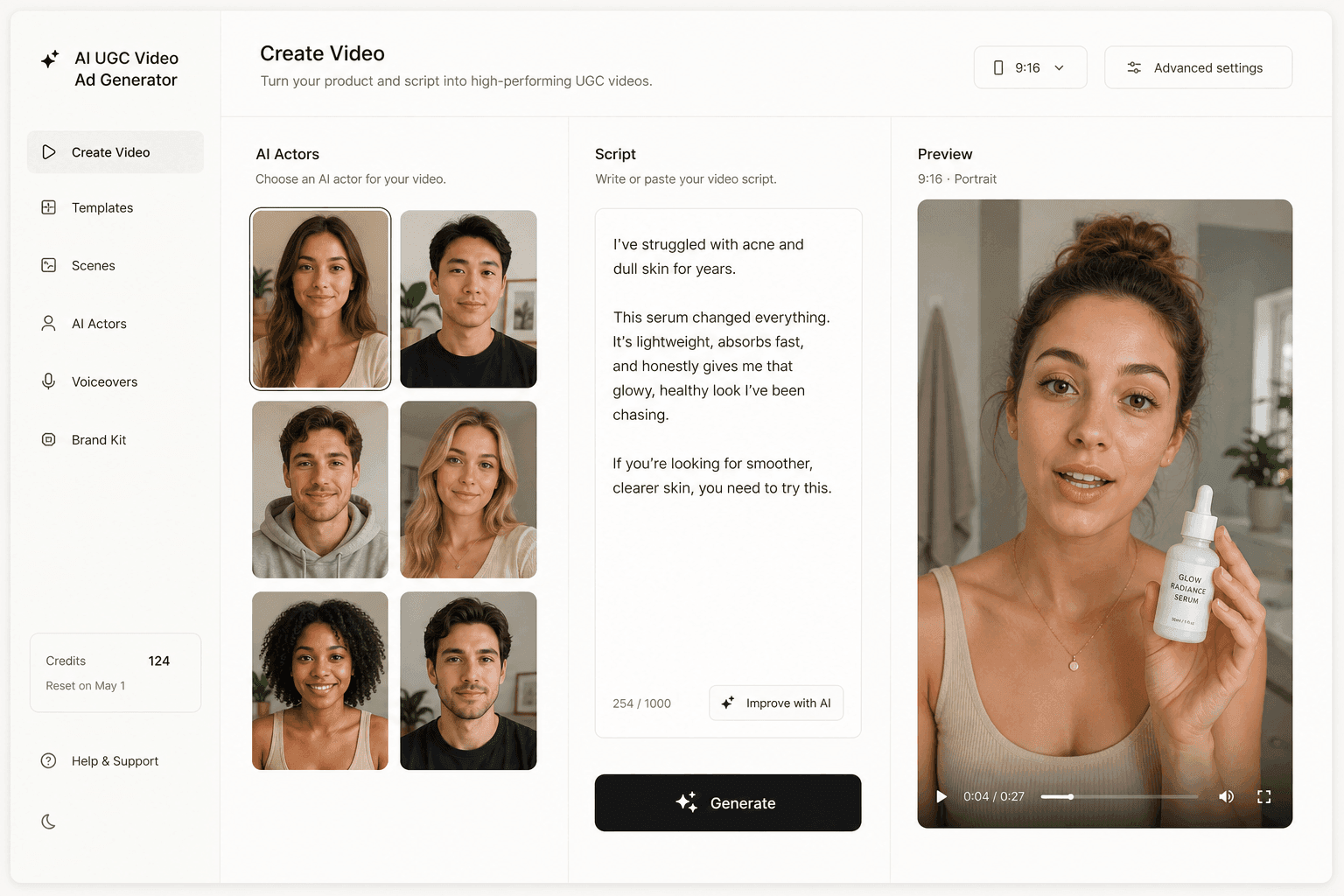
Novoads puts every model and both product-in-hand routes on its entry plan, so the price of a product-led ad is the credits it uses, not the tier it unlocks. You create the actor from a photo of someone holding your product, or use a Discover product template, write or auto-generate a script, and get an ad ready to run:
- A vertical clip with voice, lip-sync and captions, sized for TikTok, Reels and Meta.
- A choice of Seedance, Kling v3 Pro and Google Veo 3.1 on every plan, the same engine families CreateUGC's Scale card lists.
- Voices in 31 languages, with regional accents.
Novoads starts at $15/month (Starter, 200 credits per month). Plus is $49/month (1,000 credits), and Ultra starts at $129/month (3,000 credits) for more volume. All plans are published on novoads.ai/pricing. The headline time is about four minutes. For the realism end of the comparison, see Novoads versus Arcads.
Price the ad you need, not the plan on the toggle
CreateUGC's $19.90 is real, and so is its trial: three days and three videos to judge the output before paying. What the sticker hides is the gate. The moment your ad needs the product in a hand or a second language, CreateUGC's price is Scale's, and the alternatives earn their place by fixing that, or by fixing the face, the link flow or the cost of a first look. Name the reason, price the exact ad you would run, and let a small paid test pick the tool. Every Novoads plan is on the pricing page.
Frequently Asked Questions
How much does CreateUGC cost?
CreateUGC lists three plans. Launch is $19.90 a month billed yearly, which CreateUGC charges upfront as $238.80, or $26.90 billed monthly. Scale is $29.90 a month yearly or $39.90 monthly, and Max is $49.90 yearly or $66.90 monthly. The plans carry 100, 200 and 450 credits a month, which CreateUGC estimates at about 10, 20 and 50 videos. Prices were read from createugc.ai on September 21, 2026.
Does CreateUGC have a free trial?
Yes. CreateUGC offers a 3-day free trial that also includes up to 3 video creations, whichever limit you reach first. It charges the plan you selected on your fourth video or when the trial ends, and it places a pre-authorization hold for the plan amount on your card at signup, which it says is not a charge. Its AutoDS add-on has no free trial.
Is CreateUGC billed monthly or yearly?
Both. The pricing page opens on the annual toggle, which is where the $19.90 Launch price comes from, and a Monthly toggle shows $26.90. On annual billing CreateUGC charges the full year upfront. That is $238.80 for Launch, $358.80 for Scale and $598.80 for Max, each in one payment.
Which CreateUGC plan includes Product in Hand and other languages?
Scale and Max. CreateUGC's FAQ says Product in Hand, custom voices and AI image generation are available on Scale and Max only, and that multi-language voiceovers are available on the same two plans. Launch covers avatar videos with 20 avatars and three auto-generated scripts.
What is the best CreateUGC alternative?
It depends on why you are switching. For product-led UGC on a low monthly entry, Novoads (Starter at $15/month, every model on every plan, the product in hand through a custom actor or a Discover template). For talking-head polish, Arcads. For another paste-a-link workflow, Creatify or JoggAI. For the largest actor library, MakeUGC. For a zero-cost first look, Vidnoz.
How much do CreateUGC alternatives cost?
Read from each vendor's own site on September 21, 2026: Novoads starts at $15/month (Starter, 200 credits) with no trial. JoggAI gives new accounts 200 promotional credits valid for 31 days, then Starter is $29 a month with 12,000 credits. Creatify has a watermarked free plan with 10 monthly credits, then Starter at $39 a month. MakeUGC's Start up plan is $59 a month and starts for $1. Vidnoz lists a $0 plan with a watermark. Arcads publishes no price list; its help centre describes a 3-day trial that converts to its Starter plan.
Key Takeaways
- CreateUGC sells three plans. Launch is $19.90 a month billed yearly ($238.80 charged upfront) or $26.90 billed monthly; Scale is $29.90 or $39.90; Max is $49.90 or $66.90. They carry 100, 200 and 450 credits a month, which CreateUGC estimates at about 10, 20 and 50 videos.
- Every plan opens with a 3-day free trial capped at three videos. CreateUGC charges the selected plan on the fourth video or when the trial ends, and places a pre-authorization hold on the card at signup.
- CreateUGC's FAQ puts Product in Hand, custom voices, AI image generation and multi-language voiceovers on Scale and Max only. Our reading: an ad with the product in an avatar's hand, or in a second language, starts at Scale rather than Launch.
- Pick an alternative by the reason you are leaving: Novoads for product-led UGC on a low monthly entry, Arcads for talking-head polish, Creatify or JoggAI for another paste-a-link workflow, MakeUGC for the largest actor library, and Vidnoz for a zero-cost first test.
- Novoads starts at $15/month (Starter, 200 credits, monthly only) with no trial. Starter reaches every model; the plans differ in credits, not features, and the product goes into a hand through a custom actor or a Discover product template.