Best Vidnoz Alternatives for AI Video and UGC Ads: 7 Tools Compared
Vidnoz is a free-first AI avatar and talking-photo video generator, but its free ads are watermarked and built for spokesperson video, not native UGC. Here are seven alternatives compared on the ad they make, how they start, and where each one fits.

Mauricio Valdivia
·Updated ·11 min

The avatar library isn't the problem. The job is.
A DTC marketer opens Vidnoz to make a TikTok ad for a magnesium supplement. She scrolls a library of more than 1,900 avatars, picks one, pastes a script, and renders. Half a minute later she has a clean video: a good-looking presenter, natural lip sync, a voice that could pass for a real person. Then she looks again. It is a spokesperson reading lines to camera, and the free export has a small Vidnoz watermark in the corner. It is a solid talking-head video. It is not the handheld, filmed-on-a-phone UGC that paid social actually rewards.
That gap, not the size of the library and not the price, is what sends people looking for a Vidnoz alternative. Vidnoz is genuinely good at what it is. The real question is whether that is the ad your product needs, and if it is not, which tool is.
Vidnoz earned its audience. It offers 1,900+ realistic AI avatars, 2,000+ voices, support for over 140 languages, an AI Talking Photo tool that animates a still image, and daily free credits so you can start without a card. For training clips, explainers, and spokesperson video, that is a lot of tool for very little money. The catch only shows up when the job changes from "a person reads my script" to "a real-seeming customer sells my product."
TL;DR: the 7 best Vidnoz alternatives in 2026
The axis that matters is not feature count or price. It is fit: what kind of video you actually need, and how native it has to look. Vidnoz optimizes for volume of polished avatar video. Paid-social UGC optimizes for a clip that does not look like an ad at all. Sort by that first, then by cost.
- Novoads is best for native-accent UGC ads with your product in hand, via a custom actor made from a photo of someone holding it. Start for $15/month (Starter, 200 credits per month).
- HeyGen is best for polished spokesperson and avatar video, the closest like-for-like to Vidnoz.
- Synthesia is best for corporate training and reach across 160+ languages.
- Creatify is best for paste-a-product-URL ecommerce volume, with a watermarked free plan.
- MakeUGC is best for the largest AI-actor library on a $1 trial.
- HeyFish is best for the lowest cost per video, with a free first ad.
- Captions is best for an all-in-one actor plus a built-in AI editor.
Which is right for you comes down to one question before price: does the creator need to hold and demo your product, or just present it? If the ad should feel handheld and native, look at Novoads (with a custom actor made from a photo of someone holding your product), MakeUGC, HeyFish, or Creatify. If you want a clean presenter for training or explainers, which is where Vidnoz is strongest, HeyGen and Synthesia fit better. Then pick the cheapest option that can make that exact ad.
| Tool | Best for | How to start |
|---|---|---|
| Novoads | Native-accent UGC, product in hand via a custom actor | $15/month (Starter) |
| HeyGen | Spokesperson, avatar video | Free tier |
| Synthesia | Corporate training, 160+ languages | Free plan |
| Creatify | Paste-a-URL ecommerce ads | Free plan |
| MakeUGC | Biggest AI-actor library | $1 trial |
| HeyFish | Lowest cost per video | Free first ad |
| Captions | Actor plus built-in editor | Free tier |
What Vidnoz actually is
Before ranking alternatives, it helps to be precise about what you are replacing, because Vidnoz is broader than the "AI video generator" label suggests.
A deep avatar and talking-photo toolkit
Vidnoz is built around synthetic presenters and sheer breadth. Its library runs to 1,900+ realistic AI avatars, paired with 2,000+ voices and support for over 140 languages, so you can put almost any face in almost any language reading almost any script. Beyond the core avatar studio, it packs a wide toolkit:
- Avatars that speak with lip sync in a natural way, reading whatever script you paste to camera.
- An AI Talking Photo tool that turns a single still image into a short speaking clip.
- Custom avatars you can generate from your own videos, not just the stock library.
- An AI Product Avatar that puts your product beside a presenter for a showcase-style clip.
If your job is to produce a high volume of talking-head video across markets, that catalog is genuinely hard to match on price.
The pricing posture is the other half of the appeal. Vidnoz leads with a genuinely free plan, marketing 60 free credits every day, so you can create without a credit card and without committing to a subscription just to see what the tool does. For a hobbyist, a teacher, or a team spinning up internal video, starting free and staying free for light use is a real advantage, and it is the honest reason Vidnoz shows up on so many shortlists.
Where it fits, and where it doesn't
The limits are not about quality. They are about the shape of the output. Vidnoz makes avatar and spokesperson video: a presenter facing the camera, delivering a script cleanly. That is exactly right for e-learning, onboarding, support explainers, and news-style clips, which is where Vidnoz points its own use cases. It is the wrong default for a paid-social ad that has to look like a customer filmed it on their phone.
Two specifics matter for advertisers:
- The free export is watermarked. The plan that makes Vidnoz so easy to try also stamps its output with a Vidnoz watermark, so the version you can ship for nothing is the version you cannot run as a clean ad.
- Avatar delivery is not handheld UGC. Even the AI Product Avatar puts your item beside a presenter rather than in a customer's hands, and an avatar reading to camera and a creator filming your product at arm's length are different creative categories. Paid social has a strong preference for the second.
None of that makes Vidnoz bad. It makes it a talking-head tool, and a talking-head tool is not what a product-led UGC test needs. To see the format Vidnoz is not built for, our guide to what a UGC creator actually is covers it.
Match the tool to the job
The first filter is not price. It is output. The tools here split cleanly into two jobs, and picking the wrong category is the most expensive mistake, because no plan tier fixes a tool that makes the wrong kind of video.
Reach for a UGC-actor tool (Novoads, MakeUGC, HeyFish, Creatify) when:
- The ad should feel handheld and native, like a real customer filmed it.
- The creator should hold, wear, or demonstrate your product on camera (in Novoads, through a custom actor made from a photo of someone holding it).
- You are running paid social and need many angles cheaply, without a watermark on the final cut.
Reach for an avatar or corporate tool (HeyGen, Synthesia), the closest swaps for Vidnoz's core, when:
- You want a polished presenter or spokesperson, not a phone-shot vibe.
- You are making training, explainer, e-learning, or internal-comms video.
- Studio-clean delivery matters more than looking unscripted.
Most people arriving from Vidnoz want the first bucket and did not realize the tool was optimized for the second. If you want the closest like-for-like to Vidnoz instead, start with our best HeyGen alternatives and best Synthesia alternatives rundowns, then come back to the UGC-actor tools below.

The 7 best Vidnoz alternatives in 2026
1. Novoads, best for product-led UGC in many languages
Novoads is a global AI UGC video-ad generator built around the part of the job Vidnoz leaves out: the actor presents your actual product, and the result looks handheld, not studio-clean. You upload a photo of someone holding your product to create a custom actor (stock library actors have empty hands), write or auto-generate a script, and get a vertical ad where the creator holds the item. It runs multiple frontier video models under the hood, and it ships ads in 30+ languages with real regional accents, not translated captions over a neutral voice. Where Vidnoz gives you an avatar that can read in 140 languages, Novoads gives you an ad that sounds like a local creator in the market you are actually selling to.
- Best for: native-accent UGC where the product is on camera.
- Start at: $15/month (Starter, 200 credits per month).
2. HeyGen, best for spokesperson and avatar video
HeyGen is the closest like-for-like to Vidnoz's core: it is built around AI avatars and spokesperson-style delivery rather than handheld UGC. It is excellent for a clean presenter reading a script, explainer videos, and personalized video at scale, with a free entry tier to try it. For an ad that should look like a real customer in a kitchen, it is the wrong category, the same way Vidnoz is; for a polished talking head representing the brand, it is one of the strongest picks. If you liked Vidnoz's avatars but wanted more polish, HeyGen is the natural upgrade.
- Best for: polished spokesperson and avatar video.
- Start at: a free tier.
3. Synthesia, best for corporate training and reach
Synthesia is the enterprise end of avatar video: studio-clean presenters, deep localization across 160+ languages, and a feature set aimed at training, onboarding, and internal communications. Its entry Starter plan is $29 per month, with a free Basic tier to try it. It is not built to look unscripted, so it is a poor fit for native social UGC, but if what you actually valued in Vidnoz was the training-and-explainer use case, Synthesia does that job at a higher production bar.
- Best for: training and 160+ language reach.
- Start at: a free Basic plan.
4. Creatify, best for paste-a-URL ecommerce volume
Creatify's signature is workflow speed for ecommerce: you point it at a product URL and it generates an AI-avatar ad, with batch generation for running many at once. It has a watermarked free plan, so the cost to test is nothing, and it leans more avatar-and-template than native-handheld. For paste-and-go catalog volume it is hard to beat, and it is a meaningful step toward ad-shaped output compared with Vidnoz's general video studio. Our best Creatify alternatives piece goes deeper if it is on your shortlist.
- Best for: URL-to-ad batch volume.
- Start at: a watermarked free plan.
5. MakeUGC, best for the biggest actor library
MakeUGC is a script-first UGC generator with a very large AI-creator library (it advertises 1000+ realistic AI creators), and actors that can present your product. MakeUGC uses a low-friction $1 trial to start; Novoads starts at $15/month (Starter, 200 credits per month) instead. If your priority is sheer variety of faces and accents to test, and you want native UGC rather than avatar delivery, its library depth is the draw.
- Best for: maximum actor variety against one script.
- Start at: a $1 trial.
6. HeyFish, best for the lowest cost per video
HeyFish is a direct AI UGC video-ad generator (pick an actor, drop in your product, get a UGC ad) with price-aggressive positioning built around cheap per-video output. Its entry paid plan is $24.99 a month, and it offers a free first ad so you can see the output on your own product before paying. If your constraint is pure volume on a tight budget, it is the most explicitly cost-led option here.
- Best for: high volume at the lowest cost per video.
- Start at: a free first ad.
7. Captions, best for an all-in-one actor plus editor
Captions (by Mirage) pairs AI creators with a built-in, chat-based AI video editor in one app, so the clip and the edit live in the same place instead of bouncing to a separate tool. Its entry web tier is $24.99 a month, with higher Scale tiers above it and a free tier to start. If you want generation and editing without a second subscription, it is the most complete single workflow on this list.
- Best for: one app for actor and edit.
- Start at: a free tier.
A worked example: testing one supplement
Say you want to find a winning angle for a single magnesium supplement, and you plan to test five:
- A problem-solution hook about sleep.
- A testimonial to camera.
- A morning-routine clip.
- An ingredient explainer.
- An unboxing.
The format rewards running all five, because the winner is rarely the one you would have guessed. The only real questions are what kind of ad each one is and what it costs to find out.
Run that test through Vidnoz and you get five clean avatar reads. That is fine for an explainer, but it reads as a spokesperson rather than a customer, and the free versions carry a watermark. Run the same five angles through a UGC-actor tool and they come back handheld, with the product in frame:
- A published paid entry (MakeUGC's $1 trial, Novoads at $15/month on Starter, 200 credits per month): five real, unwatermarked variations, with the product on camera and a native accent.
- A free first ad (HeyFish): the first cut costs nothing, and the next ones run a few dollars each.
- A watermarked free plan (Creatify): rough cuts at no cost, enough to judge whether the hook and the actor land before you upgrade.
In every one of those paths you get a read on what works, in the right creative format, before you commit to a monthly plan. That is the point of matching the tool to the job first: the cheapest tool that makes native UGC is also the cheapest way to find your winning angle. For a closer head-to-head, our Novoads versus HeyGen breakdown and our best VEED alternatives roundup each go one level deeper.
How Novoads solves product-led UGC ads
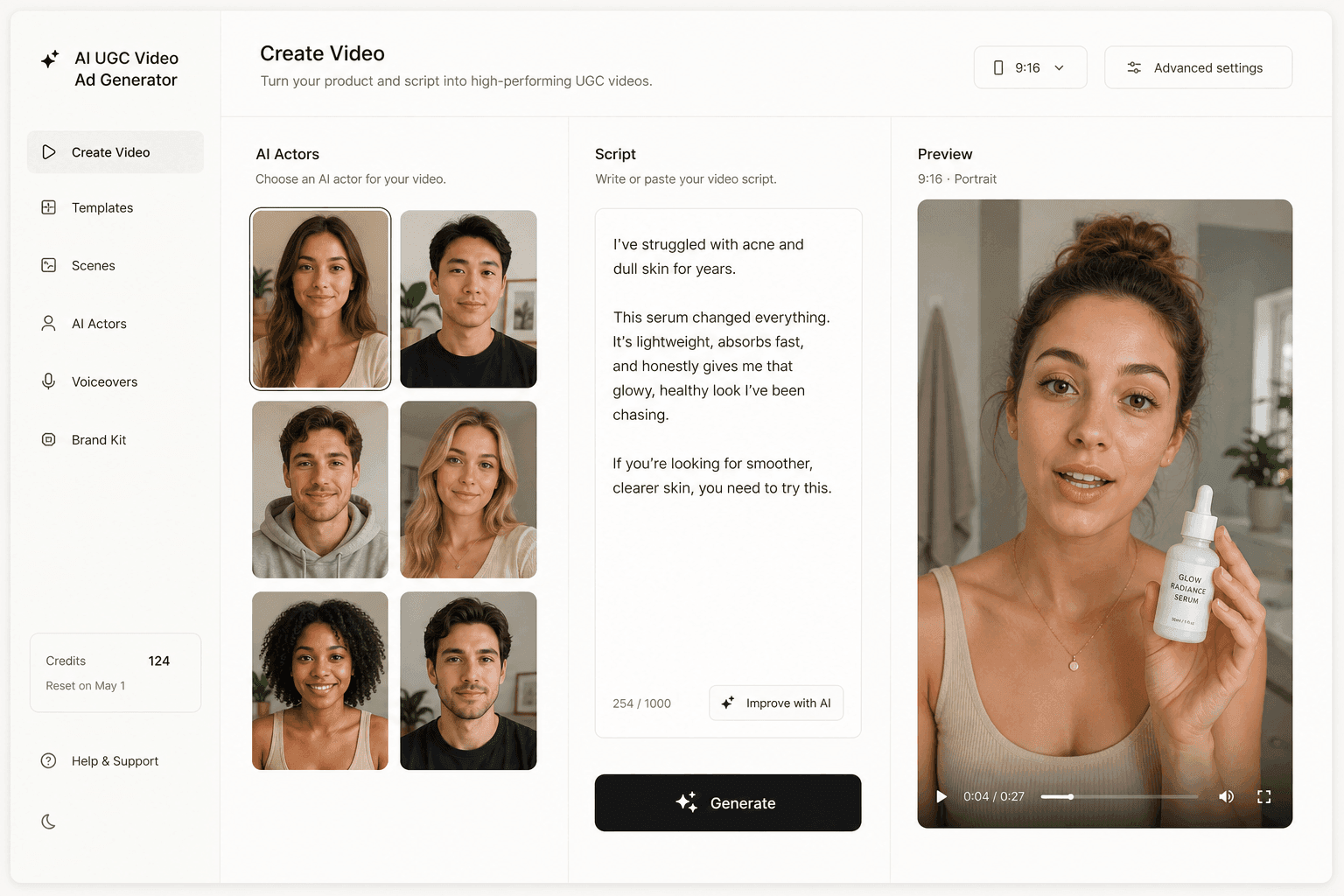
Novoads is built for the exact job that makes teams leave a talking-head tool: an ad where the creator holds your actual product, in a language your audience actually speaks. You upload a photo of someone holding your product to create a custom actor in Novoads, write or auto-generate a script, and get a vertical UGC ad with voice, lip sync, and captions, formatted for TikTok, Reels, and Meta. It runs multiple frontier models so you are not betting on one engine, and it produces ads in 30+ languages with real regional accents rather than a flat translation. The headline time is about four minutes, and a clip runs from about 25 cents for a five-second Seedance 2.0 Mini clip to about $4 for an eight-second Google Veo 3.1 clip, and about $10 for a full 30-second Seedance 2.5 take, instead of a few hundred for a hired creator.
The difference from Vidnoz is not that one is good and the other is not. Vidnoz is an excellent free-first avatar studio, and for training, explainers, and spokesperson video it may be all you need. The split is fit: Vidnoz centers the polished presenter, and Novoads centers the product-in-hand, native-accent ad that paid social rewards, built on a custom actor made from a photo of someone holding your product, without a watermark on the version you actually ship.
Fit is the whole game
The best Vidnoz alternative is not the one with the most avatars or the most generous free tier. It is the one that makes the ad your product needs, in the format the platform rewards, for the least it costs to find out. Vidnoz is a strong, genuinely free avatar studio, and for a spokesperson clip that is a fair place to start. For everyone testing whether AI UGC moves the needle, especially in ecommerce, where the demo is the ad, and in markets where the accent has to be right, the smarter move is to start with a tool built for native UGC, show your product, and let the data pick the winner. You can make your first product-in-hand AI UGC ad with Novoads by turning a photo of someone holding your product into a custom actor, from $15/month (Starter, 200 credits per month). Cancel anytime.
Frequently Asked Questions
What is the best Vidnoz alternative?
It depends on the job, not on a single winner. For product-in-hand UGC ads (through a custom actor made from a photo of someone holding the product) and native-accent delivery, Novoads is the closest fit. For polished spokesperson and avatar video like Vidnoz's core, HeyGen. For corporate training and reach across 160+ languages, Synthesia. For paste-a-product-URL ecommerce volume, Creatify. For the largest AI-actor library on a $1 trial, MakeUGC. For the lowest cost per video, HeyFish. For an actor plus a built-in editor, Captions.
Is Vidnoz actually free?
Yes, it has a genuinely free plan with daily free credits, which is a real strength for light use. The catch for advertisers is that free exports carry a Vidnoz watermark and the format is avatar or spokesperson video. For a clean, native UGC ad you either upgrade to a paid plan or pick a tool built for ads in the first place.
Vidnoz vs HeyGen: which is better?
Both are avatar and spokesperson tools, so they solve the same job. Vidnoz leans free-first with a very large avatar library and a talking-photo tool; HeyGen leans polished avatars and enterprise features. Neither makes handheld, phone-shot UGC by default. If you actually want native UGC ads, a UGC-actor tool like Novoads or MakeUGC is the better category, not another avatar app.
Can a Vidnoz alternative show my product in the creator's hands?
Yes. Novoads is built around product-in-hand UGC: you upload a photo of someone holding your product to create a custom actor (Create Actor > Upload), write or auto-generate a script, and that actor presents your actual product on camera. MakeUGC and HeyFish also pair AI actors with your product. Vidnoz itself has an AI Product Avatar, but the delivery is still avatar-style rather than handheld, filmed-on-a-phone UGC.
Do AI UGC ads actually perform?
User-generated content is the format shoppers trust, because a real-seeming person reads as more credible than a brand talking about itself. AI UGC reproduces that trust signal from a script in minutes for a few dollars, which is what makes testing many ad angles affordable. The tool you pick decides how close the output gets to a real creator and whether you can show your product on camera.
Key Takeaways
- Vidnoz is a free-first AI avatar and talking-photo video generator: 1,900+ avatars, 2,000+ voices, 140+ languages, and daily free credits. The output is a polished spokesperson reading a script, and the free export carries a Vidnoz watermark.
- The reason to look past Vidnoz is rarely its library or its price. It is fit: paid social rewards native, handheld UGC where a real-seeming creator holds and uses your product, not a studio-clean avatar talking at the camera.
- Match the tool to the job. For native product-in-hand UGC, look at Novoads (through a custom actor made from a photo of someone holding your product), MakeUGC, HeyFish, or Creatify. For polished spokesperson or training video, which is Vidnoz's core, HeyGen and Synthesia are the closer swaps.
- Most alternatives let you test cheaply: a watermarked free plan, a free first ad, Novoads at $15/month (Starter, 200 credits per month), other entry tiers from $25 a month, or MakeUGC's $1 trial, so you can validate the format on your own product before committing.
- Novoads fits product-led UGC ads best: a custom actor made from a photo of someone holding your product shows it on camera, it runs multiple frontier models, it ships ads in 30+ languages with real regional accents, and you can start for $15/month (Starter, 200 credits per month).