HeyGen Review for Ads: Where It Wins and Where It Falls Short
A review of HeyGen for advertisers, built from HeyGen's own help center and pages plus dated review data rather than hands-on use: what its avatars, translation and ad tools do well, where its meter and setup fall short, and who it fits.

Mauricio Valdivia
·12 min

The digital twin is strong. The meter just moved.
HeyGen makes a confident promise in its own help center: record a 15-second video of yourself, and its newest model, Avatar V, builds a digital twin that moves and sounds like you. That clip is not the whole kit. The same article asks for a base-look photo as your identity reference, HeyGen's custom-avatar page adds an on-camera consent code, and a voice clone is an optional extra step.
Our verdict for advertisers comes first. HeyGen is a strong pick when the ad is a person talking to camera, above all your own face reused across many ads, or one winning ad shipped in several languages. It is a weaker fit for high-volume UGC testing on a fixed budget, because its meter just moved: between the copy of its credits article archived on September 21, 2026 and the version updated October 13, Video Agent's standard rate went from 40 to 80 credits a minute, and videos made through Zapier, Make or n8n stopped drawing on plan credits.
How this review was built
We have not used HeyGen hands-on. Everything below comes from what a buyer can read before paying, and each source carries its date:
- HeyGen's help center: the Avatar V article (updated September 9, 2026), the credits article (updated October 13, 2026), and the plans and API pricing articles (both updated October 19, 2026).
- HeyGen's own product pages: UGC ads, product placement, translation, custom avatars, security and trust, read on October 20, 2026, plus the pricing page as it showed US dollar prices that day.
- An archived copy of the credits article, captured September 21, 2026, for the before-and-after on the meter.
- Two review platforms: HeyGen's pages on Product Hunt and Trustpilot, read on October 20, 2026.
Where HeyGen's pages disagree with each other, we say so instead of picking one. The one run we show is our own: the same job, a creator-style presenter reading a short product script, made in Novoads and shown near the end with what it cost.
What HeyGen does well for advertisers
Three things stand out, and all of them put a person on camera.
Avatar V turns your own face into a reusable presenter
HeyGen's own comparison post dates the model to April 2026, when Avatar V took over from Avatar IV as the engine behind its digital twins, with Avatar IV still selectable per video. The pitch is a presenter you film once: HeyGen says Avatar V learns your motion, gestures and expressions from a short reference video, then applies them to any photo of you, so the same face can front an ad in a kitchen, an office or a studio without a reshoot. Its Avatar V page adds that wide, medium and close-up shots stay consistent from one recording.
What the setup asks for, across HeyGen's own pages:
- A 15-second recording of yourself, which the help center says teaches the model your movement and expressiveness.
- A base-look photo, the identity reference for every outfit and scene you generate.
- An on-camera consent code, read on camera so HeyGen can verify it is really you.
- A voice clone, optional but strongly recommended by HeyGen.
- A motion-reference video, chosen in Advanced Settings when you generate.
For a founder-led brand, this is the most useful thing HeyGen sells: one recording session can feed a month of ads in different settings and outfits. Plan for more than a quick clip, though. HeyGen's comparison post describes the flow as starting from as little as 15 seconds of webcam footage plus a live consent clip, and its author also recorded a two-minute expressive take as the motion reference.
Translation is the clearest win
HeyGen's translator takes a finished video, lets you choose up to 10 languages at once from a list of 175+ languages and dialects, and re-voices it with lip sync. A brand glossary keeps product names and protected terms from being translated or mispronounced. In the credits article, lip-synced translation costs 6 credits a minute in speed mode and 10 in precision mode.
By our arithmetic on those rates, translating a minute of finished ad costs an eighth of rendering the same minute again on Avatar V at 48 credits. For an advertiser with one winner in English and buyers in Spanish, Portuguese or German, that is a low-cost way to test a new market without a new shoot. Our HeyGen vs Synthesia comparison weighs translating a winner against rendering it again.
The ad plumbing is already built
HeyGen sells UGC-style ads, not only corporate presenters. On its own pages:
- Creator-style presenters: 1,100+ presenters designed to look like everyday creators, not corporate spokespeople.
- Variations: swap presenters, backgrounds, hooks and calls to action to A/B test creative.
- Export: a finished ad in 2 to 3 minutes, in vertical 9:16 or square 1:1, ready to upload straight to Meta Ads Manager or TikTok Ads Manager.
- Products: AI Product Placement combines a packshot and a face photo into a presenter video and lets you review the composite before the full render.
- B-roll: generated Seedance 2.0 clips at 60 credits at 720p and 150 at 1080p, and Veo 3 clips at 90, each regardless of length.
The feature gap between HeyGen and ad-only tools has largely closed, a point our Arcads vs HeyGen comparison makes too. What is left to judge is the look and the cost per usable ad.
Consent, security and your data
HeyGen's homepage says every custom avatar requires on-camera identity verification from the person depicted, and that removal requests are always honored. Its security page says it is SOC 2 Type II certified and lists GDPR and CCPA among the standards it meets. One line deserves a brand's attention: the Trust and Safety page says enterprise customers' data is not used to train HeyGen's models, while non-enterprise customers' data may be, and users may opt out of that training. If your ads carry a founder's face or unreleased product shots, set that opt-out on day one.
What reviewers praise
Product Hunt's AI summary of its 72 HeyGen reviews, read on October 20, 2026, says reviewers mostly praise HeyGen for being easy to learn, fast to use, and capable of realistic avatars and useful multilingual dubbing or translation. HeyGen held a 4.4 rating there that day.

Where HeyGen falls short for UGC-style ads
None of these rules HeyGen out on its own. Together they make it harder to budget for an ad team that tests in bursts.
The credits article changed in four weeks
HeyGen's credits article is the page an ad budget rests on, and two of its lines changed between the copy archived on September 21, 2026 and the version updated October 13:
| HeyGen meter | September 2026 | October 2026 |
|---|---|---|
| Video Agent, standard mode | 40 credits a minute | 80 credits a minute |
| Video Agent, Seedance mode | 120 credits a minute | 240 credits a minute |
| Videos via Zapier, Make or n8n | Plan credits | API credits |
The avatar rates held: Avatar V is still 48 credits a minute and Avatar IV 16 or 31. The same article warns that some accounts see different credit costs or limits depending on when the account was created and its region, and that the cost HeyGen shows before you generate is the one it charges.
Our reading: re-price before every test. A budget built on September's numbers counts any Video Agent work at half its October rate, and an automation that ran on plan credits now needs a separate API balance. If credit math across vendors is new to you, our guide to how AI video credits work covers the basics.
Volume tests hit plan walls
The entry paid plan cannot top up, and each rung handles running out differently, per HeyGen's credits article:
- Creator: no one-time credit purchases; running out means upgrading to Pro.
- Pro: more credits come from moving to a higher Pro tier.
- Business: extra credits in blocks of 100 for $5, with optional auto-reload.
- Rollover: unused monthly credits carry over for one extra billing cycle and are lost if you cancel to the Free plan.
Throughput has a ceiling too. HeyGen's UGC page says there is no fixed limit on how many variations you make from one script, while its credits article notes that the system will not process 20 videos at the same time, so a large batch waits in a queue. On Creator, a test that runs dry mid-week means a plan change, not a top-up.
Its own pages disagree in places
HeyGen's Avatar V article says the model is only available for video-based looks and points photo-based looks to Avatar IV. Its credits article, updated a month later, lists an Avatar V Photo Look at 48 credits a minute. Both are HeyGen's pages, and they say different things, so confirm the option in the product before you plan a photo-based twin.
What reviewers flag
The same Product Hunt summary calls the main complaints serious: inconsistent lip sync, slow processing or moderation delays, confusing plan limits or credit use, and sharply mixed experiences with customer support. On Trustpilot, HeyGen showed a 4.2 TrustScore from 4,660 reviews on October 20, 2026, with 14% of them one-star. Read the one-star reviews that match your use case before you commit a budget.
What HeyGen costs, in brief
The plan ladder on October 20, 2026
As heygen.com/pricing showed it in US dollars on October 20, 2026:
- Free: $0, with 3 watermarked videos a month of up to 1 minute each; the help center says 1 to 3, depending on region.
- Creator: $29 a month, or $24 a month billed annually, with 600 credits.
- Pro: starts at $49 a month for 1,000 credits, with tiers up to 100,000 credits at $4,300; HeyGen's plans article lists access to the Seedance 2.0 engine and 4K export among its additions.
- Business: $149 a month plus $20 per seat, with 1,500 credits.
What a minute of each engine costs
From the credits article as updated October 13, 2026:
- Avatar V: 48 credits a minute.
- Avatar IV: 16 credits a minute on a photo look, 31 on a video look.
- Video Agent: 80 credits a minute in standard mode, 240 in Seedance mode.
- Lip-synced translation: 6 credits a minute in speed mode, 10 in precision mode.
- API: an Avatar V digital twin is $7.20 a minute, charged by the actual seconds generated, and API credits need no plan.
By our arithmetic, Creator's 600 credits cover about 12 minutes of Avatar V a month before anything else draws on them. What a 30-second ad costs on each plan is worked through in our HeyGen pricing breakdown, and our HeyGen vs Creatify comparison shows how a per-minute meter differs from a per-ad one.
Who HeyGen fits, and who should look elsewhere
Where HeyGen fits
- Founder-led brands. You want your own face in many ads without filming each one, and Avatar V's twin is built for that job.
- One winner, many markets. You have an ad that works and want it in several languages, and lip-synced translation is HeyGen's clearest strength.
- Teams that already make presenter video. Training or explainer video comes out of the same seat, and Business adds seats at $20 each.
- Builders. Your production runs from your own code, and the pay-as-you-go API works without any plan.
Where to look elsewhere
- Handheld creator testimonials at volume. HeyGen can make them, but you pay for a broad platform and use one corner of it. Our HeyGen alternatives guide compares seven tools built closer to that format.
- Fixed budgets with spiky tests. Creator cannot top up, and the October update showed how fast the math can move.
- Buyers who need the rate in writing first. HeyGen says credit costs can differ by account creation date and region.
Five checks to run on the Free plan first
HeyGen's pricing page says the Free plan includes up to 3 videos a month and limited trial access to Avatar IV, Video Agent and lip-sync translation. That is enough to test what matters for ads before you pay:
- Lip sync on your own script. Product Hunt reviewers name inconsistent lip sync as a main complaint, so judge it on your words, not a demo.
- The credit cost on screen. HeyGen charges what it shows before you generate and says rates can vary by account, so note the figure for yours.
- The render time. Its UGC ads page promises 2 to 3 minutes per finished ad; time your own.
- The plan line for the engine you want. The Seedance 2.0 engine inside Video Agent and B-roll is listed as a Pro addition.
- The training opt-out. Set it before you upload a real face or a product that has not launched.
How our own comparison page frames it
Our comparison page draws the line where we think ad buyers feel it: a phone-shot look, the product in hand, several video engines in one account, render speed. It is our pitch, not a test. HeyGen's pages answer some rows for themselves: its UGC ads page promises renders in 2 to 3 minutes, and its credit table prices Seedance 2.0 and Veo 3 clips.
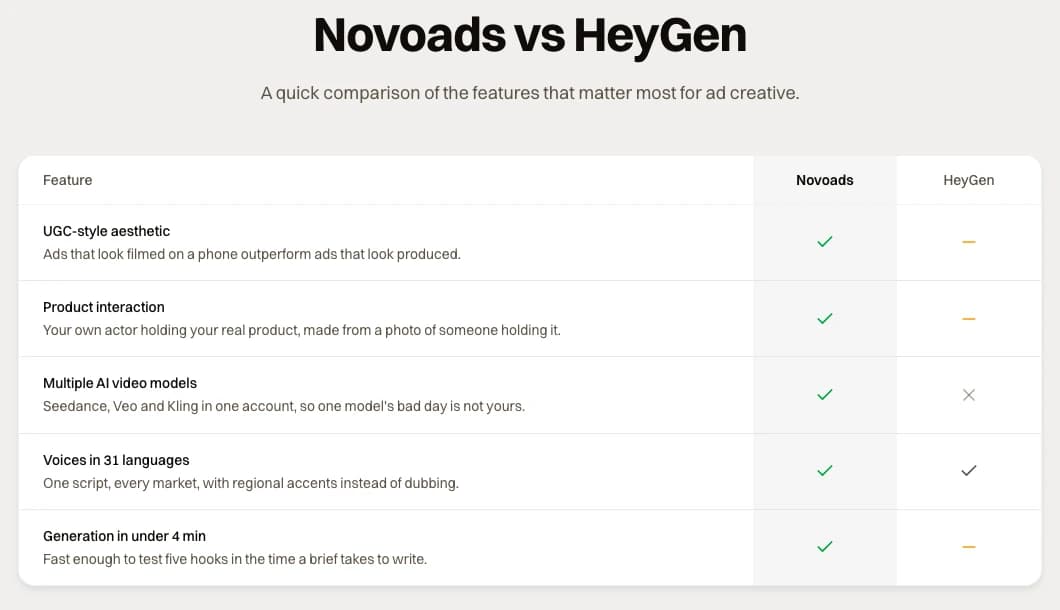 Screenshot: novoads.ai/alternatives/heygen, the Novoads vs HeyGen feature table, taken 2026-10-20
How Novoads handles the same job
The run: a soy-candle script, read by a creator with a mic
The job HeyGen's UGC generator sells is a creator-style presenter reading a short product script, cut vertical for paid social. We ran that job in Novoads on October 9, 2026, through our connector: a stock talking actor, a woman holding a small microphone in a living room, reading 14 seconds of copy for a soy candle. The script, verbatim: "I've been trying to make my apartment feel less like an office since I started working from home. Lighting a soy candle at six is now my signal that work is over. The whole room smells like cedar for hours. Link's below."
It rendered in 1 minute 33 seconds and said the script word for word, which we checked against a local transcript. It cost 200 credits at 720p. Our talking actor bills by the started minute, so any ad up to 60 seconds costs 200 credits at 720p, or 100 at 480p.
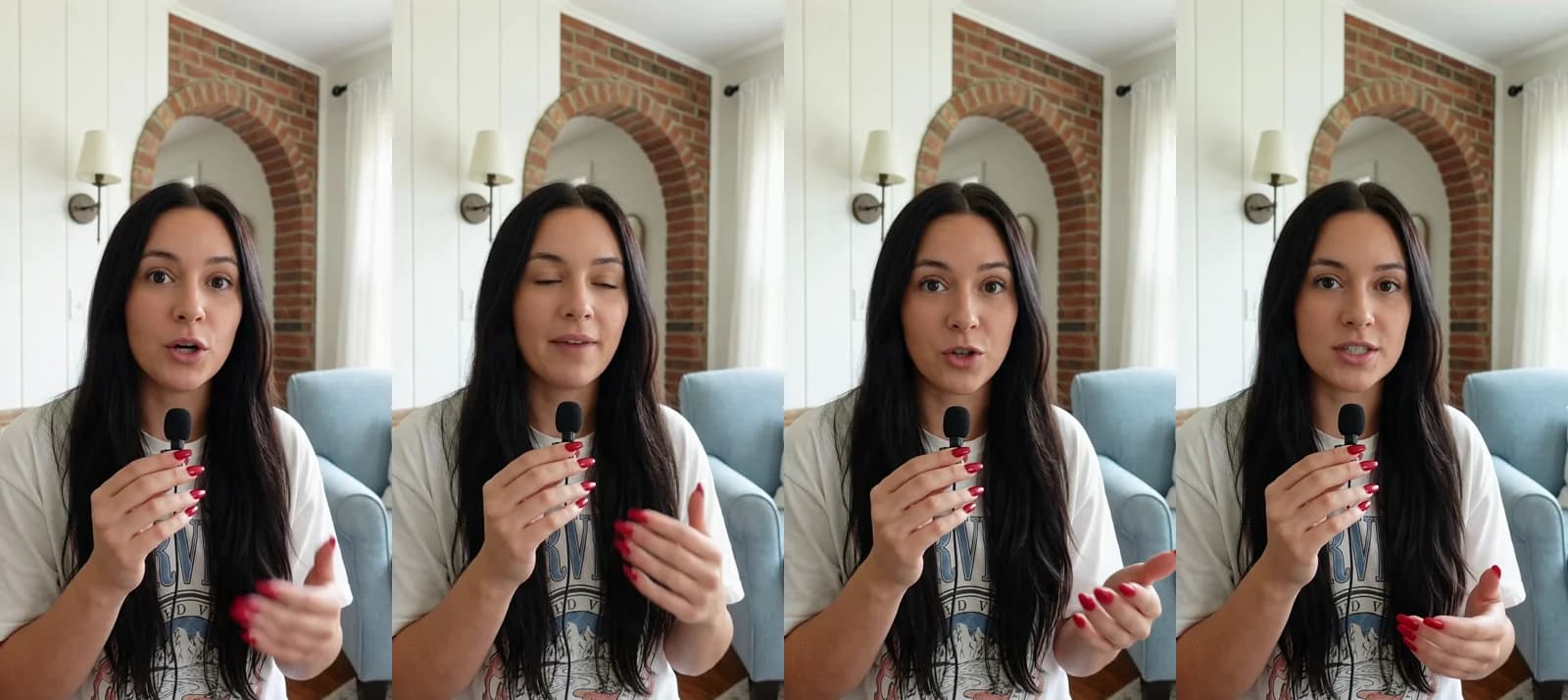 Talking actor · a creator with a small mic reads a 14-second soy-candle script, made through the Novoads connector · 200 credits at 720p · rendered 2026-10-09
What the run showed, and what it did not
- It showed the look most UGC ads chase: a creator at home with a small handheld mic rather than a studio presenter, from a stock actor and no recording of our own, saying the script exactly as written.
- It did not show the product. The candle never appears, because a stock actor's hands are empty. To put your product in hand, Novoads needs a custom actor made from a photo of someone holding it, or one of the Discover product templates, which swap your product into a template creator's hand.
Two concessions, plainly. HeyGen's translator lists 175+ languages and dialects, while our voices cover 31 languages, so for localization HeyGen has the longer list. And if the face you want is your own, Avatar V is built for exactly that. Where Novoads fits is the stranger-creator format in the strip above, made from a script in minutes, with Seedance 2.0 and Google Veo 3.1 in the same account for product shots. The side-by-side is on our Novoads vs HeyGen page, and our Novoads vs HeyGen post walks through the handheld-versus-spokesperson choice.
The face is the asset. The meter is the risk.
HeyGen's best offer to an advertiser is a presenter it can reuse: your own face from one recording session, or one ad in ten languages from one render. Its weak spot is predictability, with two meters rewritten inside four weeks and rates that can differ by account. Buy it for the face, and re-price it before every test.
Frequently Asked Questions
Is HeyGen a safe platform to use?
HeyGen's security page says it is SOC 2 Type II certified and lists GDPR and CCPA among the standards it meets, and its homepage says every custom avatar needs on-camera identity verification from the person shown. One detail matters for brands: its Trust and Safety page says enterprise customers' data is not used to train its models, while non-enterprise customers' data may be, with an opt-out. On Trustpilot, HeyGen showed a 4.2 TrustScore from 4,660 reviews on October 20, 2026, with 14% of them one-star. These are HeyGen's own statements and public ratings; we have not audited them or used HeyGen hands-on.
What is better than HeyGen AI?
That depends on the ad you run. For a presenter talking to camera, your own digital twin, or one ad translated into many languages, HeyGen covers the job well on paper. For handheld UGC-style ads tested at volume, tools built only for that format can fit better, and our HeyGen alternatives guide compares seven of them by price and fit. Whatever you pick, run one real script through it before you commit a budget.
Is HeyGen AI free or paid?
Both. As HeyGen's pricing page showed it in US dollars on October 20, 2026, the Free plan costs $0 and includes 3 watermarked videos a month of up to 1 minute each, and its help center says Free users get 1 to 3 videos depending on region. Paid plans begin with Creator at $29 a month, or $24 a month billed annually, for 600 credits. Pro starts at $49 a month for 1,000 credits, and Business costs $149 a month plus $20 per seat.
Is HeyGen good for making UGC-style ads?
It can make them. HeyGen sells 1,100+ creator-style presenters, lets you swap hooks and calls to action for A/B tests, and says a finished ad exports in 2 to 3 minutes as a 9:16 or 1:1 file you can upload to Meta or TikTok Ads Manager. Its standouts for ads are a digital twin of your own face and lip-synced translation. Check the meter before a big test: Video Agent's standard rate doubled to 80 credits a minute by HeyGen's October 13, 2026 update, and the Creator plan cannot buy one-time credits.
Key Takeaways
- HeyGen is strongest for advertisers when the ad is a person talking to camera: Avatar V turns your own face into a reusable presenter, and its translator ships one finished ad into up to 10 languages at once.
- HeyGen says Avatar V builds a digital twin from a 15-second video, but the setup also asks for a base-look photo and an on-camera consent code, and a voice clone is an optional extra step.
- The meter just moved: between the copy archived on September 21, 2026 and the October 13 update of HeyGen's credits article, Video Agent went from 40 to 80 credits a minute in standard mode, and videos made through Zapier, Make or n8n now need API credits.
- As shown in US dollars on October 20, 2026, HeyGen runs from a $0 Free plan with 3 watermarked videos a month to Creator at $29 a month for 600 credits, with Pro and Business above it; Creator cannot buy one-time credits.
- We have not used HeyGen hands-on. Our like-for-like run of the same job in Novoads, a 14-second creator-style ad, cost 200 credits at 720p and read its script word for word.