Kling vs Seedance for AI Video Ads: Native Audio, 30-Second Takes, and Which Wins
Kling 3.0 vs Seedance 2.5 for ad makers: one ships a unified video, audio, and image model; the other brings 30-second single-pass takes and up to 50 references. Here is the head-to-head by realism, audio, control, length, resolution, and cost.

Mauricio Valdivia
·Updated ·11 min

One Ships a Whole Toolbox, the Other Promises the Longest Take
A media buyer opens the model picker on a Monday. Two names she has read about all week sit next to each other, and she has one ad to ship by Friday. One is available right now and does a bit of everything. The other is the model everyone is quoting, the one that promises a full 30-second take in a single generation, and it is not out yet.
That is the whole choice, compressed. This is not a pixel-peeping quality war between two shipping models. It is a comparison between a model you can run today and a model you can only read about, which changes what "better" even means.
Kling 3.0 is a unified system: it folds text-to-video, image-to-video, frames, referencing, storyboarding, and sound into one model that is live on its host. Seedance 2.5 is ByteDance's announced next model, and its pitch is length and control at a scale nobody ships yet. Below is the head-to-head that matters for ad makers, dimension by dimension, and an honest read on which one to reach for depending on what you are actually making.
Editor's note, September 21, 2026: this comparison was written in early July 2026, when Seedance 2.5 was announced but not yet released. It has been on Novoads since August 2026, with single takes of up to 30 seconds at 480p, 720p or, since September 21, 2026, 1080p (no 4K); a 5-second clip is 35 credits at 720p and 60 at 1080p. The July framing below, a model you can only read about, is kept as the record of that month; the FAQ carries the current status.
The Quick Answer, Before the Deep Dive
If you only read one section, read this one. The verdict is not a single winner; it is a fork.
Use Kling 3.0 when the ad has to exist this week. It is live, it covers the modes an ad needs in one model, and it gives you shot-level direction (storyboarding, element references, start and end frames) without leaving the tool. For a variant set of short, sound-on hooks, it is the pragmatic pick.
Use Seedance 2.5 when the format itself is a long, unbroken take, and you can wait for it to ship and prove out. A native 30-second clip with no seams is a genuinely different unit of work, and the 50-reference consistency story is built for testing many variations of the same character and product. It is the bet for the long single-shot spot, once it is testable.
Here is the same split as a spec sheet. The point of the table is not to crown a model; it is to show you which rows are settled and which are still someone's slide.
| Dimension | Kling 3.0 | Seedance 2.5 |
|---|---|---|
| Status | Live on fal | Announced, pre-launch |
| Clip length | 3 to 15 seconds | Up to 30 seconds (announced) |
| Resolution | Up to 1080p | 4K reported, unconfirmed |
| Native audio | Yes | Yes (announced) |
| References | Element and video character ref | Up to 50 inputs (announced) |
| Editing | Multi-shot storyboarding | Region-level re-draw (announced) |
| Host price | From $0.168/s | Not published yet |
Notice how many of Seedance's cells carry "announced." That is the single most useful thing to internalize before comparing anything else. If you want the platform-level version of a same-price face-off between these two families, the Seedance vs Kling breakdown for UGC ads covers the shipping pair inside one tool.
What Kling 3.0 Actually Does
Kling 3.0 is best understood as a consolidation play. Where a lot of the field ships one model for text-to-video and a separate flow for image-to-video, Kling puts the ad maker's whole shot list into one system.
One model, many modes
Per its host, "Kling 3.0 supports text-to-video, image-to-video, start and end frame-to-video, element referencing (including video character reference), multi-shot storyboarding, and native audio generation." Read that as an ad checklist rather than a feature list. Text-to-video is your idea from a prompt. Image-to-video animates a product still. Start and end frames pin the first and last beat so a loop lands. Element and video character referencing keep the same face and product across takes. Multi-shot storyboarding lets one generation carry more than one camera setup.
The value for advertising is not any single mode; it is that they live together. You are not exporting a still out of one tool to feed another. The consistency work happens inside the model, which is where most of the wasted hours hide in an AI ad workflow. A typical fragmented pipeline looks like this: generate a talking clip in one tool, a product shot in another, then fight to make the same face and the same bottle appear in both. Kling collapses that into a single generation with references attached, so the presenter in your hook and the presenter in your call-to-action are the same person by construction, not by luck. For a media buyer running a dozen angles a week, that is the difference between a morning of setup and an afternoon of it.
Native audio and multilingual voice
Kling 3.0 generates sound with the picture. Its host page lists "native audio, multi-shot storyboarding, and real-world physics via a fast serverless API," and its audio spans multiple languages: the model documentation describes "multilingual audio (Chinese, English, Japanese, Korean, Spanish)." For a hook that has to work sound-on in the first two seconds of a feed, an audio track generated in step with the motion is one less sync problem to solve later.
Where its resolution and length land
Here is the row people get wrong, so it is worth being flat about it. According to fal, "both Kling O3 and V3 output up to 1080p with flexible durations from 3 to 15 seconds." Not 4K. The 4K number that floats around Kling comes from reseller and aggregator pages, not the host that actually serves the model, so 1080p is the figure to plan around. Fifteen seconds is a healthy ceiling for a hook or a single-beat spot, and the 3-second floor is genuinely useful for cheap b-roll and quick cutaways.
What Seedance 2.5 Promises, and What Is Confirmed
Seedance 2.5 is the more exciting spec sheet and the less certain one. Everything below is a reported figure from ByteDance's announcement, not a measured result, and that caveat is load-bearing.
The 30-second single-pass take
The headline is length. As The Decoder reported from the FORCE conference, Seedance 2.5 generates single clips "up to 30 seconds long without any post-stitching," complete with scene changes inside one generation. That matters because a 30-second spot built from short clips is really six generations plus an afternoon of matching lighting and hiding cuts. A native long take deletes the assembly step, which is the part that quietly eats an ad team's time. We walked through why that single take changes the math in what Seedance 2.5 is.
Fifty references and region-level edits
The second pitch is control. The announcement describes processing "up to 50 additional inputs at once," mixing reference images, audio, and video, and it adds region-level editing: coverage describes "editing that re-draws part of a frame without touching the rest." Read together, those are a consistency toolkit. Fifty references keep a character, a product, and a look stable across a whole variant set, and region-level editing lets you swap a product or fix a background without regenerating the entire clip. For an ad team, the region-level edit is quietly the more valuable of the two. Regenerating a whole clip to change one label means re-rolling the dice on everything else in the frame, the lighting, the motion, the face, and hoping the good take survives. Editing only the region you care about means a winning spot can be localized, re-flavored, or corrected without gambling away the parts that already work. If that lands as promised, it turns a single approved clip into a family of variants at a fraction of the regeneration cost. The catch, again, is that "if" is doing real work until the model ships.
Announced, not shipped: read the specs honestly
One caveat belongs up front, not in a footnote. As of early July 2026, Seedance 2.5 is announced, not generally available; it reached enterprise customers through Volcano Engine first. So the motion quality, the prompt adherence, and the real cost per clip are open questions until the model is in hand. The resolution claim is the clearest example: 4K is reported in press coverage but not confirmed on a primary spec sheet, so it does not belong in a plan yet. A launch is a promise. A benchmark is a measurement. This is still a promise.

Realism and Motion: the part specs do not settle
Length and reference counts are easy to tabulate. The thing that actually decides whether an ad reads as real is harder to put in a cell, and it is where a shipping model has a structural advantage over an announced one.
Physics versus length as different bets
Kling's host names "real-world physics" as part of the model's pitch, and physics is what sells a product demo: liquid that pours like liquid, fabric that falls like fabric, a hand that grips a bottle the way a hand does. Seedance is betting that a longer continuous take is the bigger unlock, because a 30-second shot that holds together is a different kind of believable than six stitched clips. Both bets are reasonable. They optimize for different failure modes: Kling for the per-second plausibility of the motion, Seedance for the continuity of the whole spot.
Why hands-on beats a benchmark right now
No spec row tells you how a model handles the awkward middle of a shot, the moment a face turns or a product rotates. That only shows up in generations. For Kling 3.0 you can find that out this afternoon. For Seedance 2.5 you cannot yet, which is the honest reason a comparison of these two cannot end in a clean "X wins on realism." The realism verdict is deferred by definition. If you want a shipping-model realism read today, the Seedance 2 vs Veo 3 comparison pits two available models against each other.
The Dimensions That Decide an Ad
Strip away the hype and an ad model is judged on a short list: does it sound right, does it stay consistent, how long can it hold a shot, how sharp is the finish, and what does it cost. Here is where each model lands on the ones that move a decision.
Native audio and control
Both models target sound-on output, so audio is a wash between them at the spec level. Control is where the daylight is right now. Kling gives you shot-level direction you can use today: storyboarding for multiple setups, element and character references for consistency, frames to pin the beats. Seedance's control story is broader on paper (50 references, region-level re-draw) but unavailable to test. If your bottleneck is keeping ten variants of one character on-model, Kling is the tool you can act on this week; Seedance is the one to watch.
Clip length, resolution, and cost per second
Length is Seedance's clearest edge, on paper: up to 30 seconds announced versus Kling's 3 to 15. Resolution runs the other way in terms of what is confirmed: Kling is a known "up to 1080p," and Seedance's 4K is reported but unverified. The model with primary-confirmed 4K for ads today is neither of these two; it is Veo 3.1, which its maker lists at "1080p and 4K." On cost, Kling has a published host number (fal prices it pay-per-second, where "text-to-video starts at $0.168/s"), while Seedance 2.5 has no public price yet, one more reason its column reads as a forecast. For the full field, the best AI video ad platforms rundown puts these numbers in context.
A Worked Example: Ten Variants of One Serum Ad
Say you are launching a vitamin-C serum and need ten UGC-style variants to find a winner: different hooks, two on-camera presenters, and a couple of pure product-in-hand cutaways. Here is how the choice plays out with what actually ships.
For the presenter hooks, you want a face that stays identical across takes and speaks with the right accent. That is Kling's referencing plus native audio, generated today, in 15-second clips that fit a hook. For the product cutaways, the 3-second Kling floor is your cheapest unit: a bottle rotating in the light, no dialogue, generated for cents. For a single 30-second "day in the life" hero spot with no cuts, that is the Seedance 2.5 use case exactly, so you note it as a fast follow and ship the ten short variants now rather than waiting.
How do you know it worked? For the presenter hooks, watch the first-second retention and whether the accent reads as native to the audience you are targeting; a face that stays consistent across takes but sounds imported will still lose. For the product cutaways, the test is simpler: does the bottle behave like a real object under real light, and does the three-second clip earn its place as a pattern interrupt in the edit. Those are things you can only judge by running the model and watching the output, which is exactly why the shipping half of this comparison is the actionable half.
The lesson is not that one model is better. It is that eight of your ten variants have a home in a shipping model this week, and the tenth is a reason to keep watching the announced one. The model that ships an ad beats the model that describes one. Testing many angles is the whole game, and you can read the argument for volume over polish in Seedance 2.0 vs Veo for ads.
How Novoads Fits: run the shipping engine today
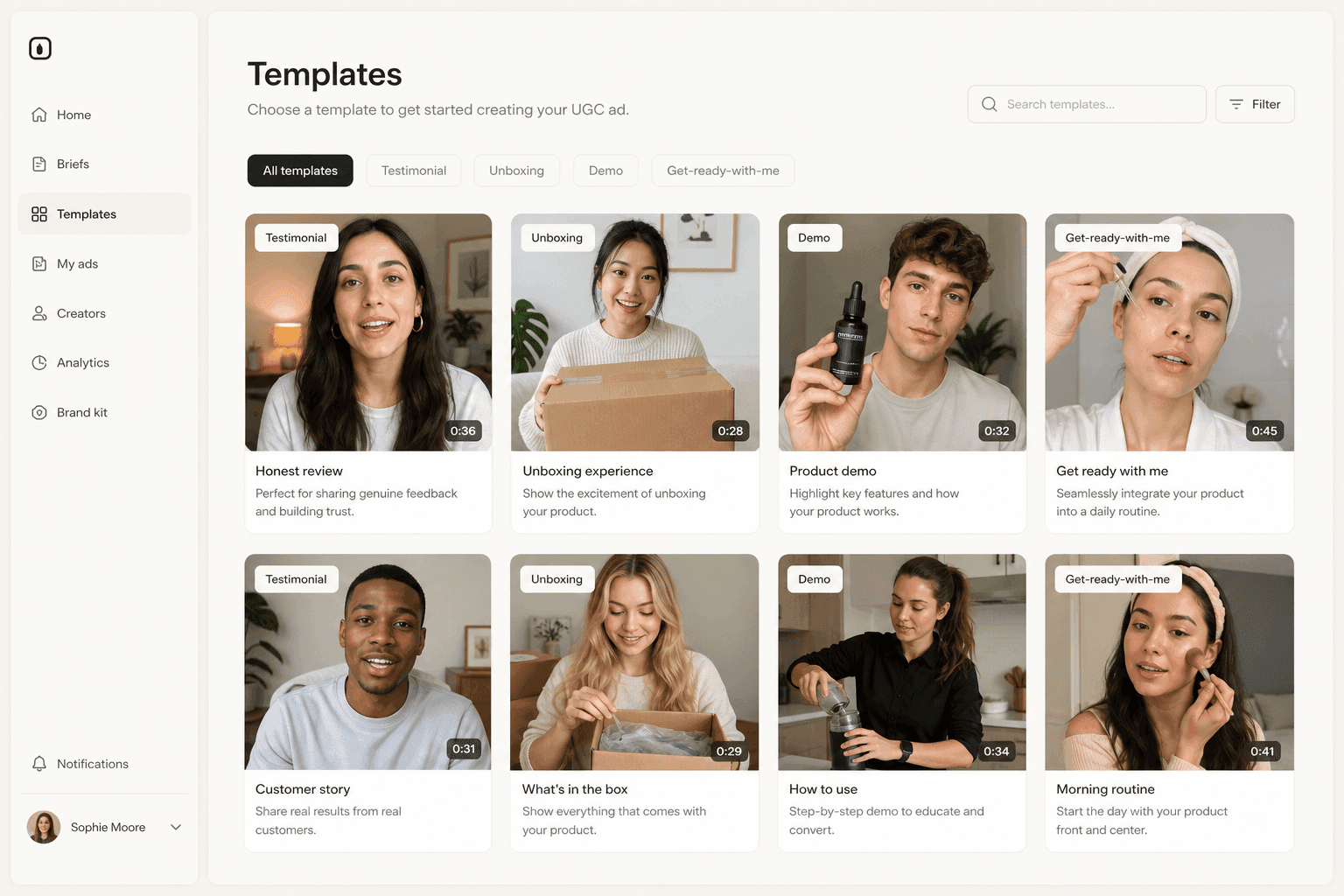
Novoads is a global AI UGC video-ad generator, and it already runs the half of this comparison you can act on. Kling v3 Pro and Seedance 2.0 are both live in the platform, next to Google Veo 3.1, so you switch engine per shot inside one project instead of stitching tools together. You upload a product photo, write or auto-generate a script, pick an AI actor, and export a vertical ad in 30+ languages with real regional accents, usually in a few minutes.
The cost is concrete, not a forecast: a 5-second Kling v3 Pro clip is 10 credits and a 5-second Seedance 2.0 clip at 720p is 23, about 49 cents and $1.13 at the Plus rate, versus the $200 to $500 a human creator charges per deliverable. That gap is the real reason model choice matters less than model access, a point we make in full in the case for AI versus human UGC creators. Seedance 2.5 has since shipped and joined the rotation the same way, at 35 credits for a 5-second 720p clip or 60 at 1080p. You can start on Novoads at $15 per month (Starter, 200 credits), and cancel anytime.
Length Is a Promise; Control Is What Ships an Ad
The tidy way to end a versus post is to name a winner, but the honest read here is a fork in time. Seedance 2.5 has the more thrilling spec sheet, and if the 30-second take holds up, it changes what a single generation can be. Kling 3.0 has the less thrilling and more useful property: it exists, it does the modes an ad needs, and you can run it before lunch. For the spot due Friday, buy the take you can ship. Keep the announced model on a short leash and test it the day it lands.
Frequently Asked Questions
Kling 3.0 vs Seedance 2.5: which is better for ads?
It depends on whether you need a variant set or a long single take. Kling 3.0 is live on fal as a unified model (text-to-video, image-to-video, frames, element referencing, storyboarding, and native audio) at up to 1080p and 3 to 15 seconds, so it is the pick for shipping a variant set this week. Seedance 2.5, on Novoads since August 2026, has a headline 30-second single-pass take and up to 50 reference inputs, so it is the pick for a long single-shot spot.
Does Kling 3.0 output 4K?
Not according to its host. fal, which serves the model, lists Kling 3.0 (both the O3 and V3 variants) at up to 1080p with durations from 3 to 15 seconds. The 4K figure circulates on reseller and marketing pages, but it is not confirmed on the host surface, so treat 1080p as the number you can actually plan around. If a confirmed-4K finish is the requirement, Veo 3.1 is the model whose maker lists 4K, though Novoads renders it at up to 1080p.
Is Seedance 2.5 available yet?
Yes. It has been on Novoads since August 2026, with single takes of up to 30 seconds at 480p, 720p or, since September 21, 2026, 1080p (no 4K); a 5-second clip is 35 credits at 720p and 60 at 1080p. When this comparison was written in early July 2026 it was announced but pre-launch: ByteDance unveiled it at its Volcano Engine FORCE conference and reached enterprise customers through Volcano Engine first.
Do both Kling and Seedance generate sound?
Yes, both target sound-on output. Kling 3.0 lists native audio generation with multilingual voice across Chinese, English, Japanese, Korean, and Spanish. Seedance 2.0 already generates native audio on fal, and the 2.5 announcement keeps audio in the reference mix. Sound is not the tiebreaker between these two; length, control, and what actually ships are.
What is the 30-second single-pass take, and why does it matter for ads?
Most AI video models generate four-to-ten-second clips, so a 30-second spot means generating several and stitching them, then matching lighting and motion across the cuts. Seedance 2.5 produces a single clip of up to 30 seconds in one pass with no post-stitching, which removes that assembly step and the seams you pay to hide. It is the model's whole pitch, and on Novoads it has been testable since August 2026.
Can I use Kling or Seedance in Novoads today?
Yes. Novoads runs Kling v3 Pro and Seedance 2.0 alongside Google Veo 3.1, so you can ship a real AI UGC ad this week; a 5-second clip is 10 credits on Kling v3 Pro and 23 on Seedance 2.0 at 720p, about 49 cents and $1.13 at the Plus rate. Seedance 2.5 shipped and joined the rotation in August 2026, at 35 credits for a 5-second 720p clip and single takes of up to 30 seconds, and it renders 1080p since September 21, 2026, at 12 credits a second (60 for 5 seconds). The entry plan is $15 a month (Starter, 200 credits), and you can cancel anytime.
Key Takeaways
- Kling 3.0 ships today on fal as a unified model: text-to-video, image-to-video, start and end frame, element referencing, multi-shot storyboarding, and native audio in one system, at up to 1080p and 3 to 15 seconds per clip.
- Seedance 2.5 was ByteDance's announced next model when this comparison was written in July 2026, with reported specs of a single 30-second take with no post-stitching, up to 50 reference inputs, and region-level editing, and the comparison below treats every number as a claim, not a measurement. It has been on Novoads since August 2026, at 35 credits for a 5-second 720p clip, and since September 21, 2026 at 1080p too (60 credits for 5 seconds).
- The real split is length versus control. Seedance is betting on the longest native take; Kling is betting on many modes and shot-level direction you can run this week.
- Resolution is where the honest reader slows down: fal lists Kling at up to 1080p, and Seedance 2.5's 4K was reported in July but never confirmed; on Novoads it renders up to 1080p. Veo 3.1 is the model whose maker lists 4K, though Novoads renders it at up to 1080p.
- You can run Kling v3 Pro and Seedance 2.0 in Novoads now, 10 credits for a 5-second Kling v3 Pro clip and 23 for a 5-second Seedance 2.0 clip at 720p, upload a product photo, write or auto-generate a script, and ship in 30+ languages with real accents. The entry plan is $15 per month (Starter, 200 credits), and you can cancel anytime.