
Novoads vs HeyFish: Lowest Cost per Video or Native-Accent Depth
Novoads and HeyFish both generate AI UGC ads. HeyFish is engineered for the lowest cost per video. Novoads centers product-image input, native regional accents, a frontier-model bench, and ad-ready output. Here is how they compare and when to pick each.

Mauricio Valdivia
·10 min

Both make AI UGC ads. Cost or accent depth decides.
A DTC founder pricing out UGC ads opens HeyFish first, and the number does its job. Roughly $2 per video, a $24.99/mo entry plan, and a free first ad you can make in about a minute. It is a real, direct AI UGC generator: pick an actor, drop in your product, get an ad. On raw cost per video it is one of the most aggressive tools in the category, and that is not marketing fluff. It is the whole pitch, and it is a good one.
So the honest question is not whether HeyFish is cheap. It is. The question is what the cheapest unit cost does and does not buy when an ad has to sound local in three markets and ship ready to post.
This is a head-to-head, not a hit piece. HeyFish has earned its price-first reputation, and for a lot of buyers that is exactly the right axis. Novoads optimizes for a different bet: that the bottleneck was never the per-video price, it was the finished, local, product-led ad. Where you land depends on which of those is your real constraint. If you want the wider field, our best AI video ad platforms guide covers more tools; this one is the close-up.
What each one is built for
Before the dimensions, name what each tool optimizes for, because that is the comparison in miniature.
HeyFish: the cost-per-video leader
HeyFish is built to make a believable UGC ad for the lowest possible unit cost. It markets itself plainly as an "AI UGC Video Ad Generator", you pick an AI actor and drop in your product, and the headline economics are the point: about $2 per video and a $24.99/mo entry plan, with the first ad free so you can see the output before you pay. For a brand whose constraint is creative volume on a tight budget, that is a clean, honest value proposition. The fewer dollars per render, the more variations you can test, and testing volume is how paid social is actually won. Every winning ad fatigues, and the only durable answer is a steady pipeline of new creatives to swap in. A tool that drives the marginal cost of one more variation toward zero is solving a real problem, and that is the bet HeyFish makes.
Novoads: the product-and-accent specialist
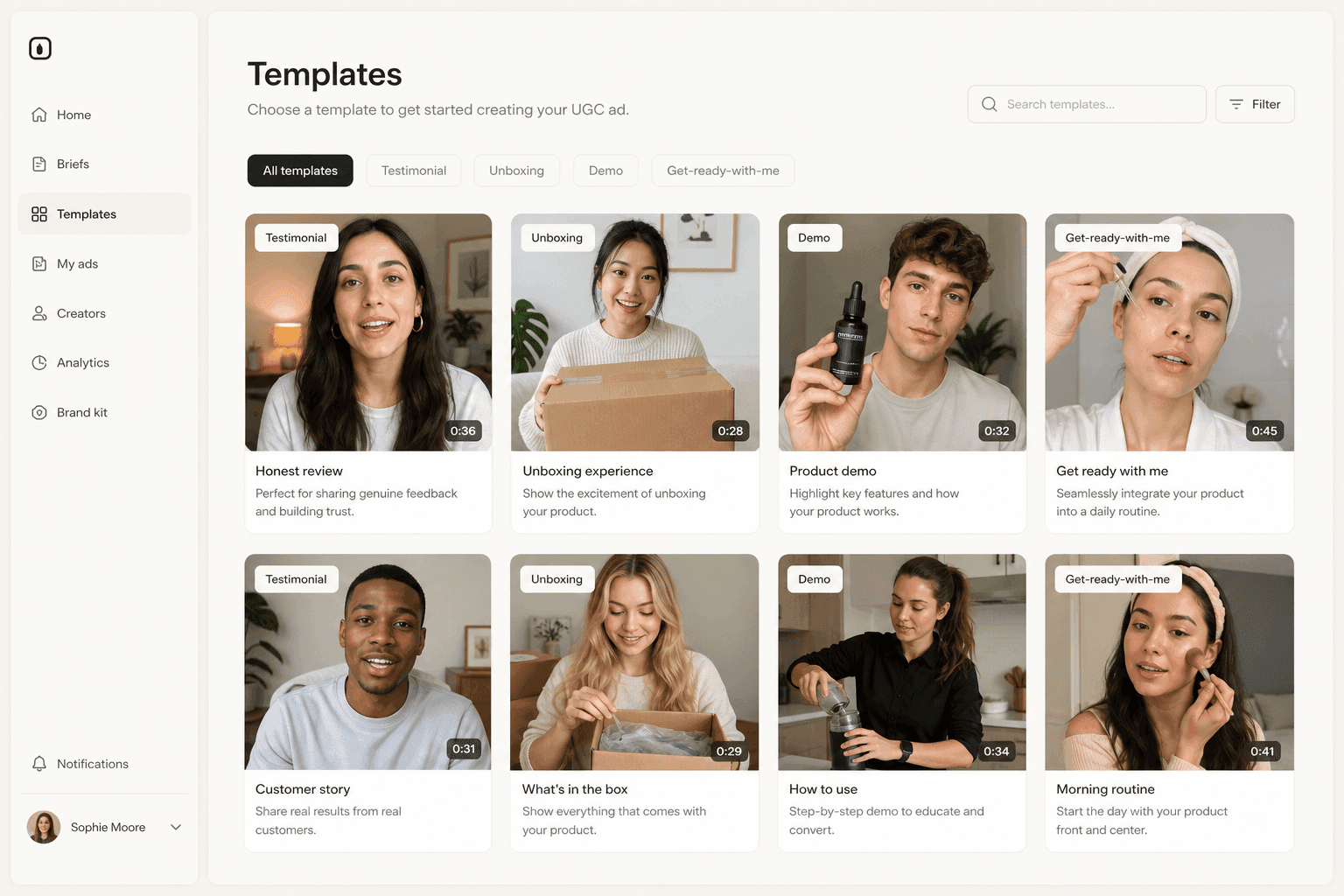
Novoads is built around the last mile of an ecommerce ad: the product on camera, in the right accent, ready to publish. You upload a product image and write or auto-generate a script, pick from 100+ AI actors, and get a vertical ad with voice, lip-sync, and captions. It runs a bench of frontier models (Seedance, Kling, and Veo) and ships ads in 30+ languages with real regional accents, not one generic version of each. Cost runs from about a dollar for a five-second Seedance 2.0 Mini clip to about $8 for an eight-second Seedance 2.5 clip, and about $26 for a full 30-second Seedance 2.5 take, and a render takes about four minutes. The bet is that for most advertisers the unit price was never the only line item. The local, finished, product-led ad was.

What Novoads and HeyFish share
The marketing around AI video makes every tool sound singular. On the things buyers worry about most, these two line up:
- Direct AI UGC. Both generate a UGC-style ad end to end: pick an actor, bring your product, get a video. Neither is a generic text-to-video toy.
- Believable AI actors. Both ship a large actor library and clear the realism bar most viewers judge on.
- Product on camera. Both can put your physical product in the creator's hands, not just talk about it (on Novoads, through a custom actor made from a photo of someone holding it, or Discover's product templates).
- A monthly, cancel-anytime start. HeyFish opens with a free first ad and a $24.99/mo plan; Novoads opens at $49/month. Neither asks for an annual contract before you have seen real output.
- Social-first output. Both make vertical ads built for TikTok, Reels, and Meta.
So this is not a "which one is real" argument. Everything below is about where they diverge: the unit price, the input, the accent, and what lands in your downloads folder.
The head-to-head, dimension by dimension
Here is the snapshot, then the four dimensions that actually move the decision.
| Dimension | Novoads | HeyFish |
|---|---|---|
| Built for | Product-led, multilingual UGC | Lowest cost per video |
| Cost per video | About a dollar (five-second Seedance 2.0 Mini) to $8 (eight-second Seedance 2.5); about $26 for a 30-second Seedance 2.5 take | About $2 per video |
| Entry point | $49/month | $24.99/mo, free first ad |
| Primary input | Product image plus script | AI actor plus product |
| Languages | 30+, real regional accents | Multilingual |
| Models | Seedance, Kling, Veo | Direct UGC pipeline |
| Output | Voice, lip-sync, captions, ad-ready | UGC video ad |
Cost per video and the entry price
This is the dimension HeyFish owns. Its entire design points at the lowest believable unit cost, and it delivers: about $2 per video, a $24.99/mo entry plan, and a free first ad to de-risk the trial. Novoads runs from about a dollar for a five-second Seedance 2.0 Mini clip to about $8 for an eight-second Seedance 2.5 clip, and about $26 for a full 30-second Seedance 2.5 take, so at the cheapest end the two overlap, but if your single axis is the lowest possible price per render at volume, HeyFish has built its whole product there and it is fair to say so. For a brand testing dozens of creatives a week on a fixed budget, that unit cost compounds fast. Edge: HeyFish.
The product image and the finished ad
This is where Novoads is built differently. Both tools put a product on camera. The difference is the starting point and the finish line. In Novoads you begin from a product image, so a product-led ad is the default thing the tool makes, not a mode you hunt for. And the file you get back already includes voice, lip-sync, and captions, sized for 9:16, 1:1, or 16:9. You download an ad, not a clip you still have to finish in a separate editor. That finishing work is invisible until you scale. On a render-only path, each variation still needs:
- a captioning pass,
- a resize for every placement,
- a voice track that matches the script.
Multiply that by every variation and it quietly becomes the real production cost. Folding it into the render is what turns a per-clip price into a per-ad price. For a small team shipping across placements every week, that finished-output default is the difference between a tool and a workflow. If you want the math on what that replaces, our video ad production cost breakdown runs it against hiring a creator. Edge: Novoads.
Native regional accents
Reach into more languages is table stakes now; both tools are multilingual. What Novoads emphasizes is the accent underneath the language: 30+ languages with real regional accents (a voice catalog covering 31 languages). In practice that means splits like:
- Spanish for Mexico, Spain, and Argentina,
- Portuguese for Brazil and Portugal,
- English for the United States and the United Kingdom.
So an ad can sound like a creator from one specific market rather than one flat version of a language stretched across every country that speaks it. For a brand selling into several markets that share a language, that local ear is often the gap between an ad that converts and one that reads as imported. If localization is a core part of how you scale, that depth is the reason to look. Edge: Novoads.
How you start before you commit
Both tools show you what they make without a sales call, which is rarer than it sounds. HeyFish lets you make your first ad free and then start at $24.99/mo, so you can judge the output before any real spend. Novoads opens at $49 a month, cancel any time, and what that month buys is a finished, publishable ad, with the product in hand when you build it on a custom actor, rather than a sample. HeyFish asks less of you at the door and it is fair to say so; the question is whether you want the cheapest look or the finished thing. Edge: HeyFish.

A worked example: 30 variations, three markets
Picture the concrete job. You sell one supplement and you want 30 UGC variations this month: 10 each for Mexico, Spain, and Argentina, same product, three audiences that do not sound alike.
If the only thing that matters is the spreadsheet, the cheapest unit cost wins outright. At about $2 per video, 30 renders is roughly $60, and HeyFish is engineered for exactly that line. It is the right answer when raw volume at the lowest price is the constraint.
Now add the part the spreadsheet hides. Those 30 have to sound native in three markets. In Novoads the loop is one path, repeated:
- Create a custom actor once, from a photo of someone holding the product.
- Write or auto-generate the script.
- Generate the batch in the Mexican accent, then the Castilian, then the Argentine.
- Each clip returns ad-ready with voice, lip-sync, and captions, in about four minutes, at the talking-actor rate of 10 credits per started minute of video, about $6.90 for a clip up to a minute long. The Seedance clip prices quoted above belong to a separate route, generated video clips, not to a custom actor.
Thirty locally-voiced ads with the product in your custom actor's hand, for 300 credits (30 clips x 10 credits, about $207), no separate captioning pass, no translation that flattens the accent into one generic voice. The line item the cheap-render path skips is localization: ship one flat "Spanish" across all three markets and you save nothing on renders, but you lose the local ear that makes a creator sound like a neighbor instead of a dub. That is the trade in one task: if the job is the most renders for the fewest dollars, optimize for unit cost; if the job is local, finished ads across markets, the per-video number is only one line in the budget. Our how to improve ROAS with UGC guide covers why that local fit tends to move the return more than the render price does.
The honest trade-offs
No tool is free of them, and pretending otherwise is how comparison posts lose your trust. Here is where Novoads asks you to give something up.
- It is purpose-built for ad UGC, not a general-purpose video studio. If you also want cinematic b-roll or artistic clips, it is the wrong shape.
- On raw cost per video it is not the rock-bottom option. The range runs from about a dollar for a five-second Seedance 2.0 Mini clip to about $8 for an eight-second Seedance 2.5 clip, and about $26 for a full 30-second Seedance 2.5 take, so a tool engineered purely for the lowest unit price can undercut it at the cheap end.
- The actor catalog is curated rather than the largest in the category. Novoads lists 100+ AI actors, so if sheer face variety is your top priority, other tools list more.
The pattern is consistent. HeyFish optimizes the unit cost and rewards you with volume per dollar; Novoads optimizes the finished, local ad and rewards you with output you can publish as-is, in the accent your market speaks. Neither is a flaw. They are different personalities aimed at different bottlenecks. If you are still deciding whether AI can stand in for a hired creator at all, AI versus UGC creators is the better starting point, and what a UGC creator actually is covers the format itself.
When to choose each
The honest version of this is not a winner. It is a fit test, and most of it falls out of two short lists.
Choose HeyFish when:
- The lowest possible cost per video is your single most important variable.
- You are testing creative volume on a tight, fixed budget and want the most renders per dollar.
- You want to see real output before paying, via a free first ad.
- Your ads do not hinge on a specific regional accent.
Choose Novoads when:
- The creator should hold your actual product, through a custom actor made from a photo of someone holding it or a Discover product template that starts from your product image.
- You sell across markets and the voice has to sound local, with real regional accents.
- You want an ad that ships with voice, lip-sync, and captions, ready for Meta or TikTok, not a clip to finish elsewhere.
- You want a bench of frontier models to choose from, and a published $49/month plan to test the whole thing on.
Many teams run both: HeyFish for high-volume, low-cost testing, Novoads for the localized, product-in-hand ads (built on a custom actor) that have to ship clean. If you are weighing the realism-first end of the category, Novoads vs Arcads covers that comparison in the same depth.

How Novoads approaches product-led, multilingual UGC
Novoads is built for the moment an ecommerce team needs an ad where the creator holds the real product, in the language the audience actually speaks. You write or auto-generate a script, create a custom actor from a photo of someone holding your product (a stock library actor's hands are empty), and get a vertical UGC ad with voice, lip-sync, and captions, formatted for TikTok, Reels, and Meta. It runs a bench of frontier models so you are not betting on one engine, and it produces ads in 30+ languages with real regional accents rather than a flat translation. A render takes about four minutes and costs from about a dollar for a five-second Seedance 2.0 Mini clip to about $8 for an eight-second Seedance 2.5 clip, and about $26 for a full 30-second Seedance 2.5 take.
None of that makes HeyFish worse. It makes the two a clean trade: HeyFish for the lowest cost per video at volume, Novoads for the finished, local, product-led ad. If you want the steps to build one start to finish, our how to create UGC ads walkthrough lays them out.
Cost or depth, named honestly
There is no winner of Novoads versus HeyFish, because they are not running the same race. HeyFish is the cost-per-video leader, and for a team whose bottleneck is creative volume on a budget, the lowest unit price is the right thing to optimize. Novoads is the product-and-accent specialist, and for the larger group whose real bottleneck is shipping local, product-in-hand ads (built on a custom actor) that publish as-is, it fits the job better. Decide by the constraint you actually have, the cheapest render or the most native one, and the answer picks itself. You can produce your first product-in-hand AI UGC ad with a Novoads custom actor from $49/month at novoads.ai. Cancel anytime.
Frequently Asked Questions
Is Novoads or HeyFish better?
Neither is universally better; they optimize for different jobs. Both are direct AI UGC generators that produce believable actors, so realism is rarely the deciding factor. HeyFish is built for the lowest cost per video, which is the right axis when creative volume on a tight budget is your constraint. Novoads centers product-led, multilingual UGC: a product image as the primary input, 30+ languages with real regional accents, a frontier-model bench, and ad-ready output. Pick by which bottleneck you actually have.
How much does HeyFish cost compared to Novoads?
HeyFish markets itself as price-aggressive, with a $24.99/mo entry plan and roughly $2 per video, plus a free first ad so you can see output before paying. Novoads starts at $49 a month, and runs from about a dollar for a five-second Seedance 2.0 Mini clip to about $8 for an eight-second Seedance 2.5 clip, and about $26 for a full 30-second Seedance 2.5 take. At the cheapest end the per-video cost overlaps; if the single lowest unit price is your priority, HeyFish is engineered for it.
Can HeyFish make a UGC ad with my product?
Yes. HeyFish is a direct AI UGC ad generator: you pick an AI actor, drop in your product, and get a UGC video ad. The difference is the input default in Novoads, where uploading a product image is the primary way you start an ad, so a product-led ad is the thing the tool makes by default. For catalog-heavy ecommerce, that default matters.
What is the difference in languages and accents between the two?
Both tools are multilingual, so raw language reach is table stakes. What Novoads emphasizes is the accent underneath the language: 30+ languages with real regional accents (a voice catalog covering 31 languages), so an ad can sound like a creator from Mexico, Spain, or Argentina rather than one generic version stretched across all three. If your ads have to sound local in a specific market, that accent depth is the reason to look at Novoads.
Which is better for ecommerce product ads?
Novoads, in most cases, because uploading a product image is the primary input and the output ships ready for Meta or TikTok with voice, lip-sync, and captions, in the accent your market speaks. HeyFish is the stronger pick when the lowest possible cost per video at volume is the priority and a specific regional accent is not the deciding factor. Many teams use both.
Can I use Novoads and HeyFish together?
Yes, and plenty of teams do. A common split is HeyFish for high-volume, low-cost creative testing, and Novoads for the localized, product-in-hand ads (built on a custom actor) that have to ship clean across markets. They are not mutually exclusive; they are good at different parts of the same job.
Key Takeaways
- Both Novoads and HeyFish are direct AI UGC ad generators. The decision is fit, not whether either makes a believable UGC ad, because both clear that bar.
- HeyFish's edge is the unit price: it is engineered for the lowest cost per video, with a $24.99/mo entry plan and a free first ad to try it.
- Novoads' edge is the finished local ad: a product image as the primary input, 30+ languages with real regional accents, a bench of frontier models, and output with voice, lip-sync, and captions.
- On the cheapest end the two overlap on price. Novoads runs from about a dollar for a five-second Seedance 2.0 Mini clip to about $8 for an eight-second Seedance 2.5 clip, and about $26 for a full 30-second Seedance 2.5 take.
- Pick by your real bottleneck: lowest cost per render points to HeyFish; local, ad-ready output with the product in a custom actor's hand points to Novoads.