Qwen-Image-2.1 Explained: Transparent Cut-Outs, 10 Reference Images and a Non-Commercial License
Alibaba's Qwen team released Qwen-Image-2.1 on September 20, 2026, with downloadable weights, native transparent output and editing from up to ten reference images. Its benchmark is Qwen's own and its license allows non-commercial use only. Here is what an ad team can do with it today.

Mauricio Valdivia
·12 min
Open Weights You Can Download, but Not Yet Sell With
A designer at a small skincare brand could have spent Sunday, launch day, doing a job that used to take two tools. Qwen's README hands her a prompt that begins "This is an RGBA image with transparency." The model answers with an image that carries its own alpha channel: a product shot with no background to remove, ready to layer into next week's static ads. No masking pass. Then she opens the license.
Alibaba's Qwen team released Qwen-Image-2.1 on September 20, 2026. It is one model for generating and editing images, with 7B parameters in its visual generation component, native transparent output, editing from up to 10 reference images and native 2K resolution. The weights are on Hugging Face and ModelScope, with the code on GitHub.
The catch is in the paperwork. The Qwen Research License Agreement grants use for non-commercial purposes only, and says commercial use needs a separate license from Qwen. The benchmark behind the loudest launch headline is Qwen's own, and as of September 21 no independent benchmark had checked it.
So test it, yes. Build a paid pipeline on it, not yet.
What follows is what actually shipped, the three capabilities that matter for ad creative, how much weight the benchmark can bear, and what the license asks of a business before a single campaign asset comes out of it.
What Qwen Released on September 20
The README's news line is dated plainly: "2026.09.20: We released Qwen-Image-2.1!" Weights went up on Hugging Face and ModelScope the same day, and the repository describes the release as Qwen's "most powerful open-source image generation model". Keep that phrase in mind. The license section below complicates it.
One model for generating and editing
Qwen-Image-2.1 is a single checkpoint for both jobs. Qwen says one model can "Generate regular or transparent (RGBA) images from text, edit transparent layers, and extract subjects from photographs". In code, the Diffusers pipeline Qwen documents, QwenImage21Pipeline, takes a text prompt alone, one input image, or a list of reference images, and the README describes it as handling both text-to-image and image-conditioned generation in a single pipeline.
For a team that makes ads, one model means:
- one set of prompt habits to learn
- one place where the brand's product photos go in
- one set of failure modes to learn to spot
That is a smaller thing than a benchmark win. It is also the part you can confirm on day one.
What the 7B figure covers, and what it leaves out
The headline number needs its qualifier. Qwen's README says 2.1 has "7B parameters in its visual generation component", a transformer of 32 single-stream DiT layers. That is the part that draws the image. It is not the whole system. The same README's architecture section lists:
- Generator: a 32-layer single-stream DiT with 7B parameters.
- Text encoder: Qwen3-VL 8B, a vision-language model that encodes both the text instruction and any condition images.
- Autoencoder: a 64-channel RGBA VAE, which is where the native transparency lives.
- Optional prompt rewriters: two fine-tuned Qwen3.5-VL 9B checkpoints, one for generation and one for editing, that expand a short prompt into a detailed one.
So "a 7B model" is shorthand that undersells the memory bill. The generator is 7B. A working pipeline also loads an 8B encoder, and the recommended prompt-rewriting setup adds another model on top.
Day-zero support in the usual tools
Five inference stacks announced support on release day, according to the README's news section:
- Diffusers, through
QwenImage21Pipeline - ComfyUI, natively, with workflows for text-to-image and image editing
- vLLM-Omni, for high-performance serving
- SGLang, including multi-image editing and transparent output
- LightX2V, for faster inference on data-center and consumer GPUs
That matters more than it sounds. An open model nobody can run is a press release. One that loads into ComfyUI the day it ships is something a studio can start evaluating the same week.
Where 2.1 Sits Next to Qwen Image 3
The version numbers read backwards, and it is worth two minutes to straighten them out before choosing either one.
A lower number that arrived later
Qwen Image 3 was announced on July 21, 2026, and shipped as an API-only model, sold through partner APIs such as fal, with no downloadable weights. We covered that launch and the evidence it left out in our breakdown of Qwen Image 3. Qwen-Image-2.1 arrived two months later, on September 20, carrying the lower number.
Do not read 2.1 as a trimmed-down copy of 3, an open release of 3, or its successor. Qwen has not described it that way in anything we could read. The simplest reading of the numbering is that Qwen runs two tracks: a flagship that launched as a hosted service, and an open-weight line that ships checkpoints, a parameter count and a license you can read. 2.1 is the newest release on the second track.
What each release gives an ad team
| Qwen-Image-2.1 | Qwen Image 3, at launch | |
|---|---|---|
| Date | Released September 20, 2026 | Announced July 21, 2026 |
| Access | Download and self-host | API only |
| Weights | Hugging Face, ModelScope | None to download |
Pick by the job, not the number. Reach for 2.1 when:
- you want to see how a model handles your own product photos, on hardware you control
- nothing can leave the building while you evaluate
- you are building the case for a commercial license request
Look elsewhere when:
- you need a commercial supply of images this week, because 2.1's own license sends you to Qwen for a separate deal first
The Three Features That Matter for Ad Work
Strip away the launch adjectives and three capabilities in the README map onto jobs ad teams already pay for. A fourth, the output sizes, decides whether the results fit a placement at all.
Transparent product cut-outs, straight from the model
Static ads are built in layers: a background, the product, a headline, a price badge. The product layer is the one you reuse across twenty variants, and it is usually the one that costs the most cleanup. Qwen-Image-2.1 generates transparent (RGBA) images natively, and the README gives a recommended prompt format for it:
This is an RGBA image with transparency. <your description>. The image has alpha channel and the background is transparent.
The same model can also edit transparent layers and extract a subject from an existing photograph, which covers the other half of the job: turning a catalog photo into a cut-out you can place on a new scene.
Here is our read. Background removal after the fact is where product shots usually go wrong:
- a halo around a clear glass bottle
- a dropper or pump that loses its tip
- knit fibers or fine hair sliced into a hard edge
A model that outputs the alpha channel itself could skip that step. Whether its edges hold up on your products is exactly what the launch materials cannot tell you, so test your hardest SKU first: clear glass, fine hair, anything fuzzy.
Ten reference images, identity kept
The README lists support for up to 10 reference images and says the model can "preserve identity for people and products". Its showcase includes a group photograph built from six separate portraits and a "Complete outfit assembled from five reference images (model, clothing, shoes, bag, hat)". That second example is the same job catalog teams buy AI fashion product imagery tools for.
For an ad, ten slots is room for a whole brief:
- the product from two or three angles, so the label reads correctly
- a creator or model reference, so the face stays consistent across variants
- a background plate or set
- a style reference pulled from a past ad that worked
Qwen also says the architecture computes input images and text instructions once, at the first denoising step, and caches them for all later steps, which it credits with faster multi-reference editing. That is a speed claim from the vendor. Time it on your own hardware.
Local edits by circle, paint or mask
The README says you can "specify local edits via circles, painted annotations, or separate masks", and its showcase demonstrates circle-guided edits that remove a watch, change hair color and replace clothing.
Variant production is mostly this kind of edit:
- a new flavor needs a different label color, held to the brand's exact hex values
- a seasonal refresh needs a different background
- a new market needs the same scene with a different pack size
Marking the region instead of re-describing the whole image is how you keep the parts of a proven creative that already work.
Native 2K, including a vertical size
Qwen-Image-2.1 natively supports 2K resolution. The README's recommended sizes include:
- 1:1 at 2048 by 2048, for feed squares
- 9:16 at 1536 by 2752, the vertical frame Stories and Reels placements use
- 4:3, 3:4, 3:2, 2:3 and 16:9 for everything in between
Generating at the placement's aspect ratio beats cropping a square afterward, because a crop throws away the framing the model composed.
The Benchmark Only Qwen Has Run
The launch headline was a ranking. The ranking is the part of this release you can least act on.
What Qwen claims
The Decoder's report on the launch carries the claim in full: the model "beats most closed models on Qwen's own benchmark, the team claims, though independent benchmarks are still pending." The chart itself sits on Qwen's launch blog, which builds its page in the browser. Our fetcher could load the page but none of its text, so we are not reproducing a single number we could not check.
As of September 21, 2026, no independent benchmark of Qwen-Image-2.1 had been published. There is nothing outside Qwen to check the claim against yet.
Why a benchmark the maker ran cannot settle it
This is not an accusation. Every lab publishes its own evaluations first. But a benchmark the maker built answers a narrower question than the headline implies, because the maker chose:
- which prompts to test and which categories to weight
- which closed models to compare against, at what settings and on what date
- who judged the outputs, and how disagreements were scored
"Beats most closed models" also leaves the obvious question open: which ones did it not beat? Launch rankings carry qualifiers that headlines drop, as the Imagine Image 2.0 debut showed last month. For ad work there is a second problem. No general benchmark can score what you care about: your label rendered correctly, your product's shape intact, edges clean enough to place on a new background.
A test you can run in an afternoon
Here is a worked example, sized for one person and one GPU. Take 8 SKUs from your catalog. For each, run 3 jobs:
- a transparent cut-out from a text prompt
- a multi-reference composite: product photos plus a background plate
- one local edit, such as a color swap marked with a circle
Render each at 2 sizes, the square and the vertical one above.
That is 8 × 3 × 2 = 48 images. Score each one pass or fail on three checks:
- The label text is legible and spelled correctly.
- The product's shape and color match the reference photo.
- The edges are clean enough to place on a new background without retouching.
An image passes only if it clears all three. Then run the same 48 prompts through the model you use today, whether that is Nano Banana 2 or Nano Banana Pro or something else. If 2.1 passes 40 of 48 and your current model passes 30, you have a real finding about your own catalog. If it passes 25, you have a demo. Either way you have a number no launch chart can give you, gathered the same way you would read any ad creative test: same inputs, one variable, a pass rule written down before you look.
One more reason this is the right first step: evaluation is exactly what the license allows.
The License Is the Real Headline
Strip the launch coverage down and one document decides whether 2.1 is a tool or a toy for a business. The text is short, and worth reading in full before anyone on your team downloads the weights for work.
What the Qwen Research License allows
The Hugging Face model card says the model "is licensed under the Qwen Research License Agreement", and the license file carries a release date of September 20, 2026. Its grant lets you use, reproduce, distribute, copy, create derivative works of and modify the Materials "FOR NON-COMMERCIAL PURPOSES ONLY". It defines Non-Commercial narrowly: the term "shall mean for research or evaluation purposes only".
On that definition, these sit inside the grant as long as the purpose is research or evaluation:
- downloading the weights and running the model
- studying its outputs and its failure modes
- comparing it against the models you already use
- the 48-image test above
What it asks of a business
The license is specific about what a commercial user needs:
- A separate commercial license. "You shall not use the Materials for any commercial purpose without obtaining a separate commercial license from us." Section 2 gives an email address for the request.
- Attribution if you train on it. Anyone who uses the Materials "or any outputs or results therefrom to create, train, fine-tune, or improve an AI model that is distributed or made available" must prominently display "Built with Qwen" or "Improved using Qwen".
- No Qwen-branded products. You may not use "Qwen" as the primary name of a derivative work or product.
- Chinese law. The agreement is governed by the laws of China, and the People's Courts in Hangzhou City have exclusive jurisdiction over disputes.
What the text does not settle
The license defines the Materials as Qwen's "proprietary Qwen and Documentation". In the text we read, it does not separately say whether an image you generate falls under the non-commercial grant. Outputs come up only in passing: in the "Built with Qwen" rule for training other models, and in the clauses on warranty, liability and lawsuits, such as a disclaimer that covers the Materials "and any output therefrom". None of those clauses says in plain words whether a generated image may be used commercially.
That leaves a gap we will not fill with a guess. Our own conservative reading, which is not legal advice: running the model to make creative for a client or a paid campaign is using it for a commercial purpose, so ask Qwen first and get the answer in writing. Rights questions around AI creative do reach court, as a recent copyright suit against an AI ad generator showed.
A turn from the first Qwen-Image
The open-weight line did not start this way. The original Qwen-Image model card reads "Qwen-Image is licensed under Apache 2.0.", a permissive license that allows commercial use. Its newest release is research-only unless Qwen grants you a separate license.
That is why the repository's "open-source" label needs translating for a business reader. Here it means the weights are downloadable and inspectable. It does not mean you can put them to work for a client without asking.
Can You Run It on Your Own Machine?
For evaluation, the answer looks like yes, with one number to keep in mind.
What the hardware reports say
The Decoder reports that the model "runs on capable consumer GPUs like a 3090". That line is The Decoder's; Qwen's README does not name a card. What the README does offer is a memory setting: "For GPUs with limited memory, use model offloading", which moves parts of the pipeline to system memory as they are needed and trades speed for fitting on a smaller card.
When you size a machine, count the whole pipeline, not the headline:
- the 7B generator
- the 8B text encoder, which has to load too
- the optional 9B prompt rewriter, if you use Qwen's recommended setup
A card that holds 7B comfortably may still need offloading for the full pipeline.
Ways to look before you install
Qwen runs a demo of the model as a Hugging Face Space, linked from the README. It is the quickest way to see the model's outputs before you install anything. Treat it as a first look, not a test: your own 48-image run on your own products is what tells you whether 2.1 deserves a place in your process.
How Novoads Solves the Step After the Still
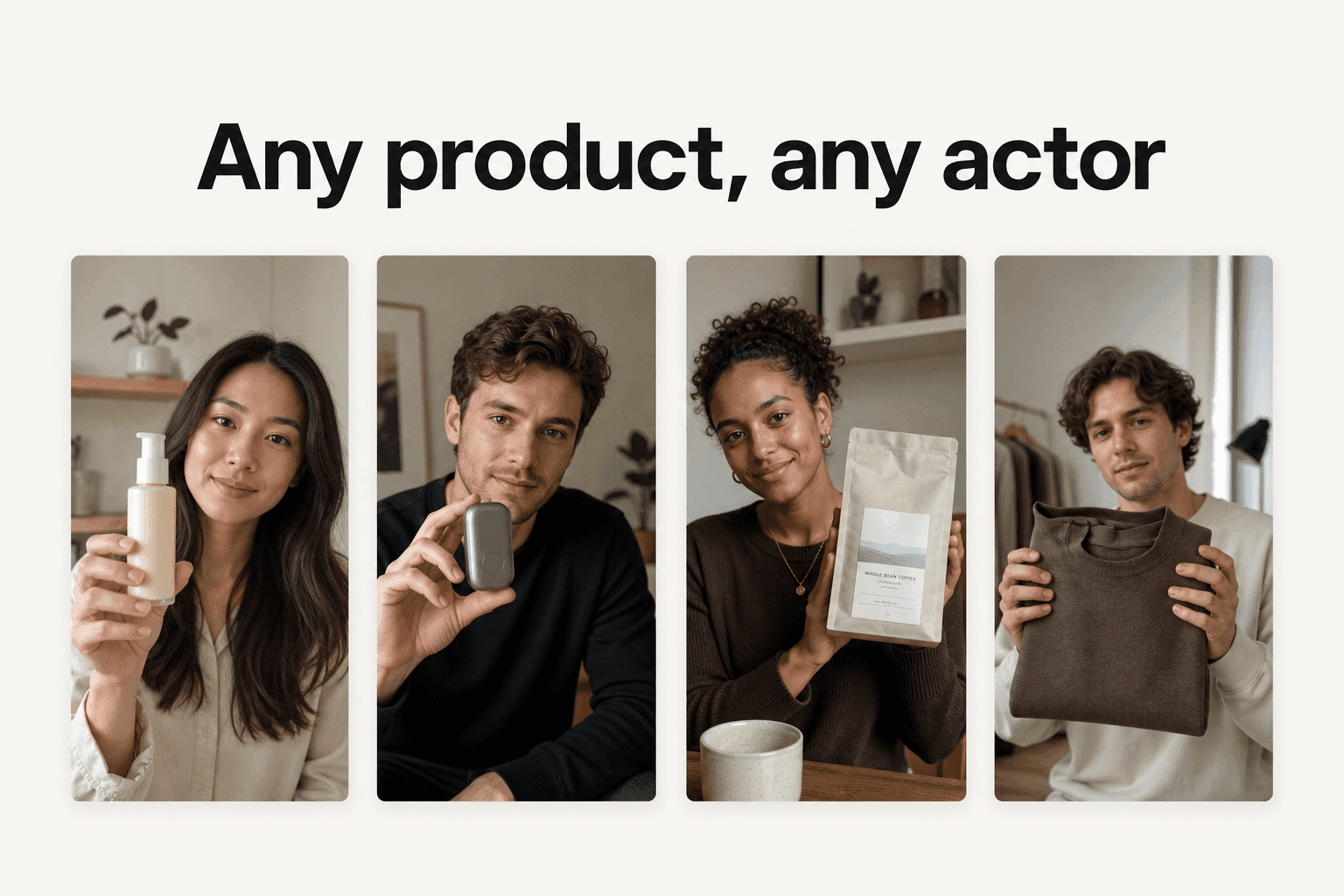
Novoads turns a product photo into an ad image, and a script into a UGC-style video ad with an AI actor, in one workspace, on models it runs today. It does not run Qwen-Image-2.1 or any Qwen model.
The image side runs on:
- GPT Image 2, which powers Product-to-Ad from an uploaded product photo
- GPT Image 2.5 Sunburst and Flare
- Nano Banana Pro
- Seedream 5 Lite and Seedream 5 Pro
- Reve 2.1
None of that is a claim that those models beat 2.1 on anything. There is no fair test yet to say so either way. The point is that a still is one layer of an ad. The step after it, a video with an AI actor delivering your script, is the part a still cannot do. You can build that ad in Novoads and see every plan on the pricing page.
Open Weights Are a Test Bench, Not a Supply Chain
For anyone who makes static ads, Qwen-Image-2.1 is worth an afternoon: native transparency, ten reference slots, a vertical 2K size and weights you can run yourself. Download it, run the 48-image test, and keep the scores. Just do not wire it into client work until Qwen has answered your email. An open model you cannot yet use commercially is a test bench, not a supply chain.
Frequently Asked Questions
What is Qwen-Image-2.1?
Qwen-Image-2.1 is an image generation and editing model from Alibaba's Qwen team, released on September 20, 2026. One checkpoint handles text-to-image, single-image editing and multi-reference editing. It can output transparent (RGBA) images, accepts up to 10 reference images, supports local edits marked by circles, painted annotations or masks, and generates natively at 2K. Its weights are downloadable from Hugging Face and ModelScope, under the Qwen Research License Agreement.
Is Qwen-Image-2.1 a 7B model?
Only its generator is. Qwen's README says the model has 7B parameters in its visual generation component, a transformer of 32 single-stream DiT layers. The same README lists a separate Qwen3-VL 8B text encoder that reads prompts and reference images, plus a 64-channel RGBA autoencoder, and Qwen offers two optional 9B prompt-rewriting models on top. Calling the whole system 7B understates what you need to load.
Can I use Qwen-Image-2.1 for commercial ads?
Not under its default license. The Qwen Research License Agreement grants use for non-commercial purposes only, defines non-commercial as research or evaluation, and says you may not use the Materials for any commercial purpose without a separate commercial license from Qwen. The license text does not separately address generated images, so the conservative course for a business is to request a commercial license before using the model for client work or paid campaigns. This is a reading of the license, not legal advice.
Does Qwen-Image-2.1 really beat closed image models?
That is Qwen's claim, measured on Qwen's own benchmark. The Decoder, reporting the launch on September 20, 2026, noted that independent benchmarks were still pending, and as of September 21 none had been published. Until an outside evaluator tests it, the fair way to judge it for ad work is to run it on your own products next to the model you use today.
How is Qwen-Image-2.1 different from Qwen Image 3?
They are different releases on different tracks. Qwen Image 3 was announced on July 21, 2026, and shipped as an API-only model, with no downloadable weights. Qwen-Image-2.1 arrived two months later with downloadable weights, a stated parameter count and a published license. Qwen has not described 2.1 as a smaller or open version of 3, so it is best read as the latest release in Qwen's open-weight line.
Is Qwen-Image-2.1 available in Novoads?
No. Novoads does not run any Qwen model. Its image models are GPT Image 2, which powers Product-to-Ad, GPT Image 2.5 Sunburst and Flare, Nano Banana Pro, Seedream 5 Lite, Seedream 5 Pro and Reve 2.1, and the still you make there can become a UGC-style video ad in the same workspace.
Key Takeaways
- Alibaba's Qwen team released Qwen-Image-2.1 on September 20, 2026, as one model for generating and editing images, with weights on Hugging Face and ModelScope and code on GitHub.
- The 7B figure covers the visual generation component only. Qwen's README lists a separate Qwen3-VL 8B text encoder, so a working pipeline loads more than 7B parameters.
- For ad work the parts that matter are native transparent (RGBA) output, editing from up to 10 reference images with identity kept for people and products, local edits by circle, paint or mask, and native 2K sizes including 9:16.
- The claim that it beats most closed models comes from Qwen's own benchmark. As of September 21, 2026, no independent benchmark had been published to check it.
- The Qwen Research License allows non-commercial use only, defined as research or evaluation, and says commercial use needs a separate license from Qwen. Test it on your products; ask Qwen before any commercial use.
Sources
- •QwenLM on GitHub: Qwen-Image-2.1 README
- •QwenLM on GitHub: Qwen Research License Agreement for Qwen-Image-2.1
- •Hugging Face: Qwen/Qwen-Image-2.1 model card
- •The Decoder: Alibaba's open-weight Qwen-Image-2.1 claims to beat closed models in image generation with just 7 billion parameters
- •fal: Qwen Image 3 (Text to Image), partner API (read September 21, 2026)