How Much Do Snapchat Ads Cost? The $5 Floor and the Auction Behind It
Snapchat publishes a daily minimum and nothing else. Here is what the platform actually commits to, why every CPM chart you find is someone's estimate, and how to price your own campaign before you spend.

Mauricio Valdivia
·Updated ·13 min

Snapchat publishes one number. It is not a price.
A founder opens Ads Manager with $500 to spend and one question: what does this cost. She finds an answer immediately, because Snapchat prints it on its own pricing page. $5 a day. She sets $5, runs a week, spends $35, gets almost nothing, and concludes Snapchat does not work for her category.
The number was real. It was also the only number Snapchat is willing to publish, and it is a floor, not a price. On the same page, two sentences later, Snap answers the question you actually asked: "Snapchat advertising cost depends on how much you're willing to invest to get the results you want." That is not evasion. It is an accurate description of an auction. Snapchat's self-serve inventory has no rate card, no per-impression list price and no published benchmark of any kind. It has a floor, a recommendation, and a machine that decides the rest in real time.
This guide covers what Snapchat actually commits to in writing, how the auction turns your budget into a cost per result, why every average CPM you will find online is a third party's estimate, and how to produce your own number before you spend. One thing it will not do is tell you that Snapchat ads cost X in 2026. Every figure below was read off a Snap-owned page on July 27, 2026, and those pages carry no publication date, so treat them as current-as-of rather than permanent. If you want the setup, the formats and the file specs instead, they live in the full Snapchat ads guide, and the exact dimensions Snapchat accepts sit alongside every other platform in our video ad specs by platform reference.
What Snapchat actually commits to in writing
Strip away the agency blogs and Snapchat's own published position on cost fits in a paragraph. It is worth reading closely, because the gaps in it are the whole story.
The floor, and the number Snap would rather you spend
The pricing page states it plainly: "The minimum spend per day is $5, although we recommend $20-50 per day." Two numbers, a factor of four to ten apart, on the same line.
The reason for the gap is on the same page. Snap wants the higher figure so your campaign can "complete the exploration phase", the learning window when a campaign first launches, which it says runs "typically 4 days or more, depending on your campaign objective". The Exploration Phase is Snapchat's version of a learning period: the system spends real money working out who in your audience responds before it optimizes toward them.
That turns the floor into something more useful than a price. It gives you a minimum viable unit of spend. Not $5. Four days at $20 to $50, which is $80 to $200 to buy one honest reading on one creative.
The sentence that replaces a rate card
Ask Snapchat's own FAQ what an ad costs and it does not give you a number, it gives you a list of variables: "The exact cost of advertising on Snapchat can fluctuate depending on a number of factors such as your selected advertising objective, your selected budget, the duration of your campaign, your bid goal, and your bid amount."
Read that as a checklist rather than a disclaimer, because four of the five inputs are yours to set:
- Objective. A brand awareness buy and a purchase buy are not priced against the same competition, so the objective moves cost before anything else does.
- Budget. The floor decides whether the learning window can finish, which decides whether the cost you observe means anything.
- Duration. Cost is an average over a window, and a window too short to include a full Exploration Phase reports a number that is mostly learning.
- Bid goal and bid amount. What you are willing to pay per result, and how you want Snapchat to chase it.
The fifth variable is the one Snap does not name in that sentence: everybody else bidding for the same people at the same moment. That is the input you cannot set, and it is the reason a fixed answer to this question cannot exist.
Why the 2026 in the headline is a checking date, not a change
Here is the part most cost articles quietly get wrong, including ones with this year in the title. Nothing about Snapchat's published pricing changed in 2026.
I pulled dated captures of that exact pricing URL. The January 2024 capture reads "The minimum spend per day is $5, although we recommend $20-50 per day." The January 2025 capture reads the same. The July 2026 capture reads the same. Go back further, to a March 2021 capture, and the page already said "With our daily minimum spend of just $5" and already described the Snap Auction as the thing that "functions to serve the right ad to the right user and determines how much to charge the winning ad."
So the $5 floor is a five-year-old commitment, not a development. Any guide that presents it as a 2026 figure is dating a fact by the day it was retyped. The honest version: these are the numbers Snapchat publishes, they have been stable for years, and 2026 is when they were last verified.
How the auction turns a budget into a cost
Snapchat's pricing page points you at the mechanism in a single line: "Learn more about the Snapchat ad auction to understand how it serves the right ads to the right people and then determines how much to charge the winning ad." On its own blog, Snap describes the same system as one that "allows businesses to bid for ad placements based on their CPM rates and target audience."
Auction pricing means your cost is an output, not an input. You control the inputs, and the platform's developer documentation is more precise about them than any marketing page.
The four bid strategies, in Snap's own words
Snap's Marketing API documents the exact set of bidding strategies available on an ad squad: auto_bid, lowest_cost_with_max_bid, min_roas and target_cost. Those four are the levers behind whatever your Ads Manager interface calls them today.
- Auto bid. You hand the bid to Snapchat and it spends your budget chasing the cheapest results it can find.
- Lowest cost with max bid. You set a hard ceiling per result and Snapchat buys under it.
- Target cost. You name a cost you want to average and Snapchat tries to hold the average there.
- Minimum ROAS. You name a return threshold and Snapchat bids to clear it, which requires purchase-value signal flowing back through the pixel.
There is no fifth option called "pay the published rate", because there is no published rate.
Your bid is a ceiling on exactly one goal
This is the detail that separates people who understand Snapchat's cost from people who are surprised by it, and it is buried in the Bid Estimate documentation rather than any pricing page.
On the impressions goal, priced as cost per 1000 impressions, Snap says "bid_micro will not be exceeded". Your bid is a wall.
On every other optimization goal, including swipes, app installs, video views, story opens, add to cart, signups and purchases, Snap says the opposite in the same table: "bid_micro is treated as a goal, not a maximum, and can be exceeded."
Read that twice if you buy conversions. A $20 target cost per purchase is not a promise that no purchase will cost $34. Your actual spend controls are the daily and lifetime budgets, not the bid, which is exactly why Snap's page frames budget as the thing you set and control.
What the API floors tell you about the real minimum
Three numbers in Snap's developer documentation put the $5 headline in context. All of them are expressed in micro-currency, where a million units is one dollar.
- Ad squad daily budget: at least 5,000,000. Snap's own wording is "minimum value 5000000 across all supported currencies", which is the same $5 floor the marketing page publishes.
- Campaign daily spend cap: at least 20,000,000. The campaigns reference is explicit about the dollar figure, calling for an "integer ≥ 20,000,000 (i.e., ≥ $20.00)", so a campaign-level cap cannot even be set below $20.
- The bid itself: 10,000 to 500,000,000 for a US dollar account. That is a legal bid anywhere from one cent to five hundred dollars per result.
A range that wide is not a price. It is a market.
Why every average Snapchat CPM you find is an estimate
Search the question and you will get confident tables: awareness CPM, conversion CPM, average CPC, all with this year stamped on them. Before you plan against any of them, check where they came from.
Snapchat publishes no benchmark at all
Not on the pricing page, not in the advertising FAQ, not in the Marketing API reference. Snap publishes floors, mechanics, bid strategies and reporting fields. It does not publish what other advertisers paid, and it never has. That absence is itself the answer to "what is the average Snapchat CPM": there is no official one, and anybody presenting a figure as Snapchat's rate is mislabeling somebody else's measurement.
What a measured number looks like
There is a difference between an estimate with a method and a number with a year attached. Gupta Media, a media-buying agency, publishes a Social Media CPM Tracker built from its own campaign data, which the firm describes as drawing on "years of analysis and tens of millions of ad impressions". Its Snapchat reading, dated June 2025: $8.39 CPM, $0.90 average cost per link click, and a 0.94% average link click-through rate.
Three things make that citable where a floating "2026 average CPM" is not. It names the measurer. It names the month. It names the sample. The three figures are also internally consistent, which is a quiet sign they came out of real accounts rather than a spreadsheet: a thousand impressions bought at $8.39, clicked at 0.94%, works out to about $0.89 per click, within a cent of the cost per link click they report.
It is also a year old now, and it is one agency's book of business, weighted to its own clients and countries. Use it as a sanity anchor for arithmetic, never as a forecast for your account.
How to read any cost figure you find
Three questions, in order:
- Who measured it? A named buyer with a tracker beats an unnamed aggregation of unnamed sources.
- When? Auction prices move with seasonality and competition. A figure with no month is a figure with no meaning.
- On what? A CPM from an awareness campaign in one country tells you very little about a purchase campaign in another.
If a page cannot answer all three, it is not evidence, and neither is the number it copied.
Estimate your own cost before you spend a dollar
Since there is no rate card, the useful skill is producing your own number. Snapchat will give you most of it before you commit budget, and the rest is arithmetic you already have from your own site.
Make the platform quote you first
Two of Snapchat's own tools price your specific audience rather than the internet's average, and both run before you commit budget.
- Use the Ads Manager forecast when you are planning a campaign. The pricing page describes it directly: "When you set up your ad, you can see estimates of reach and results based on how much you want to spend." It quotes against your real targeting, so it already contains the competition you specifically will face.
- Use the Bid Estimate endpoint when you are sizing an audience. Snap's API "returns a bid estimate min and max for a given ad squad or targeting spec", and it accepts a targeting spec that is not in use yet. You can price an audience before you build anything around it.
Neither output is a rate. Both are worth more than a benchmark table, because a benchmark averages other people's auctions and a forecast prices yours.
The arithmetic, with your numbers in it
Now the part no platform can do for you, because it needs a figure only your analytics has. Work in this order, using one dated benchmark as the placeholder until your own account replaces it.
Start with the exploration window, since it is the smallest honest unit of Snapchat spend: 4 days at $20 a day is $80. At Gupta Media's June 2025 reading of $8.39 CPM, $80 buys roughly 9,500 impressions. At a 0.94% link click-through rate, that is about 90 link clicks for the whole window.
Ninety clicks. That is what the minimum honest test buys at those benchmark values, and it reframes the entire question. Now run the same arithmetic at Snapchat's published floor of $5 a day, and four days of spending buys roughly 22 link clicks, which is not a test, it is a rounding error. The floor is real. It is just not a budget.
Then convert clicks into customers with your own rate, and the cost per acquisition falls out of one division:
Cost per acquisition = cost per link click / your landing page conversion rate.
| If your page converts | At $0.90 per click, one customer costs |
|---|---|
| 1 in 100 | $90 |
| 2 in 100 | $45 |
| 5 in 100 | $18 |
Use the rate your own analytics already reports, not a number from a chart. And read the table as arithmetic on one third party's June 2025 measurement rather than as a prediction, because your auction, your country and your objective will produce different inputs. The method survives even when the numbers do not, which is the point.
The floor test
Now check the answer against your margin, before you launch. If your contribution margin per order is $30 and the arithmetic says $45 to acquire, no bid strategy fixes that. Either the offer changes, the average order value changes, or the click-through rate you get from the creative has to beat the benchmark by enough to close the gap. That is a creative problem with a media budget attached to it, and it is the same shape on every auction platform, which is why the method here transfers directly to what TikTok ads cost.
The buys that sit outside the auction
One honest caveat, because "Snapchat ads are auction-priced" is true of the path you are on and not of every path that exists.
Reserved buying and the 500,000-user gate
Snap's Marketing API documents two buy models on a campaign: "auction(default), reserved". Reserved covers Reach and Frequency buying, where you book a forecast reach and impression goal in advance instead of bidding for each impression.
It is also fenced. Snap's own guide says the feature "is currently in beta and available on a whitelist basis only", requires a "Minimum reach of at least 500,000 unique users", and must be booked no less than 12 hours and no more than 365 days in advance.
What that means for your budget
If you are reading an article about what Snapchat ads cost, you are on the auction. Reserved is a large-brand instrument with an account manager attached, and half a million unique users is not a threshold a $1,000 test clears. The correct move is to know it exists, so you understand why some published Snapchat cost figures come from a fixed booking rather than an auction, and then plan as though it does not apply to you. It does not.

The cost the auction never bills you for
Every number so far describes media. None of it describes the thing that actually decides your cost per result, and it happens to be the line item Ads Manager never shows.
Media is metered, creative is fixed
Snapchat charges you for delivery. Nobody invoices you for the fact that the ad did not work, but you pay for it anyway, in a click-through rate that turns a perfectly ordinary CPM into an unaffordable cost per customer.
Snap is unusually direct about what it wants in the slot: on its Sponsored Snaps page, the platform's published creative guidance asks for UGC-style video under 10 seconds that grabs attention early and speaks the app's native visual language. That is a brief, and briefs cost money to satisfy. Hiring it out, creator rates run $50 to $100 per video for entry-level talent shooting simple verticals and $150 to $500 for creators with stronger production value. None of that appears in Ads Manager, and none of it is optional.
One creative per window, and the windows add up
Put the two halves together and Snapchat's own published numbers give you a production schedule, not just a budget.
An exploration window is 4 days or more. A month running sequentially therefore holds about six or seven honest windows. If you want the auction to separate winners rather than average them, each window needs its own creative, and the winners decay, so next month needs a fresh set. The media budget is the small, predictable half of that. The creative operation is the half that quietly decides whether the program is affordable.
Where the money actually leaks
Four failure modes, all of them expensive, none of them visible in a CPM table:
- Judging before the Exploration Phase completes. You are reading a learning period as a result, then killing creatives that never got optimized.
- Running at the floor. $5 a day funds an exploration window you may never finish, then you conclude the platform is expensive.
- One asset in every placement. The same file across Sponsored Snaps, Story Ads and Collection Ads is one ad in three costumes, and it teaches you nothing about which opening works.
- Optimizing bids instead of creative. Bid tuning moves cost at the margin. A first second that earns attention moves it by multiples, which is why creative testing is the real cost lever on an auction platform.
How Novoads solves the creative half of the bill
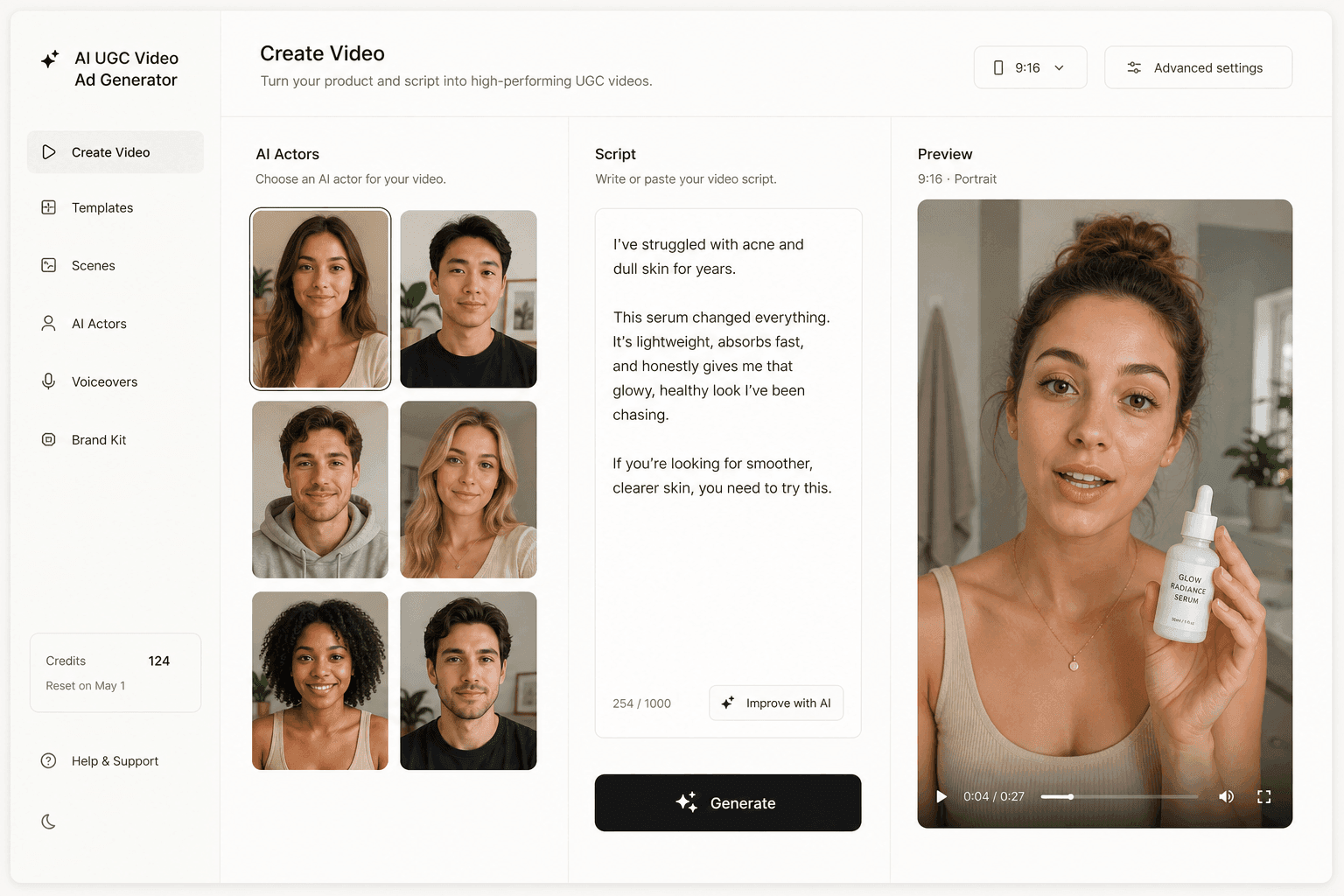
Novoads is an AI UGC video-ad generator. You upload a product image or write a script, pick an AI actor, and get an ad-ready vertical video, which is the shape Snapchat's video formats take anyway.
That changes the arithmetic in this article at exactly one place: the cost per creative. Generated video runs from about 25 cents for a five-second Seedance 2.0 Mini clip to about $4 for an eight-second Google Veo 3.1 clip, and about $10 for a full 30-second Seedance 2.5 take, so filling six exploration windows a month costs tens of dollars at most instead of hundreds or thousands. Pricing is per model and published, so a testing month is a line item you can forecast rather than a quote you wait for. Novoads starts at $15/month (Starter, 200 credits per month). Plus is $49/month (1,000 credits), and Ultra starts at $129/month (3,000 credits) for more volume. Cancel anytime.
The floor is published. The price is negotiated, every time.
Snapchat has told you everything it is prepared to tell you about cost, and it fits on one page: $5 a day to enter, $20 to $50 to learn anything, and an auction that prices each impression against whoever else wants the same person at the same second. There is no rate card because there cannot be one. What you pay is a function of your bid, your objective, your audience and your competition, and three of those four are close to fixed the moment the campaign is live. The ad is not.
Which reframes the question people actually ask. "How much do Snapchat ads cost" has no answer. "How much does a customer cost me on Snapchat" has one, it is computable before you spend, and it is decided less by what you bid than by how many first seconds you can afford to test.
Frequently Asked Questions
How much do Snapchat ads cost?
Snapchat publishes no rate card for self-serve advertising. Its pricing page states that the minimum spend per day is $5, although it recommends $20 to $50 per day, and says that beyond the floor, cost depends on how much you are willing to invest to get the results you want. What you actually pay per impression or per click is set in Snapchat's ad auction by your bid, your objective, your audience and the advertisers competing for the same people, so there is no single correct answer, only a floor and a method for estimating your own number.
What is the minimum budget for Snapchat ads?
$5 per day, verified on Snapchat's own pricing page on July 27, 2026. The same page recommends at least $20 to $50 per day so that a campaign can complete the Exploration Phase, which Snap says typically takes 4 days or more depending on the objective. Snap's Marketing API documents the same floor for an ad squad's daily budget and a higher one, $20, for a campaign-level daily spend cap.
What is the average CPM for Snapchat ads?
Snapchat does not publish one. No Snap-owned page carries a CPM or CPC benchmark, so every figure in circulation comes from a third party. One measured example: Gupta Media's Social Media CPM Tracker, which the agency says draws on tens of millions of ad impressions, reported $8.39 CPM, $0.90 per link click and a 0.94% link click-through rate for Snapchat in June 2025. Treat that as one dated reading from one buyer's book of business, not as Snapchat's rate.
Did Snapchat ad prices change in 2026?
Not on any published surface. The $5 minimum and the $20 to $50 recommendation appear word for word in archived captures of Snapchat's pricing page from January 2024, January 2025 and July 2026, and a $5 daily minimum was already published there in March 2021. A 2026 date on a Snapchat cost guide means the numbers were re-checked in 2026, not that they moved.
Is my Snapchat bid a maximum I cannot exceed?
Only on one goal. Snap's Bid Estimate documentation states that for the impressions goal, which is priced as cost per 1000 impressions, your bid will not be exceeded. For swipes, app installs, video views, page views, purchases and the rest, the same page says the bid is treated as a goal, not a maximum, and can be exceeded. Your daily and lifetime budgets are the real spend controls.
Are there fixed-price Snapchat ads?
Yes, but not on the path most advertisers take. Snap's Marketing API documents two buy models, auction as the default and reserved, and reserved covers Reach and Frequency buying, which Snap describes as available in beta on a whitelist basis with a minimum reach of at least 500,000 unique users. If you are asking what Snapchat ads cost for a normal budget, you are on the auction, and the reserved path is not open to you.
Key Takeaways
- Snapchat commits to exactly one price in public: a minimum spend of $5 per day, with its own recommendation set at $20 to $50. Everything above that floor is decided by an auction.
- The $5 floor is old, not new. Dated captures of Snapchat's own pricing page carry the same sentence in January 2024, January 2025 and July 2026, and a $5 daily minimum was already on that page in 2021.
- Snapchat publishes no CPM or CPC benchmark anywhere on its own surfaces, so every average you find online is a third party's measurement or a copy of one. Ask for the sample and the date before you use it.
- Your bid is only a hard ceiling on the impressions goal. On swipes, installs, purchases and every other goal, Snap's own docs say the bid is treated as a goal, not a maximum, and can be exceeded.
- The honest unit of Snapchat cost is not a CPM. It is one exploration window: 4 days or more at $20 to $50 a day, which is $80 to $200 before you learn anything, and one creative per window.