What Is Nano Banana Pro? Google's Premium Image Model for Ads
Nano Banana Pro is Google's Gemini 3 Pro Image, the model Google says is best for complex graphic design, product mockups and data visuals with accurate text. Google offers it in the Gemini app, Flow, Google Ads and its API, and Novoads sells it from 2 credits an image.

Mauricio Valdivia
·12 min

Google's premium Nano Banana, tested on a candle ad
Nano Banana Pro is Google's name for Gemini 3 Pro Image, the model its developer guide calls "the premium choice for the most complex visual tasks." Google's model page is more specific. It says Nano Banana Pro "is best for complex graphic design, high-fidelity product mockups, and factual data visualizations that require accurate text rendering and real-world grounding via Google Search." We sell it in Novoads, and on October 20, 2026, we used it to make ads for an unlabeled candle jar. One request gave us four static ad variants. The headline and sub-line came out readable on every one, and the whole run cost 8 credits.
We didn't test Google's own apps or its API for this post. Everything on Google's side comes from Google's pages, read November 1, 2026. The Novoads side comes from that run and our pricing page.
For ad work, we'd reach for Pro when an image needs exact words, a logo and products that have to look like the real thing. We'd also expect it to cost more per image than Google's faster Nano Banana models, and on Google's own price list it does.
Gemini 3 Pro Image, the model behind the name
Announced in November 2025, stable since May 2026
Google announced Nano Banana Pro on November 20, 2025. The launch post introduces it as "Nano Banana Pro (Gemini 3 Pro Image)" and says it's built on Gemini 3 Pro. Google's changelog lists a preview release for developers the same day. The stable version came months later, on May 28, 2026, when Google released the generally available versions of Nano Banana Pro and Nano Banana 2. Google's deprecations page lists the stable Pro model with no shutdown date announced.
So "when did it come out" has two right answers.
- If you mean when Google introduced it, that's November 2025, with a preview for developers on day one.
- If you mean when it stopped being a preview, that's May 2026, when Google released the stable version.
The preview had a shutdown date of June 25, 2026, and Google named the stable model as its replacement. In the API, developers now call that stable version gemini-3-pro-image. One line on Google's model page doesn't match those dates. Its "Latest update" entry still reads November 2025, so don't take it as the date of the stable release.
How Google says it works
Google's model page calls Nano Banana Pro "a sophisticated reasoning-driven engine for professional-grade image editing and generation, offering studio-quality precision and advanced creative control." Google's image generation guide, last updated October 26, 2026, spells out what that means in practice. Gemini 3 image models run a reasoning step on complex prompts. It's on by default, you can't turn it off in the API, and the model "generates up to two interim images to test composition and logic" before the final one.
That changes how we'd write an ad prompt. If the layout matters, say where the headline, the product and the logo go, because Google says the model tests composition before the final render. It also changes the bill. The guide says thinking tokens are billed by default, so a call costs more than the image price alone.
One of five Nano Banana models
"Nano Banana" isn't a single model. Google's guide says "Nano Banana is the name for Gemini's native image generation capabilities," and it lists five models under that name in the Gemini API today.
| Model | Also called | How Google's guide describes it |
|---|---|---|
| Nano Banana 2.1 | Gemini Nano Banana 2.1 | "the primary high-efficiency workhorse model for image generation and conversational editing" |
| Nano Banana 2 Lite | Gemini 3.1 Flash Lite Image | "The fastest and cheapest Gemini image model" |
| Nano Banana 2 | Gemini 3.1 Flash Image | "The previous-generation high-efficiency workhorse model" |
| Nano Banana Pro | Gemini 3 Pro Image | "The premium choice for the most complex visual tasks" |
| Nano Banana | Gemini 2.5 Flash Image | "The legacy pioneer of the Nano Banana series" |
Google doesn't steer most work to Pro. In its entry for Nano Banana 2, the guide says "Recommended for all new projects to use Nano Banana 2.1," and it presents Pro as the step up for harder jobs. The original Nano Banana has a shutdown date of March 15, 2027. Of the five, we sell only Nano Banana Pro in Novoads, and our Nano Banana 2 vs Nano Banana Pro comparison goes deeper on those two.
What Nano Banana Pro does that an ad needs
Words that come out spelled right
A static ad usually carries a headline, so this is the claim that matters most for ads, and it's the one Google led with. Its November 2025 launch post says "Nano Banana Pro is the best model for creating images with correctly rendered and legible text directly in the image, whether you're looking for a short tagline, or a long paragraph." That's Google rating its own model at launch, against the image models of 2025. Google has since released Nano Banana 2 and Nano Banana 2.1, and its guide (last updated October 26, 2026) now says the Nano Banana models as a group are "capable of generating legible, stylized text for infographics, menus, diagrams, and marketing assets."
Our own run is a single test, so it doesn't rank anything. We asked for the headline "Light it. Slow down." and the sub-line "Soy wax · Cotton wick · Hand-poured," and both came back legible on all four variants. One tip in Google's guide matches how we'd work anyway. It reads, "When generating text for an image, Gemini works best if you first generate the text and then ask for an image with the text." So settle the exact words before you write the image prompt, then paste them in as they should appear. Our Nano Banana prompts guide walks through Google's own examples for text in images.
Up to 14 reference images, split three ways
Reference images are where Google's own tables set Pro apart. The guide says "Nano Banana models allow you to mix up to 14 reference images," and its table divides Pro's share three ways.
- Objects, up to 6 images "with high-fidelity to include in the final image"
- Characters, up to 5 images "to maintain character consistency"
- Style, up to 3 images "to be used as style references"
That's 14 in all. But the same guide's limitations note says Pro "supports 5 images with high fidelity, and up to 14 images in total," which is one fewer high-fidelity image than the table allows for objects. Google doesn't say which count is right, so we'd plan an ad around five items that have to be reproduced exactly and treat a sixth as a bonus.
Google's other pages give their own numbers. The launch post talked about "using up to 14 images and maintaining the consistency and resemblance of up to 5 people." An undated Google Ads announcement says Asset Studio can "create a single, cohesive lifestyle scene or product showcase featuring up to five of your products." A product ad built from a hero shot, a logo and one person needs three reference images, well inside any of those counts.
Search grounding, from the web only
You can turn on Google Search grounding when you generate with Pro. Google's model page lists Search grounding as supported, and the guide describes using "the Google Search tool to generate images based on real-time information, such as weather forecasts, stock charts, or recent events." That's the "real-world grounding" in Google's best-for sentence, and judging by those examples, it's aimed at charts and data visuals more than at product shots.
With Pro, that grounding means web search. The guide says that when you use Grounding with Google Search, "image-based search results are not passed to the generation model and are excluded from the response." Grounding on Google Image Search is "only available for the Gemini Nano Banana 2.1 and Gemini 3.1 Flash Image models." So grounding a Pro image brings in facts from the web, but no pictures from Google Image Search.
Nano Banana Pro or Nano Banana 2, going by Google's own pages
What Google says each one is for
Google's guide says "Gemini Nano Banana 2.1 and Gemini 3.1 Flash Image are optimized for speed and high-volume use-cases, and Gemini 3 Pro Image is optimized for professional asset production." Gemini 3.1 Flash Image is Nano Banana 2, and Nano Banana 2.1 is its update.
Google introduced Nano Banana 2 on February 26, 2026, under the headline "Nano Banana 2: Combining Pro capabilities with lightning-fast speed." Then, on October 6, 2026, it released Nano Banana 2.1 in the API, told developers to migrate to 2.1 and marked Nano Banana 2's API model deprecated, with no shutdown date announced. So if you're weighing Pro against Nano Banana 2 for new work, the faster model to compare it with is 2.1.
Prices and limits side by side
The prices are Google's Standard paid rates per output image, from its Gemini API pricing page, last updated October 30, 2026. The other rows come from Google's image guide, last updated October 26, 2026.
| Nano Banana Pro | Nano Banana 2 | Nano Banana 2.1 | |
|---|---|---|---|
| 1K image | $0.134 | $0.067 | $0.0336 |
| 2K image | $0.134 | $0.101 | $0.0504 |
| 4K image | $0.24 | $0.151 | $0.113 |
| Object reference images | up to 6 | up to 10 | up to 10 |
| Character reference images | up to 5 | up to 4 | up to 4 |
| Style reference images | up to 3 | none in Google's table | none in Google's table |
| Video as an input | no | yes | yes |
| Google Image Search grounding | no | yes | yes |
At 1K, Pro costs twice what Nano Banana 2 does at Google's rates. Against Nano Banana 2.1, it's about four times the price. For the extra money, Google's tables give Pro a fifth character slot and a style-reference row. The faster models get more object references, video input and image search grounding.
What the faster models share with Pro
Some of what Google's launch post said about Pro now describes the cheaper models too.
- Nano Banana 2 is, in the guide's words, a model "balancing speed with 4K generation, world knowledge, and multi-reference image consistency."
- Google credits Nano Banana 2.1 with "improved visual quality, text rendering, multi-turn consistency, and Google Search grounding across 1K, 2K, and 4K resolutions."
- The 14-image reference ceiling comes from a line about Nano Banana models in general.
So if a page tells you only Pro can render readable text, make 4K images or use Search grounding, it's out of step with Google's own docs. In our view, Pro is the pick when an image needs several people to stay recognizable, a reference style held across variants, or a dense layout with a lot of words on it. When you want many cheap variations, we'd go with Nano Banana 2.1. We sell only Pro, so if 2.1 suits the job, Google's own API is one place to get it.
Where you can use Nano Banana Pro
The Gemini app and Flow
In the Gemini app, Google now offers Pro as a redo option. Google's February 2026 post on Nano Banana 2 said "Nano Banana 2 will replace Nano Banana Pro across the Fast, Thinking and Pro models." The Gemini Apps help page, read November 1, 2026, describes Pro as an option "available when you have the Gemini model set to Pro and want to redo an image when additional detail is needed," for people with a Google AI plan. The same page says Pro "can provide additional detail, especially for images that use text rendering or for infographics," and that once you hit your daily quota of Nano Banana 2 images, you can't redo more with Pro.
Flow's own help pages disagree on which image model is the default.
- The page on images says "By default, Google Flow sets the model to Nano Banana Pro."
- The page on models says Pro "is the default model for Google AI Ultra subscribers" and that Nano Banana 2 Lite "is the default model available at no charge."
Both pages read that way as we write, so check Flow's model menu before you generate.
Google Ads Asset Studio
Asset Studio is the Google surface built for advertisers. Google's November 2025 launch post said "We're upgrading image generation in Google Ads to Nano Banana Pro," and Google Ads help for Asset Studio now says the tool "has been upgraded with a powerful suite of AI-powered tools, including the Nano Banana Pro image generation model." You open Asset Studio from the Tools menu in Google Ads. An undated Google Ads announcement says the model "is now rolling out to all active Google Ads users in Asset Studio."
The help page and a Google Ads article from March 2026 read like an ad brief.
- The help page says "With one or two product images, Google AI can generate scenes that include backgrounds, people, and usage scenarios, while preserving product fidelity."
- One of the help page's tips is "Include crisp, legible text in your images."
- The article suggests uploading up to 14 reference images (logos, style guides, product shots) and using "Nano Banana Pro's Precision Text Rendering for clear Calls to Action (CTAs) on images."
If your campaigns already run on Google, Asset Studio is the shortest path from the model to a live ad, because you make the image inside the account that runs the ad.
The API, Vertex AI and the sites in between
Developers use Pro through the Gemini API, and Google's model page lists Batch API support. Google's developer post for the preview said the model was starting to roll out in paid preview in Google AI Studio and Vertex AI for enterprises, and that "leading creative platforms are integrating the model, including Adobe and Figma."
Other sites use the name without being Google, and some of them are among the top results for this question. Novoads is a third party too. We sell Nano Banana Pro inside our own app, at our own prices. So take Google's claims from Google's pages, and judge the rest of us on price and output.
Commercial use, in Google's words
We didn't find a plain yes on the Google pages we read. Four lines come close.
- Flow's FAQ asks "Can I use outputs of these tools for commercial purposes?" and answers that "The Terms of Service govern how these tools may be used, and must be consulted and followed in their entirety," then quotes the terms' line that Google won't claim ownership of what you generate.
- The Gemini API's additional terms, effective March 23, 2026, follow that line with "You acknowledge that Google may generate the same or similar content for others and that we reserve all rights to do so."
- The Gemini Apps policy says "Do not use Gemini Apps to enable or create automated or repetitive commercial or promotional content (spam)."
- The image guide says "All generated images include a SynthID watermark."
Before a campaign, read the terms of the surface you use, and assume another advertiser could get an image close to yours.
What Nano Banana Pro costs
Google's API price per image
Google's Gemini API pricing page, last updated October 30, 2026, lists Nano Banana Pro for paid use only, and on its Batch tier an output image costs half the Standard price.
| Gemini API tier | 1K or 2K image | 4K image |
|---|---|---|
| Standard | $0.134 | $0.24 |
| Batch | $0.067 | $0.12 |
Those prices cover the output image alone. Input, text output, thinking and Search grounding are billed on top, at Google's Standard rates.
- text and image input at $2.00 per million tokens, which Google puts at $0.0011 per input image
- text output and thinking at $12.00 per million tokens
- Search grounding at $14 per 1,000 search requests, after 5,000 a month at no charge
That no-charge allowance is shared across Gemini 3 and newer models, and Google's page lists a daily cap of 1,500 search requests.
Flow's daily limits
In Flow, Nano Banana Pro images come out of a daily allowance instead of a price per image. Google's Flow help, read November 1, 2026, says "Generating and upscaling images in Google Flow does not currently use your monthly Google Flow credits or AI credits," and gives Pro a daily limit that rises with your Google plan.
| Your Google plan | Nano Banana Pro images a day in Flow |
|---|---|
| No Google AI plan | up to 20 |
| Google AI Plus or Pro | up to 100 |
| Google AI Ultra | up to 500 |
By that table, you can make up to 20 Pro images a day in Flow without a Google AI plan. The Gemini app's Pro redo does need a Google AI plan, and we didn't price Google's plans for this post. Our post on what a Nano Banana image costs covers the Gemini app side in more detail.
What Nano Banana Pro costs in Novoads
In Novoads, Nano Banana Pro costs 2 credits an image at 1K or 2K and 4 credits at 4K, however many reference images you use. The dollar figures below are our own arithmetic, at $0.075 a credit on Starter and $0.049 on Plus.
| Nano Banana Pro in Novoads | Credits | On Starter | On Plus |
|---|---|---|---|
| One 1K or 2K image | 2 | 15 cents | about 10 cents |
| One 4K image | 4 | 30 cents | about 20 cents |
| Four 2K images, as in our run | 8 | 60 cents | about 39 cents |
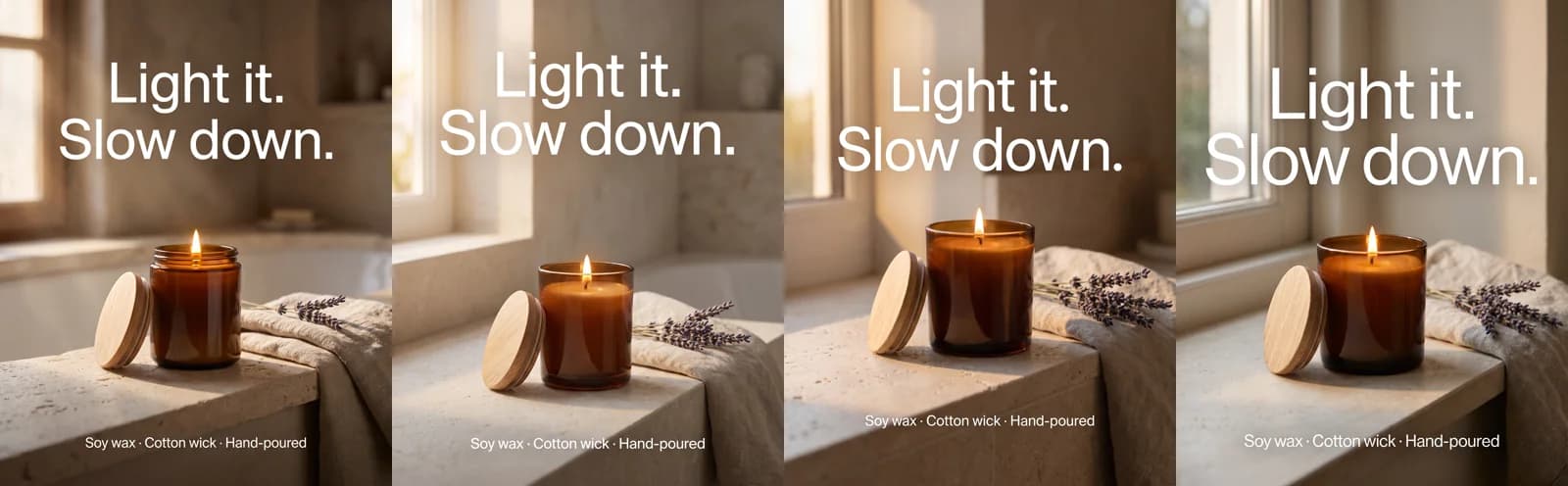 Made in Novoads with Nano Banana Pro · one request through the Novoads MCP connector for four 4:5 static ads at 2K of an unlabeled amber candle jar with a linen towel and a sprig of lavender, headline and sub-line legible in all four · 8 credits · rendered 2026-10-20
That strip shows the run from the top of this post. In all four variants, the jar keeps its amber glass and wooden lid, the wick is lit, and the headline runs large across the top of the frame, with the sub-line set small along the bottom. Our static ads guide covers how we build statics from a single prompt, and our post on Nano Banana Pro for ad creative looks at headlines, price badges and resolution.
Our plans are on the Novoads pricing page. Starter is $15 a month for 200 credits, billed monthly only. Plus is $49 a month for 1,000 credits. Billed annually, Plus is $39 a month. Ultra starts at $129 a month for 3,000 credits.
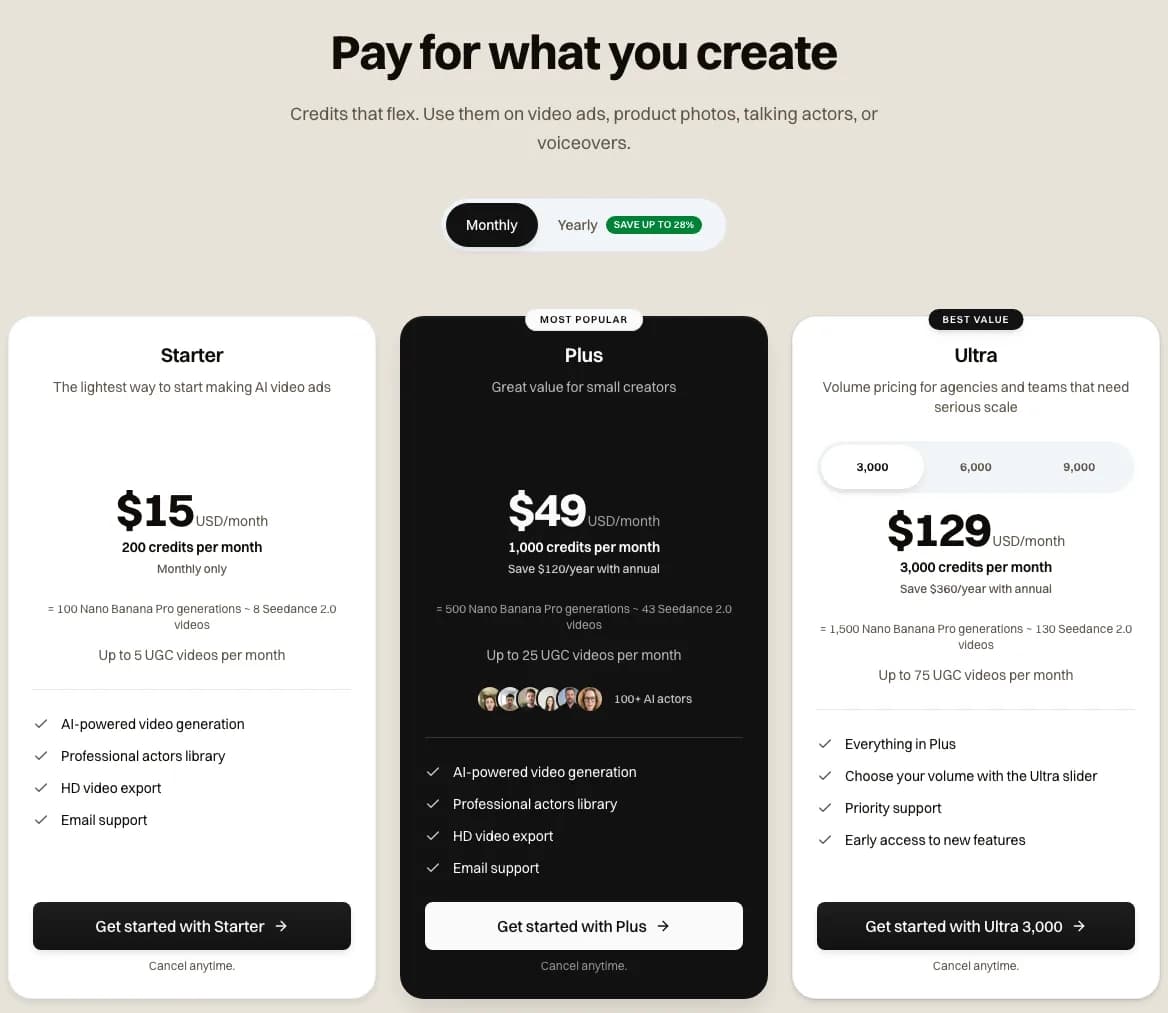 The Novoads pricing page with monthly billing selected, taken 2026-11-01
Google's own routes cost less in three places.
- Batch API images cost less than ours on Starter and on Plus.
- Standard API images cost less than ours on Starter and more than ours on Plus, though Google's figures leave out input and thinking tokens.
- Flow gives up to 20 Pro images a day with no Google AI plan at all.
The reference limits earlier in this post are Google's, for Google's own tools. We set our own, so Google's numbers don't carry over to our app. What you get in Novoads for the difference is Pro alongside our video models, paid from one credit balance that also covers the video ad you build around a Nano Banana Pro static. Novoads is paid from the first month.
Nano Banana Pro from 2 credits an image
Run Google's premium image model inside Novoads for your static ads, paid from the same credits as your video ads.
See the plansIf an ad needs a quick product shot, Google's faster models, its Batch API or Flow's daily allowance will make it for less. If it needs complex design, a mockup that has to look like the real product and words that read right, that's what Google says Pro is best for. In our candle run, the text held up in all four variants.
Frequently Asked Questions
How much better is Nano Banana Pro than Nano Banana 2?
On Google's own pages, the gap shows up in purpose, price and references. Google's image guide says Nano Banana 2.1 and Nano Banana 2 are optimized for speed and high-volume use, while Pro is optimized for professional asset production. Google's Gemini API pricing page was last updated October 30, 2026. It puts a 1K image at $0.134 from Pro and $0.067 from Nano Banana 2. Pro takes up to 5 character reference images against 4, and Google's table gives a style-reference row to Pro alone. Nano Banana 2 takes more object references, video input and Google Image Search grounding. Google's changelog now points Nano Banana 2 users to Nano Banana 2.1.
What is nano AI?
If you mean Nano Banana, Google's developer guide says 'Nano Banana is the name for Gemini's native image generation capabilities.' Five models carry the name in the Gemini API today (Nano Banana 2.1, Nano Banana 2 Lite, Nano Banana 2, Nano Banana Pro and the original Nano Banana). Nano Banana Pro is Gemini 3 Pro Image, the one Google's guide calls 'the premium choice for the most complex visual tasks.'
Does it cost money to use Nano Banana Pro?
It does in Google's Gemini API, where the pricing page (last updated October 30, 2026) lists the model for paid use only, at $0.134 per 1K or 2K image on the Standard tier. Google's Flow help, read November 1, 2026, lists up to 20 Nano Banana Pro images a day for people without a Google AI plan, and image generation in Flow doesn't use Flow credits. In the Gemini app, Pro is a redo option that comes with a Google AI plan. Novoads charges 2 credits per 1K or 2K image, which comes to 15 cents on the Starter plan. Every Novoads plan is paid from the first month.
What model does Nano Banana Pro use?
Nano Banana Pro is Gemini 3 Pro Image. Google's launch post, from November 20, 2025, says it's built on Gemini 3 Pro. The stable version, called gemini-3-pro-image in the Gemini API, has been generally available since May 28, 2026, and Google's deprecations page lists no shutdown date for it.
Key Takeaways
- Nano Banana Pro is Google's Gemini 3 Pro Image. Google announced it on November 20, 2025, and the stable version has been generally available in the Gemini API since May 28, 2026.
- Google's model page says it's best for complex graphic design, high-fidelity product mockups and factual data visuals that need accurate text and Google Search grounding. With Pro, that grounding draws on web results only.
- Google's guide gives Pro up to 14 reference images, split among objects, characters and styles. But the same guide's limitations note counts five high-fidelity images where its table counts six objects.
- Google recommends Nano Banana 2.1 for new projects. On Google's API, a 1K image costs $0.134 from Pro and $0.0336 from Nano Banana 2.1.
- In Novoads, Nano Banana Pro costs 2 credits an image at 1K or 2K and 4 at 4K. Google's Batch API and Flow's daily allowance cost less, and in our own run the headline came out readable on four variants out of four.