Udio for Ads: The $10 Plan, Credits and the No-Download Rule
Udio's terms limit its songs to personal, non-commercial use with no downloads on any plan. See its prices, credits and key dates, and where to get ad music.

Mauricio Valdivia
·12 min
Udio's terms bar downloads and commercial use, on every plan
If you typed "udio" because you need music for an ad, read this before you subscribe. Udio's Terms of Service, last revised November 12, 2025, say "You may not download copies of any Output or any other output generated by the Services." The same page lets you use Output "solely for your personal and non-commercial purposes, provided that you may not download any copies of your Output from the App for any purpose." Output means what Udio generates, sound recordings and musical compositions included.
We think that keeps a Udio track out of a paid ad on every plan unless Udio gives you written permission. We didn't find a plan or program that offers it.
You wouldn't learn this from the search results. Google's top five for "udio" in the US on November 4 were a song on Suno that borrows the name, Udio's YouTube channel, its blog index, a Soundverse guide and a Reddit page that didn't open for us. The four we could read don't mention the rule. The guide comes from a company with its own song generator. It's dated January 30, 2026, three months after Udio switched downloads off, but it still says Udio leaves you with "a final track ready for download" and serves people "seeking quick, royalty-free music solutions".
We read Udio's terms, help articles and pricing page on November 4, 2026, along with archived copies of its older terms. The Novoads side comes from our own API reference and one real music request. We didn't test Udio for this post.
What Udio is today, a year into its transition
A song generator from Uncharted Labs
Udio makes songs from a text prompt. Its terms name Uncharted Labs, Inc. as the company behind it. A post from May 8, 2024, says it had launched a month earlier. Every generation gives you two songs. They run 32 seconds by default, though you can choose a longer clip of about 2 minutes.
From there you can remix a song or extend it, up to 10 sections in total according to a help article from March 8, 2025. Uploading your own audio takes a paid plan, and when you do, you confirm "that you own the rights to the audio." Another help article, from March 12, 2025, says "we don't currently offer a public API", so as far as we can see, Udio is a tool you use by hand. On a phone, that means the iOS app. A help article dated January 28, 2026, says "We don't currently have an Android app".
The two label deals behind the change
Udio's help article on the change, dated February 17, 2026, says "On October 29, 2025, Udio entered into a partnership with Universal Music Group". Udio's post that day said "Over the next several months, Udio will be in a transition period as the team prepares our newest models and product experiences." Then, on November 19, 2025, Udio announced a deal with Warner Music. Its post says the arrangement "additionally resolves the companies’ copyright litigation" and promises a platform where people can "make remixes, covers, and new songs using the voices and styles of artists who choose to participate." The same post says neither label bought Udio.
A year later, that transition doesn't look finished. The newest post on Udio's announcements page is still the Warner one. We found nothing on its pages saying the licensed platform is live. In the meantime, the Warner post says you keep "the same v1, v1.5, and v1.5 Allegro models" and tools like extend and remix. Sony is a separate matter. It filed a second suit against Udio on July 20, 2026, and our post on that suit goes through what it means for advertisers.
What the plans cost
Prices as of November 4, 2026, from Udio's pricing page, in US dollars. The page notes that tax rates may vary by location.
| Free | Standard | Pro | |
|---|---|---|---|
| Billed monthly | No charge | $10 a month | $30 a month |
| Billed annually | No charge | $8 a month ($96 a year) | $24 a month ($288 a year) |
| Monthly credits | 100 | 2,400 | 6,000 |
| Daily credit limit | 10 | None | None |
| Songs at the same time | 4 | 6 | 10 |
| 130-second songs | 3 a day | No daily limit | No daily limit |
Standard and Pro add Udio's library of Voices, audio upload and editing of music and lyrics. Only Pro lets you adjust who has access to a song.
A 32-second song costs 1 credit. A 130-second song costs 2. Each generation makes two songs, so a request costs double that. Plan credits don't roll over, but the pricing page says credits you buy on their own never expire. A pack of 100 is $3.00. A pack of 1,000 is $25.00.
Apple's US store matches the web on annual Standard at $96.00. Its annual Pro is $289.00, a dollar over the web's $288.
Where Udio's credit numbers disagree
Udio's pages don't agree on those credit counts, so we've listed every version.
- The pricing table says 2,400 on Standard and 6,000 on Pro. A credits article from October 29, 2025, says the same.
- A roll-over article dated February 20, 2026, says "Standard accounts come with a 1200 credit limit" and "Pro accounts come with a 4800 credit limit".
- The pricing page's own FAQ still gives "1200 credits for standard" as an example.
- The Universal article explains the gap, as far as it goes. It says the Standard limit "has been increased from 1200 to 2400". It says the same of Pro, "from 4800 to 6000".
We've gone with the table's numbers, but we'd check the limit on your account before you plan around either one.
Before you start a trial
Udio offers a one-time trial of its Standard plan, and an article from January 9, 2026, sets out how it works. If you're testing it for an ad, watch what happens when it ends.
- It lasts "up to 7 days", and trial accounts keep the free credit limits.
- If you don't cancel before the end of that period, "the creator will be immediately charged the full price of an annual subscription unless they previously toggled the subscription period to monthly".
- Clause 3.4 of the terms says "Except as expressly set forth in these Terms, payments for any subscriptions to the Services are nonrefundable".
So we wouldn't pay for a year to find out whether a track can go in an ad.
What Udio's terms say about your songs
Four clauses decide the ad question, but they only make sense when you read them together. All four come from the version last revised November 12, 2025. We read the page from Spain. We can't rule out a regional version, but the archived copies show no sign of one.
The four clauses that matter
- Clause 1.2 opens with the ban we quoted at the top. It then has you agree not to "download, reproduce, transmit, display, publish or otherwise distribute or make available" Output "on any personal device or on any streaming platform or user generated content platform", naming YouTube, Facebook, Instagram, TikTok, Spotify and Soundcloud as examples. The one opening it leaves is for links. Udio "may permit you to share hyperlinks to certain output" on services it has approved in writing, as long as you follow its written instructions. It can also revoke that approval.
- Clause 5.2 lists what you may not do "unless applicable laws or regulations prohibit these restrictions or you have our written permission to do so". Downloading Output is on that list. So is the line "exploit the Services, any Output, or the outputs of other users for any commercial purpose".
- Clause 6.1 covers ownership. It says "the Company and/or its licensors own all right, title and interest in and to the Services and the Output". If ownership of a song does end up with you, "you hereby assign and agree to assign" it to them.
- Clause 6.3 is the permission you do get, the line we quoted at the top. You may use Output "solely for your personal and non-commercial purposes", with no copies downloaded "for any purpose", and only if you follow the rest of the terms.
We looked through the rest of the page for wording that treats older songs, paid plans or offline copies differently on downloads or commercial use, and we didn't find any.
Why clause 6.4 isn't a permission
Clause 6.4 is the one we'd expect people to misread, because it talks about public use. It says "If you exploit or otherwise make any public use of any Output", you have to include a credit saying the song came from Udio. It also says a paid subscriber doesn't owe that credit for songs made during the subscription. We read all of that as a rule about the credit. It doesn't grant you any use. Clause 6.3 still limits you to personal, non-commercial purposes on whatever plan you're on.
One App Store line that points the other way
Udio's App Store listing, which we read on November 4, lists "Audio/video exports" under the Free Plan, and the same listing links to these terms. But Udio's help article dated February 17, 2026, says "Note that downloading of audio, video, and stems has been disabled". We didn't test the app, so we can't tell you what that listing line means in practice. We'd go by the terms and the help article, since the terms are what you agree to.
What we think this means for a paid ad
We think an ad for something you sell is a commercial purpose under clause 5.2 and falls outside "personal and non-commercial purposes" under clause 6.3. Neither clause mentions ads by name, so that's our reading of them. Clause 1.2 does name YouTube, Facebook, Instagram and TikTok among the platforms you agree not to publish Output on. Those are the places we'd expect such an ad to run. On that reading, a Udio track can't run under a paid ad on any plan without Udio's written permission, and we didn't find a plan or program that grants it.
We don't see a way around it, either. Recording the audio from the player doesn't look like one to us, since clause 1.2 also covers reproducing and publishing. Links don't solve it. The Warner post says "you can keep sharing your Udio songs with others through udio.com URLs", but an ad needs the sound itself. If your campaign depends on a Udio track, ask Udio in writing and keep the answer.
If you're weighing another generator, read its terms the same way. Our posts on Suno cover its plans and download cap, what its label partners change for ad music and a German court's ruling against it.
How downloads ended, date by date
The ban is a year old and easy to misdate, because Udio revised its terms twice within two weeks.
The order of events
- May 16, 2025. The terms from this date said "you may use your Output for both personal and commercial purposes, and we permit you to download a copy of your Output that consists of an audio file for such purposes." Udio now titles that page "OLD TERMS OF SERVICE - DEPRECATED".
- September 30, 2025. An archived copy of the pricing table lists MP3 downloads on all three plans, WAV and stems on Standard and Pro, and bulk downloads on Pro alone.
- October 29, 2025. Udio's post on the Universal deal said "Starting today, downloads from the platform will be unavailable". The terms revised that day said "You may not download copies of your Output or any other user's Output."
- November 3, 2025. Press reports quote Udio's statement offering "a 48-hour window for all users to download their existing songs", starting that day. We read that in the reports, not in Udio's own post. It was a one-off.
- November 12, 2025. The current revision widened the wording to "any Output or any other output generated by the Services" and added the line about hyperlinks.
- February 17, 2026. Udio's help article with this date says downloading of audio, video and stems "has been disabled".
- As of November 4, 2026. The pricing table's section that read "Share & Download Your Music" now reads "Share & Upload Your Music", and its four download rows are gone.
Where Udio's own dates differ
Two Udio pages from November 19, 2025, date the transition terms differently. The blog says "our transition ToS that was put into place on 12 November", while the help article says "put into place on 29 October". Archived copies show both revisions existed, so we read those as two steps of one change. The ban itself started on October 29, according to Udio's own post that day.
Songs people already saved
Some people saved songs before the ban or during the 48-hour window. We wouldn't stretch today's clause 1.2 to those files. The press reports quote Udio saying "Downloaded songs will be subject to the prior TOS". That doesn't prove an old file is fine in an ad. The May 16 terms are still online, so read them yourself first. They allowed commercial use and asked for a credit that "prominently indicates that such Output was generated using the Services", which paid subscribers didn't owe for songs made while subscribed.
What people say about Udio
Trustpilot and the App Store
Trustpilot showed Udio at 1.5 from 59 reviews when we read it on November 4, 2026. One-star reviews make up 76% of them. The profile is unclaimed, and the page says "This company hasn't invited their customers, so reviews may not be representative". Only 30 of the reviews came in the last 12 months.
Some recent ones complain about this same rule. A review from July 5, 2026, says "they don't allow you to download the music you create", and one from March 17, 2026, says "You don’t clearly get rights to download, distribute or commercially use your own tracks". Those are individual reviews. We didn't count how many say the same thing.
Apple's US store shows "4.2 out of 5" from about 3,700 ratings, which is a very different picture. We can't tell you why the two differ, and we wouldn't read either one as a verdict on using Udio for ads.
Lookalikes in search results
Search the name and you'll hit things that aren't Udio. The top result on November 4 was a song on Suno titled "Udio | AI Music Generator - Official Web". A Google Play app further down says "This is strictly a GUIDE and NOT the official Udio application." And Udio's help article on its iOS app says any "Udio" apps "in the Google Play store are unauthorized". Udio's own addresses are udio.com and help.udio.com, plus the App Store listing from Uncharted Labs.
How you get ad music in Novoads
You send a request through our API or connector
We don't sell Udio or any of its models. In Novoads, you get music by sending a request through our API or our MCP connector. It isn't a step in the editor, whose music dialog offers stock tracks and your own upload. Our public API reference lists the endpoint, which needs a paid plan. If you work in Claude or Claude Code, you can use the connector instead. You sign in with OAuth, no API key needed, and it works with anything that speaks MCP over Streamable HTTP. Our post on making ads from Claude shows the setup, and our comparison of AI video MCP servers puts ours beside the others.
What a request costs, and where Udio is cheaper
One request costs 2 credits and returns two takes. Our reference says "The price is flat per request". You pay for Novoads from the first month. What a request comes to depends on what a credit costs on your plan. Our pricing page has every plan, and this table shows the first two.
| Plan | Monthly price | Monthly credits | Per credit | One music request |
|---|---|---|---|---|
| Starter | $15 | 200 | $0.075 | 15 cents |
| Plus | $49 | 1,000 | $0.049 | About 10 cents |
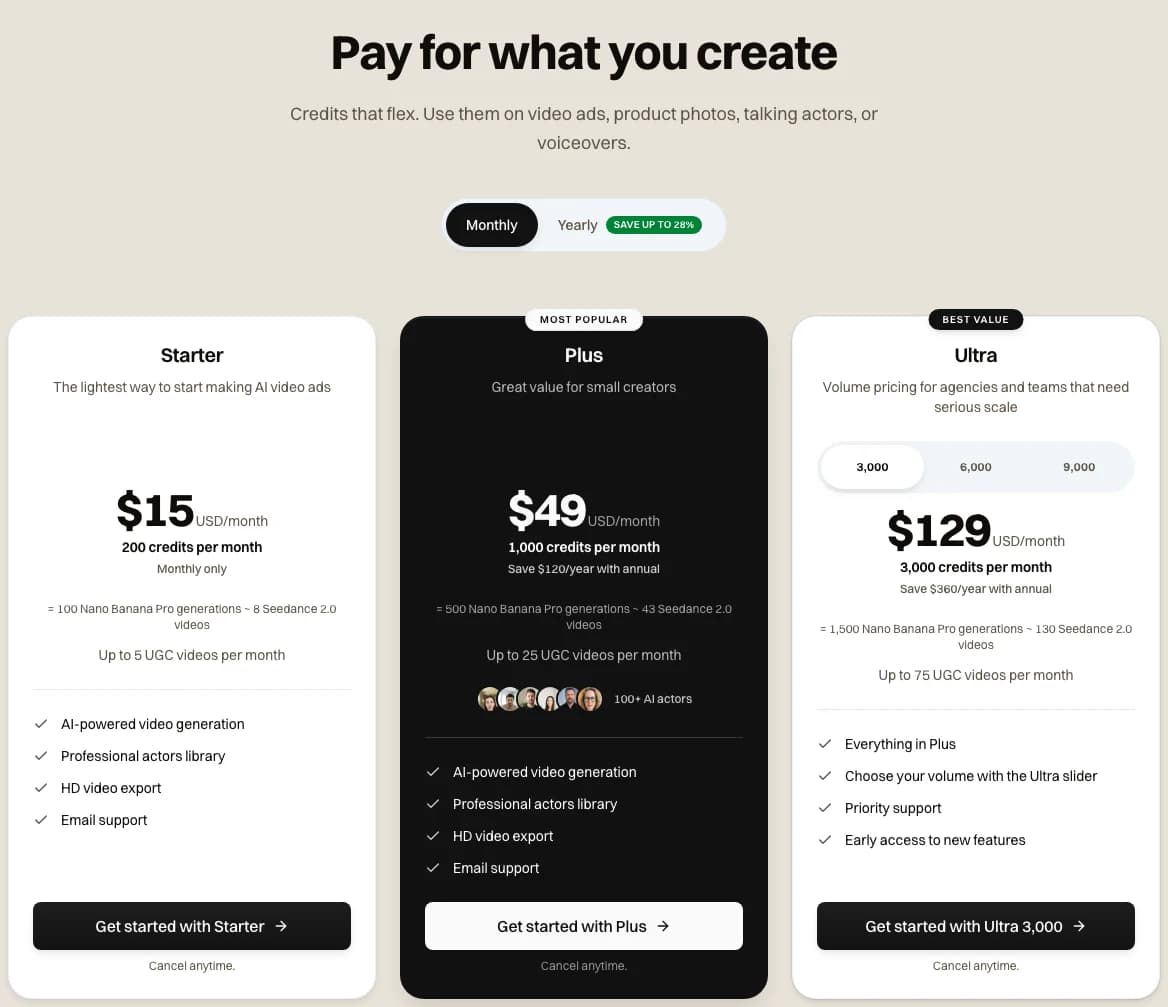 Novoads pricing, Monthly side, as it looked on 2026-11-04
Udio is cheaper per song on its own numbers. Standard's $10 a month buys 2,400 credits by the pricing table's count. At that rate, one 130-second generation of two songs comes to about 2 cents. If you're making songs for yourself, that's a good price. For an ad, we think the terms come first, because those credits don't buy you a track you can use in one.
See what a music request costs on each plan
Each request is 2 credits and comes back as two takes to cut down for your ad. Our pricing page shows what every plan's credits come to.
Compare the plansWhat one real request came back with
We sent one real request on October 31, 2026, with a prompt that started "Bright, feel-good lo-fi pop instrumental bed for a wellness influencer's Instagram story: soft clean electric guitar". It took about 34 seconds and cost 2 credits. Two takes came back, at 165 and 166 seconds, and the model named both "Sunlit Sprout".
One request isn't a speed promise. Our reference says "Typical renders finish in about 75 seconds." It also says to "expect roughly one to two minutes of audio whatever you ask for, and trim it yourself", but both of our takes ran longer than that. Either way, plan on cutting a take down for a short ad. Takes default to instrumental, which suits a bed under a voice-over. Both come back as links to audio files, and the first also shows up in your dashboard library. Our post on prompts for ad beds covers how to ask for one that leaves room for a voice.
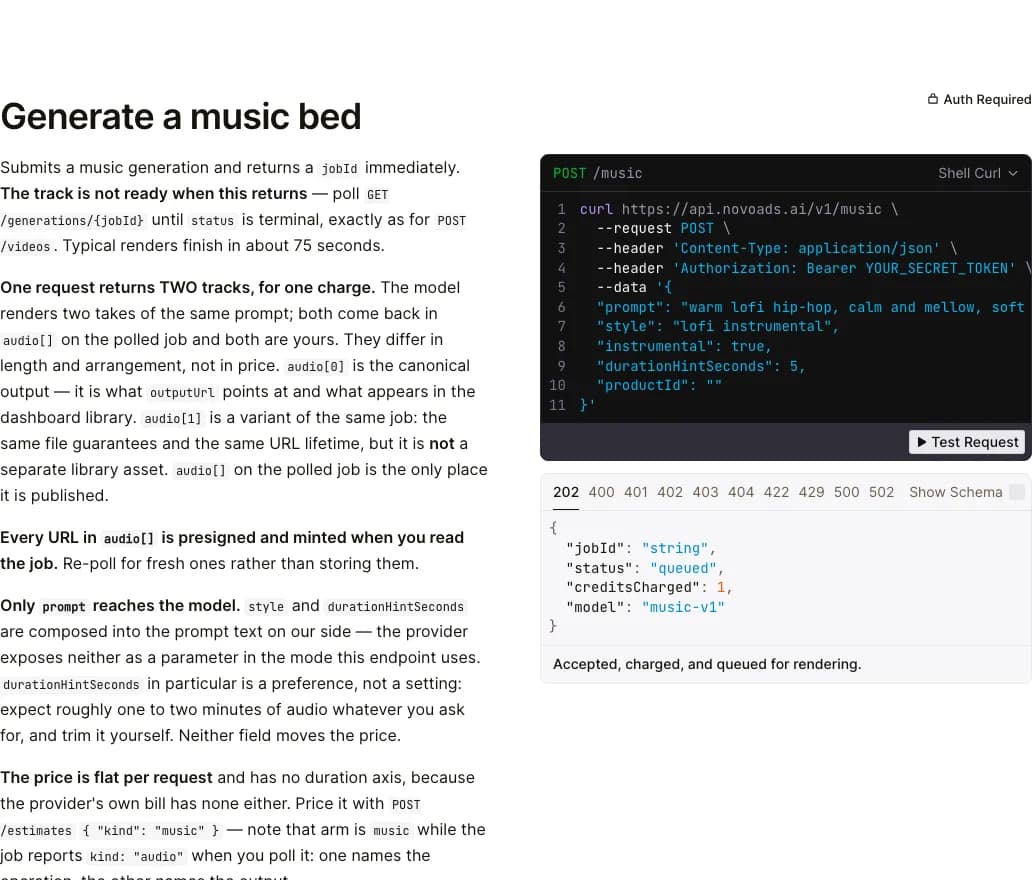 Our API reference's entry for a music request, captured 2026-11-01. The 1 in its sample reply is a placeholder, and a request costs 2 credits.
What our FAQ covers
Our pricing FAQ says "All videos generated with Novoads are fully licensed for commercial use." That line names videos. It doesn't mention a music take on its own, and we won't stretch it past what it says. If you'd rather not use a generated bed, the editor's stock tracks and your own upload are the other two routes. Our post on Sony's suit has a section on lower-risk ways to fill a soundtrack.
What would change this answer
A relaunch would. Udio said "several months" a year ago, and its licensed platform could arrive any day with new terms and new plans. Nothing we read gives a date. So before you decide, look at the revision date at the top of Udio's terms page. If it still says November 12, 2025, what we've written here holds. If it's changed, read the new version before you rely on anything above.
Frequently Asked Questions
Can I use Udio music in an ad?
Not under Udio's current terms, as we read them. The version last revised November 12, 2025, limits Output to 'personal and non-commercial purposes' and bars downloading it or using it for any commercial purpose unless you have Udio's written permission. We didn't find a plan or program that grants that permission. A paid plan only drops the credit line in clause 6.4. If your ad depends on a Udio track, ask Udio in writing first.
Key Takeaways
- Udio's Terms of Service, last revised November 12, 2025, say you may not download copies of any Output and limit its use to personal, non-commercial purposes. We think that keeps a Udio track out of a paid ad on every plan unless Udio gives you written permission.
- Udio switched downloads off on October 29, 2025, according to its post that day. The November revision widened a ban that was already there, and press reports describe a one-off 48-hour window in between.
- Billed monthly, Standard is $10 a month and Pro is $30. Udio's pages disagree on how many credits those plans carry, so check your account before you plan around a number.
- Udio has been in transition since its Universal and Warner deals. We found nothing on its pages saying the licensed platform is live. A relaunch could change the terms, so check their revision date before you decide.
- In Novoads, you make music through the API or the MCP connector. A request costs 2 credits and returns two takes to trim. That comes to 15 cents on Starter and about 10 cents on Plus. Udio is cheaper per song, but we think its terms come first.
Sources
- •Udio: Terms of Service (last revised November 12, 2025)
- •Udio: Old terms of service (May 16, 2025)
- •Udio: A New Era of Music, with Universal Music Group (October 29, 2025)
- •Udio: Udio with Warner Music Group (November 19, 2025)
- •Udio help: Changes associated with the Universal Music Group partnership (February 17, 2026)
- •Udio help: Credits and credit limits (October 29, 2025)
- •Udio: Pricing
- •New Industry Focus: Udio allows downloads for 48 hours