Suno v6 Arrives With Label Partners: What Licensed Training Data Changes for Ad Music
On September 9, 2026 Suno introduced v6 in three variants, built with Warner Music Group, BMG and Believe, and said every model before it will be retired. Here is what the announcement does and does not say, and what it changes for the music sitting under your ads.

Mauricio Valdivia
·Updated ·11 min

Suno is switching off every model that came before
Open the folder where your live creatives sit. Count the ones with a generated instrumental under the voice-over. Now try to say, without guessing, which model version made each of them. Most teams cannot.
On September 9, 2026, Suno introduced v6, a generation of music models it says it developed with industry partners including Warner Music Group, BMG and Believe. The coverage led on the partnerships, because the partnerships are the story for the music industry. For anyone buying media, the important sentence sits near the end of the same announcement: as v6 rolls out, Suno will retire its previous models and move entirely onto the v6 generation. This is a launch post whose real news is a shutdown.
That is worth separating from the copyright question, which we covered when the Munich judgment landed in the GEMA ruling against Suno. This piece is about the launch: what shipped, what the word licensed is doing in it, and what a supplier retiring its whole model line does to a creative pipeline that already has generated audio in it.
What Suno actually shipped on September 9
Three models, and they are not interchangeable
Suno's release note introduces the v6 family as three variants with different jobs. v6 is the flagship, described as reliable and precise and consistently delivering polished music across every genre and style. v6-wild is built for exploration, described as less predictable and more varied, producing unexpected, textured and ambitious results. v6-mini is the faster, more efficient version available to everyone.
The availability split is stated plainly. The release note says v6 and v6-wild are available only to paid users, and Suno's help centre puts both on the Pro and Premier tiers, with v6-mini reaching all plans.
| Variant | Built for | Who gets it |
|---|---|---|
| v6 | Polished, predictable results | Pro and Premier |
| v6-wild | Unexpected, textured results | Pro and Premier |
| v6-mini | Fast, efficient generation | All plans |
Suno's help centre also adds a number the announcement post does not: all three variants support up to 8 minutes per generation, which is many times longer than anything you will put under a thirty-second ad.
The new tools point at people who already make music
The feature list reads like a digital audio workstation, not a toy. v6 can edit part of an existing song from a plain-language instruction. It can build a mashup from multiple sources in one request. It can sample, isolate and build a new beat in a single workflow. And it accepts text, audio, images and video as creation inputs rather than a text box alone.
None of that is aimed at someone generating a lofi bed for a product cut. It is aimed at producers, and it arrives at the moment Suno can point at three label partners. Read the feature list and the partner list together and you get the actual positioning: Suno is trying to become a tool professionals can be seen using.
One of those tools does translate cleanly to advertising, though. Editing one section of a track with a plain-language instruction is the exact operation a media buyer keeps wanting and rarely gets: the bed is right for twenty-five seconds and wrong for the five where the offer lands, and today the answer is to regenerate the whole thing and hope. A model that can change one section while leaving the rest intact turns an audio problem into an edit rather than a re-roll. It is the same shift that made regional editing interesting in video, and it is worth watching for whoever exposes it through an API first.
The line at the bottom of the announcement
Then, near the end, one sentence: as v6 rolls out, Suno will retire its previous models and move entirely onto the v6 generation. No date range, no deprecation window, no migration guide. Trade reporting on launch day went further and said the previous models would be retired the same day, citing Suno's chief product officer.
If you make ads, that sentence outranks every capability above it. A model you cannot call again is not a quality question. It is an inventory question.

What licensed covers, and what it does not
Three named partners, no named catalogues
Suno's announcement names Warner Music Group, BMG and Believe and calls them partners in developing the models. That is the whole of the disclosure. The post publishes no list of catalogues, no indication of how much material was involved, and no description of how the training was carried out. For a launch built around the distinction between licensed new models and disputed old ones, that gap is conspicuous.
This matters because of what advertisers tend to hear. "Trained on licensed music" sounds like a clearance. It is not one. It describes a commercial relationship between Suno and three companies. It says nothing about the rights position of the specific thirty-second instrumental you are about to put behind a paid placement, and the announcement offers advertisers no warranty about it either.
Two of the majors are on the other side
The partner list is also a list of who is absent. Universal Music Group is not in the announcement, and neither is Sony Music Entertainment. Music Business Worldwide reported Suno's chief product officer saying the v6 training data does not include data from Universal Music Group or Sony Music Entertainment, and TechCrunch reported the same day that Suno is still facing lawsuits from labels including both.
So the honest description of v6 is narrower than the headline. It is a model generation developed with one of the three majors, plus BMG and a distributor, while the other two majors remain plaintiffs. That is a real change from where Suno was a year ago. It is not the end of the dispute.
The judgment the announcement does not touch
Europe has not moved with the American settlements. A German court ruled this year that Suno infringed copyright, in a case brought by the collecting society GEMA, and it explicitly held Suno responsible for the infringing outputs rather than the users who typed the prompts. Wednesday's launch does not change that ruling, and that judgment is a first-instance decision that is not final.
We wrote that judgment up in full when it landed, including what it does and does not mean for an advertiser, so it is not relitigated here. The one line worth carrying forward: the remedies in that case run against the tool maker. What reaches you is the supplier's reaction to them, which is exactly what a model retirement is.
A model retirement is a supply event, not a news event
Your bed is not a one-off asset
The instinct is to file this under industry news and move on, because the track you already rendered still plays. That instinct is right about the file and wrong about the campaign. Audio in performance marketing is rarely rendered once. It gets re-cut for a new aspect ratio, re-timed when a hook changes, extended when a fifteen-second variant becomes a thirty, and regenerated when the creative test says the pacing is wrong.
Every one of those is a return trip to the generator, and a supplier gets to decide whether the trip still works: Higgsfield, to take a neighbouring example, only guarantees seven days of output retention on its API. If the model that made the original is gone, the return trip produces something that sounds adjacent instead of identical, and a viewer watching two variants of the same ad in one session will hear the seam even if they cannot name it.
The version number belongs in the asset record
Most teams record the prompt and lose the version. That is backwards. A prompt without a version is not reproducible, because the same words through a different model generation give you a different arrangement, a different mix and a different length. A version without a prompt at least tells you what you are dealing with.
The fix is boring and takes a minute per asset. Whatever you use to track creative operations, add two fields next to any generated audio: the generator and the model version. If you already track this for video, you have the habit. Audio usually escapes it because the bed feels like set dressing rather than an asset.
A worked example: the set that has to be re-cut
Say you have twelve live ads, all sharing one generated instrumental, and the generator retires the model that made it. You are not regenerating one track. You are regenerating the bed and re-cutting twelve timelines against a new arrangement that will not land on the same beats.
Priced in our own terms, the generation part is small: a music request in Novoads is a flat 2 credits, and every request hands back two takes to choose from. Set against the 200 credits a month on Starter, the smallest plan, the audio is a rounding error next to the video it sits under.
The editing part is the expensive half, and it is expensive in hours rather than credits. Twelve timelines re-cut against a new arrangement is most of a day for one editor, and it is a day nobody planned for, because it was triggered by a supplier's release note rather than by anything in the brief. That asymmetry is the whole argument for writing the version down. The cheap step is repeatable. The expensive step is the one you pay twice for when you cannot reproduce the cheap one. The same logic runs through how ad credits are actually spent: the line item you watch is rarely the one that costs you.
How Novoads runs Suno for ad beds
One request, two takes, one charge
Novoads generates ad music on Suno. It runs on our API rather than in the dashboard picker, and the finished track lands in the same library as everything else you generate.
Two properties of that endpoint are worth knowing before you plan around it. The first is that one request returns two takes of the same prompt, for one charge. They differ in length and arrangement, not in price, and both are yours. The second is that the price is flat per request with no duration axis, because the provider's own bill has none either. In practice a request settles in about 75 seconds, and the takes come back around a minute and a half to two minutes long, which is far more audio than an ad needs. Trimming is your job, and it is the right place for it to be.
What the prompt actually controls
The prompt is the whole interface, and it has a hard ceiling of 500 characters that applies to the composed string rather than to your text alone. Style guidance and any length preference get folded into the same string before submission, so leave headroom.
Two defaults are chosen for advertising rather than for music:
- Instrumental is on unless you ask otherwise, because lyrics compete with your voice-over for the same attention in the same three seconds.
- The duration hint is advisory, since the provider takes no duration parameter. Asking for twenty seconds gets you a preference expressed in prose, not a setting.
Write the prompt the way you would brief a composer: instrumentation, mood, tempo, and what it sits under. The phrase that does the most work is the last one. "Sits under a voice-over without competing with it" changes the arrangement more reliably than any adjective about genre, because it tells the model to leave the midrange alone, which is where a human voice lives. If you already write camera-movement prompts for ads, the discipline is identical: describe the job, not the vibe.
The version we pin, and what moves it
Our endpoint submits a fixed Suno model version, written as one constant in our own code rather than resolved from whatever the provider happens to be serving. Today that is not v6. It is the version our published price and our measured render latency were taken against, and changing it reopens both measurements.
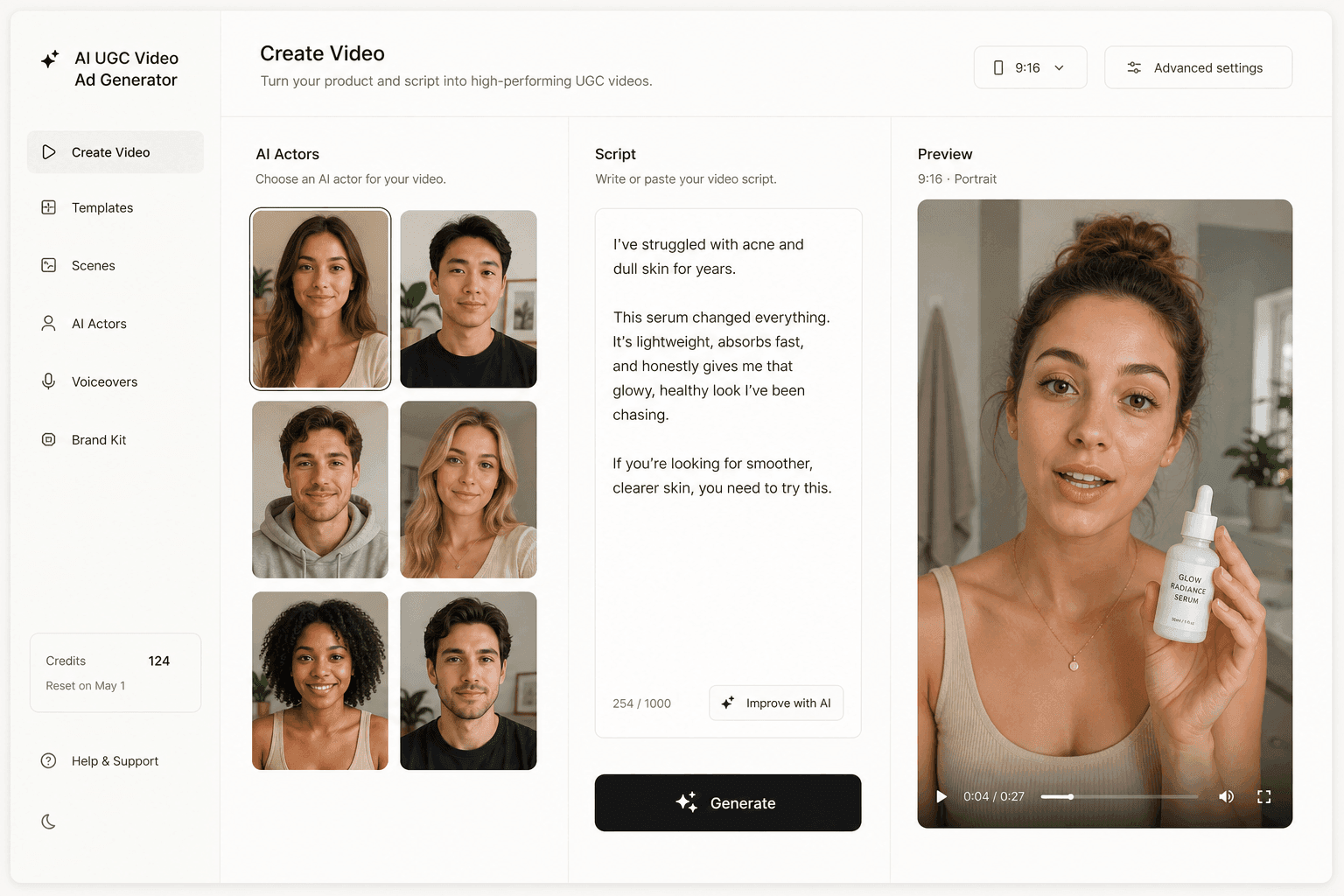
That is the part of this story with a direct answer for a customer. A vendor retiring its model line is an upstream event, and the question that matters is whether it reaches your campaign as a surprise. Because the version lives in one line on our side, moving to v6 is a change we make deliberately, measure again, and publish, rather than a silent swap that arrives between two renders of the same ad set. If you want to hear what the current pipeline sounds like under a script, you can generate an ad and put a bed under it in the same session.
What to do with this in the next week
Inventory the beds in live creative
Start with what is running and spending. Pull the list of active creatives, mark the ones carrying generated audio, and note the tool that made each. This is usually a thirty-minute pass and it is the only step that has to happen this week, because everything else is cheaper once you know the size of the problem.
Write the version down next to the file
For each one, record three fields in the same place you record the aspect ratio:
- Generator. Which tool produced the audio.
- Model version. The exact string, not the family name.
- Date generated. What was current when it ran.
If you cannot recover the version for an old asset, mark it unknown rather than guessing. An honest unknown tells a future you to re-render from scratch. A wrong guess sends you looking for a model that never made that track.
Keep the brief, not just the render
Store the prompt and a one-line description of what the bed is doing: the tempo, the instrumentation, and which beat the hook lands on. When a model retires, that description is what lets someone rebuild the same feel on a new generation in one sitting. The audio file is the output. The brief is the thing you can actually reuse.
If you are weighing generators rather than auditing one, the current field of AI music models for ads and the clearance paths for AI soundtracks are the two pieces to read next, and how AI-generated ads get labeled covers the disclosure side that sits alongside all of this.
Licensed is a supply chain, not a permission slip
The headline from September 9 is that a leading AI music generator now ships models built with major labels in the room. The sentence under it is that everything before it gets switched off. Both are true, and only one of them will show up in your workflow this quarter.
Suno has told advertisers something real: it now has commercial relationships where it previously had lawsuits, and it says nothing further about what went into the models. Treat that as information about your supplier, which is what it is, and treat the retirement as the thing that touches your calendar. The teams that will not feel this are not the ones with a legal opinion on file. They are the ones who wrote down which model made the track.
Novoads starts at $15/month (Starter, 200 credits per month). Plus is $49/month (1,000 credits), and Ultra starts at $129/month (3,000 credits) for more volume. All plans are published on /pricing.
Frequently Asked Questions
What did Suno actually launch on September 9, 2026?
A generation of music models called v6, in three variants. Suno's release note describes v6 as the flagship, reliable and precise across genres, v6-wild as the exploratory one that is less predictable and more varied, and v6-mini as a faster, more efficient version available to everyone. The release note states that v6 and v6-wild are available only to paid users, and Suno's help centre puts both on the Pro and Premier tiers. All three support up to 8 minutes per generation.
Does licensed training data mean AI music is now cleared for commercial ads?
No, and Suno does not claim that. The announcement names Warner Music Group, BMG and Believe as partners and calls them co-developers of the models. It says nothing about which catalogues were used, how much material was included, or how the training was carried out. A licensing relationship with three companies is a statement about Suno's supply chain. It is not a representation about your campaign, and it is not a warranty you can hand to a legal reviewer.
Are the older Suno models going away?
Suno says so directly. Its announcement reads that as v6 rolls out it will retire its previous models and move Suno entirely onto the v6 generation. For anyone with generated audio in live creative, that is the operationally important line in the whole post. The track you already rendered keeps playing, but the model that produced it stops being something you can go back to.
Which Suno model does Novoads use for ad music?
Our music endpoint submits a fixed Suno model version, pinned in one constant in our own code rather than resolved from whatever the provider is serving that day. That is deliberate. The price and the render latency we publish were measured against a specific version, so moving it is a decision with a measurement behind it, not a silent upgrade that changes what your beds sound like between two renders of the same campaign.
What does a music bed cost in Novoads?
A flat 2 credits per request, with no duration term, because our provider bills per request rather than per second. One request returns two takes of the same prompt and both are yours for that single charge. Novoads starts at $15/month (Starter, 200 credits per month). Plus is $49/month (1,000 credits), and Ultra starts at $129/month (3,000 credits) for more volume. All plans are published on /pricing.
What should I do about this in my own account this week?
Treat it as inventory work rather than legal work. List the live creatives that carry a generated instrumental, write the generator and the model version into the asset record next to each file, and keep the prompt or the brief that produced the track. If a supplier retires a model, the difference between a ten-minute re-render and a week of archaeology is whether somebody wrote the version down.
Key Takeaways
- Suno introduced v6 on September 9, 2026 in three variants: v6, v6-wild and v6-mini. On Suno's own release note, v6 and v6-wild are for paying users and v6-mini is available to everyone. All three support up to 8 minutes per generation.
- The sentence that matters for production is not about quality. Suno says that as v6 rolls out it will retire its previous models and move entirely onto the v6 generation, so the model that made your current beds is on a clock.
- Suno names Warner Music Group, BMG and Believe as partners and calls the models co-developed. It publishes nothing about which catalogues were used, how much material was involved, or how the training was carried out, so licensed here describes a supply agreement, not a clearance you can rely on.
- Universal Music Group and Sony Music Entertainment are not in the announcement, and reporting on launch day placed both still in litigation against Suno. A German court separately held Suno responsible for infringing outputs rather than the people typing the prompts.
- Novoads generates ad music on Suno through its API at a flat 2 credits per request, and one request returns two takes. The model version we submit is pinned on our side, so a vendor retirement is a change we make deliberately rather than one that lands mid-campaign.