
How to Improve Your ROAS with AI-Generated UGC Video [2026]
Improve your ROAS with UGC by treating creative volume as the lever, not budget. The mechanism, a step-by-step, the metrics to watch, and the math behind it.

Mauricio Valdivia
·11 min
![How to Improve Your ROAS with AI-Generated UGC Video [2026]](/_next/image?url=%2Fblog%2Fcomo-mejorar-roas-con-ugc.jpg&w=3840&q=75)
Your ROAS problem is a creative supply problem
You can improve your ROAS with UGC, but not the way most teams try. The reflex when return on ad spend stalls is to fiddle with audiences, bids, and budgets. The lever that actually moves the number sits upstream of all of that: how much fresh, trustworthy creative you can put in front of the algorithm.
Short version. AI-generated UGC raises ROAS because it does two things at once. It lifts the revenue side, since a real-seeming person converts better than a brand talking about itself. And it lowers the cost side, because native-looking content earns cheaper distribution. The catch was always production. You cannot test your way to a better ROAS on two hand-shot videos a month.
This guide breaks down the mechanism, a step-by-step you can run this week, the metrics that tell you it is working, and the math that explains why creative volume, not budget, is the cheapest ROAS lever you have.
Why UGC moves ROAS in both directions
ROAS is revenue divided by ad spend, so there are only two ways to improve it: earn more revenue from the same impressions, or buy those impressions more cheaply. Most optimization work touches the second lever a little and the first not at all. UGC is unusual because it pushes on both at the same time.
The two levers of return on ad spend
Write the equation out and the strategy gets obvious. There are exactly two ways to move the number:
- Revenue per impression rises when more of the people who see your ad click and buy.
- Cost per impression falls when the platform decides your ad is worth showing for less.
Targeting and bidding nudge the cost lever. Creative is the only thing that reliably moves the revenue lever, and on modern platforms it quietly moves the cost lever too. That is why a budget increase rarely fixes a ROAS problem on its own: it pours more money into a lever you have already maxed out.
The Trust Discount on brand content
Here is the first named mechanism. A brand talking about itself is discounted on arrival, because everyone knows it is selling. Call it the Trust Discount: the gap between what your message is worth and what it is believed to be worth once people see your logo on it. A person who looks like a peer does not pay that discount. Brand content pays it for predictable reasons:
- The audience knows a brand is selling, so it pre-discounts the claim.
- Polished production reads as "ad," which trips the scroll reflex.
- A logo on the message caps how authentic it is allowed to feel.
The numbers bear it out. Social posts featuring UGC drove over 10 times higher conversion than posts without it, and 65% of US consumers say they rely on UGC when making buying decisions. The format that looks the least produced is the one shoppers trust the most, which is exactly why it converts. If the idea is new to you, our explainer on what UGC is and the role of a UGC creator lay the foundation.
Cheaper distribution, not just better clicks
The revenue lever gets the attention, but the cost lever is where UGC quietly compounds. Feeds reward content that holds attention, and a native-looking clip holds attention better than a studio ad that screams "skip me." Higher engagement signals lower your effective CPM, so the same budget buys more reach. You get more clicks per dollar and more revenue per click in the same motion, which is the whole reason UGC ads have become the default for paid social.
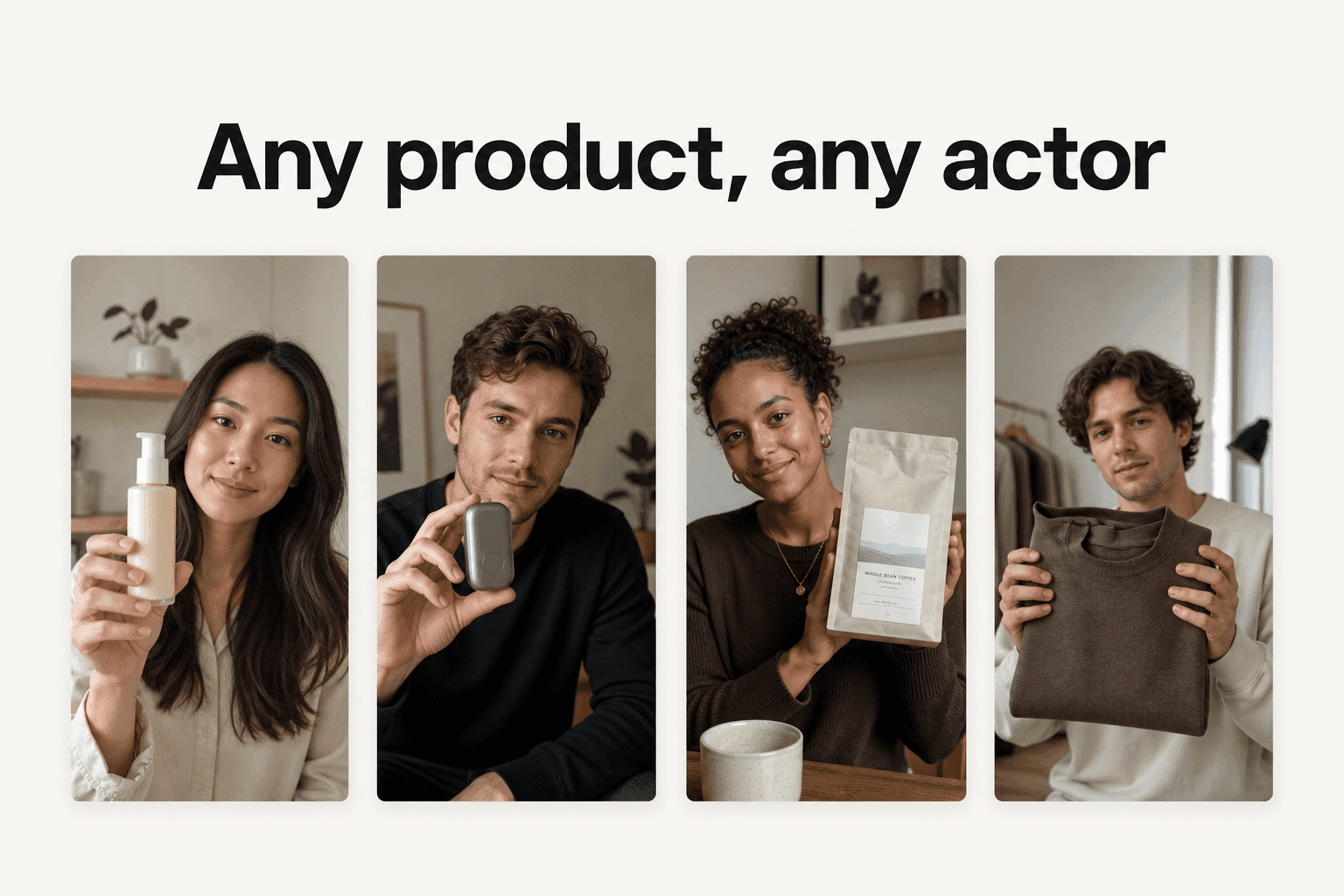
The Winner Rate: the equation that sets your ceiling
If you only remember one idea from this guide, make it this one. The thing standing between you and a better ROAS is not a better ad. It is more attempts at one.
Winners are rare and unpredictable
Anyone who has run paid social knows the winning ad is rarely the one you would have bet on. The clip you loved flops, and the throwaway angle you almost cut becomes the campaign. This is not bad judgment, it is the nature of the medium. Audience taste is not knowable in advance, so the only honest way to find a winner is to put many candidates in front of the market and let it choose.
The Winner Rate, defined
So name the thing. The Winner Rate is the share of the creatives you produce that actually beat your ROAS benchmark. It is usually low, often one in five or one in ten, and it is roughly stable for a given account. Once you accept that the rate is fixed and small, the implication is unavoidable: the number of winners you ship is just the Winner Rate multiplied by the number of variations you test.
Why volume is the only honest lever
That equation is the whole strategy. You cannot raise the Winner Rate by trying harder on a single ad, because you do not control taste. You raise the count of winners by raising the count of attempts. Budget does not help here, and neither does another week of polishing. The only input you control is throughput, which is precisely the input that human production makes expensive. Hold that thought, because it is where AI changes the math.
A worked example: ten angles, one winner
Frameworks are easy to nod along to and easy to ignore, so here is the Winner Rate in real numbers. Treat them as illustrative, not measured, but the shape is what matters.
The setup
Say you sell a skincare serum at $40. Today you run three static-image creatives and your blended ROAS sits at 1.8, which means every dollar of ad spend returns $1.80. You are not losing money, but you are not scaling either, because pushing more budget into three tired creatives just raises frequency and drags performance down.
The math
Now you switch to testing UGC. From one product you build twelve variations: three angles (a problem-solution, a testimonial, a demo), each paired with two hooks and two actors. Assume a conservative Winner Rate of one in six. That is two winners out of twelve. Suppose the winners run at a 3.2 ROAS while the rest get cut after a couple of days. You shift budget onto the two winners, and your blended ROAS climbs from 1.8 toward the high 2s as the losers fall away.
What the numbers actually say
Look at where the lift came from. You did not change your targeting, your bids, or your budget. You changed how many shots you took, and the fixed Winner Rate did the rest. Now run the cost side: producing those twelve clips with AI costs less than a single hired UGC video would, a contrast our video ad production cost breakdown makes concrete. The expensive version of this experiment is the reason most brands never run it. The cheap version is the reason ROAS finally moves.

A step-by-step system to lift ROAS with UGC
The mechanism is settled, so here is the loop. It is deliberately mechanical, because a repeatable system beats a burst of inspiration that you cannot run again next week.
- Pick one product and write three angles. Not three scripts, three angles: a problem-solution, a testimonial, and a demo. Angles are the unit of testing, because they are the thing most likely to change who responds.
- Split hooks from scripts. Treat the first three seconds as a separate variable. Write two or three hooks for each angle and pair them in every combination. A single hook change often moves CTR more than a full rewrite of the body.
- Produce variations, not one ad. Multiply angles by hooks by actors and you have a batch, not a clip. Hiring, that batch is a dozen briefs and two weeks. Generated, it is a dozen clips in a sitting. Our walkthrough on how to create UGC ads covers the full flow.
- Launch as a test, then read the data. Run the batch together, kill the clear losers after a day or two, put budget behind the one that beats your benchmark, and feed what you learned into the next batch.
How to know it worked: within one or two batches you should see at least one creative pull a meaningfully lower cost per acquisition than your old control. If nothing beats the control after a couple of full batches, the problem is the offer or the product fit, not the creative, and no amount of new ads will rescue it.
The metrics that tell you it is working
Per-creative measurement is the difference between a testing program and a guessing program. Track these for every variation, because the campaign average hides the one ad you should be scaling.
Hook rate and hold rate
Hook rate is the share of viewers who watch past the opening, and it tells you whether your first three seconds survive the scroll. Hold rate is the share who reach the end, and it tells you whether the script keeps the people the hook caught. Read together they localize the problem: a strong hook rate with a weak hold rate means the opening works but the middle sags, so you rewrite the body, not the hook.
CTR and cost per acquisition
Click-through rate tells you whether the ad earns the click, and cost per acquisition tells you which variation converts most efficiently. CPA per creative is the metric that ends arguments, because it points at the exact script, hook, and actor combination worth more budget. Let the data, not the loudest opinion in the room, decide which ad scales.
| Metric | What it signals | When to act |
|---|---|---|
| Hook rate | Opening survives the scroll | Weak: rewrite first 3 seconds |
| Hold rate | Script keeps the viewer | Drop-off: tighten the middle |
| CTR | Ad earns the click | Low: test a new angle |
| CPA per creative | Cheapest path to a sale | Scale the winner, cut the rest |
Frequency and Creative Fatigue Decay
The last metric is a clock, not a quality score. As the same people see an ad again and again, response falls. Call it Creative Fatigue Decay: every winning ad has a half-life, and rising frequency is the warning light. The fix is not a higher budget, it is having the next batch ready before the current winner burns out. A testing loop that never stops producing is also a fatigue defense, which is the second reason volume pays.

Where ROAS programs quietly stall
Most teams do not fail at UGC by doing something dramatic. They fail by doing the same small wrong things until the budget drains. Here are the ones worth naming, with why each happens and how to recover.
- Running the same few creatives for weeks. Creative Fatigue Decay is the quietest ROAS killer because the chart slides instead of crashing. Recover by scheduling the next batch before the current one peaks, not after it falls.
- Optimizing bids while ignoring creative. When ROAS dips, the dashboard tempts you to tune audiences and bids. The algorithm cannot rescue a creative the market has stopped believing. Fix the input, not the knobs.
- Using one creative across every funnel stage. A cold prospect needs a pain-point hook, a warm one needs social proof. One message for all audiences underperforms all of them. Match the angle to the stage.
- Judging a concept on too few clips. A two-ad test almost never contains a winner, because the Winner Rate is small. Killing a concept after two clips is killing it before the test even ran.
If you are weighing whether to hire creators or generate clips for this volume, our comparison of AI versus UGC creators walks the trade honestly. The short version:
- Hire a human when you need a specific real face, a long-term ambassador, or one flagship piece where the person is the message.
- Generate with AI when you need the relentless variation paid social rewards and the speed to refresh a winner before fatigue hits.
Most brands need far more of the second than they admit, because one hero video is not a testing program and a testing program is what lifts ROAS.
How Novoads turns the Winner Rate in your favor
Here is the resolution to the thought you have been holding. If the only lever is throughput, and human production is what makes throughput expensive, then the tool that lifts ROAS is the one that produces each variation for a fraction of a creator's fee.
From a script to an ad in minutes
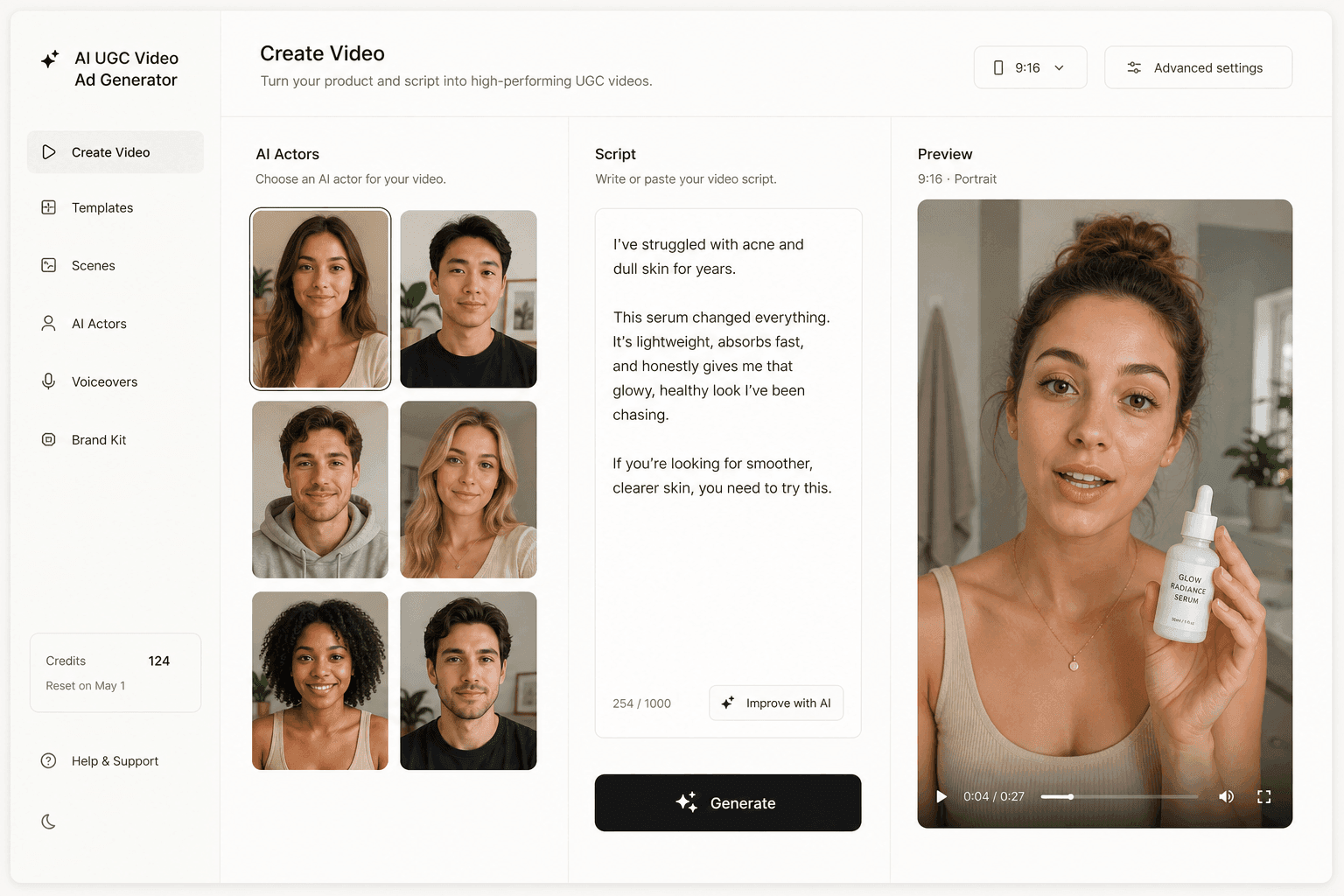
In Novoads, one batch is three short moves:
- Upload a product image and write or auto-generate a script.
- Pick from 100+ AI actors to talk about your product on camera, or, for the product in hand, create a custom actor from a photo of someone holding it (library actors have empty hands).
- Get back a vertical video with voice, lip-sync, and captions, formatted for TikTok, Reels, and Meta.
It runs in about four minutes and for a few dollars rather than a few hundred, so a batch of a dozen angles stops being a two-week project and becomes an afternoon.
The Localization Multiplier
There is a third lever most teams leave on the table. The Localization Multiplier: the same product, run in 30+ languages with real regional accents, multiplies your testable surface without multiplying your effort. In practice that means:
- A separate version per market, with local hooks instead of a flat translation.
- Real regional accents, so the ad sounds native rather than dubbed.
- More attempts per product, which feeds straight back into the Winner Rate.
A flat translation reads as foreign and converts like one. A localized version earns the authenticity each audience rewards, and every new accent is one more shot on goal.
What it costs to run the loop
Novoads runs frontier video models (Seedance, Kling, and Veo) so quality is not the trade you make for volume. The Starter plan is $49 a month with 50 credits, and you can cancel anytime. The point is not a cheaper video. It is that the testing the UGC format was built for finally fits inside an ad budget, which is what our roundup of the best AI video ad platforms gets at from the tooling angle.
Creative volume is the cheapest ROAS lever you have
Strip the tactics away and one sentence remains: your ROAS is downstream of how many trustworthy variations you can afford to test. The Winner Rate is fixed and small, taste is unknowable in advance, and winners fatigue, so the brand that ships the most credible attempts wins, almost regardless of who has the better instincts.
That used to be locked behind a human's calendar and a few hundred dollars per clip. Now it is a script and a few minutes. You can produce your first batch of AI UGC ads with Novoads from $49/month at novoads.ai. Cancel anytime.
Frequently Asked Questions
How does UGC actually improve ROAS?
ROAS has two levers: revenue per impression and cost per impression. UGC moves both. A real-seeming person clears the credibility bar that brand content cannot, so more people click and buy (the revenue side), and native-looking content earns cheaper distribution because platforms reward engagement with lower CPMs (the cost side). You are not buying a prettier video, you are buying a trust signal that the whole funnel responds to.
How many UGC variations should I test?
Enough to clear what we call the Winner Rate: ad winners are a small, unpredictable share of what you produce, so a handful of clips rarely contains one. As a practical floor, run at least ten variations per product or offer before you judge a concept, then keep a fresh batch in the pipeline so you are never down to one tired ad. The exact number matters less than the habit of always testing more than feels necessary.
How fast will I see ROAS improvement?
As fast as you can run enough variations to find a winner and put budget behind it. There is no fixed timeline, because the speed is set by your creative throughput, not the calendar. Teams that produce many variations cheaply find winners in days, not months, simply because they take more shots on goal in the same window.
Should AI UGC replace all my other creative?
No. AI UGC should be your highest-volume format because it makes testing affordable, but keep a mix. Static images, carousels, and the occasional polished piece still earn their place for variety and for audiences that respond to them. The goal is a steady supply of fresh creative, not a monoculture.
Do I need a big budget to improve ROAS with UGC?
No. The constraint is creative supply, not media budget. A larger budget behind the same two tired ads will not lift ROAS, and often lowers it as frequency climbs. The cheap lever is producing more variations so the algorithm has something better to spend your existing budget on.
Which metrics tell me a UGC ad is working?
Track them per creative, not per campaign: hook rate (does the opening survive the scroll), hold rate (does the script keep people), CTR (does it earn the click), and cost per acquisition (which variation converts cheapest). Read each one as a signal about a specific part of the ad, then fix that part in the next batch.
Key Takeaways
- ROAS has two levers, revenue per impression and cost per impression, and UGC moves both because a real-seeming person clears the credibility bar that brand content cannot.
- The Winner Rate: ad winners are a small, unpredictable share of what you test, so your ROAS ceiling is set by how many variations you can afford to produce, not by your budget.
- User-generated content drove over 10 times higher conversion than posts without it, and most shoppers now lean on UGC before they buy, which is why it lifts the revenue side of the equation.
- The system is mechanical: pick one product, split hooks from scripts, produce many variations, launch as a test, kill losers fast, and scale the winner.
- AI UGC removes the production cost that made volume testing unaffordable, which is what finally lets the format do the testing it was built for.