AI Video Generator for TikTok: Make Native 9:16 Ad Variants in Minutes, Not Days
An AI video generator for TikTok turns a typed script into a native 9:16 vertical ad with a real-sounding voice in minutes, so you can test ten angles for the price of one creator clip. Here are the best tools, the formats TikTok rewards, and a full workflow.

Mauricio Valdivia
·Updated ·11 min
Ten TikTok ads for the price of one shoot
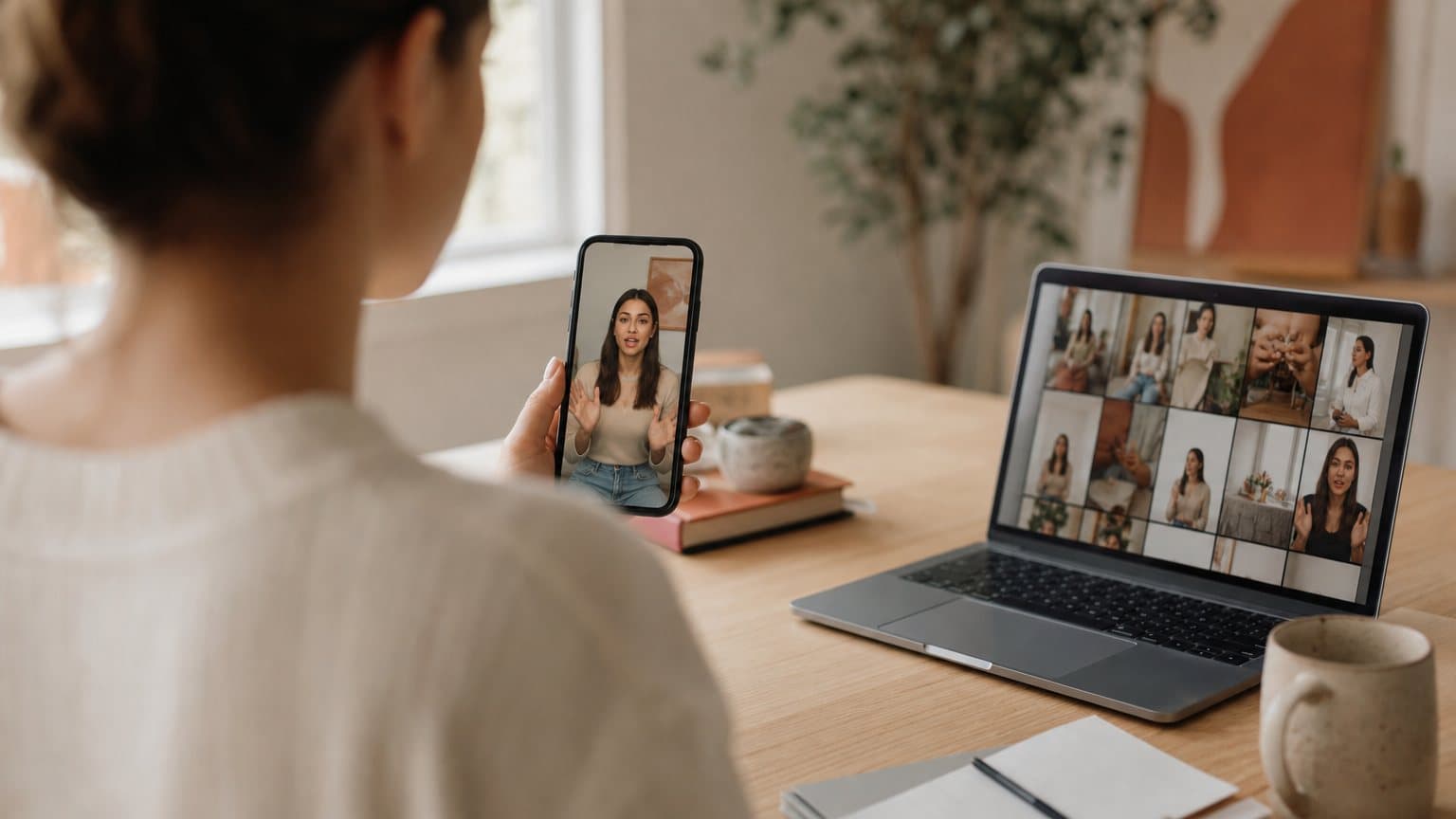
Picture the marketer for a small electrolyte-drink brand at 9pm. She has one product, five hooks she wants to try, and a media budget that will only reward the winner. The old plan was to brief a creator, wait a week, and get back one clip. The new plan is to type five scripts, pick an AI actor for each, and have five native 9:16 videos rendered before she closes the laptop.
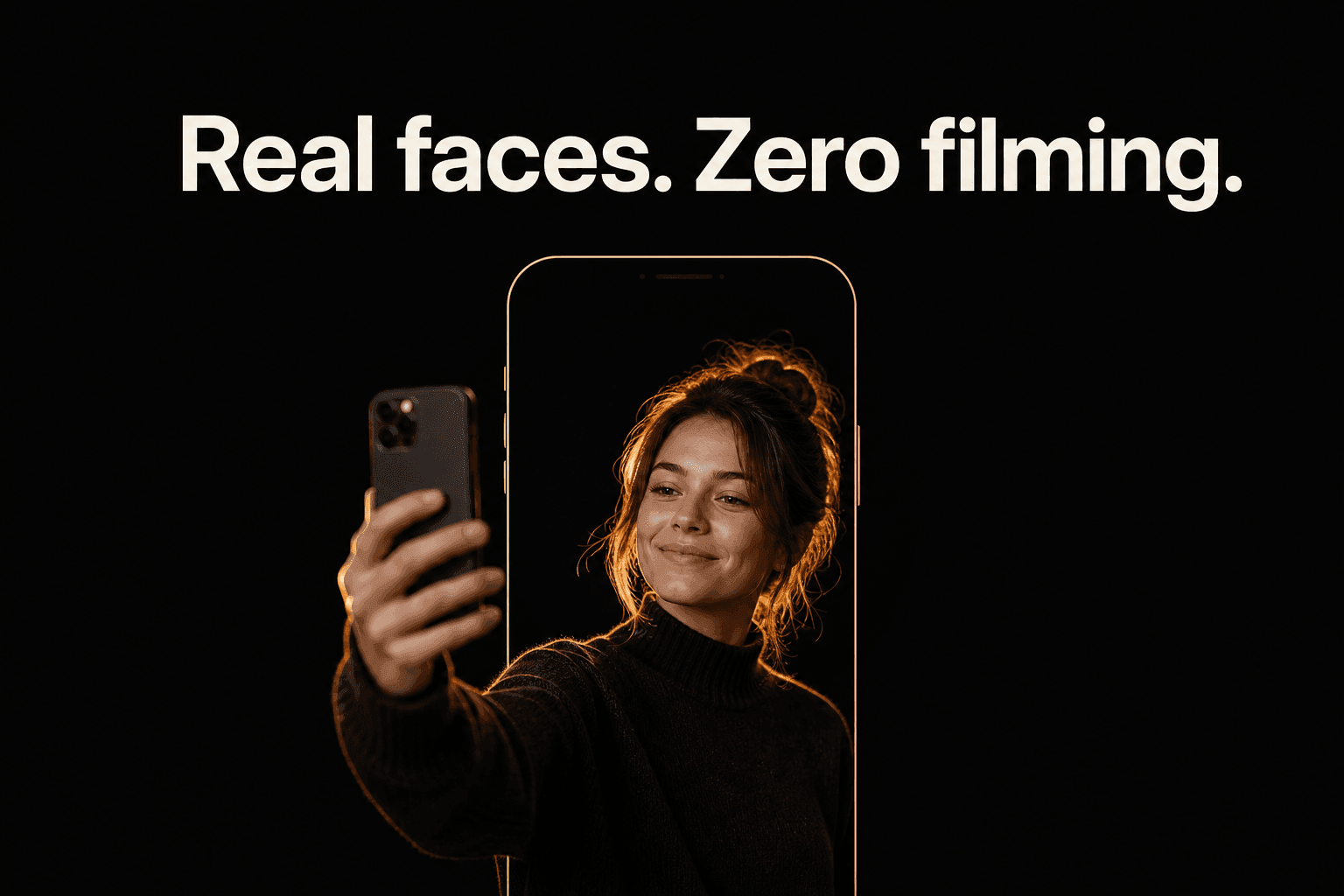
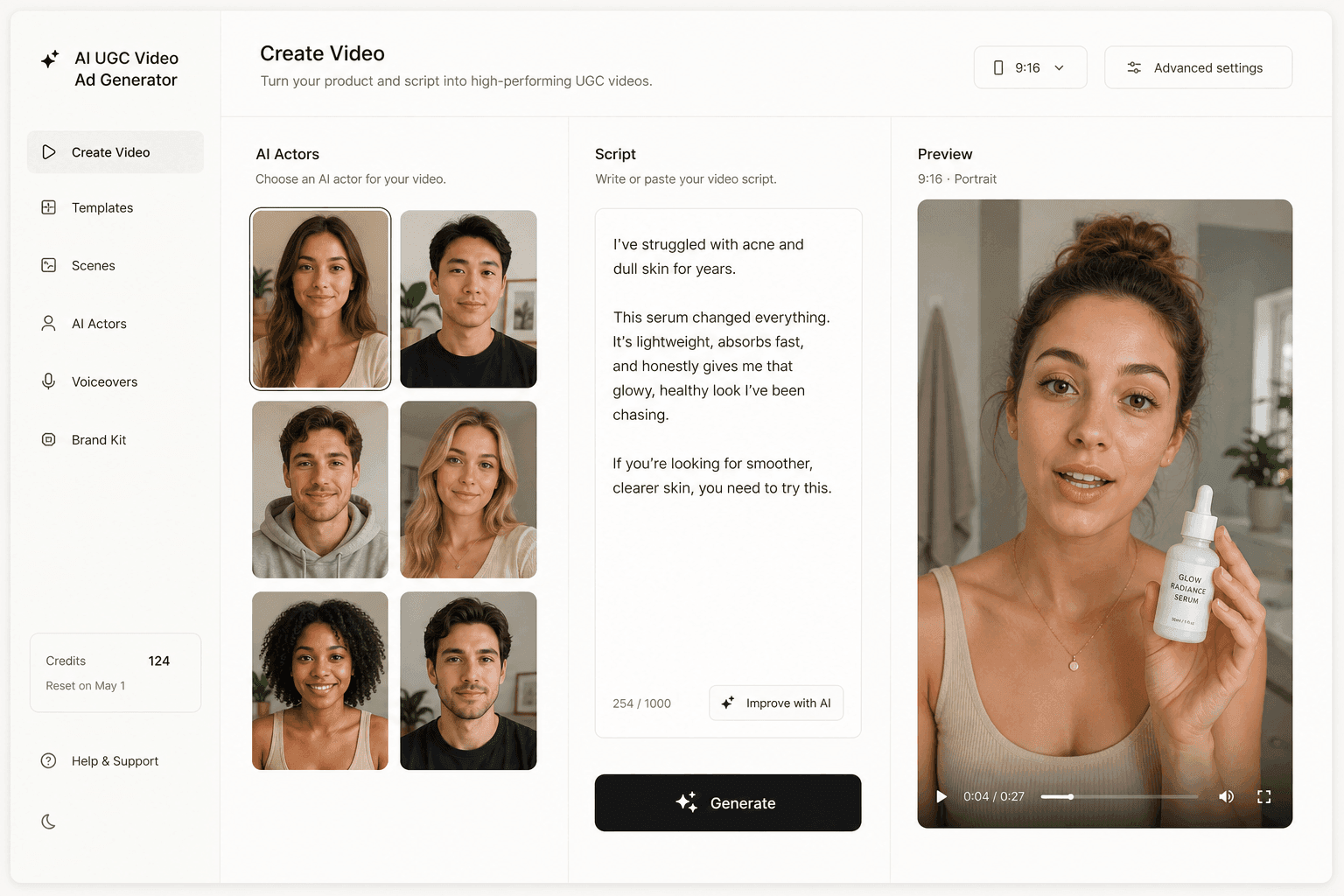
An AI video generator for TikTok is the tool that collapses that gap. You give it a script and a face, and it returns a vertical, UGC-style video ad with a real-sounding voice, lip-sync, and captions, formatted for the feed. No set, no shoot, no scheduling. TikTok's own creative guidance tells advertisers to orient vertically at 9:16 and use a DIY look so the ad blends into organic content. An AI generator is simply the fastest way to produce that native look on demand, in the volume TikTok's algorithm actually rewards.
This guide covers what these tools do, the models that produce TikTok-native footage, the formats that convert, a worked example from script to five live variants, and where the real savings come from. If you want the broader account-setup and targeting side, our complete guide to running TikTok ads covers that end.
What an AI video generator for TikTok actually does
From a script to a 9:16 clip
The core loop is short, and it is the same four steps whether you make one ad or ten:
- Write or auto-generate a script for the angle you want to test.
- Choose an AI actor whose age, gender, and accent fit your audience.
- Render a vertical clip of that actor delivering the lines, with voice and lip-sync generated together.
- Add captions and export a downloadable 9:16 file for TikTok or TikTok Ads Manager.
The headline time to a first draft is about four minutes.
That is the same trust signal a hired UGC creator sells, produced from text. Our step-by-step walkthrough on how to make UGC ads with AI covers the full flow, but the short version is: script in, native vertical ad out.
Why "native to TikTok" is the real spec
The feature that separates a TikTok ad from a generic video is format, not polish. TikTok's own creative guidance is blunt about what a native ad looks like:
- Vertical 9:16. The advice is explicit about "orienting vertically at 9:16," so the clip fills the screen instead of sitting in a letterbox.
- A DIY look. Go for "a DIY or not overly polished style so that it fits in with the user-generated content on TikTok," not a glossy brand film.
- A fast hook. Land the hook "in the first 6 seconds," because that is the window where the scroll is decided.
A 16:9 clip cropped into the feed reads as an import and surrenders the full-screen space TikTok is built around. So the job of the generator is not to make the prettiest film. It is to produce something that looks like a real person filmed it on a phone, at the ratio the app expects. That is why a talking-actor UGC clip usually beats a glossy product render on TikTok, and why the same footage often works on Reels and Shorts too.
What it does not do
One honest correction, because it saves you a wrong assumption. These tools are script-based, not URL-based. You do not paste a TikTok Shop link and get a finished ad. You bring a script (or let the tool draft one) and, for product shots, upload a product photo, which the generator turns into an ad creative. Knowing that up front changes how you prep, and the prep is short:
- Write the angle first, not the script. One clear problem, one clear turn to the product.
- Gather one clean product image on a plain background if you want a product shot cut in.
- Pick the audience match before the words: the actor's age, gender, and accent do as much work as the copy.
Then let the model handle the motion, voice, and captions. The scarce input is the idea, not the footage.
The models that make TikTok-native footage
Behind any good generator is a set of video models, and they are not interchangeable. The video models available in Novoads split cleanly into two jobs: cheap, fast volume, and cinematic hero shots.
Seedance 2.0 and Kling v3 Pro: fast, cheap, native audio
These are the workhorses for testing. Seedance 2.0, from ByteDance, produces "Cinematic output with native audio, multi-shot editing" in a single generation, so a clip can change scenes without stitching, and its half-price sibling Seedance 2.0 Mini drops the cost further when you are running raw volume. Kling v3 Pro delivers cinematic 1080p video with "native audio" generation and "flexible durations from 3 to 15 seconds," plus multilingual audio, which matters if your TikTok audience is not English-speaking. Both bring their own sound, so a talking-actor ad arrives with voice already in the file, no separate voiceover pass. At roughly $2 for a short clip, they are what you reach for when you want ten variants, not one. Our Seedance 2.0 retrospective digs into the trade-offs.
Google Veo 3.1: cinematic, higher-end
When a shot has to look expensive, the heavier models earn their cost. Google Veo 3.1 generates cinematic video with "native audio and extended videos" and can "Generate outputs in 1080p and 4K," which is the tool for a crisp product beauty shot that has to survive a full-screen phone. You would not render fifty test variants on it. Save the heavy model for the shots that justify the cost:
- A hero product beauty shot in 1080p or 4K that has to look premium.
- A dialogue-driven scene where sound generated with the picture carries the realism.
- The one clip you will put real budget behind, once cheap testing has picked the angle.
Which model to reach for
A quick reference for matching the model to the shot:
| Model | Native audio | Max resolution | Best for |
|---|---|---|---|
| Seedance 2.0 | Yes | Up to 1080p | High-volume UGC testing |
| Kling v3 Pro | Yes | Up to 1080p | Multilingual, 3-15s clips |
| Google Veo 3.1 | Yes | Up to 4K | Cinematic product shots |
The point of having them all in one generator is that a single campaign rarely wants only one. You test cheap and fast on Seedance 2.0 or Kling v3 Pro, find the angle that holds attention, then re-render that single winner on Google Veo 3.1 so the ad you actually scale looks the part.
The TikTok ad formats that convert
The talking-actor UGC testimonial
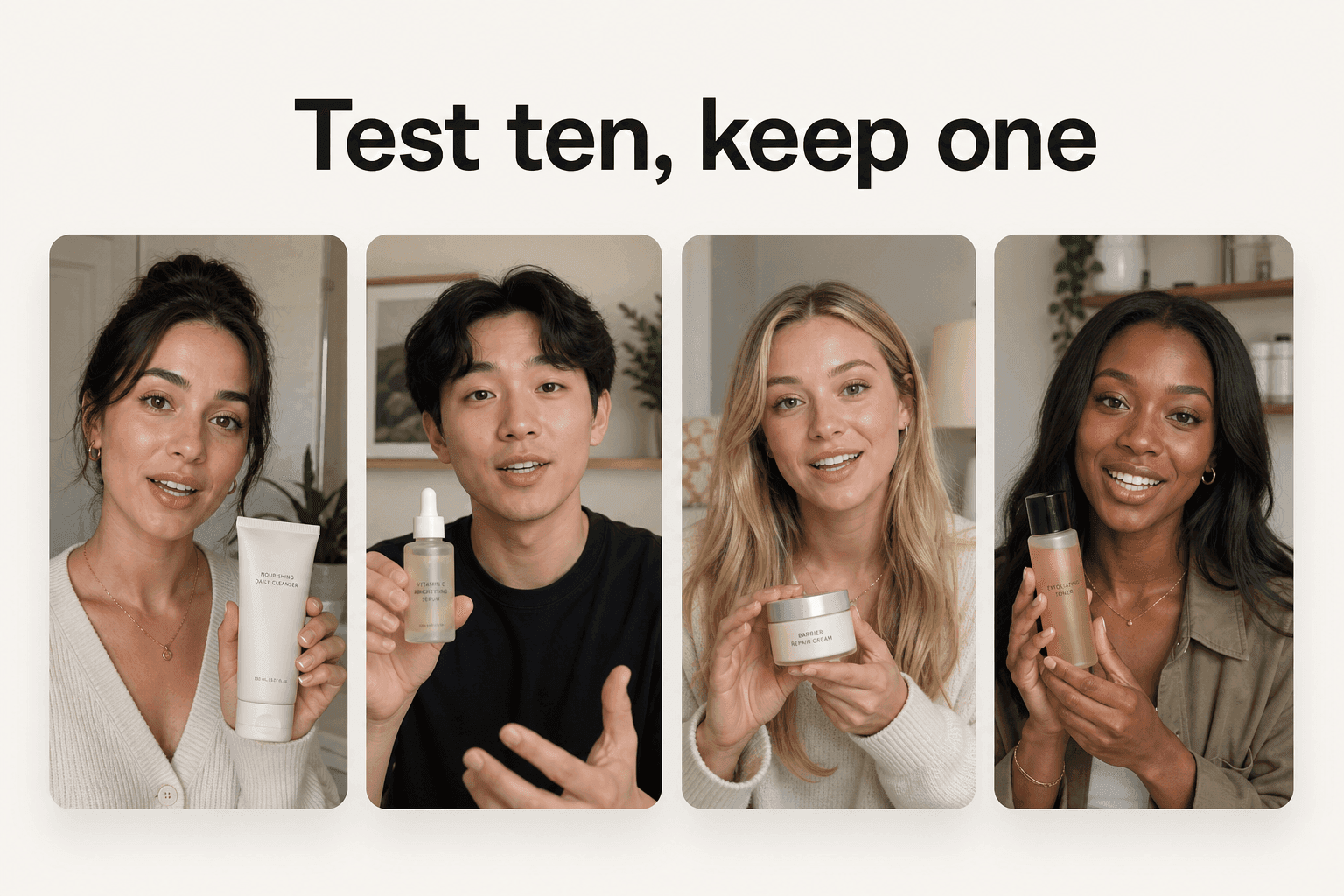
The default TikTok ad format is a person talking to camera about a product, because it reads as a recommendation rather than an ad. An AI actor delivers this at scale: same script, five different faces and accents, five clips. This is the format most brands should start with, and it maps directly to what TikTok recommends, "featuring people such as creators, employees, or customers."
Faceless and product-only formats
Not every brand wants a face. Product-only clips, screen recordings, and text-over-motion are strong on TikTok and remove the awkwardness of a synthetic presenter. Our guides to making TikTok ads without showing your face and faceless video ads break down four formats each. For sellers, the same idea powers TikTok Shop videos made with AI: the product, not a person, carries the pitch.
A quick way to pick a format by goal:
- Building trust for a personal or service brand: talking-actor testimonial.
- Selling a physical product cold: product-only demo or unboxing.
- Explaining an app or software: screen recording with a voiceover.
- Scaling fast with no on-camera risk: text-over-motion with captions.
Hook-first structure
Whatever the format, the first three seconds decide whether the rest is seen. TikTok tells advertisers to land the hook "in the first 6 seconds," and on a testing budget that is the single variable most worth changing between variants. Keep the product, the actor, and the offer fixed, and rewrite only the opening line five ways. That is the cheapest, highest-leverage A/B test you can run.
A TikTok ad made with AI, start to finish
Here is the whole loop on a real example: a direct-to-consumer electrolyte mix that sells for $29 a tub.
The brief
Pick one product and one job. The job here is a cold-audience TikTok ad that makes a skeptical scroller stop. The angle is problem-solution: afternoon energy crash, then the product as the fix. Write a 20-second script with a sharp first line, or let the generator draft one from the product page and edit it down.
- Product: a $29 electrolyte drink mix.
- Angle: the 3pm crash, solved.
- Actor: a relatable 30-something, casual kitchen setting.
- Format: 9:16 talking-actor UGC, captions on.
Generate the clip
In the generator, paste the script, pick the AI actor, and choose Seedance 2.0 for a fast, cheap first pass with native audio. The settings that keep it TikTok-native are few:
- Aspect ratio: 9:16 vertical, never a cropped 16:9.
- Captions: on, burned in, since most of the feed watches on mute at first.
- Length: aim for 15 to 25 seconds, with the payoff up front.
- Audio: native model audio, so voice and lip-sync land in one render.
Hit generate, and in a few minutes you have a native TikTok ad with voice and lip-sync baked in. Upload a product photo and the tool can cut in a clean product shot without a separate shoot. A stock library actor's hands are empty, so to have the presenter hold the product on camera, create a custom actor from a photo of someone holding it (Create Actor > Upload).
Ship five variants and read the data
Now duplicate the winner-hunt. Keep the actor, product, and offer fixed and change only the first line. Five variants of the same 20-second ad, differing only in the opening three seconds:
- Question: "Why do I crash every afternoon at 3pm?"
- Bold claim: "This $29 tub replaced my third coffee."
- Relatable complaint: "The 3pm slump was killing my workday."
- Stat: "Most of that afternoon crash is just dehydration."
- Pattern-break: "Stop reaching for another coffee. Do this instead."
Render all five, launch them as one test, then let the platform tell you which hook wins before you put budget behind it. Reddit's self-serve ad tools make this kind of split test cheap on a second channel too, which we cover in A/B testing your AI UGC variants. If you plan to boost an organic post, our TikTok Spark Ads guide walks through the authorization step.
How to know it worked. Read three signals in order, not just the click:
- Three-second view rate: did the hook stop the scroll at all?
- Hook retention: did viewers stay past the opening line?
- Click-through: only meaningful once the first two clear your benchmark.
If a variant holds attention past the opening line, it earns more budget. If it does not, kill it and feed the lesson into the next batch.
What it costs, and where the savings really come from
Per-clip cost versus a creator
The sticker comparison is stark. A short AI clip runs from a few dollars, about $2 for a 5-second Seedance 2.0 render in Novoads, against a single creator video that typically costs from tens to a few hundred dollars. Our breakdown of what UGC creators charge has the full ranges. But the per-clip price is the least interesting number here.
The real lever is volume
The savings that matter are not on the invoice, they are in throughput. Run the electrolyte example forward: five hook variants at about $2 each is roughly $10 and one evening. The human route to those same five clips is five briefs, a creator, and one to two weeks, which is why most brands quietly shoot one or two ads and hope. When each variation costs a couple of dollars and takes minutes, testing ten becomes trivial, and the winning ad is almost never the one you would have guessed. AI does not make a better single ad. It removes the reason you were only running one.
That said, AI does not replace every job. Reach for a real creator or a live shoot when the piece genuinely calls for it:
- A specific, recognizable face you want as a long-term brand ambassador.
- A tactile product demo where a human handling the item sells it better than a model can fake.
- A flagship hero piece where the person on camera is the message, not the vehicle.
For the relentless volume of test variants underneath those few set-pieces, AI is the tool that makes the testing affordable.
Free tools versus paid
You will see "free AI video generator" everywhere, and it is worth setting expectations. Free tiers are real, but they usually cap length, add watermarks, or lock the models that carry native audio, which is exactly what a talking-actor TikTok ad needs. Our honest look at what free AI video generators actually get you lays out the trade. For a serious testing program, the paid math already favors volume.
How Novoads turns one script into a TikTok test batch
The tools changed the economics of the trust signal, not the signal itself. TikTok still rewards a real-seeming person, filmed vertically, saying something true in the first three seconds. What is new is that you no longer need a calendar and a creator invoice to produce that ten times.
That is the whole idea behind Novoads: write or auto-generate a script, pick an AI actor that matches your audience, and get a native 9:16 UGC ad with voice, lip-sync, and captions in about four minutes, with Seedance 2.0, Kling v3 Pro, and Google Veo 3.1 all in one place so you can test cheap and finish rich. You can also drop in a product photo and turn it into an ad creative, or upload a photo of someone holding your product as a custom actor so it shows in hand on camera. The best TikTok ad is the one you found by running ten, and this is the tool that makes running ten the easy option. You can make your first one for $49/month, which includes 50 credits every month, cancel anytime.
Frequently Asked Questions
What is the best AI video generator for TikTok ads?
There is no single best tool, there is a best model for the job. For fast, low-cost volume with native audio, Seedance 2.0 and Kling v3 Pro are the workhorses. For a cinematic hero shot in 1080p or 4K, Google Veo 3.1 is stronger and costs more. The right approach is a generator that gives you all of them in one place so you can match the model to the angle, which is how the models available in Novoads are set up.
Can AI make vertical 9:16 TikTok videos?
Yes. A modern AI video generator outputs vertical 9:16 natively, which is the format TikTok's own creative guidance recommends. That matters because a horizontal clip letterboxed into the feed reads as an import and gives up the full-screen real estate that TikTok is built around. Generate 9:16 from the start rather than cropping a 16:9 file afterward.
How much does it cost to make a TikTok ad with AI?
A short UGC-style clip runs from a few dollars. In Novoads a 5-second Seedance 2.0 clip works out to about $2, while a cinematic Google Veo 3.1 shot costs more. Compared with a single creator video, which typically runs from tens to a few hundred dollars, the savings are real, but the bigger lever is being able to test ten variants instead of shooting one.
Do AI TikTok videos need an AI disclosure label?
TikTok asks creators to disclose AI-generated content that looks realistic, and it can auto-apply a label in some cases. It is a quick toggle or a line in your caption, and disclosing does not suppress your reach. We cover the exact steps in our guide to TikTok's AI disclosure rules so your ad stays compliant.
Can I make TikTok ads with AI without showing my face?
Yes. You can use an AI actor to deliver the script, or skip the face entirely with product-only, screen-recording, or text-on-motion formats. Faceless UGC is one of the most reliable AI ad formats because the product, not a specific person, carries the message.
Key Takeaways
- An AI video generator for TikTok turns a typed script into a native 9:16 vertical ad with a real-sounding voice and captions in minutes, no camera or actor required.
- The spec that matters is native format: TikTok's own guidance says to orient vertically at 9:16 and shoot in a DIY, not-overly-polished style so it reads like organic content, not a billboard.
- The video models available in Novoads split by job: Seedance 2.0 and Kling v3 Pro for fast, cheap volume with native audio; Google Veo 3.1 for cinematic hero shots at higher cost.
- The real win is not a cheaper clip. It is throughput: at roughly $2 a clip you can ship five to ten hooks in a sitting and let the platform pick the winner.
- AI does not replace a specific real face or a flagship shoot. It replaces the week of briefs between you and ad variant number ten.