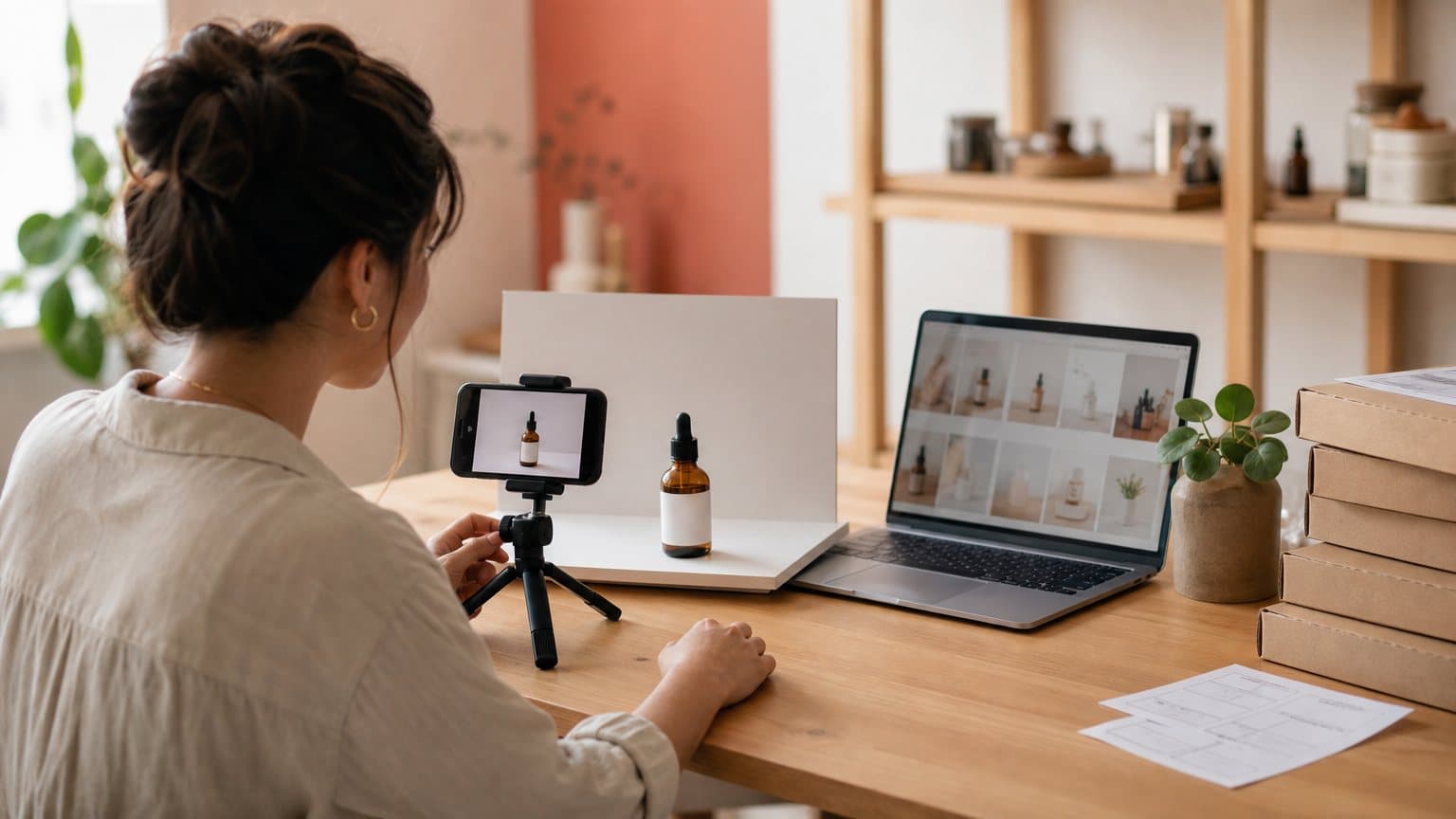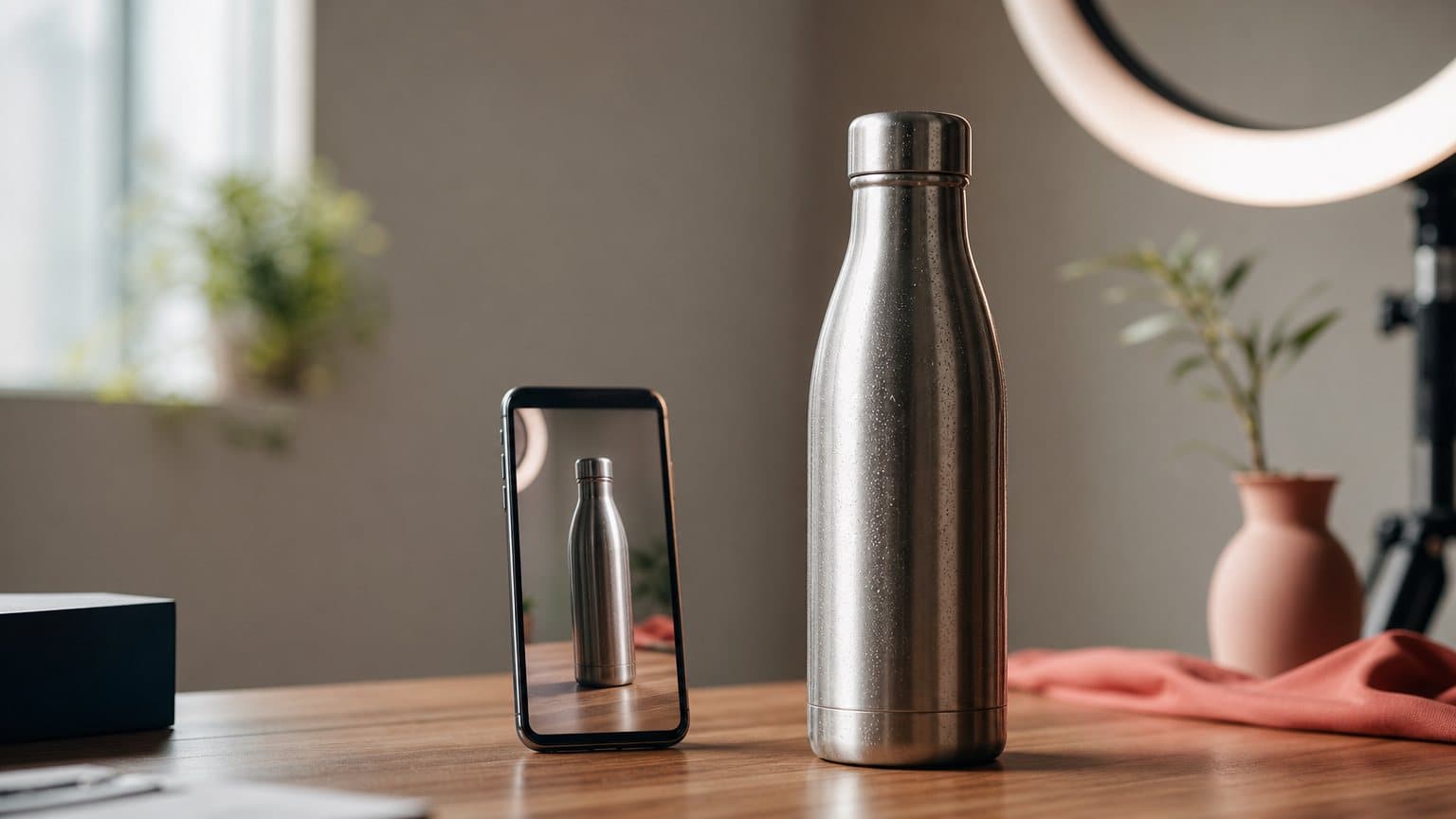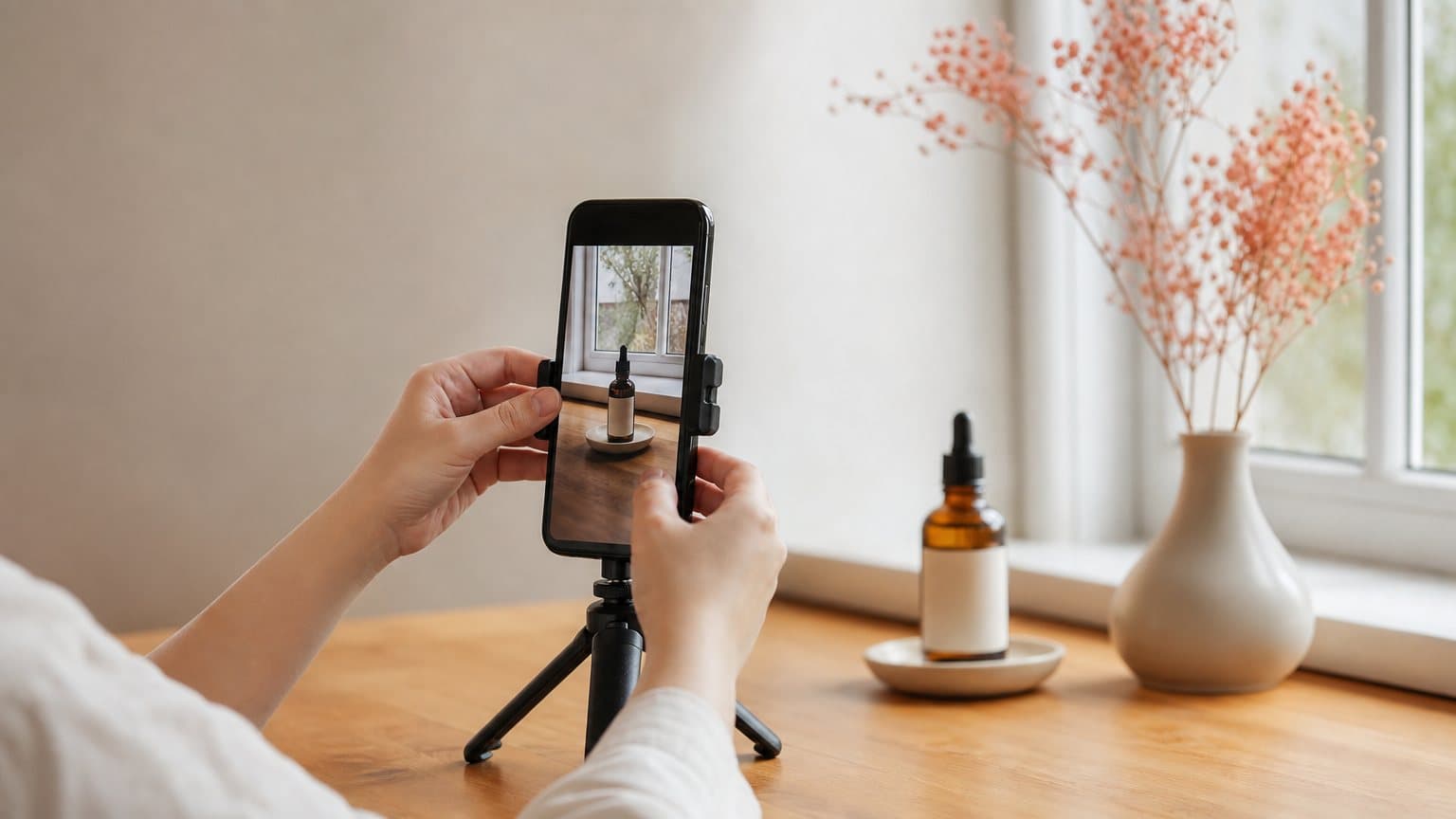
TikTok Shop Videos With AI: 5 Steps to Clear the Still-Frame Rule
TikTok Shop's US video rules do not permit product promos that rely primarily on still images. Here are five steps to AI clips that move and show the physical product, plus Shop's daily posting caps by tier and the two labels to turn on.

Mauricio Valdivia
·Updated ·14 min
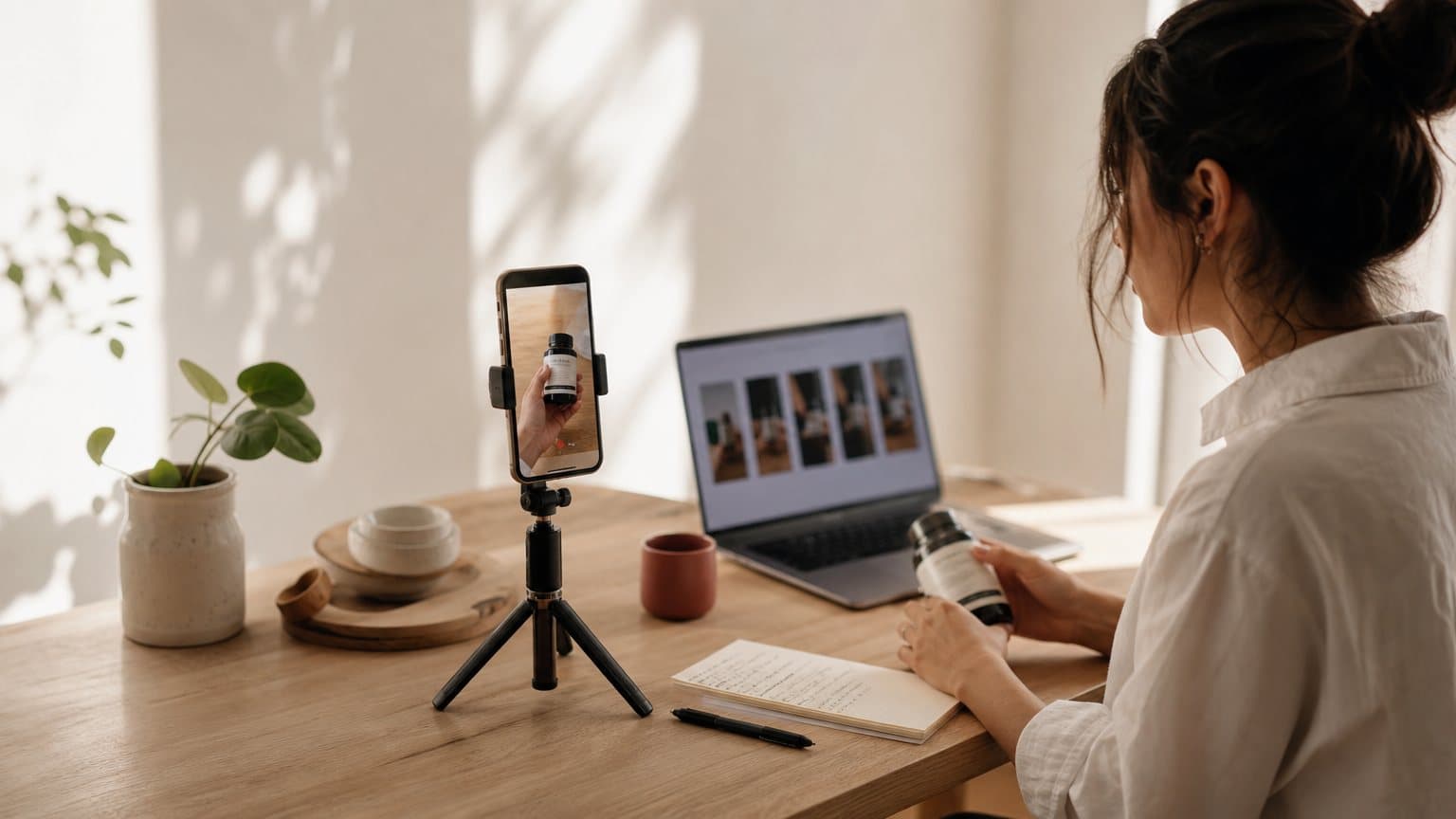
TikTok Shop Draws the Line at Still Images
Six seconds, one match, one amber candle. In a clip we rendered in Novoads on 2026-10-20, a woman strikes the match, lights the candle on her coffee table and only then looks up to say her line. Nothing in the frame holds still.
On TikTok Shop, that is the point. Its US Academy page "Requirements for High-Quality Videos and LIVEs", in the revision dated 09/17/2026, puts the rule in one sentence: "Content that relies primarily on still images or static visuals is not permitted when promoting products on TikTok Shop." The sentence is not new. It was already on the page's revision dated 04/01/2026.
A TikTok Shop video is a short in-feed video with a shoppable product link, posted by a seller or an affiliate creator so viewers can buy directly on TikTok. This guide covers making those clips with AI so they clear that rule: the formats that pass and the one that fails, five steps from a product photo to a tagged clip, the posting caps for each account tier, and the two labels TikTok asks for. Every rule below is quoted from TikTok's own pages, with the date each page shows.
What a TikTok Shop Video Is, and Who Can Post One
Three places Shop sells
TikTok's help article on Shop and Showcase, last updated June 2026, says: "TikTok Shop allows sellers to sell products directly on TikTok through in-feed videos, LIVE videos, and the Showcase tab." Showcase is the shopping bag icon on a seller's or creator's profile. LIVE selling has stricter rules of its own, covered below. This guide is about the in-feed video, which TikTok Shop's US Creator Eligibility Policy, dated 09/25/2026, describes as "promoting products with a shoppable link in videos uploaded on TikTok."
The channel is large. In a report published 2026-02-11, Momentum Works put TikTok Shop's 2025 US GMV at US$15.1B, up 68% in a year.
Three kinds of account that can post one
The same eligibility policy names three types of TikTok Shop creator:
- Official Shop creators: a seller's own account, bound to its shop.
- Marketing creators: accounts a seller invites to promote its products.
- Affiliate creators: individuals who self-apply and must "Have a minimum of 1,000 followers".
The policy says there is no minimum follower requirement to bind as an official or marketing account, and every creator must be at least 18 and based in the United States. Opening a shop, listing products and paying fees are a separate job; our guide to selling on TikTok Shop walks through them.
Three shapes worth making
Pick the shape by what you sell. Each one has a source of motion built in, which matters for the rule in the next section:
- Product demo: the product doing its one job, so the motion is the product in use.
- Affiliate review: a person vouching for it, so the motion is a hand turning, opening or applying it.
- Problem-solution: a pain, then the fix, so the motion is the before turning into the after.
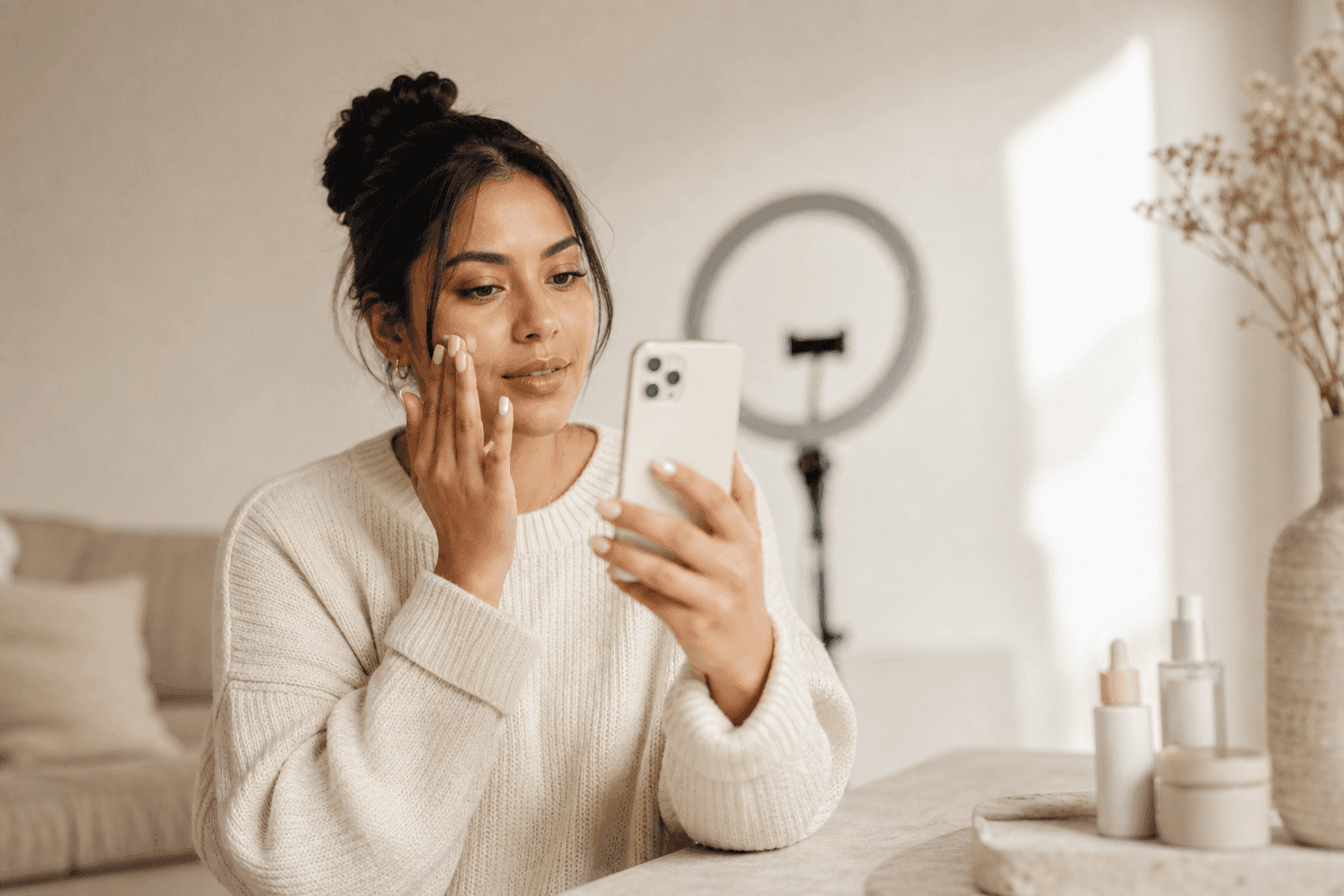
What Shop's Quality Page Rules Out
The page sits in TikTok Shop's US Academy under Policy Center, Creator and Promotional Content. It is marked as applying to the United States, and it says it applies to sellers and creators. Four parts of it shape an AI workflow.
What counts as still frame content
The page defines still frame content as "any content that lacks on-screen activity or features a static image with minimal verbal interaction or movement". Its own examples:
- still images and screenshots
- scrolling images and screen recordings
- slideshows and animated content
- static visuals with little to no movement, human presence, or interaction
Moving text does not rescue a still. Of one example video, the page says: "Although there is text animation, this is considered still frame content." The rule targets content that relies "primarily" on stills. Our reading: a clip can hold on the product for a beat and still pass, while a clip built from stills cannot.
What a posted video should show
Under "When Posting a Video", the page asks for content "recorded in a real-world environment", with "some camera movement" and people in frame. Two more lines matter most:
- "Include engaging and dynamic visuals, ensuring they feature your face and the physical product."
- "Aim for at least 3 seconds of dynamic content without any still images or looping visuals to keep the audience engaged."
Its prohibited list for posted videos holds one line: "Do not use still, looping, or scrolling images through the entire video without featuring your face and the physical product."
Read together, those lines ask for things an AI clip can show, motion, a person and the product, and two it cannot supply on its own: footage recorded in a real-world environment, and your own face. The next section deals with both.
Lines that apply to LIVEs only
Two limits on the page are easy to read as rules for every clip, and both sit under "During a LIVE":
- the ban on "non-real-time verbal interaction such as AI-generated voices, audio recordings, or radio"
- the cap on stills, slideshows, scrolling images and animation that cover more than 50% of the screen
As this page words them, neither covers a posted video. An AI voice in a posted clip still needs TikTok's AI label, covered below.
What happens to a clip that breaks them
The page says content that relies heavily on still frames or static visuals "may be subject to enforcement actions that impact your account health". The actions it lists:
- assigning violation points
- removing content, or access to features
- "Restricting commission earnings"
- restricting or removing a creator account
For an affiliate, the commission line is the one that costs money.
AI Formats That Clear the Still-Frame Rule
The first three formats below move from the first frame and put a person and the product on screen, which is our reading of what the still-frame rule asks; the fourth is the one that fails. The model matters less than the motion.
A product-in-hand video clip
A video model animates a still of a person holding your product, from a prompt that names the action and the line. Novoads runs this route on its video models, and the lowest-priced, Seedance 2.0 Mini, costs 1 credit a second at its default 720p. Our guide to product videos from one photo covers the prompt side.
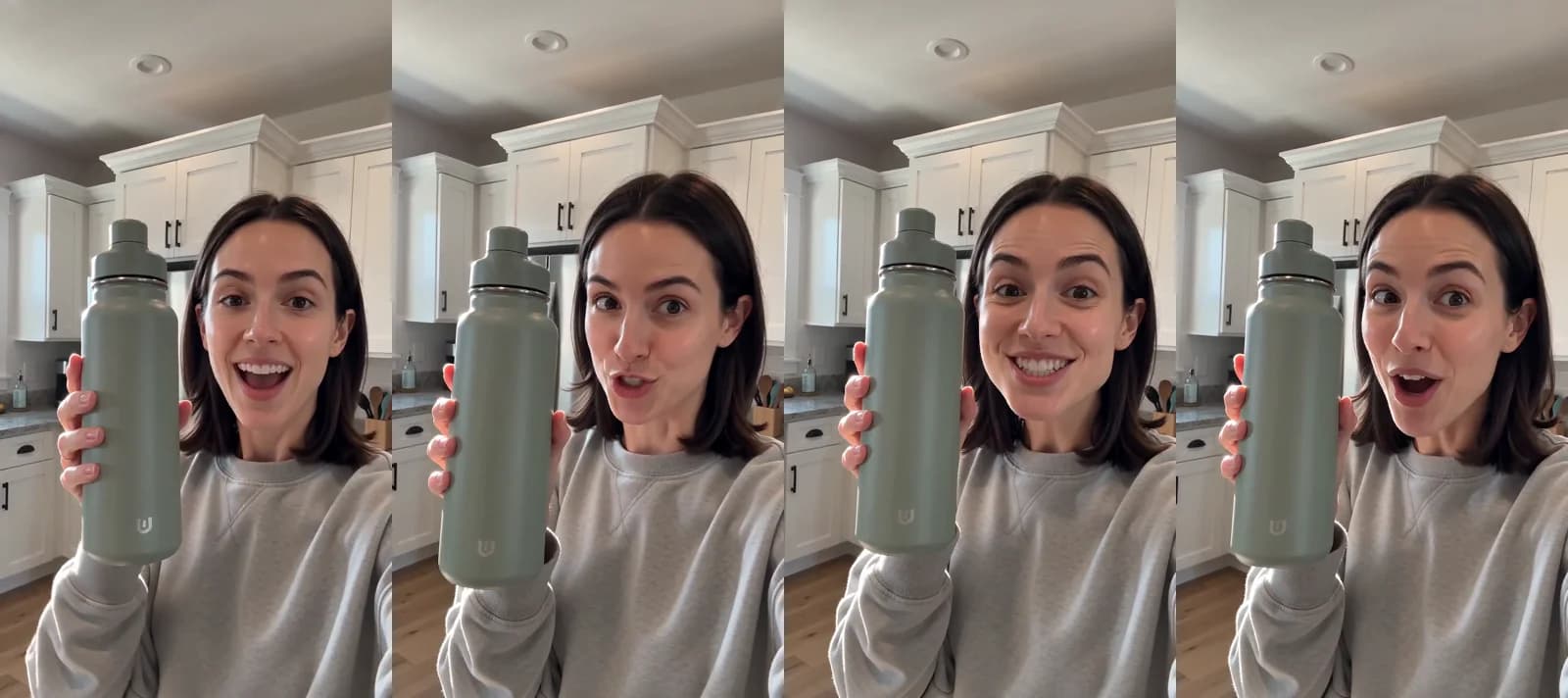 Seedance 2.0 Mini · prompt: a woman in her kitchen holds a sage-green water bottle to her phone camera and says the ice is still frozen a day later · 6 credits · rendered 2026-10-20
A talking actor holding your product
The Novoads talking actor reads your script with lip-sync. A stock actor from the library has empty hands, so to put your product in the actor's hand you upload a photo of someone holding it and turn it into a custom actor; the upload option reads "Transform a picture into a talking actor". If the photo is of you, the face on screen is yours, animated from your photo. The talking actor bills per started minute, 200 credits at 720p or 100 at 480p, so a 20-second clip costs the same as a 60-second one.
A product template from Discover
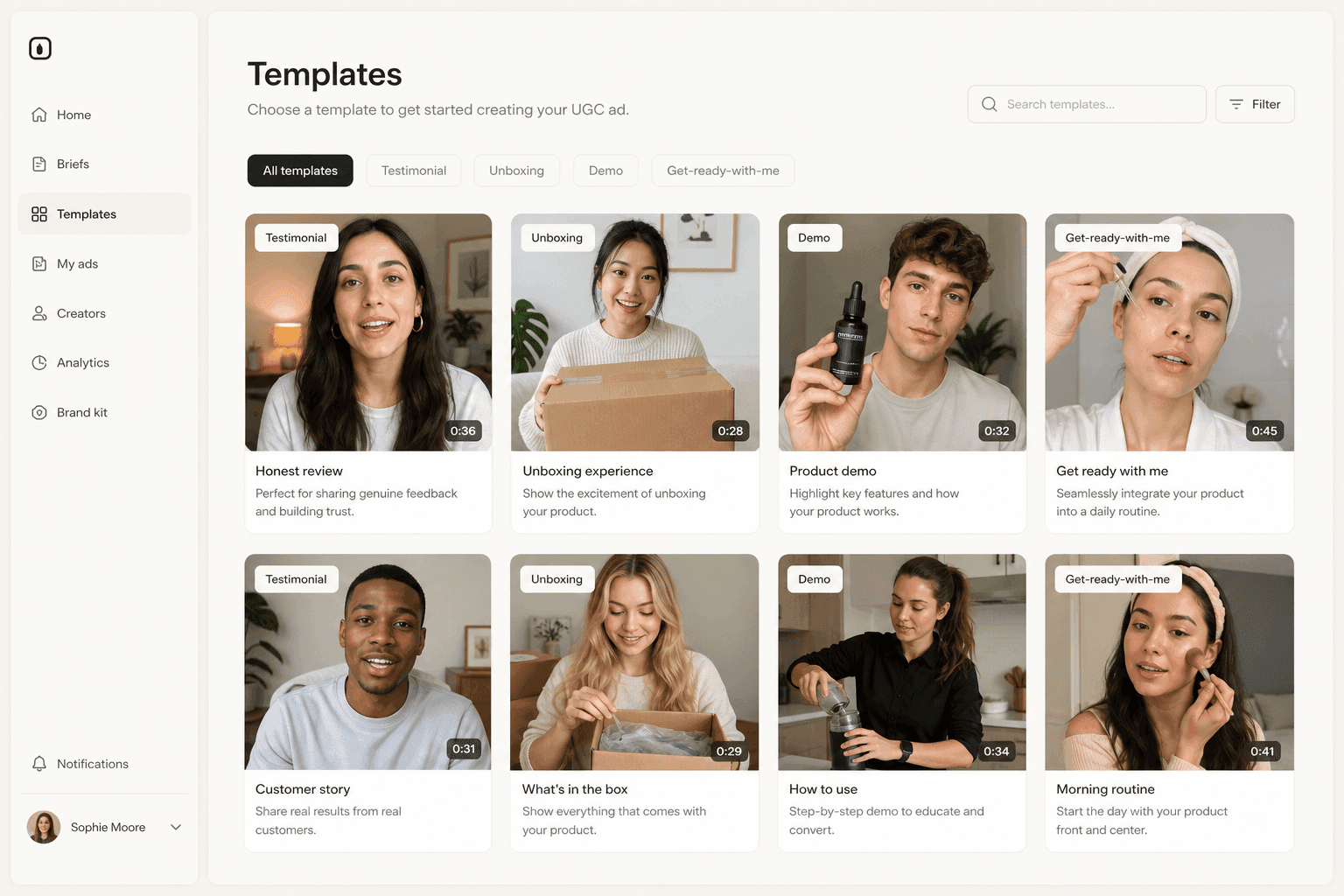
Discover, the template gallery in Novoads, has product templates that take your uploaded product photo, swap it into a template creator's hand with an image edit, then animate that still with Seedance. The clip shows your actual product, and you skip the custom actor.
Where a photo slideshow falls
Plainly: a slideshow of product photos fails. Slideshows are on the page's own list of still frame content, and animated captions on top do not change that. Product-to-Ad in Novoads turns one product photo into a still ad image; that is a static ad, not a Shop video. Use stills as the reference a video model animates, never as the video itself.
What AI cannot supply on its own
The page asks posted videos to be "recorded in a real-world environment" and to feature "your face and the physical product". An AI clip is generated, not recorded, and an AI actor is not your face. The page's AI lines all sit under LIVEs, so it does not say how Shop treats an AI presenter in a posted video, and we have not posted an AI clip to a Shop account to find out. Two ways to stay close to its wording:
- Your face, filmed: record the talking part yourself in a real room, holding the product, and let AI make the extra product shots and the hook variations. This matches the page's wording most closely.
- Your face, animated: a custom actor made from a photo of you holding your product, labeled as AI-generated when you post. It is the closest an all-AI clip gets.
TikTok Shop's US Academy also keeps a separate page on AI-generated content. Read it in full before you post an AI clip.
The Build: Five Steps From Product Photo to Shop Clip
The credits below are Novoads prices on 2026-10-22.
Step 1: Start from a photo of the product you actually sell
The page asks for "the physical product", and a viewer is one tap from the listing, so the item on screen has to be the item they receive. Upload a clean photo of the real product, front-on and in good light. Then write the one sentence the clip has to land, in words a person would say out loud: "this is how I clock out at six" does more than "a premium soy-wax blend". Our candle and bottle were generated stand-ins for a test; a Shop clip needs your real product.
Step 2: Write three hooks that open on motion
Write each hook and its first action together, so the clip moves before it talks. Three openings to try:
- The action: the product in use in the first frame, a match struck or a lid opened.
- The callout: the product held up to the lens while the line names the buyer's problem.
- The proof: a detail that shows ownership, like a row of empties.
The page's target is "at least 3 seconds of dynamic content"; a hook that opens on an action covers it before the line lands. Our guide to ad hooks has twelve formulas for the words.
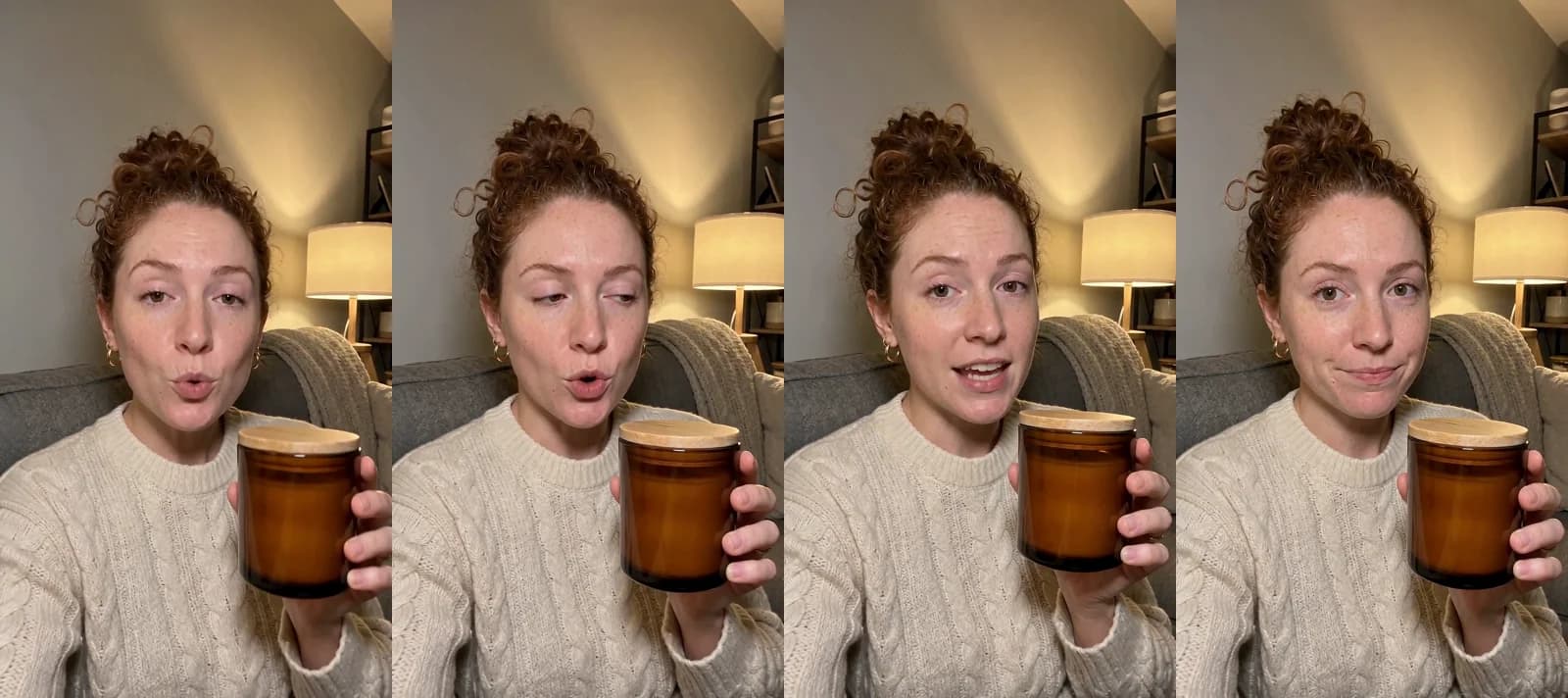 Seedance 2.0 Mini · hook A, the callout: she holds the candle to the lens and says your workday never really ends · 6 credits · rendered 2026-10-20
Step 3: Render the clip in Novoads
Pick the route from the formats above, set the clip to vertical 9:16, and pick the model by job:
- Drafts and hook tests: Seedance 2.0 Mini at 1 credit a second at 720p, so a 6-second hook costs 6 credits.
- A longer cut: Seedance 2.0 at 68 credits for 15 seconds at 720p, or Seedance 2.5 at 7 credits a second at 720p.
- A talking clip: the talking actor at 200 credits per started minute at 720p, or 100 at 480p.
Render two takes of the hook you like, then scrub the first three seconds. If they could pass for a photo, re-render with a stronger action in the prompt.
Step 4: Caption it, link the product, set the labels
Burn in captions so the line reads with the sound off, and keep the hook line legible in the first frame. Trim dead air at the start. When you post, attach the shoppable product link, which is what makes the video a Shop video, then switch on the commercial content disclosure setting and, for an AI clip, the AI-generated label. Both are covered below.
Step 5: Batch inside your posting cap
Build the variations from one product photo and one script: three hooks, two or three looks, one change at a time, so a winner teaches you something. Spread them across the days your cap allows instead of posting them at once, cut the flat ones, and point the next batch at the opening that held attention.
How Many Shop Videos You Can Post a Day
TikTok Shop's US Creator Eligibility Policy, dated 09/25/2026, says: "Effective from May 11, 2026, TikTok Shop will introduce daily posting limits for shoppable content for all US merchants and creators." Newer accounts sit under lower caps. The tiers, as the policy words them:
| Tier | Who it covers | Shoppable videos | Shoppable LIVEs |
|---|---|---|---|
| All US accounts | Merchants and creators | Up to 30 a day | Not listed |
| Affiliate pilot | Affiliates under 5,000 followers | Up to 3 a day | Up to 3 a week |
| Extended pilot | Creators TikTok Shop tags | Up to 3 a week | Up to 1 a week |
| Early-stage pilot | New official and marketing creators | Up to 3 a day | Not listed |
The all-accounts limit also allows up to 60 shoppable photo posts a day. For the early-stage pilot, the policy gives the 3-a-day limit as an example of what "may" apply.
What the pilot means for a new affiliate
A new affiliate with fewer than 5,000 followers is enrolled in the Affiliate Creator Pilot Program for at least 30 days. During it, the account has access only to products whose Shop Performance Score, a measure of seller reliability, is 95% or higher, and cannot join campaigns. Graduating takes at least 5,000 followers and 30 days in the program. TikTok Shop may also, at its discretion, tag an account as an Extended Pilot Creator, and the cap then drops to 3 shoppable product videos a week.
Plan the batch around the cap
Our three-hook candle batch is exactly one day of a pilot affiliate's allowance, which tops out at 21 shoppable videos a week. For accounts past the pilot, 30 a day is a ceiling, not a target; the real limit is how many hooks worth testing you can write.
Where a deep bench of clips pays off
Two of TikTok's own case studies put numbers on Shop creative volume:
- Dossier, published 2026-10-01: the perfume brand ran GMV Max, which the case study calls "an automated Shop solution that optimizes for ROI", and "ensured they had at least 200 creatives per product."
- A hair-care brand, published 2025-01-07: its GMV Max campaign was set up "pulling from nearly 100 affiliate and organic videos."
TikTok adds that past performance does not guarantee or predict future performance. Our reading: clips that clear the rules can also feed Shop's automated ads, so the bench is worth building.
Two Labels to Turn On Before You Post
Commercial content disclosure
TikTok's help article for creators, last updated April 2026, makes three points:
- "When posting content that promotes a brand, product, or service on TikTok, you must turn on the commercial content disclosure setting."
- Turning the setting on "will not affect the way TikTok recommends content to users".
- If commercial content is not properly disclosed, "the video may not be eligible for distribution in the For You feed".
One of the three factors TikTok uses to flag a video as commercial content is a product recommendation: "Showing or talking about a product or service, such as demos, tutorials." Our reading: that covers nearly every Shop clip. Our guides to TikTok ad disclaimers and making TikTok ads that sell cover the paid side.
AI-generated content
TikTok's newsroom post of September 19, 2023 sets out three points:
- Its synthetic media policy "requires people to label AI-generated content that contains realistic images, audio or video".
- The AI-generated label is for "any content that has been completely generated or significantly edited by AI".
- Creators can use the label "or other types of disclosures, like a sticker or caption".
TikTok's help page still stated the rule in June 2026. Our reading: an AI actor, an AI voice and a custom actor animated from your photo all count as realistic AI content. Our checklist for disclosing AI-generated UGC on TikTok walks through the setting.
How Novoads Makes Shop Clips That Move
Novoads turns a product photo and a script into a vertical clip that moves, with a person and your product on screen. Its video picker offers Seedance 2.0 Mini, Seedance 2.0, Seedance 2.5, Kling 3.0 (catalogued as Kling v3 Pro), Veo 3.1 and Omni Flash, and the talking actor covers clips where someone speaks to camera.
Our run: one candle, three hooks
On 2026-10-20 we rendered three 6-second openings in Novoads with Seedance 2.0 Mini, 9:16 at 720p, for one unlabeled amber candle and one AI-generated creator, each built on the same Nano Banana Pro reference still:
- Hook A, the callout: she holds the jar to the lens and says, "If you work from home, your workday never really ends."
- Hook B, action first: she strikes a match and lights the candle, then says, "This is how I clock out at six."
- Hook C, the proof: she lines the jar up with her empties and says, "I've bought this exact candle four times."
Every line came out word for word, and the one miss was visual, on hook C's shelf. The same run anchors our guide to making ads that convert.
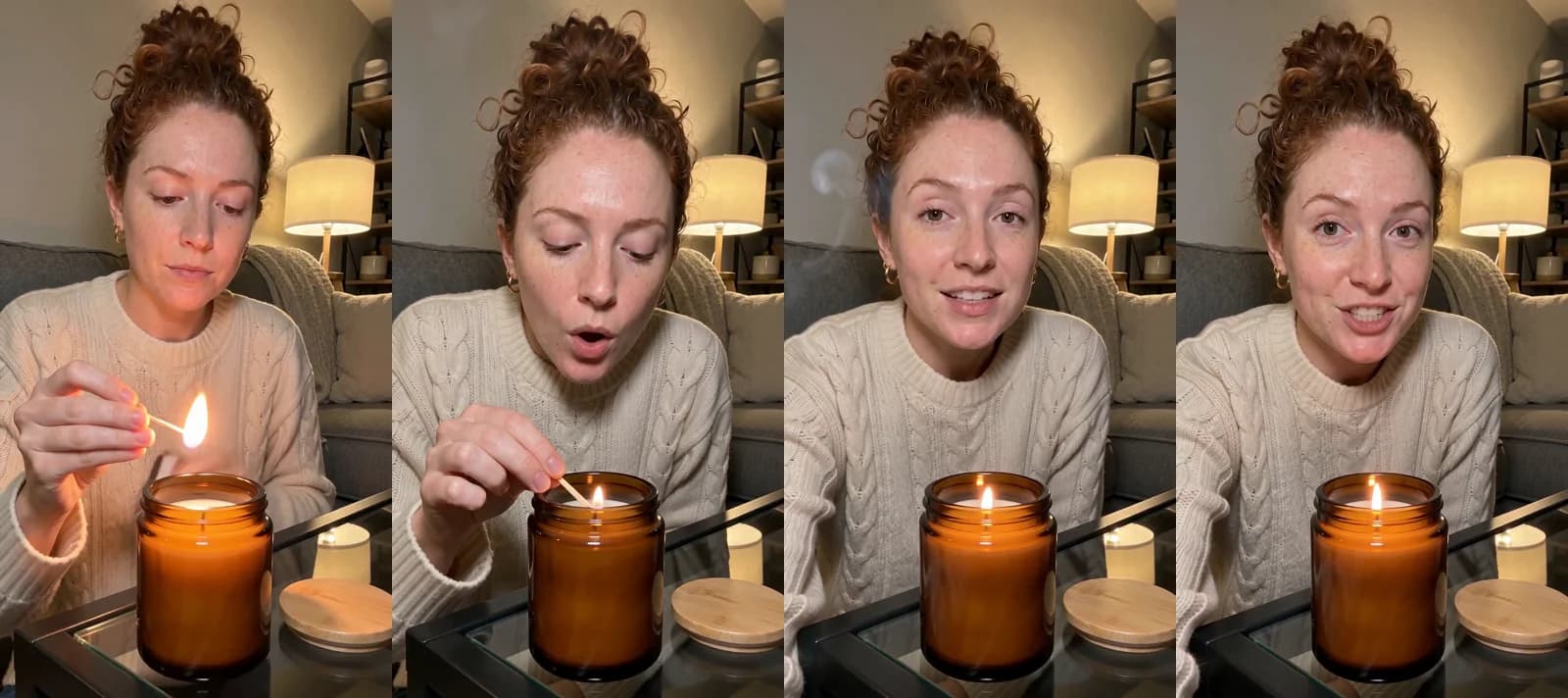 Seedance 2.0 Mini · hook B, action first: she strikes a match and lights the candle, then says this is how she clocks out at six · 6 credits · rendered 2026-10-20
What it cost
The three hooks cost 18 credits in all:
- On Starter ($15 a month for 200 credits): 9% of a month.
- On Plus ($49 for 1,000 credits, or $0.049 a credit): about 88 cents.
- As a talking-actor clip: one hook would cost 200 credits at 720p, all of a Starter month or $9.80 on Plus, because the talking actor bills per started minute; 480p halves that.
What the run does not prove
The candle and the creator are generated stand-ins, not a real listing or a real seller's face, and we did not post the clips to a Shop account. They show the parts of the format an AI clip can supply: motion first, a person, a product in hand. They are not a Shop approval. For a live listing, start from your own product photo and, for the face, your own photo or footage.
Plans are published on the pricing page. Novoads starts at $15 a month for Starter's 200 credits. Plus is $49 a month for 1,000 credits, and Ultra starts at $129 a month for 3,000 credits. The TikTok video ads page shows the formats, and you can start a batch in Novoads.
Motion Gets the Clip In. The Hook Sells It.
TikTok Shop's US rules set a floor, not a strategy: the clip has to move, show the physical product and, in the page's words, your face, and carry the right labels. AI makes the motion cheap, 6 credits for a 6-second hook, which leaves the work where it always was: finding the opening line your buyer stops for, inside the cap your account allows. Start from the product you ship, make it move, and let the batch tell you which hook sells.
Frequently Asked Questions
What are TikTok Shop videos?
They are short in-feed videos with a shoppable product link, so a viewer can buy without leaving TikTok. TikTok's help article on Shop and Showcase, last updated June 2026, says TikTok Shop sells through in-feed videos, LIVE videos and the Showcase tab, and TikTok Shop's US Creator Eligibility Policy, dated 09/25/2026, lists promoting products with a shoppable link in videos uploaded on TikTok among a creator's options. In the US those videos also have to move: TikTok Shop's quality page, in its revision dated 09/17/2026, does not permit promotional content that relies primarily on still images or static visuals.
How many followers do you need to do TikTok Shop videos?
In the US, an affiliate creator needs at least 1,000 followers, according to TikTok Shop's Creator Eligibility Policy dated 09/25/2026. Below 5,000 followers, a new affiliate starts in the Affiliate Creator Pilot Program for at least 30 days, with up to 3 shoppable product videos a day, and graduating takes 5,000 followers and 30 days in the program. Official and marketing accounts bound to a seller have no minimum follower requirement. Every creator must be at least 18 and based in the United States.
How do you start doing TikTok Shop videos?
First become eligible: apply as an affiliate once you have 1,000 followers, or post from an account bound to a seller. Then pick a product and make a vertical clip that moves from the first seconds and shows a person and the physical product, because TikTok Shop's US quality page does not permit promotional content that relies primarily on still images. Attach the shoppable product link when you post, and turn on the commercial content disclosure setting, plus TikTok's AI-generated label if the clip is AI-made. Post inside your tier's daily cap: up to 3 shoppable videos a day in the affiliate pilot, up to 30 for every US account.
Can you make TikTok Shop videos with AI?
Yes, if the clip moves and carries the right label. TikTok Shop's US quality page, in its revision dated 09/17/2026, does not permit promotional content that relies primarily on still images or static visuals, so a slideshow of product photos fails that rule, while a clip with motion, a person and the physical product on screen is what the page asks for. TikTok's synthetic media policy, as its newsroom described it in 2023, requires a label on AI-generated content that contains realistic images, audio or video. The quality page also asks posted videos to be recorded in a real-world environment and to feature your face and the physical product. An AI actor is not your face, so the safest route is filming the talking part yourself and using AI for the product shots, and the closest all-AI route is a custom actor made from a photo of you holding your product.
Key Takeaways
- TikTok Shop's US quality page, in its revision dated 09/17/2026, does not permit promotional content that relies primarily on still images or static visuals. The sentence was already on the page's 04/01/2026 revision, so treat it as a standing rule, not news.
- A photo slideshow is still frame content on the page's own list, even with animated text. A product-in-hand video clip, a talking actor holding your product or a Discover product template moves from the first frame and puts a person and the product on screen.
- The same page asks posted videos to be recorded in a real-world environment and to feature your face and the physical product. An AI clip is generated and an AI actor is not your face, so start from a photo of the product you actually sell, and film the talking part yourself or use a custom actor made from your own photo.
- Since May 11, 2026, every US account can post up to 30 shoppable short videos a day, while affiliates under 5,000 followers start in a pilot capped at 3 a day for at least 30 days (Creator Eligibility Policy, dated 09/25/2026).
- Turn on the commercial content disclosure setting for any product promotion and TikTok's AI-generated label for realistic AI content. In Novoads a 6-second Seedance 2.0 Mini hook costs 6 credits at 720p, and a talking actor costs 200 credits per started minute.
Sources
- •TikTok Shop US Academy: Requirements for High-Quality Videos and LIVEs
- •TikTok Shop US Academy: Creator Eligibility Policy
- •TikTok: About the Commercial Content Disclosure setting for creators
- •TikTok Newsroom: New labels for disclosing AI-generated content
- •TikTok: About TikTok Shop and Showcase
- •TikTok case study: Dossier with Smart+ and GMV Max
- •TikTok case study: A Good Ass Day with Shop Ads and GMV Max
- •Momentum Works: TikTok Shop U.S. GMV 2025 report