Brand Videos for Small Teams: What to Make When $5,000 Is the Whole Budget
A commercial or brand film starts at $5,000. Almost 40% of companies spend less than that on video all year. Here is which brand videos are worth making first, what each one costs, and the math that decides.

Mauricio Valdivia
·11 min

One brand film, or a year of video
A skincare founder in Bogotá asked three studios what a brand video would cost. The cheapest quote came back at $6,400 for a 75-second film: half a day of shooting, one actor, a location fee, two rounds of revisions. It was a fair price. She did not take it, because $6,400 was more than she had budgeted for every video she planned to make that year.
That is not an unusual position. It is the normal one. Almost 40% of companies spent under $5,000 producing video last year, and a commercial or brand film is priced at $5,000 to $20,000+ in Vidico's 2026 breakdown. The floor of the category sits above the ceiling of the budget.
A brand video is any video whose job is to represent the company rather than close one transaction. The homepage film, the product explainer, the founder note, the spot that carries your voice into a feed. Nobody argues about whether to make them. 91% of businesses already use video as a marketing tool. The argument is always about which ones, and in what order, and the honest answer depends less on the genre of the video than on how long it stays useful after you pay for it.
What actually counts as a brand video
The category is badly defined, and the vagueness costs money. "Brand video" gets used for a two-year homepage film and for a nine-second clip that will be dead by Friday, and treating those as one purchase is how small teams end up with an expensive asset nobody watches and no budget left for the ones that would have worked.
Sort by shelf instead.
The standing shelf
Standing-shelf assets are the ones you buy once and keep. A homepage film, a product explainer, a founder note about why the company exists. They sit on owned surfaces, they answer a question that does not change month to month, and their cost spreads over a very long tail. Wistia's 2026 report found on-demand webinars still earning plays 12 months after the live event, which is the clearest published evidence that some video keeps working long after the invoice clears.
These are the assets where paying properly is defensible. A standing-shelf video is not an expense, it is an amortized one.
The moving shelf
Moving-shelf assets are consumed. The social spot, the paid variant, the launch clip, the seasonal cut. They are aimed at a feed, they compete against everything else in that feed, and they decay. Social media video is now the single most common thing marketers make, at 69%, followed by explainers at 68%. Volume is the point. 76% of companies publish at least one video a month.
Nothing about a moving-shelf video is lesser. It is simply perishable, and perishable inventory should never be bought at a price that makes you reluctant to throw it away.
Why the shelf, not the genre, decides the budget
The same genre can live on either shelf. A product video on your product page is standing. The same product video cut to nine seconds for a paid placement is moving. What changes is not the footage but the expected life, and expected life is the only variable that makes a price sensible or absurd.
Two questions assign the shelf, and they take about ten seconds each.
Treat it as standing when:
- It lives on a surface you own, such as a homepage, a product page or an onboarding email.
- The question it answers will still be the same question in a year.
- Replacing it would mean rewriting the page around it.
Treat it as moving when:
- It is aimed at a feed, an ad account or a dated moment.
- You already know you will want a second version of it.
- Its performance is measured in the first week, not the first year.
Wistia's respondents named educational, social, product and webinar video as the four types over half of companies make regularly, and those four split cleanly across the two shelves. The list is not the useful part. The split is.

What each brand video costs to produce
The by-type price bands
Vidico's 2026 numbers, which draw on published rate cards and Clutch's agency pricing survey, give the clearest current bands. Note how narrow the gap is between a serious product demo and a throwaway social piece.
| Deliverable | Typical range | Usual shelf |
|---|---|---|
| Commercial / brand film | $5,000 to $20,000+ | Standing |
| Standard corporate or explainer | $4,500 to $20,000 | Standing |
| Product demo | $1,500 to $5,000 | Standing |
| Short social content | $1,500 to $5,000 | Moving |
Across all project types the spread runs $1,500 to $50,000+. Freelancers charge $600 to $1,200 per filming day, and agencies start at a $5,000 project minimum. If you want the full breakdown of where that money goes, we took it apart in the video ad production cost piece.
The per-minute number that hides the real bill
Finished video is priced at $1,000 to $10,000 per minute. That figure is quoted constantly and it quietly misleads small teams, because it implies the bill scales with runtime. It does not. Setup dominates. A 20-second spot and a 90-second film share the same crew call, the same location fee, the same first hour of lighting, which is why nobody will make you a 20-second brand video for a fifth of the 90-second price.
The practical consequence: length is cheap and occasions are expensive. Every separate thing you want to shoot is a new setup, and every new setup is a new floor.
What the same deliverable costs generated
Generated video removes the setup entirely, which is why its price behaves differently. In Novoads, a five-second clip on Seedance 2.0 Mini costs 1.5 credits, about $1.04 at our internal reference rate; the same clip on Seedance 2.0 or Kling v3 Pro costs 3 credits, about $2.07; Veo 3.1 and a one-minute talking-actor video each cost 10 credits, about $6.90. A product image generated for an ad costs 0.3 credits, roughly $0.21.
There is no crew call to amortize, so a second version costs the same as the first. That single property is what the rest of this post is about. The mechanics of getting there are covered in how to create video ads without a camera and, for the script-only route, text to video AI.

The Shelf-Life Ledger
Here is the framework worth keeping. The Shelf-Life Ledger prices a brand video by cost per useful month, not by cost per video. Take what you paid, divide it by the number of months the asset will realistically stay in service, and compare across the whole catalogue.
Cost per useful month
Two inputs: the invoice and the expected life. The invoice is known. The expected life is a judgment, and it is the judgment most teams never write down, which is exactly why their video budget feels arbitrary.
Standing-shelf assets have long denominators, so even large invoices divide down to small monthly numbers. Moving-shelf assets have brutal denominators. Anything bought at a standing-shelf price and used on a moving-shelf timeline is a budget accident.
The worked example
Take the floor of each band and put honest lives against them. The 24-month and three-week figures below are assumptions, stated so you can argue with them; only the 12-month webinar figure is measured.
| Asset | Invoice | Assumed life | Cost per useful month |
|---|---|---|---|
| Homepage brand film | $5,000 | 24 months | ~$208 |
| One social spot | $1,500 | 3 weeks | ~$2,100 |
| 20 generated spots | ~$41 | 3 weeks each | ~$41 |
The expensive video is the cheap one. A $5,000 film that holds a homepage for two years costs about $208 a month. A $1,500 social spot with a three-week life costs roughly $2,100 a month, ten times more, while looking on the invoice like a bargain. And twenty generated five-second clips at $2.07 each come to about $41 total, which is less than one month of the "cheap" option.
What it changes about your first purchase
It reorders the queue. If you have one budget and one decision, buy the longest denominator you can afford, because that is the asset that survives a flat year. Only 40% of companies expect to spend more on video this year while 46% hold budgets flat, and 38% of marketers say costs are rising. A standing-shelf asset is the only kind of video that gets cheaper the longer that stalemate lasts.
It also gives you a defensible way to say no. Three checks before any brand video gets approved:
- Name the surface. Where does this live, specifically, and for how long?
- Divide. Invoice over expected months. Write the number down next to the quote.
- Compare across shelves. If a perishable asset costs more per useful month than your evergreen one, you are buying the wrong shelf at the wrong price.
None of that is sophisticated. It is just arithmetic nobody does, because video quotes are presented per project and budgets are approved per project, so the denominator never enters the conversation.
The six brand videos worth making first
Three for the standing shelf
- The homepage film. Sixty to ninety seconds on what you do and who it is for. The highest-leverage single video most companies will ever own, and 71% of people believe videos between 30 seconds and 2 minutes are the most effective length.
- The product explainer. How the thing works, shown rather than described. Explainers are the second most common video marketers make, at 68%, because they answer the question that stalls a purchase. If you sell physical goods, how to make product videos with AI covers the generated route in detail.
- The founder note. Why the company exists, told by the person it belongs to. Cheap to shoot, hard to fake, and it ages more slowly than anything else you will make.
Three for the moving shelf
- The social spot. Hook-led, vertical, made in batches rather than one at a time. This is the format the feed rewards and the one traditional production prices out of reach. UGC ads are the dominant flavor.
- The ad variant. The same idea in four or ten versions, testing angle rather than polish.
- The launch clip. Short, dated, disposable by design. Never spend standing-shelf money here. If you would rather not put a face on camera at all, faceless video ads is a legitimate and much cheaper lane for this row.
Six is enough. Two or three evergreen pieces cover a year of owned surfaces; the moving shelf is where quantity belongs, and quantity is a pricing problem, not a creative one.
Where small-team brand video budgets leak
Three failure modes account for most of the waste. Each one is a pricing mechanic, not a taste problem.
The re-quote line
Traditional production prices deliverables, not ideas. So the second hook is a new line item, the shorter cut is a new line item, the Spanish version is a new line item. Your creative appetite is unlimited and your quote is not, so the catalogue shrinks to whatever fit in the original scope. Recovery: decide up front which shelf a project belongs to, and never commission moving-shelf work on a per-deliverable contract.
The format tax
76% of teams adjust aspect ratio depending on where they are posting, and over half repurpose their video into social clips. Under a per-deliverable quote, every ratio is another charge. Under generated production it is a setting, and the same script renders 9:16, 1:1 and 16:9 from one job. Recovery: count ratios and languages as multipliers when you price a project, because that is how the invoice will count them.
The push-medium trap
Wistia found company goals and product launches driving more than half of decisions about which videos get made. Video is still largely pushed on an internal calendar rather than pulled by demand, which means budget gets committed to a launch clip nobody searched for while the homepage film waits another quarter. Recovery: before approving any moving-shelf spend, name the surface it will live on and the month it dies. If you cannot, it is a standing-shelf need wearing a launch costume.
The one-good-take fallacy
The fourth leak is the quietest. Because a shoot is expensive and hard to repeat, teams protect the footage they got: they re-edit it, re-caption it, re-cut it, and stretch a single day of material across a year of posts. It looks like discipline and it is actually sunk cost. 59% of marketers already produce video in house, so the instinct to make one asset go further is nearly universal, and it is exactly what a feed punishes.
The tell is a content calendar where every slot traces back to the same afternoon. Recovery: budget the moving shelf by the number of distinct ideas you want to test, not by the number of finished files you can extract from one take. If the per-asset price makes that impossible, the price is the problem, not your creativity.
How Novoads solves the cost-per-useful-month problem
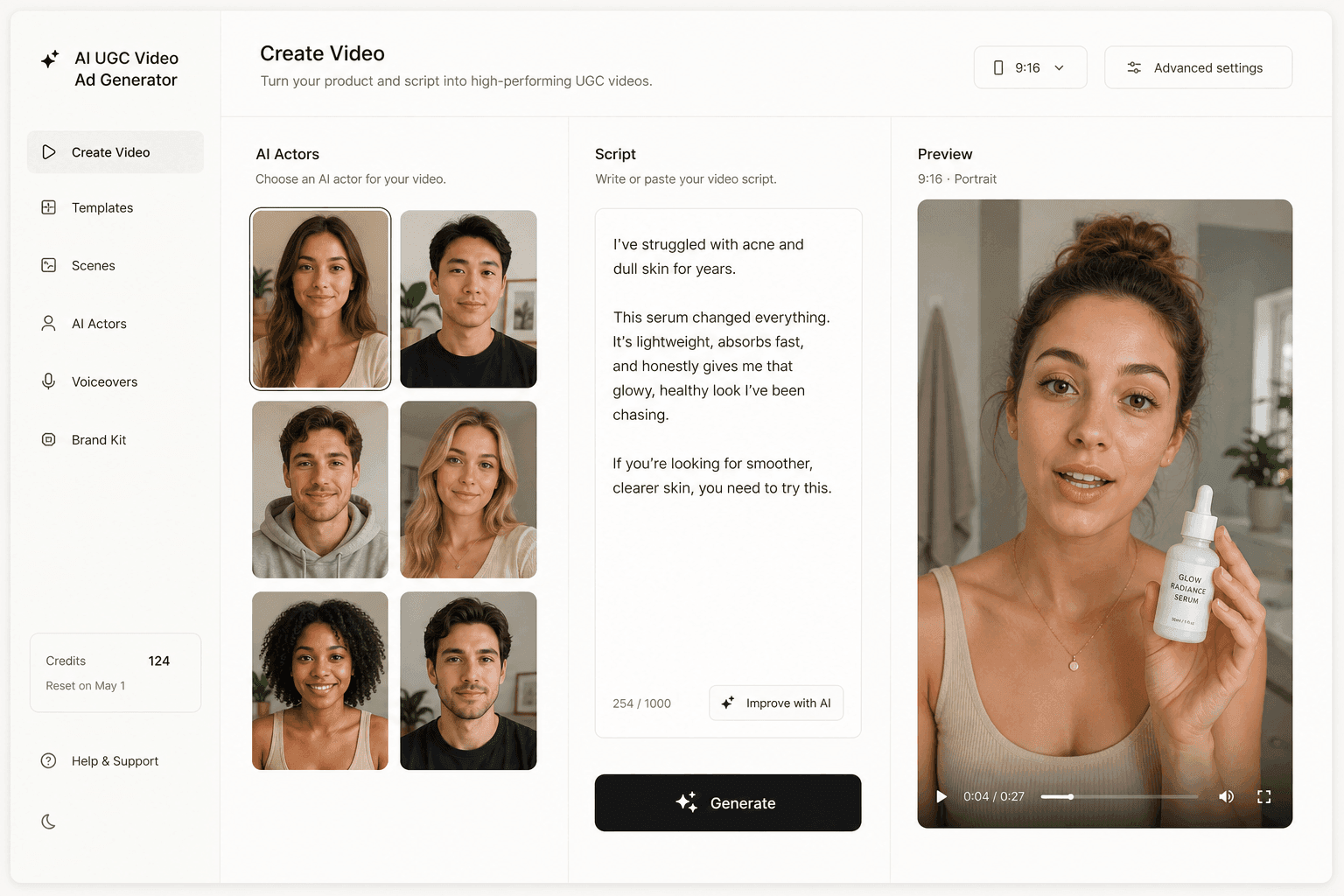
Novoads generates finished UGC-style brand video from an uploaded product image and a script you write or auto-generate, with an AI actor delivering it to camera. A clip costs from about a dollar for a five-second Seedance 2.0 Mini clip to about $8 for an eight-second Seedance 2.5 clip, and about $26 for a full 30-second Seedance 2.5 take, and the same generation exports 9:16, 1:1 and 16:9, so ratio stops being a line item. Voices cover 31 languages, which turns a language version into a rerender rather than a reshoot.
That does not replace a flagship film, and it should not. What it changes is the denominator problem on the moving shelf. On the Starter plan at $49/mo you get 50 credits a month, which is about 16 five-second Seedance 2.0 clips or 33 on the Mini, enough to keep a feed stocked without re-entering a quote. You can start there and cancel anytime.
Brand video is an inventory problem, not a production problem
63% of video marketers have now used AI tools to help create or edit video, and 59% produce in house. The constraint was never craft, and it was never ideas. Wistia's respondents named company size and resources as their top barrier for the third year running, with cost right behind.
Which is the whole thing, really. A brand video is not a purchase you make once and admire. It is inventory with a shelf life, and the teams that win are not the ones who bought the most beautiful asset. They are the ones who never ran out of stock.
If you have one budget and one decision this quarter, buy the longest denominator you can afford, and generate the rest.
Frequently Asked Questions
What is a brand video?
A brand video is any video whose job is to represent the company rather than close a single transaction: the homepage film that explains what you do, the product explainer, the founder note, the social spot that carries your voice into a feed. The useful distinction is not the genre but the shelf life. Some brand videos stay live for years and some are spent in three weeks, and those two groups should be budgeted in completely different ways.
How much does a brand video cost in 2026?
Vidico's 2026 breakdown prices a commercial or brand film at $5,000 to $20,000+, a product demo at $1,500 to $5,000, and short social content at $1,500 to $5,000, with finished video running $1,000 to $10,000 per minute. Freelancers charge $600 to $1,200 per filming day and agencies start at a $5,000 project minimum. Generated video sits in a different order of magnitude: in Novoads a finished clip costs a few dollars, not a few thousand.
Which brand video should a small team make first?
A standing-shelf asset, almost always. A homepage film or a product explainer is the one video that will still be earning its cost eighteen months from now, which is why it survives a flat budget. Social spots and ad variants matter enormously, but they belong to a different purchase: high volume at low unit cost, not one careful commission.
Is it worth paying an agency for a brand video?
For a single flagship film built on location, on real people, or on a story only a director can stage, yes. That asset carries the brand for years and the cost amortizes. For the recurring layer of social spots, ad variants and platform cuts, an agency retainer is the wrong instrument, because you are paying a per-deliverable price for something you need dozens of.
How many brand videos does a small team actually need per year?
Fewer standing-shelf assets than people think and far more moving-shelf ones. Two or three evergreen pieces will cover a homepage, a product page and a founder story for a year or more. The moving shelf is where volume lives, and 76% of companies now publish at least one video a month, which is the cadence the feed rewards.
Can AI-generated video replace a brand film?
Not the flagship one. If the message is a specific real place, a specific real person, or a story that needs a director, film it. What AI genuinely replaces is the moving shelf: the twenty variants, the vertical and square cuts, the language versions, the seasonal refreshes. That is where the per-deliverable price of traditional production stops making arithmetic sense.
Key Takeaways
- A commercial or brand film is priced at **$5,000 to $20,000+**, while almost **40%** of companies spend under $5,000 on all video production for the year. For most small teams, one brand film is the entire budget.
- Sort brand videos by shelf, not by genre. Standing-shelf assets (homepage film, product explainer, founder note) stay useful for years. Moving-shelf assets (social spots, ad variants, launch clips) burn out in weeks.
- The Shelf-Life Ledger prices video by cost per useful month. A $5,000 film on the homepage for two years costs about $208 a month; a $1,500 social spot that lasts three weeks costs about $2,100 a month.
- The moving shelf is what breaks small budgets, because traditional production re-quotes every new cut, ratio and language as a separate deliverable.
- Generated video changes only one number, but it is the number that matters: at about a dollar to $8 per finished clip of up to eight seconds, from a five-second Seedance 2.0 Mini clip to an eight-second Seedance 2.5 clip (a full 30-second Seedance 2.5 take is about $26), a burned-out spot stops being a loss worth mourning.