
Content Seeding: What Sending Free Product to Creators Actually Buys You
Seeding puts your product in a creator's hands with no obligation attached. Here is what that genuinely buys a brand, what it structurally cannot deliver, what a seeded unit really costs, and where generated video belongs in the same plan.

Mauricio Valdivia
·11 min

The box ships. The post is optional.
Forty boxes go out on a Tuesday. Each one holds a serum, a handwritten card, and a QR code almost nobody scans. Three weeks later the brand has eleven organic posts, two of them genuinely good, and a spreadsheet that cannot say which part of the pitch did the work.
That is content seeding running normally.
Seeding is the practice of putting your product into a creator's hands and letting their own judgment decide the rest. HubSpot's guide to the channel quotes Jonathan Goldberg of Kimberfire defining it as "the strategic distribution of valuable content across various platforms and networks to organically reach and engage your target audience," and defines its creator variant as "the process of sending products or services to influencers in your target demographic with the aim of encouraging authentic reviews, content creation, and word-of-mouth marketing." The load-bearing word is encouraging. Not commissioning.
This guide is written for the brand side of that transaction: what a seeded unit genuinely buys, what it structurally cannot deliver no matter how well you run it, what it costs once you count the parts nobody budgets, and where generated video actually belongs in the plan. Which is not where most tool vendors will tell you.
What content seeding is, and what the vocabulary hides
The umbrella and the no-strings variant
HubSpot's guide puts gifting inside the wider practice rather than beside it: "I like to think of gifting as a strategy under the content seeding umbrella," sitting alongside paid partnerships and affiliate arrangements. What separates the gifting variant from the rest is the absence of a deal. Your brand "identifies an influencer in your niche, and you send them your product or service for free."
Three independent guides land on the same defining property. Aspire states it flatly: "There is no obligation for the influencer to post." Sprout Social describes the same handoff as product sent "with no strings attached or explicit expectation for content creation." GRIN calls seeding "a no-strings-attached gift from a brand to a creator." When four separate vendors with four separate methodologies describe a channel identically, that part of the definition is safe to build on.
Nobody standardized the words
The taxonomy underneath is a mess, and pretending otherwise causes real operational damage. GRIN says influencer seeding and influencer gifting are simply two terms for the same practice. Other agencies split them, and then invert each other: one assigns the no-obligation property to seeding and an implied ask to gifting, another does exactly the reverse.
There is no standards body here, so the terms mean whatever the person using them thinks they mean. The practical consequence is small and important: define the arrangement inside your own outreach, in one sentence, rather than assuming "we would love to send you this" reads the same to a creator with five brand inboxes as it does to you.
It is not a paid brief with the invoice removed
The most expensive misunderstanding is treating seeding as a cheaper version of hiring. It is a different transaction. A paid UGC creator owes you deliverables, revisions, and usually a rights window, which is exactly what their rates are pricing. A seeded creator owes you nothing, which is precisely why anything they do say carries weight.
You are not buying a discount on production. You are buying a different asset class.
What a seeded unit actually buys
An endorsement nobody wrote for them
The whole value is in the part you cannot direct. A creator who tried the product, liked it, and said so unprompted is making a claim about the world that no amount of budget manufactures. Their audience knows the difference, mostly, and so does the algorithm that ranks the comments underneath.
This is the one thing generated video genuinely cannot produce, and the line is not a technical limitation that a better model will erase in a year. It is a category difference. A synthetic actor can deliver a script beautifully and still not be a person who bought the thing.
Rights you can ask for, but do not automatically own
Shipping a product transfers a product. It does not transfer a licence. This trips up more programmes than any other single detail: the brand sees a great organic video, tries to run it as an ad, and discovers there is no agreement covering that at all.
If you intend to reuse seeded content, the ask goes in the box, before the post exists. On TikTok you additionally need the creator to authorize the post through the platform's own flow, which is what Spark Ads exist to formalize. A one-line permission request costs nothing and converts a lucky organic post into an asset you can put budget behind.
A handle you can run partnership ads from
The third asset is the relationship itself. A creator who has already used your product and posted about it is a warm start for a paid partnership later, and the partnership ad formats on Meta, TikTok and YouTube run from the creator's own handle rather than yours. That is a distribution surface you cannot buy on the open market, and the seeded unit is often the cheapest way to open it. The nano tier is where this compounds fastest, because the same creators are reachable, affordable, and rarely already on somebody's roster.
What it structurally cannot deliver
Volume you can forecast
Seeding has no output guarantee, and this is the number most plans quietly assume away. GRIN's guide to the channel is blunt about it: some creators may post because they genuinely liked the product, but "this is the exception, not the rule," and brands should go in with "the expectation that you won't see a direct ROI from the product and shipping costs."
Read that as a planning constraint rather than a warning. A channel with an unforecastable hit rate cannot carry a launch on its own, and it cannot be the thing you scale when performance dips in week three.
A controlled test of anything
Even when the posts arrive, they do not answer a question. Forty creators produce forty different hooks, at forty different moments, to forty different audiences, with no shared variable. If two videos perform and thirty-eight do not, you cannot tell whether the winner was the claim, the face, the format, the caption, the hour it posted, or the fact that one creator happens to be funny.
That is not a flaw in your brief. It is the structure of the channel. Organic distribution and clean measurement pull against each other, which is why the brands that get the most out of seeding usually run their angle testing somewhere else entirely.
Timing
Nothing lands on your date. A creator posts when the product arrives, when they get around to it, when the light is good, or never. For an evergreen catalogue that is fine. For a launch week, a seasonal window, or a retail cut-off, it is a gamble with a long tail and no way to buy the tail down.

The real cost of a seeded unit
The line items nobody budgets
Brands price seeding at cost of goods and stop there, which is how a channel with no fee ends up looking cheap on a spreadsheet and expensive in the P&L. The honest cost of one seeded unit has five parts, and only the first one shows up in the inventory system:
- Landed product cost, not retail price and not wholesale, including any sample packaging you made specially.
- Fulfilment: pick, pack, postage, and the returns and reships when an address is wrong.
- Sourcing hours: finding creators who fit, checking the audience is real, and writing outreach that gets opened.
- Coordination hours: chasing addresses, tracking what shipped to whom, and answering the replies.
- Watching hours: monitoring for posts that may never arrive, and asking for rights on the ones that do.
The hours are the part that scales badly. Product cost is linear and predictable. Coordination is neither, which is why seeding programmes tend to stall at the size one person can hold in their head.
A worked example, with your own numbers
Run the arithmetic on a small programme. Say a unit costs you $9 landed, and pick, pack and postage add $7, so a shipped box is $16. Forty boxes is $640. Add twelve hours of coordination at a fully loaded $40 an hour and you are at $1,120 committed before a single video exists.
Now divide by what actually appeared. Eleven posts puts you near $102 per organic post. If two of those are good enough to put money behind, the real figure is $560 per usable asset, and you still do not own the right to run either one until you ask.
Those inputs are illustrative. The method is not: divide by posts that appeared, never by units that shipped, and count the hours.
What that number is for
The number exists to be compared. Against a paid UGC brief, seeding is usually cheaper per asset and far less certain. Against generated video, it is a different line entirely: our own catalogue prices a short UGC-style video in the range of about a dollar to $8 per clip of up to eight seconds, from a five-second Seedance 2.0 Mini clip to an eight-second Seedance 2.5 clip, or about $26 for a full 30-second Seedance 2.5 take, which is the cost of a test rather than the cost of an endorsement.
Those are not competing purchases. One buys credibility you cannot manufacture. The other buys the ability to be wrong forty times before Tuesday.
Free product is not free of obligation
A gift is a material connection
The FTC treats a brand "giving you free or discounted products or services" as a material connection, in the same category as paying someone. No obligation to post is true. No obligation to disclose is not.
The exposure sits with the advertiser as much as the creator, which is the part brands skip when seeding is run out of a marketing budget with no paperwork attached.
What the brand is expected to do
The FTC's guidance is specific about unsolicited gifting. If a company sends influencers a free unsolicited product and nothing else, it "should ask them to clearly and conspicuously disclose the gift in any resulting social media posts or other endorsements, tell them how it should be disclosed, and ask them to tag the brand." That is three separate asks, and most seeding programmes make none of them:
- Ask for the disclosure, in writing, in the same message that announces the box.
- Say how to disclose it, rather than leaving a creator to guess which tag counts.
- Ask them to tag the brand, which is also how you find the posts you never got told about.
Placement is part of the standard too: disclosures "are likely to be missed if they appear only on an ABOUT ME or profile page, at the end of posts or videos, or anywhere that requires a person to click MORE."
Platform rules stack on top of the federal ones, and gifted product is explicitly in scope for several of them, which we covered in the guide to branded content. If your programme also runs generated creative, the AI disclosure rules are a separate obligation again. Put the disclosure instruction in the box. It is one printed line and it is the cheapest compliance you will ever buy.
Find the angle before you spend the product
Seeding is a bet on a message you have not tested
Here is the sequencing error at the centre of most disappointing seeding programmes. The brand decides what the product is about, prints that message on the card, ships forty units, and discovers three weeks later that the message was the weak part. The product was fine. The claim did not land.
Seeding is a distribution mechanism, not a discovery mechanism. It is very good at spreading a message that already works and very bad at telling you which message that is, because its feedback loop is slow, noisy and uncontrolled. Spending physical inventory to learn something a test could have told you first is the expensive way round.
Seed when you need a real person's credibility attached to the product, when the creator's own audience is the market you want, when you are opening relationships you intend to pay for later, or when the organic post itself is the deliverable.
Generate when you need to know which claim works before committing product, when you need the same product shown ten ways this week, when a launch date is fixed and a creator's schedule is not, or when the asset's only job is to run as a paid ad you made.
What generated video stands in for, and what it must never claim
Generated UGC-style video is the cheap half of that loop. You can put the same product in front of ten different openings, formats and personas, run them as paid tests, and know within days which claim earns attention before you commit product to anybody. Then you seed the thing that already works.
The boundary matters and it is not negotiable. A generated video is not a customer, and presenting one as a real person's testimonial is a lie regardless of how good the render is. Use it as an ad you made, disclosed where the platform requires it, and let the seeded creators carry the endorsement. That division of labour is the whole point of running both.
How Novoads solves the untested-angle problem
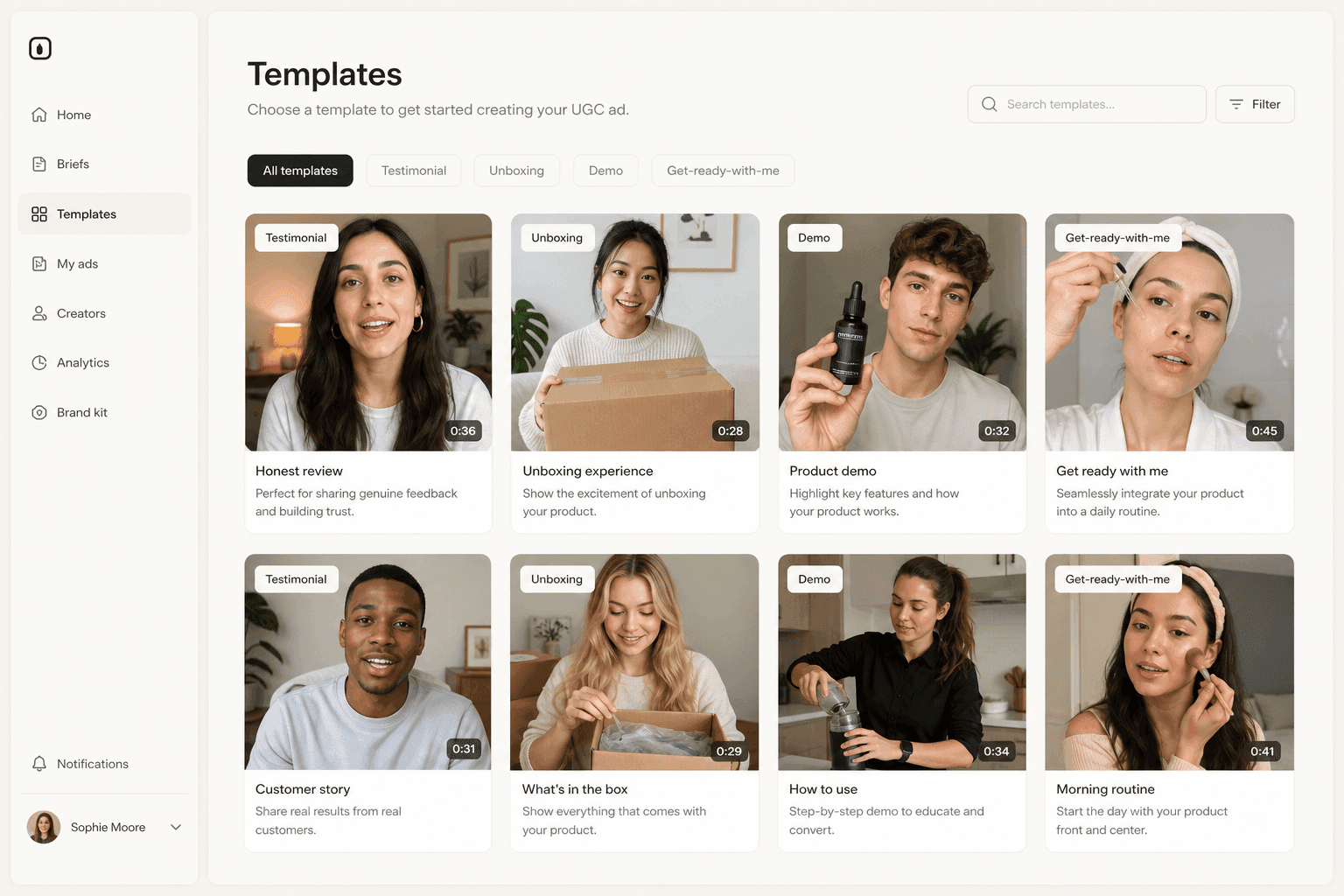
Novoads exists for the part of this that happens before the boxes ship. Upload your product photo, write or auto-generate a script, pick an AI actor, and you get an ad-ready vertical video, so ten competing angles cost about as much as one seeded unit and arrive the same afternoon instead of three weeks later. Because our per-model pricing is transparent, you can see what each test costs before you run it and keep the losers cheap.
Then take the claim that won and spend real product on real people saying it. You can try it from $49/month, and cancel whenever you like.
Seeding buys belief. It cannot buy volume.
The mistake is asking one channel to do both jobs. Seeding is how a brand borrows credibility it has not earned yet, one genuine endorsement at a time, on somebody else's schedule. Testing is how it finds out what is worth saying, at speed, on its own. Run them in that order and the boxes go out carrying a message that already works. Run them backwards and you are paying shipping to learn something a few dollars of test spend would have told you first.
Test the claim before you spend the product.
Frequently Asked Questions
What is content seeding in marketing?
Content seeding is the strategic distribution of content across platforms and networks so it reaches an audience organically rather than through paid placement. In creator marketing the best-known version is influencer seeding: you send a creator your product in the hope of earning an authentic review, a post, or word of mouth. HubSpot's guide to the practice quotes Jonathan Goldberg of Kimberfire defining it that way, and places gifting as one strategy under the seeding umbrella, alongside paid partnerships and affiliate arrangements.
Is content seeding the same as gifting?
Roughly, but the industry never standardized the words. GRIN says seeding and gifting are two terms for the same practice. Other agencies split them and then disagree about which term carries the no-obligation property, so one guide calls seeding the no-strings version and another calls gifting the no-strings version. Because there is no standards body, the only safe move is to define the term inside your own brief instead of assuming a creator reads it the way you do.
Does a creator have to post if I send free product?
No. That is the defining feature of the gifting variant, not a loophole in it. Aspire's guide states plainly that there is no obligation for the influencer to post, and Sprout Social describes the same handoff as product sent with no strings attached. GRIN's guide goes further and warns that a resulting post is the exception, not the rule, and that brands should not expect direct ROI from the product and shipping costs.
Do I own the video a seeded creator makes?
Not automatically. Shipping a product transfers a product, not a licence. If you want to reuse an organic post in a paid ad you have to ask for permission in writing, and on TikTok you additionally need the creator to authorize the post through the platform's own flow. Brands that plan to run the best seeded videos as ads should put the rights request in the box, before the post exists.
Does gifted product need to be disclosed?
Yes, if the creator posts. The FTC treats a brand giving you free or discounted products or services as a material connection, and its guidance says a company that sends influencers free unsolicited product should ask them to clearly and conspicuously disclose the gift in any resulting posts, tell them how to disclose it, and ask them to tag the brand. Placement matters too: a disclosure hidden on a profile page or behind a MORE click is likely to be missed.
Can AI video replace content seeding?
No, and any tool that says otherwise is selling you something. A generated video is not a customer and must never be presented as one. What generated video replaces is the expensive guessing that happens before seeding: you can test which claim, hook, and format actually hold attention for a few dollars each, then send product to creators to say the thing that already worked.
Key Takeaways
- Content seeding is the strategic distribution of content to reach an audience organically, and its gifting variant means sending a creator your product for free with no obligation to post.
- What it buys that generated video cannot: a real person's genuine endorsement, an organic post you can ask permission to reuse, and a creator handle you can later run partnership ads from.
- What it cannot buy at any budget: forecastable volume, a controlled variant test, or a post that lands on your launch date.
- A seeded unit costs more than the product. Count landed cost, fulfilment, and the coordination hours, then divide by posts that actually appeared, not units that shipped.
- Free product is not free of obligation. Under the FTC's guidance a gift is a material connection, and the brand is expected to tell creators how to disclose it.