Higgsfield AI Review for Ads: 9 Modes, a 15-Second Cap, and Who It Fits
Higgsfield's ad tool, Marketing Studio, turns a product link into a finished video ad, and its own help center is candid about the trade-offs. What it does well, where it falls short for advertisers, how the credit model works, and who it actually fits.

Mauricio Valdivia
·13 min

The most candid Higgsfield review is its own help center
The founder of a small coffee brand pastes her product page into Higgsfield on a Monday morning. The landing page promises a finished video ad from that link in 2 minutes. The pitch holds up on paper. Higgsfield says Marketing Studio pulls the product name, description and images, writes the script, directs the shots and delivers the final cut.
Then she opens the help center. Higgsfield's own article on Marketing Studio, dated August 1, 2026, lists the current limits in plain words: a maximum clip length of 15 seconds per generation, voiceover and pacing in UGC videos that "can vary by generation," and results outside the Posters category that are regenerated, not edited. Few vendors put that much in writing.
That is this review in miniature. Higgsfield is a capable ad generator sitting inside a much larger creative suite, and it documents its trade-offs more candidly than many of the pages ranking for its name. A disclosure before going further: we make Novoads, an AI UGC ad tool that competes with Higgsfield for some of the same buyers. So everything below rests on what Higgsfield commits to in writing, on its product pages, help center and developer docs as read in September 2026, rather than on our own test renders, and it says plainly where Higgsfield is strong. Here is what it is, how the ad workflow runs, what you control, how the credits behave, and the limits an advertiser will actually hit.
What Higgsfield is, and where the ad tool lives
Before judging the ad tool, place it correctly. Most confusion in Higgsfield reviews comes from treating a suite as a single product.
A creative suite first, with ads as one use case
Higgsfield's about page describes the company as "the ultimate infrastructure for professional AI video and image creation," and lists product video ads as one use case among several, next to AI filmmaking, enterprise content and pre-production storyboards. Its help center splits the suite by job:
- Cinema Studio for cinematic video with camera control.
- Marketing Studio for product ads and UGC from a URL or image.
- AI Influencer for building a consistent AI character.
- Canvas for chaining models into one workflow.
- Supercomputer for planning and delivering a whole project from one chat.
This review covers the ad tool. If your ads are mostly still images, our list of Midjourney alternatives for ad creatives compares image generators by the job each one does.
Higgsfield also says it has shipped more than 200 releases since launch. Take that as a warning label for every review of it, this one included: the product moves faster than write-ups do, so check a dated source before you rely on any detail.
Marketing Studio is the product, "AI Ad Generator" is the page
If you searched for Higgsfield's ad generator, you probably landed on its AI Ad Generator page. That page is a landing page for Marketing Studio: its own FAQ answers "What is Marketing Studio?" by calling it "Higgsfield's AI ad generator for marketing teams." Higgsfield runs sibling pages for the same capability:
- AI Commercial Generator, whose page says the tool "writes the script, builds the scenes, and adds voiceover, music, and a call to action."
- Click to Ad, listed on Higgsfield's Ads and Products apps page as turning "product links into UGC and professional video ads."
Several doors, one product family.
What it is built to make
Higgsfield's help center describes Marketing Studio as "the marketing creation workspace for ads, product creative, UGC, and other commercial content," with templates covering both images and video. That scope matters for a review. By Higgsfield's own category list, this is not only a UGC video tool: the same workspace makes product shots, marketplace listing images, editable posters and motion graphics. For a brand that needs all of those around one product launch, the breadth is a real advantage, and it is the first thing Higgsfield genuinely does well.
The ad workflow, from product link to finished ad
Higgsfield documents three ways into an ad. Which one you use changes how much of the result you decide.
The one-click path: link, avatar, mode, generate
The AI Ad Generator page lays out four steps: add your product, pick an avatar, choose a mode, generate. On import, Higgsfield says Marketing Studio "automatically extracts the product name, description, and images," or lets you build the product profile yourself by uploading up to 5 images. The page also pitches a variant worth noting for software companies: drop an app URL instead of a store link "and get a UGC video of someone demoing your screen."
When extraction goes wrong, Higgsfield's help center tells you to upload product images directly or switch to the prompt path. That is the right fallback, and it is worth knowing before a launch day.
The template path: start from a finished format
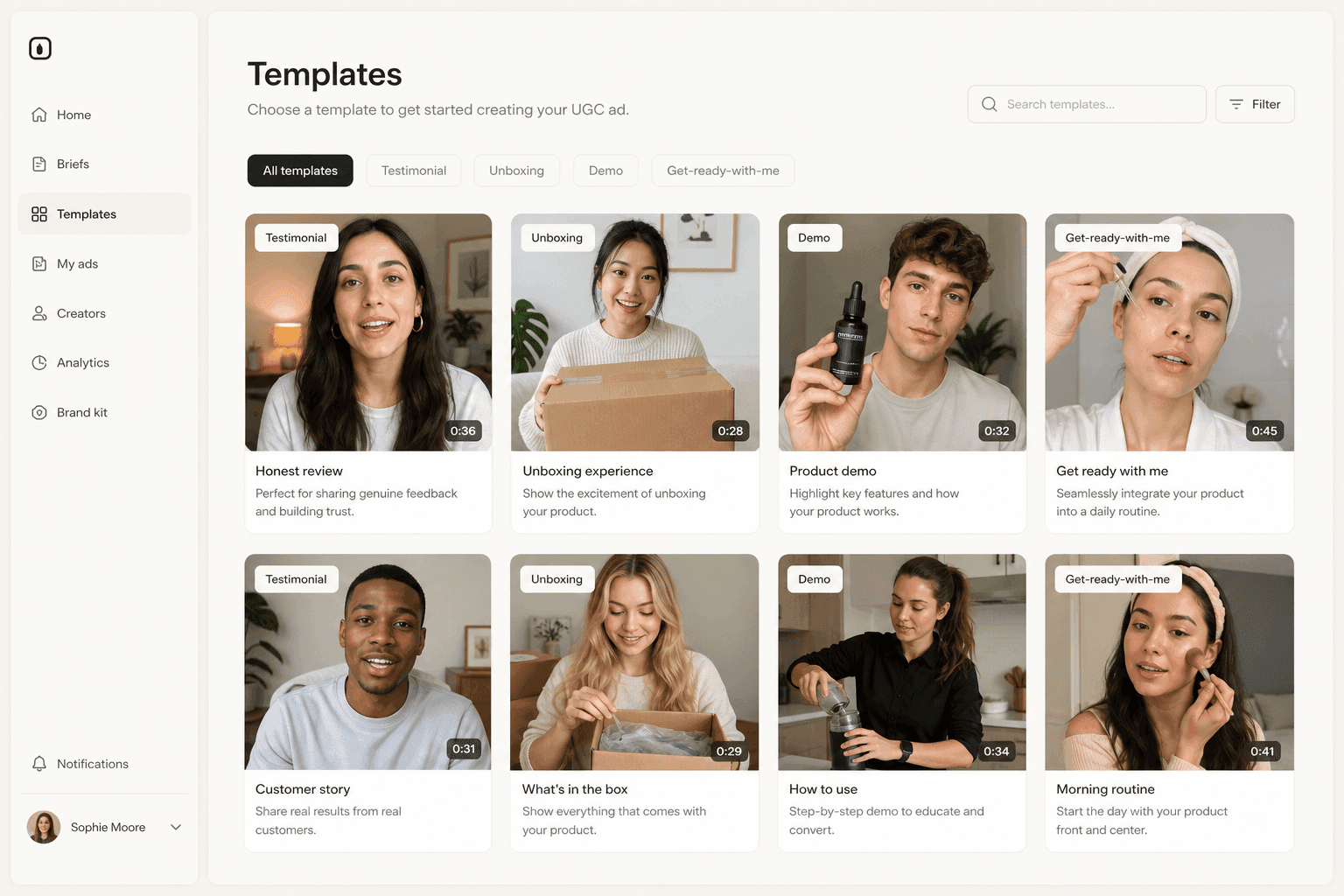
The newer entry point is template-first. Higgsfield's help center says you "pick a template from a library of 1,500+ options organized by task," grouped into these categories:
- Product Shots, in studio, lifestyle and with-model formats.
- Ads, as image ads built to Meta and Google placement specs.
- Marketplace listing imagery.
- Posters, editable after generation.
- UGC Videos, in Faceless, Talking Head and Silent formats.
- Motion, including hypermotion and motion design.
You connect your brand by uploading a product image or pasting a link, and Higgsfield says the credit cost is shown on the Generate button before you confirm. On its Marketing Studio intro page, a Recreate flow lets you open any template, "swap in your product, pick the face, tell it what should look different," and rebuild the same style around your brand.

The prompt path and reference ads
Two further options round out the workflow. The prompt path, per Higgsfield, "skips templates": you paste a URL or upload images and describe the shot, tone and what the ad needs to show. And in the UGC Videos category, Higgsfield says you can drop in "a reference ad you're allowed to use" and Marketing Studio reproduces its structure with your product in place of the original.
Marketing Studio also includes a Virality Predictor, and Higgsfield describes it honestly: "an estimate to guide your choice, not a guarantee of performance on any platform." Treat it as a sorting aid for which variations to run first. The verdict still comes from spend, which is why a disciplined ad creative testing loop matters more than any pre-launch score.
Output and creative control
Range is where Higgsfield earns its reputation. Control is where the trade-offs start.
Nine modes across three creative directions
The AI Ad Generator page lists nine modes, grouped by Higgsfield into authentic, polished and cinematic directions:
- UGC, described as face-to-camera reviews with "selfie framing, natural speech, genuine reactions, all shot in iPhone style."
- Tutorial, Product Review and Unboxing for creator-style demos.
- UGC Virtual Try-On and Pro Virtual Try-On for apparel.
- Hyper Motion, a pure CGI product film with "no people, no voiceover, just the product as the hero."
- TV Spot, a broadcast-style ad with a story arc.
- Wild Card, which Higgsfield calls "the most creative mode with the least input required."
That spread is the clearest thing a suite buys you: a selfie-style review and a CGI packshot film from the same product card, in one session. For fashion brands in particular, two try-on modes are a genuine draw.
The engine under the ad
Higgsfield states that Marketing Studio videos "are powered by Seedance 2.0," which it says generates motion, audio and speech in a single pass with native lip-sync, while images come from Nano Banana and avatars from Soul 2.0. Seedance 2.0 is a ByteDance model that other tools rent too, Novoads among them, so raw realism is not what separates Higgsfield from the field. The workflow wrapped around the engine is.
Length, aspect ratio and the 15-second ceiling
Three documented facts set the shape of every ad:
- Aspect ratios. Higgsfield says ads support 9:16, 16:9 and 1:1.
- Duration. Configurable per generation, per the AI Ad Generator page, and capped by Higgsfield's help center at 15 seconds per Marketing Studio generation.
- Longer clips live elsewhere. Higgsfield's Seedance help article says Seedance 2.5 reaches 30 seconds in the general video tool on Pro and Plus plans and above, a different workspace from the ad templates.
In practice, 15 seconds covers most hook-and-proof cuts for paid social. A 30-second testimonial means stitching clips, and stitching is where consistency work starts to cost time.
You regenerate, you do not edit
This is the limit that shapes daily use. Higgsfield's help center says editing after generation is available only in the Posters category, and "results in other categories are regenerated, not edited." It also warns that voiceover and pacing in UGC videos can vary between generations. Put those together and one wrong word in an otherwise good take is fixed by a new render, and, per Higgsfield, every generation costs credits. Higgsfield is upfront about it, which is to its credit. It still makes precise, word-level iteration the expensive kind.
Consistency: one face and one brand across variations
A single good ad is easy. The twentieth variation with the same spokesperson and the same brand look is the real test, and Higgsfield has built real tooling for it.
Avatars you can pin and reuse
The AI Ad Generator page offers "40+ ready-to-use avatars" or a custom one generated from a text prompt, which you can "pin, rename, and reuse across ad campaigns." The count is not consistent across Higgsfield's own pages, though: its Marketing Studio intro page mentions 100+ avatars in one section and 40+ in another. Check the live library before choosing Higgsfield on library size.
Soul ID for the same spokesperson
For a face that holds across variations, Higgsfield's help center says you train a Soul ID once "on 20 or more photos of one person (up to 80)," and every ad variation after that uses the same face automatically. The same article sets expectations well:
- Similarity, not identity. Expect "clearly the same person" rather than a pixel-identical face across every generation.
- One person per Soul ID. Scenes with two consistent characters need Elements instead.
- Not portable. The trained identity is not exportable as a standalone file.
- Consent. Higgsfield says to upload only your own photos, or those of someone who has given permission.
Keeping one actor steady across a batch is a craft problem on any platform, and our notes on consistent AI actors across ad variations cover the parts no setting solves.
Brand Kit and team workspaces
Higgsfield says its Brand Kit reads your website and "extracts the logo, brand colors, fonts, imagery, and tone of voice automatically" to keep generated ads on-brand. For agencies it adds "shared projects, built-in chat, video calls, and team workspaces." Those two features are what make Marketing Studio credible for an in-house team rather than a solo experimenter.
How Higgsfield pricing works, without the price tag
We are not printing plan prices. Higgsfield's help center points to its pricing page for "all available plans and their current prices," that page renders in the browser, and promotions sit on top of it, so any figure here would drift. The mechanics are documented, though, and they matter more than the sticker.
Credits, shown before you spend them
Higgsfield's help center says a generation's credit cost depends on the model, resolution and duration, and that "the exact cost is shown on the Generate button before you confirm." That is genuinely good design. The rules around the balance are stricter:
- No rollover. Subscription credits "reset regularly and don't roll over," per Higgsfield.
- Subscription required. "Credits can't be used without an active subscription."
- Batches multiply. Higgsfield says a batch size of 2, 3 or 4 charges each output separately.
- Failures mostly refund. Higgsfield says credits for failed generations usually come back automatically, and names Grok as the one model charged the moment a generation starts.
For the wider logic of credit-metered tools, our explainer on AI video credits walks through how to compare them.
Unlimited models and the queue trade-off
Higgsfield says mid and top plans include Unlimited models, where generations on specific models do not deduct credits. Three conditions come attached, per Higgsfield:
- Web only. Unlimited access "applies only on higgsfield.ai."
- Slower lane. Unlimited generations run in the standard queue, while credit-based generations always run in the priority queue.
- Humans only. Unlimited is "designed for personal, human use only."
Unlimited is a real perk for exploring on the web. It is a slower lane, not a production pipeline.
Agents and the API always spend credits
Higgsfield reaches outside the browser through a hosted MCP server, a CLI and a public API. The billing rule carries over: Higgsfield's help center says generations through MCP, CLI, Canvas, Supercomputer and other automated tools always deduct credits, whatever the plan. It also says the template-based Marketing Studio is not available through Supercomputer, MCP or other agentic channels yet. We cover the connector in detail in our Higgsfield MCP explainer, and the developer surface in our guide to the Higgsfield API.
Refunds, renewals and cancellation
Here the policy is tight. Per Higgsfield's help center:
- Refunds cover initial purchases "within 7 days or as permitted by the law in your jurisdiction, and only if no credits have been used," minus a service fee of up to 6%.
- Renewals are not refundable, and an approved refund cancels the subscription immediately.
- Promo prices apply to the first payment, after which the plan renews at the standard price.
- No trial period. Higgsfield's free tier is limited to a small set of models and watermarks every generation.
That creates the sharpest practical trap in this review. The refund window and the evaluation window are the same week, and evaluating properly means spending credits, which closes the refund. Decide what you need to prove before you pay, and test your hardest product first.
Limits and failure modes an advertiser will hit
None of these are hidden. All come from Higgsfield's own help center articles, and each one lands harder on advertisers than on hobbyists.
Brand names and logos can trip the IP filter
Higgsfield's copyright article is specific about what gets blocked and what can be undone:
- The trigger. "Branded product names or logos used as generation subjects" are among the common IP-block triggers.
- Model-level checks. Some models, such as Seedance, run their own separate IP check that Higgsfield says it cannot override.
- Owned inputs. For eligible inputs you own, an "I own the rights for this image" button can unblock a generation.
- No account exceptions. Per Higgsfield, "IP blocks apply platform-wide and can't be overridden for individual accounts."
An advertiser's product is, almost by definition, a branded product. Run your real packaging through Marketing Studio early, before the refund window is gone.
Safe products that get flagged anyway
Higgsfield's NSFW article is equally direct. It names swimwear, athletic content, medical imagery, certain reference images and ambiguous prompt wording as common safe-but-flagged triggers, and says Higgsfield "can't override safety classifiers manually." It adds that credits for flagged generations are returned for most models, so the cost is time rather than money. Still, swimwear, activewear and health brands whose ads need clinical-looking imagery should expect retries.
Parallel limits and slow lanes
At volume, throughput becomes the constraint. Higgsfield documents three pieces of it:
- A parallel ceiling. Its troubleshooting page shows the message "You've hit your limit of generations at the same time" when a plan's slots are full, and says higher plans run more generations at once.
- A shared pool. Unlimited and free generations run on a shared pool that can take longer, per the same page.
- A paid way around it. Higgsfield sells Concurrency Boost packs that add "+4, +8, +12, or +16 on top of your base limit."
Rights, exclusivity and training
The rights position is clear and mostly favorable. Higgsfield says it "does not restrict the commercial use of outputs," so ads and client work are fine. Three caveats sit in the same article:
- Not exclusive. "Other users may generate the same or similar outputs."
- Training. Higgsfield may use content to train its models, except on Enterprise agreements.
- Indemnification. Protection against third-party IP claims is available on the Enterprise plan only.
Higgsfield also says it may embed invisible, machine-readable markers identifying content as AI-generated, which is worth knowing as ad platforms tighten their AI labels.
The verdict: who Higgsfield fits
Higgsfield's Marketing Studio is a genuinely complete ad workspace for teams that want the system to direct. Its limits are the flip side of that design, and Higgsfield documents them.
The scorecard
| Area | What Higgsfield documents | Our read |
|---|---|---|
| Speed to a first ad | Link in, finished ad out | Strong |
| Format range | Nine modes, templates | Strong |
| Face consistency | Soul ID, 20+ photos | Strong |
| Cost visibility | Cost on Generate button | Strong |
| Script control | System writes the script | Mixed |
| Clip length | 15 seconds per generation | Mixed |
| Credit terms | Monthly reset, no rollover | Mixed |
| Editing | Regenerate outside Posters | Weak |
| Brand-name filters | Logos can trigger IP blocks | Weak |
| Refunds | Zero credits used, 7 days | Weak |
For an outside view, Hack'celeration, a growth agency that also sells Higgsfield production services, scored the platform 3.6 out of 5 in its own test, with value for money its lowest criterion at 2.8. That is one agency's opinion, but it matches the pattern above: strong on capability, tougher on economics.
Use Higgsfield when
- You need UGC, CGI product films, try-ons and static product shots from one workspace.
- You want the system to write the script and direct the shots.
- Your brand or client runs fashion or apparel, where two try-on modes pay off.
- Your team collaborates inside the tool and values a Brand Kit.
Look elsewhere when
- Legal has approved a line that must be said word for word, twenty times.
- Your standard ad is a single-take testimonial longer than 15 seconds.
- You want agents to run the template path today.
- You need IP indemnification without an Enterprise contract.
If you land in the second list, our roundup of Higgsfield alternatives for ad creative compares seven ad-first tools, and our head-to-head of Higgsfield and Novoads covers the script-first case directly. If you are weighing avatar-led tools instead, our HeyGen vs Creatify comparison tests the two best-known against each other.
How Novoads solves the script-first UGC ad
Novoads is built for the case where the line comes first. You upload a product image, write or auto-generate the script, pick one of 100+ AI actors, and get a finished UGC video ad in which the actor delivers the script you wrote.
The engine question is a tie: Novoads runs Seedance 2.0 as well, alongside Seedance 2.0 Mini, Seedance 2.5, Kling v3 Pro, Google Veo 3.1 and Omni Flash. The difference is the order of operations: your script is the input, not the output. A clip runs from about a dollar for a five-second Seedance 2.0 Mini clip to about $8 for an eight-second Seedance 2.5 clip, and about $26 for a full 30-second Seedance 2.5 take. Novoads starts at $49/month (Inicial, 50 credits per month), and all plans are published on /pricing. Where it concedes: Novoads is built around talking-actor UGC rather than a spread of cinematic ad modes, so if range across formats is the job, Higgsfield covers more ground. If the job is your script on camera, repeatedly, you can start making script-first UGC ads in Novoads.
Higgsfield sells a director. Decide whether you want one.
Every strength in this review and every limit trace back to one design choice: Higgsfield's Marketing Studio makes the creative decisions for you. That is why a product link becomes a finished ad so quickly, why nine modes and a large template library sit one click apart, and also why results regenerate instead of editing, why the script is, by default, the system's output rather than your input, and why the first honest test can use up the refund you would otherwise have been owed. For a team that wants direction across many formats, Higgsfield is a strong choice, and its help center is more candid than most. For a team that already knows exactly what the ad must say, the better tool is the one that treats your words as the fixed point.
Frequently Asked Questions
Is Higgsfield good for making video ads?
Yes, for a specific kind of team. Higgsfield's Marketing Studio takes a product link or image and returns a finished ad, and Higgsfield says it writes the script, directs the shots and delivers the final cut. It offers nine modes, from selfie-style UGC and unboxings to a pure CGI product commercial and a cinematic TV spot, plus a template library Higgsfield puts at 1,500+ options. It is strongest when you want the system to make creative decisions across many formats. It is a weaker fit when your ad has to say an approved line word for word, repeatedly, because Higgsfield's help center says results outside the Posters category are regenerated rather than edited.
What are the limitations of Higgsfield Marketing Studio?
Higgsfield lists them itself in its help center article on Marketing Studio: the maximum clip length is 15 seconds per generation, voiceover and pacing in UGC videos can vary by generation, editing after generation is available only in the Posters category, and the template-based Marketing Studio is not yet available through Supercomputer, MCP or other agentic channels. Separately, its troubleshooting articles note that branded product names or logos used as generation subjects can trigger the IP check, and that swimwear, athletic content and medical imagery are common triggers for false NSFW flags.
How much does Higgsfield cost?
Higgsfield publishes its current plan prices on its pricing page, which renders in the browser and changes with promotions, so we do not quote a figure here. What its help center does document is how the credits behave: each generation's credit cost depends on the model, resolution and duration and is shown on the Generate button before you confirm, subscription credits reset each cycle and do not roll over, credits cannot be used without an active subscription, and a promo price applies to the first payment before the plan renews at the standard price.
Does Higgsfield have a free trial?
Higgsfield's help center says there is no trial period. You can explore on its free tier, which is limited to a small set of models, and Higgsfield says every generation on a free account carries a Higgsfield watermark while paid plans come without one. Refunds are available on an initial purchase within 7 days, or as local law allows, only if no credits have been used, with a service fee of up to 6%.
Can I use Higgsfield ads commercially?
Higgsfield's help center says it does not claim ownership of your outputs and does not restrict their commercial use, so ads, paid campaigns and client work are allowed. Two caveats come from the same article: other users may generate the same or similar outputs, so results are not guaranteed to be exclusive, and Higgsfield may use content to train its models unless you are on an Enterprise agreement. Legal indemnification against third-party IP claims is available on the Enterprise plan only.
Can Higgsfield keep the same AI spokesperson across ad variations?
Yes. Higgsfield's help center says you can train a Soul ID once from 20 or more reference photos of one person, after which every ad variation uses the same face automatically. It also sets the expectation honestly: aim for clearly the same person rather than a pixel-identical face, one Soul ID holds one person, and the trained identity cannot be exported as a standalone file. Marketing Studio's library avatars can also be pinned, renamed and reused across campaigns.
Key Takeaways
- Higgsfield's ad product is Marketing Studio. The AI Ad Generator page is a landing page for it, and Higgsfield runs sibling pages (AI Commercial Generator, Click to Ad) for the same capability.
- Its strengths are speed from a product link, range (nine ad modes from selfie-style UGC to pure CGI, plus a template library Higgsfield puts at 1,500+), and consistency tools: pinned avatars, a Soul ID trained from 20 or more photos, and a Brand Kit.
- Its own help center lists the limits: 15 seconds maximum per Marketing Studio generation, UGC voiceover and pacing that can vary, results outside Posters that are regenerated rather than edited, and a template path not yet available to MCP or other agents.
- The credit model is transparent at the moment of spend (the cost sits on the Generate button) but strict around it: subscription credits reset without rollover, refunds require zero credits used within 7 days, and renewals are not refundable.
- Higgsfield fits teams that want the system to direct across many formats. Teams that need the exact approved line on camera, many times, should weigh control over range.