
Arcads vs Higgsfield for UGC Ads: AI Actors Against a 15-Second Marketing Studio
Arcads bills talking actors by the minute and lets you write every word; Higgsfield's Marketing Studio writes and directs ads of up to 15 seconds from a product link. How each works, what each meters, and which fits your ads.

Mauricio Valdivia
·12 min

One tool casts the actor. The other directs the ad.
A skincare founder has a 30-second script her compliance lead already signed off. She also has a product page and a Friday deadline for ten new hooks. Two tools keep coming up. They solve different halves of her week.
Arcads and Higgsfield both sell AI UGC ads, and both render on some of the same frontier engines, but they start from opposite ends. Arcads starts from the actor: you pick a face from a library of more than 1,000, paste your script, and pay for talking-actor video by the minute. Higgsfield's ad tool, Marketing Studio, starts from the product: paste a link or pick a template, and it writes the script, directs the shots and hands back a clip of up to 15 seconds per generation.
Novoads competes with both, so treat this as a rival's attempt at a fair comparison. Every capability and number below comes from each company's own website or help centre as we read them on September 17, 2026, each with its own date where the page carries one. We did not run test renders in either product.
TL;DR: Arcads vs Higgsfield in one read
The decision is less about quality than about who holds the pen.
Choose Arcads if:
- your script is written, or approved, and has to be spoken as written;
- you want to budget talking-head minutes before you open the app, from a published credit meter;
- you plan to run one script across many faces or languages;
- your testimonials run past 15 seconds.
Choose Higgsfield if:
- you would rather hand over a product link and approve what comes back;
- you want the tool to pick the creative direction, from selfie-style UGC to pure CGI product spots and TV-style ads;
- you want to rebuild a reference ad's structure around your own product;
- 15-second clips suit your placements.
| Arcads | Higgsfield Marketing Studio | |
|---|---|---|
| Starts from | Actor library and your script | Product link or template |
| Who writes the script | You | The tool, or your prompt |
| Presenters | 1,000+ actors, custom actors | 40+ avatars, Soul ID |
| Clip length | Billed per started minute | 15 seconds per generation |
| Talking-actor meter | 800 credits per minute, per actor | Shown on the Generate button |
| After the render | Per-use editing tools | Regenerate (Posters excepted) |
| Public pricing page | No | Yes |
| Shared engine | Seedance 2.0 | Seedance 2.0 |
What each tool is built to make
The two products overlap on paper, and a quick feature checklist will tell you they are the same thing. The workflows say otherwise.
Arcads: an actor library with a script box
Arcads' homepage sells a library of more than 1,000 AI actors, with the option to create your own AI avatar. Its complete platform guide calls the talking-actor models the core of its ad creation pipeline, and its help centre describes three of them, each with a recommended use:
- Arcads 1.0 generates a video from a text script, and Arcads recommends it for longer scripted videos with stable actor movement.
- Audio-Driven animates an actor from an audio file you supply, and Arcads recommends it when lip sync matters most.
- OmniHuman 1.5 animates a static image, and Arcads recommends it for more expressive delivery.
Around those models sits a production kit: video models priced per generation, presets such as Unboxing POV and Product Showcase, and tools for captions, translation, extension and upscaling, each priced per use. The unit of work is still a person on camera saying words you chose.
Higgsfield: Marketing Studio directs from a link
Higgsfield is a broad creative suite, and its help centre routes ad work to one part of it. Marketing Studio is described there as the marketing creation workspace for ads, product creative, UGC and other commercial content. The flow is template-first: a library of more than 1,500 templates organized by task (Product Shots, Ads, Marketplace, Posters, UGC Videos and Motion), with UGC Videos coming in Faceless, Talking Head and Silent formats.
There is also a one-click path. Higgsfield's AI Ad Generator page lists four steps: add your product by link or by uploading up to five images, pick an avatar, choose a mode, generate. The modes range from UGC, Tutorial, Product Review and Unboxing to virtual try-ons, Hyper Motion CGI, TV Spot and Wild Card, where the AI invents the scenario. In Higgsfield's own words, Marketing Studio writes the script, directs the shots and delivers the final cut. Our Higgsfield review for advertisers walks through each mode in more depth. For the wider suite set against Runway's, see our Runway vs Higgsfield comparison.
Where the two overlap more than the pitch suggests
Both sell the formats that most ecommerce UGC briefs ask for:
- Product on camera. Arcads' Show Your Product places your product in a generated video, held by an actor, on a surface or in a lifestyle scene. Higgsfield's Product Shots include a With Model format, and its UGC Videos take a product image.
- App demos. Arcads' Show Your App puts your app's interface beside a talking actor. Higgsfield turns an app URL into a UGC video of someone demoing your screen.
- Proven formats. Arcads' Hook Repurposer rebuilds a proven hook around your product. Marketing Studio reproduces a reference ad's structure and format with your product in place of the original.
- The engine. Arcads' credit table lists Seedance 2.0, and Higgsfield says Marketing Studio videos are powered by Seedance 2.0 with native lip-sync.
That last row matters. When both tools can call the same model, realism is close to a tie, and the choice moves to workflow and cost.

Who writes the words on camera
This is the real fork. In UGC-style ads the words carry the sale, so the question of who drafts them decides more than any spec row.
Arcads: you write the line, the actor says it
On Arcads, the script is the input. Arcads 1.0 takes your text, and Audio-Driven goes further by taking your recorded voiceover, so even the delivery is yours. The help centre's length guidance for Arcads 1.0 is soft: no character limit, but best to keep it below 1,500 characters.
That matters in categories where a claim has been through legal review. A supplement, skincare or finance brand that approved one sentence word for word needs a tool that treats that sentence as fixed, and Arcads' design does.
Higgsfield: the studio drafts, you approve or regenerate
On Marketing Studio, the script is usually the output. The template path needs no prompt at all, and the prompt path skips templates and lets you describe the shot, the tone and what the ad has to show. Either way, the system makes the creative calls.
Higgsfield's help centre is candid about what follows:
- voiceover and pacing in UGC Videos can vary by generation, so review before publishing;
- editing after generation is available only in the Posters category, and results in other categories are regenerated, not edited;
- the template-based Marketing Studio isn't available through Supercomputer, MCP or other agentic channels yet.
For exploring angles you had not thought of, that is a strength. For shipping a sentence someone signed, it is a cost you pay in regenerations.
Length is the quiet decider
Marketing Studio's maximum clip length is 15 seconds per generation. Arcads bills talking actors in whole minutes and recommends Arcads 1.0 for longer scripted videos. Higgsfield does offer longer clips outside the template flow: its Seedance help article says Seedance 2.5 generates clips up to 30 seconds and is available on Pro and Plus plans and above.
The practical rule: at 15 seconds or less, both fit. A 30 to 60 second testimonial fits Arcads' model more naturally, and on Higgsfield it means leaving Marketing Studio or planning the ad in pieces.
Faces you can reuse across a campaign
A face that works becomes an asset. Both tools let you keep one, with different trade-offs.
Arcads: library actors, custom actors and a clone of you
Arcads' platform guide lists three ways to own a presenter:
- Custom Actor: create your own AI actor from a single headshot image, saved to your account for reuse.
- Clone Yourself: a digital twin that replicates both your face and your voice.
- Actor Replacement: swap the actor in an existing video while preserving the script, timing and background.
Two actors in one video are billed as two, because Arcads counts credits per actor.
Higgsfield: pinned avatars and a trained Soul ID
Marketing Studio offers more than 40 ready-to-use avatars, or you can generate one from a text prompt through Soul 2.0, then pin, rename and reuse it across campaigns. For a single spokesperson, Higgsfield trains a Soul ID once from 20 or more reference photos, and every ad variation after that uses the same face automatically.
Its help centre sets expectations plainly: expect clearly the same person rather than a pixel-identical face across every generation, and a Soul ID holds one person, so scenes with two or more consistent characters use Elements instead. The identity also stays inside Higgsfield and is not exportable as a standalone file. Our HeyGen vs Higgsfield comparison sets Soul ID against a digital twin built from video.
What that means for a face test
The two designs suit different tests. We cover the method in how to keep one AI actor consistent across every ad variation, but the short version:
- Testing the face itself (same script, five presenters): Arcads' Actor Replacement is built for exactly that swap.
- Testing formats around one face (same spokesperson, many ad types): Higgsfield's Soul ID carries one identity across every variation.
Either way, change one variable per round, as in any ad creative test, or you will not know whether the face or the format won.
How the credits work on each side
Both tools meter in credits. The meters are built differently, and one of them is much easier to budget from the outside.
Arcads: 800 credits per actor-minute, rounded up
Arcads' help centre article "How Are Credits Counted?", last updated April 29, 2026, prices its three talking-actor models (Arcads 1.0, Audio-Driven and OmniHuman 1.5) at 800 credits per minute, per actor. Two rules sit under that number:
- Per actor: if you use multiple actors in the same video, credits are counted per actor.
- Rounded up: length is always rounded up. The article's own example bills a 1 minute 45 second video with two actors as 2 minutes times 2 actors, 3,200 credits.
Read literally, the rounding rule means a 30-second actor clip draws a full 800-credit minute. The same article prices video models per generation and tools per use, and because it dates from April, its model rows are a snapshot: check the in-app cost before a large run.
The plans are public in credits, if not in dollars. A help centre article dated July 30, 2026 gives Starter 8,000 monthly credits and Creator 16,000. Starter and Creator reset each cycle with no rollover and pause usage at the monthly limit, while Pro, Scale and Business roll unused credits into the next cycle, and Arcads states that higher volumes get a lower cost per credit. Our Arcads vs HeyGen comparison goes deeper on that meter.
Higgsfield: the price appears on the Generate button
Higgsfield's credits article says every generation costs credits depending on the model, resolution and duration, and that the exact cost is shown on the Generate button before you confirm. For Marketing Studio specifically, the help centre answers "How much does an ad cost?" with the category, clip length and resolution.
The rules around that number:
- Batches multiply. A batch size of 2, 3 or 4 charges each output separately.
- No rollover on individual plans. Subscription credits reset each billing cycle; Credit Pack and Auto-Refill credits expire 90 days from purchase.
- Unlimited has fences. Mid and top plans include Unlimited access to selected models for a set period (365 days for most, as little as 7 for the newest flagships), only while your subscription is active, only on higgsfield.ai and in the standard queue, while credit-based generations run in the priority queue.
The one published figure close to a UGC ad comes from a Higgsfield blog post dated August 14, 2026, run through its ChatGPT plugin rather than Marketing Studio: a 15-second UGC video with Seedance 2.5 at 1080p cost 270 credits.
Why the two numbers do not divide
It is tempting to set 800 against 270. Do not. A credit is each vendor's own currency, and you need the dollar price of a credit on each side before any comparison means anything, which is the whole argument of AI video credits explained.
That is where the two differ most. Higgsfield's help centre says all available plans and their current prices are on its pricing page. Arcads has no public pricing page (arcads.ai/pricing returned a 404 on September 17, 2026), and its help centre sends upgrades through its paywall. We compared that gap directly in Novoads vs Arcads.
A worked example: ten 30-second hooks for one serum
Take the founder from the top. She wants ten talking-head ads for one serum, each about 30 seconds, each with one presenter, to test ten opening hooks.
On Arcads
Each 30-second clip rounds up to one billed minute.
- Ten clips times 800 credits is 8,000 credits, the entire monthly allowance of the Starter plan.
- Make each ad a two-person exchange and the count doubles to 16,000, Creator's full month.
- A take she rejects for flat delivery costs another 800. Arcads' refund policy says poor output quality alone, such as unsatisfying lip sync, does not qualify for credit reimbursement.
On Starter, the eleventh minute waits for the renewal date or an upgrade, since usage pauses at the limit.
On Higgsfield
A 30-second script does not fit one Marketing Studio generation, because clips cap at 15 seconds. She has three options: cut each hook to 15 seconds, plan every ad as two generations and assemble them in her own editor, or leave Marketing Studio for Seedance 2.5 in the general video tool on a plan that includes it.
For the 15-second route, the Generate button shows each ad's cost before she commits. As a rough anchor only, Higgsfield's published ChatGPT-plugin run put a 15-second Seedance 2.5 UGC video at 1080p at 270 credits, so ten of those would be 2,700 credits, and a batch of four per hook would quadruple it.
What the example actually shows
- Arcads is budgetable from outside: minutes times actors times 800, before she opens the app.
- Higgsfield is budgetable per click: exact at the button, fuzzier across a month of regenerations.
- Neither answers the dollar question on its own: Higgsfield's lives on a public page, Arcads' behind its paywall.
- Length changed the Higgsfield plan more than the price did: the 15-second cap reshaped the brief before any credit was spent.

Where each one asks more of you
Neither tool is frictionless. The friction just sits in different places.
Arcads: commitment comes before the dollar figure
The price is the first ask. With no public pricing page, you meet the plans inside the product. Arcads' refund policy, updated September 16, 2026, describes a 3-day trial after which a saved card is automatically charged for the Starter plan unless you cancel. The same policy offers a full refund when you used zero generation credits in a billing period and ask within 30 days, and it may restore credits, not cash, when a generation failed because of a platform issue, reviewed case by case. For a wider set of options priced in the open, see our list of Arcads alternatives.
Higgsfield: the studio makes more of the calls
The ask here is control. Results regenerate rather than edit outside Posters, delivery varies between generations, and Marketing Studio stays on the website for now. The money rules are strict too:
- refunds apply to initial purchases, within 7 days or as local law allows, only if no credits have been used;
- a service fee of up to 6% applies, and renewals aren't refundable;
- there is no trial period, and the free tier covers a limited set of models.
Higgsfield's credits article adds that a failed generation's refund is usually automatic and lands within a few minutes, though specific models might not refund.
The part that is a tie
Realism. Both tools rent frontier engines, and both put Seedance 2.0 under their ads. A polished demo reel from either is proof of the engine, not of the workflow you will live in. Judge on who writes the script, how long the ad runs, and whether you can price a month before you commit.
How Novoads solves the approved-script ad at a published price
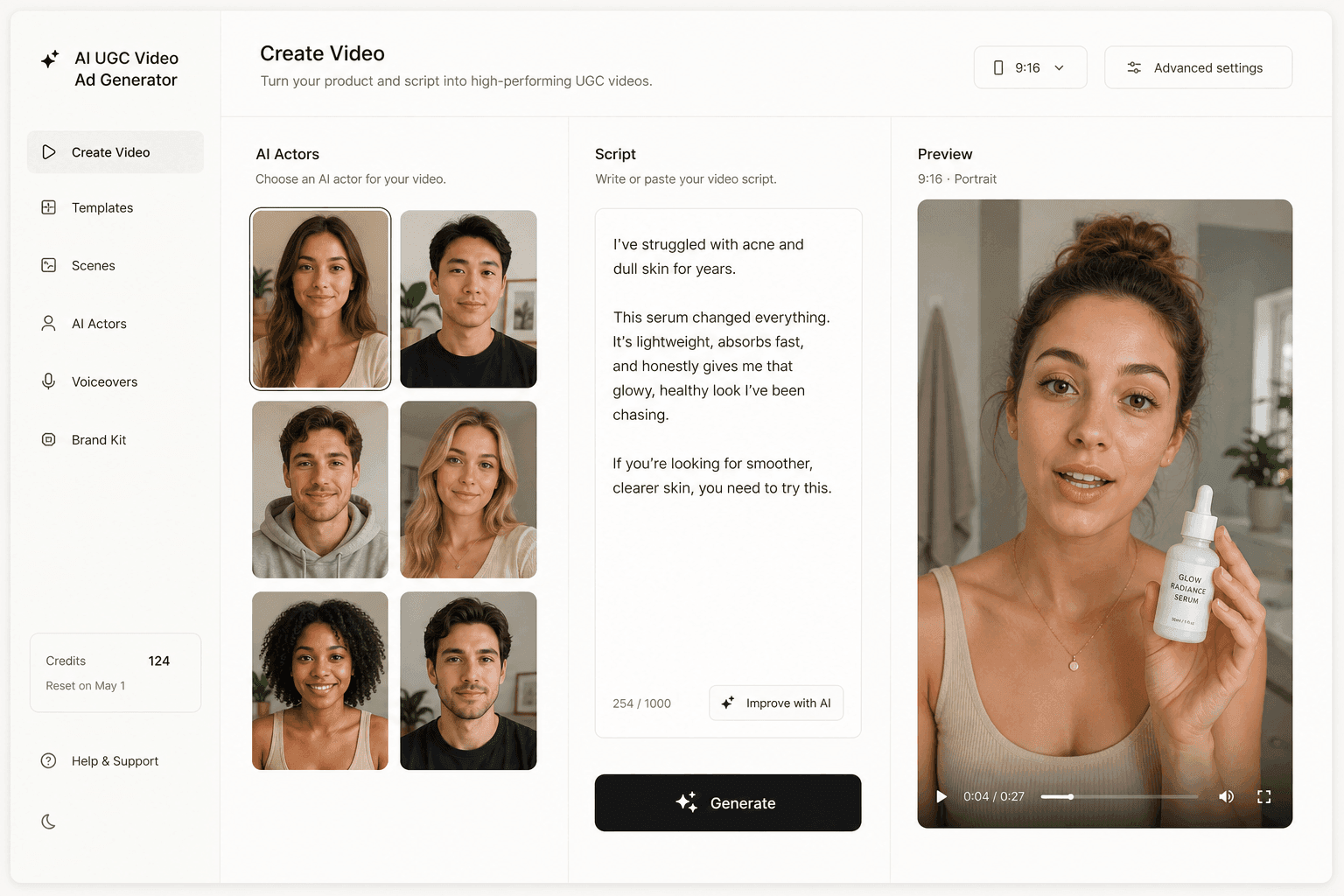
Novoads turns an uploaded product photo and a script you write, or have it draft, into a UGC video ad delivered by one of 100+ AI actors. It sits closer to Arcads' end of this comparison: the script is the input, and a talking actor bills per started minute, per actor, at 10 credits a minute.
What stays the same, and what does not
The engine is not the difference. Novoads runs Seedance 2.0 too, alongside Seedance 2.0 Mini, Seedance 2.5, Kling v3 Pro, Google Veo 3.1 and Omni Flash. The difference is the price you can see before you sign up: Novoads starts at $49/month (Starter, 50 credits per month), which covers five one-minute talking-actor videos, and all plans are published on /pricing.
What it concedes
Arcads' actor library is far larger (1,000+ against 100+), and it can clone your own face and voice. Higgsfield's nine modes and 1,500+ templates cover CGI, try-on and TV-style formats Novoads does not try to match. If your week looks like the founder's, with an approved script and ten hooks to test, you can make script-first UGC ads in Novoads and know the monthly cost before the first render.
Decide who holds the pen, then pick the tool
Arcads and Higgsfield are not two versions of the same product. Arcads gives you a cast, a meter and your own words on camera; Higgsfield gives you a studio that drafts the words and makes the creative calls for you. The approved script on your desk, or the lack of one, is what tells you which of the two to rent.
Frequently Asked Questions
Is Arcads or Higgsfield better for UGC ads?
It depends on who writes the script. Arcads is built around an actor library and a script you supply: pick one of more than 1,000 AI actors, paste the words, and a talking-actor model delivers them. Higgsfield's Marketing Studio is built around the product: paste a product link or upload images, pick a template or a mode, and it writes the script, directs the shots and returns a clip of up to 15 seconds per generation. If an approved line must be spoken as written, Arcads fits more naturally. If you want the tool to pick the angle and the format, Higgsfield does more of that work.
How much does an Arcads talking actor video cost?
In credits, Arcads' help centre article 'How Are Credits Counted?', last updated April 29, 2026, prices its three talking-actor models (Arcads 1.0, Audio-Driven and OmniHuman 1.5) at 800 credits per minute, per actor. Length is always rounded up, so its own example of a 1 minute 45 second video with two actors bills 3,200 credits. The Starter plan carries 8,000 monthly credits and Creator 16,000. Arcads has no public pricing page, so the dollar price of a plan is shown inside the product rather than on its website.
How long can a Higgsfield Marketing Studio ad be?
Higgsfield's help centre article on Marketing Studio, dated August 1, 2026, says the maximum clip length is 15 seconds per generation. Longer clips exist elsewhere in Higgsfield: its Seedance help article says Seedance 2.5 generates clips up to 30 seconds and is available on Pro and Plus plans and above, but that is the general video tool, not the template-based Marketing Studio flow.
Do Arcads and Higgsfield publish their prices?
Higgsfield does: its help centre says all available plans and their current prices are on its pricing page, and each generation's credit cost appears on the Generate button. Arcads publishes its credit meter and plan allowances in its help centre, but arcads.ai/pricing returned a 404 when we checked on September 17, 2026, and its help centre sends upgrades through its paywall.
Can I keep the same AI presenter across many ads?
Yes, on both, in different ways. Arcads lets you create a custom actor from a single headshot, clone yourself (face and voice), and swap the actor in an existing video while keeping the script, timing and background. Higgsfield lets you pin and reuse avatars, or train a Soul ID once on 20 or more photos so every ad variation uses the same face; its help centre says to expect clearly the same person rather than a pixel-identical face.
Do Arcads and Higgsfield give credits back when a generation fails?
Both describe a path. Arcads' refund policy says it may restore credits, not cash, when a generation failed because of a platform issue, reviewed case by case, and that poor output quality alone does not qualify. Higgsfield's credits article says the refund for a failed generation is usually automatic and lands within a few minutes, though specific models might not refund credits.
Key Takeaways
- Arcads starts from the actor: a library of more than 1,000 AI actors, three talking-actor models and a script you write. Higgsfield's Marketing Studio starts from the product: paste a link or pick a template, and it writes the script, directs the shots and delivers the cut.
- Arcads' help centre article on credits, last updated April 29, 2026, prices its three talking-actor models at 800 credits per minute, per actor, with length always rounded up. Its Starter plan carries 8,000 monthly credits and Creator 16,000.
- Marketing Studio caps clips at 15 seconds per generation, regenerates results instead of editing them (Posters excepted), and shows each ad's exact credit cost on the Generate button before you confirm.
- The two credit currencies do not divide into each other. Arcads has no public pricing page and routes upgrades through its paywall; Higgsfield lists its current plans and prices on a public pricing page.
- Both render on Seedance 2.0, so realism is close to a tie. Choose on who writes the words: Arcads when an approved script must be spoken as written, Higgsfield when you want the tool to choose the creative direction.